Regime Change: The Art of the Deal Meets The Art of War

I am sure somewhere in the annals of military history there are wars that were just “quick excursion.” The Franco/Prussian War of 1870 was quick and decisive as a European war can be but it lasted almost a year. A quick excursion sounds more like a raid, capturing Osama Bin Laden: In and out before anybody knows you were in. 

It is hard to believe that an air campaign bombing Iran with missiles, drones and smart bombs is a quick excursion. It is also hard to  argue with the Trump Administration’s reasons for bombing Iran. Most people can agree that Iran’s religious leaders, for almost 50 years, have exhibited a national religious psychosis that has kept the country in an 8th Century frame of mind. Instead of bombing them back into the Stone Age are we trying to push them into the A/I age?

It also would be delusional to believe that if the current Iranian regime was to have nukes they would behave rational with them; or any other weapon of mass destruction, considering they don’t play nice with the weapons that they already have. 

In many ways it makes sense that a regime change is in order. But we tried that already in Iran after World War II. The group we overthrew in the 1950s over threw our group in the late 1970s and now we are trying to overthrow them–again. Are we locked in some sort of irrational Twilight Zone circular reality that comes around like Haley’s Comet.

There is one point I would say is completely off the rails. This is the idea that it will be a short war. History indicates that we might be in for a longer haul, depending on objectives. And as crazy as it sounds it maybe over based sooner if we go by one man’s feelings. The rational for bombing, or going to war with Iran may seem logical. Practical? What is not rational or logical is to think a war can be won in two or three weeks simply by dropping bombs from above–or one man’s feelings.

Most wars have been irrational in terms of means or ends or both together. This is because choices for war are influenced by emotions, ideologies, domestic politics, and the tyranny of history, as well as by the more rational pursuit of material and strategic interests. Decisions for war have been almost invariably made by a handful of rulers and their advisors and entourages, and this is as true of democracies as authoritarian regimes.–Michael Mann, a Distinguished Research Professor of Sociology Emeritus at the University of California, Los Angeles, writes in  Yale University Press 

The Israelis have had a series of short duration wars with their Arab neighbors. In 1948 they dispatched their Arab foes in less than a year. Then in 1967 they fought a Seven Days War and then a twenty-day Yom Kippur War in 1973. In all of those wars Israel came out on top. I am not a historian by trade or a military history by practice; but, those engagements were called “wars.” I would call them battles in a continuous war starting with the UN carving out a hunk of Palestine and thus creating the state of Israel in 1947. 

On a side note, when Western Powers have gotten involved militarily in the Mideast, it has not turned out well. The French and British found out during the Suez Crisis in 1956. Egyptian President Gamal Abdel Nasser had nationalized the Suez Canal and closed the Straight of Tiran and the Gulf of Aqaba. The Anglo/Franco force, along with the Israelis tried to regain control the Suez Canal, and at the same time topple Nasser. They left within a year. According to Britannica “Nasser emerged from the Suez Crisis a victor and a hero for the cause of Arab and Egyptian nationalism….(and) Britain and France, less fortunate, lost most of their influence in the Middle East as a result of the episode.”

In 1982 President Ronald Reagan had the bright idea of sending the Marines into the region. His thinking was they could stabilize the fighting that always seems to be going on in Lebanon. Lebanon is not a Central American “banana republic” or Grenada. American troops in the Mideast tend to attract more attention, particularly those with bombs and guns. We left after terrorist blew up the Marine’s barracks killing 241.

I am not going to argue the logic one way or the other on the UN decision to create Israel. It seemed like a good one after WWII and still is a good one. The geopolitical/ religious change in Palestine just hasn’t worked out like the 1940s planners thought.

So if we look at the Mideast starting in1947 there has been some sort of conflict going on for nearly 80 years. We have to look back to Europe circa 1330 to The Hundred Year’s War to find that kind of stamina (or blunt trauma stupidity) to sustain a war of that length. England and France fought a for a century in war that resulted in France chucking the Brits out of Continental Europe. (* see link below for a more comprehensive list of long-lasting wars)

“There is no instance of a nation benefitting from prolonged warfare.”
― Sun Tzu, The Art of War

In 1568 there was an Eighty Year’s War or the Dutch Revolt. And some how in the same time frame Europe managed to roll in a Thirty Year’s, both ending in 1648. I am not sure what those wars settled but knowing just a tad of European history I would say it didn’t settle anything. 

A student who paid attention in their middle school US History class might recall the French and Indian War being fought in North America in 1756. In Europe it was known the Seven Year’s War. 

And, in April of 1861 President Lincoln called for 75,000 volunteers to serve three month enlistments after Confederate forces bombed Fort Sumter. That three month enlistment was a pipe dream.  Before long Lincoln was calling for 300,000 volunteers to serve three-year enlistments. Eventually Lincoln initiated a draft; and that still did not cover the entire war effort. 

But those wars were fought without strategic air bombardment. Let’s jump to World War II, the ultimate regime change war. It was a war that looked like it would be over within a year. In fact there was an eight month period in Europe called the “Phony War” where Germany, France and Britain just sat there looking at each other–I dare you. No. I double dare you.

Finally, Hitler took up the dare and blitzed France. In a month they went through France as if it was a wedge of Brie cheese. They chased the British once again off the continent leaving the Wehrmacht to sit at the English Channel looking across at the White Cliffs of Dover. Hitler turned the war over to the Luftwaffe. Its commander Hermann Goering, thought he could bomb his way into England. The German army continued to lookacross the channel. They had no way of getting “boots on the ground” in England. 

When the Luftwaffe gave up the British just kept calm and carried on. Hitler, however, turned his attention to the East. Before long he got snowed-in in Russia where his lightening warfare froze up and lost its thunder against the Red Army and the Russian winter.  

Meanwhile, the US Army Air Corps was batting around a theory with British Bomber Command that the war could be won by simply bombing Germany around the clock, and hence into submission. By destroying the military industrial complex Germany could be brought to its knees—and possibly a regime change could be had. An arial theory that appears to still be a work in progress and may never be proven.

Without a doubt the the British and American air forces’s Combined Bomber Offensive played a significant role in Germany’s defeat, but it was two ground offensives Overlord (D-Day) on the Western Front and Russia’s Operation Bagration in Byelorussian (Belorussia) on the Eastern Front in June and August of 1944 that brought Germany to its knees. From there it was a race to Berlin and a regime change. 

In the Pacific the Japanese Empire rolled up the Dutch the British and the Americans like a wet blanket in the early weeks of 1942. Within months they upended the control of just about the entire Pacific Ocean from the shores of Australia to India and the Himalayas and north to parts of the Aleutian Islands in the Bering Sea. Only after four bloody years of ground troops “island hopping” across the Pacific and two atomic bombs was there a regime change in Japan.

And did we not learn anything in Vietnam. After nine years, despite virtual air superiority over most of Vietnam, and some nifty named air campaigns like Rolling Thunder and Linebacker, and the belief that a country could be pushed back into the Stone Age with strategic areal bombardment, the US Air Force, Naval Aviation and more than 500,000 ground troops could not secure victory or a regime change. The best deal hoped for was hollowed out “Peace with Honor.”

A significant lesson concerned the ethical and political challenges associated with bombing campaigns, especially their impact on civilian populations and infrastructure. These issues prompted a reassessment of air campaign strategies to balance military objectives with humanitarian considerations. The war also demonstrated that air operations alone could not achieve decisive victory without effective integration with ground and naval forces.–armistia.com

I am not saying the Trump administration will not be successful in bombing Iran. At this point most of us have an only a vague idea of what success would be–in the short term or long term. We also need to be leery about first round successes. If military history bears us out it is a good chance this war will not end in few weeks or months. Which leads me to ask: What are 2,500 Marines going to do? If there is any consistency in military history, we might as well settle in for the long haul; and wait for a negotiated deal: “Peace with honor” has already been taken.” 

* https://247wallst.com/special-report/2023/04/30/these-are-20-longest-wars-in-history/

GOP wants TSA style voter PreCheck

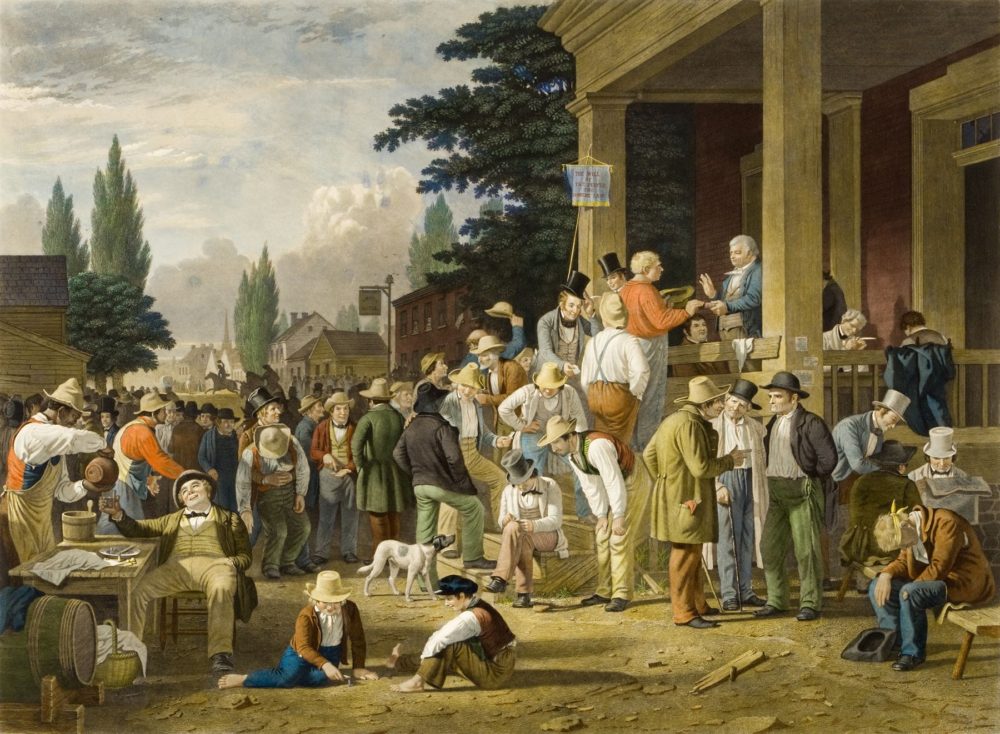
Booze was proof of citizenship in Caleb Bingham, “The County Election,” 1854, Reynolda House Museum of American Art.

When I was in college many years ago I took a class on State and Local Government. One thing that I clearly remember was what the professor said about voting rights. He said that when it came to expanding suffrage it was the federal government that took the lead. Today, I am not so sure.

The House of Representatives just passed the SAVE America Act or its official moniker: The Safeguard America Voter Eligibility Act. USA Today writes that “The legislation would require people to provide proof of citizenship “in person” when registering to vote in federal elections, and adds an additional requirement that voters show an approved form of photo identification to cast their ballot. It also places new rules on mail-in voting, requiring Americans to send in a copy of their ID when both requesting and submitting their ballot.”

Before long we will be carrying some sort of portmanteau with all of our various IDs, Usernames and Passwords. But I suspect voting will turn out much like applying for, and being approved, for a TSA PreCheck Pass. For less than $90 you can skip the lines and renew every five years for just under $60. Is this where we are heading with voting?

It is all about manipulating the vote. I would not be surprised if the SAVE Act were to morph into a law that “allows” Americans access to the polling place but in order to actually cast a ballot the voter will be charged a fee for individual ballots for federal, state and local elections; much like how Medicare drug plans categorize medications into tiers, with lower tiers generally having lower copayments. To vote in local elections would cost X dollars and in State X2 dollars and Federal elections would be the top tier. It would be The FEAR Act: Funding Elections Against Reprobates. Those not paying can wait in the back of the line with the riffraff and vote at the DMV.

By making voting a user fee and a funding mechanism it would take it out of the realm of the Twenty-fourth Amendment “The right of a citizen of United States to vote…shall not be denied or abridged by the United States by reason of failure to pay any poll tax or other tax.” It is now a funding mechanism for those who can afford to vote.

Let’s face it, there have always been some sort of voting restrictions or requirements going all the way back to Colonial times. Even after the Revolutionary War, which was basically fought over the lack of representation in Parliament over who gets to tax Americans, had requirements. Even the newly independent Americans were faced with voter requirements. The most obvious requirement was being a property owning white male. This requirement hit the propertyless poor, white men, women and anybody of color–even the propertyless veteran of Valley Forge who fought to found this country could be disenfranchised.

The republican logic of the times believed that in order for a citizen to vote he, and I use the word “he,” had to have an economic interest in the community at large. Those lacking economic independence, even if they fought for independence, were believed to be easily manipulated and could not be trusted to vote–for whatever reason.

There is some truth to manipulating the weak-minded voter on Election Day. George Washington lost his first run at the Virginia House of Burgesses because his liquor wagon ran dry. Washington was swamped losing the election by 231 votes. He garnered only 40 votes. According to classiccitynews.com “Washington avoided the same mistake during his second run, spending nearly the entire campaign budget on 28 gallons of rum, 50 gallons of rum punch, 34 gallons of wine, 46 gallons of beer, and two gallons of cider royal served to 391 voters — nearly a half-gallon per voter.” A good time in the old town was had by all as Washington floated his way into the House of Burgesses.

The GOP backed SAVE bill incorporates some of the same logic Washington used but with a twist of lemon–the mail-in ballot. Trump believes he lost the 2020 election due to mail-in ballots. There is a lot of truth in this. According to MIT’s Election Lab study on How We Voted in 2020: A Topical Look at the Survey of the Performance of American Elections states that “Looking at 2020 (election), the partisan difference in voting by mail increased substantially. The proportion of Democrats voting by mail more than doubled, while the proportion of Republicans using vote-by-mail increased by “only” 50 percent compared to 2016. In total, 60 percent of Democrats cast their ballots by mail in 2020, compared to only 32 percent of Republicans.”

This does not explain Trump’s 2024 victory but here is the bitter lemon in the cocktail. MIT’s Election Lab study says that voting by mail, which includes dropping votes off at drop boxes had steadily increased since 1996. Standing in line and expecting a gill of rum for doing your civic duty has dropped from 89 percent to 60 percent in 2016. “The fraction of voters casting ballots by mail more than doubled from 2016 to 46 percent. “Meanwhile, the share of voters casting ballots on Election Day declined by half, from 60 percent to 28 percent.” Granted, the Covid pandemic had states scrambling to set up safe voting procedures. Drop-off and mail-in ballots provided voters with safe access to voting without the crowds. However, it appears that voters like the idea of early voting using drop-off boxes and mail-in ballots.

The other twist is that Trump, constitutionally, is not allowed to run again per the Twenty-second Amendment. Without Trump’s rum wagon pulling up on Election Day maybe GOP Congressional representatives feel the need to legally control the voting process. Voting by either drop-off or by mail is like the forward pass in pro football. In 1933 the NFL changed the rules that a passer had to be “five yards behind the line of scrimmage before he can pass the ball…” to allowing “the passer to pass the ball from any point behind the line of scrimmage.” In three years, 1936, the NFL had its first 1,000 yard passer when Green Bay Quarterback Arnie Herber threw for 1,239 yards.  In 1967 Joe Namath became the first QB to throw for 4,000 yards and in 1984 Dan Marino threw for 5,000 yards. Simply put, mail-in voting, like the forward pass is a game changer. Since Marino threw for 5,000 yards that number has been eclipsed ten or more times.

I am not sure where this act of saving our elections from ourselves fits into the timeline of our county’s democratic principles. Voting rights can be easily fit into historical narrative and are often associated to important events in our history. The most obvious is the Fifteenth Amendment giving freed slaves the right to vote. Then there was the Twenty-sixth Amendment ratified in 1971 which allowed 18 year-olds the right to vote. This amendment came out of the Vietnam War. If a young man or woman was old enough to die for their country they surely should be old enough to vote much like their forefather in the Continental Army. The Twenty-fourth says the right to vote shall not be denied or abridged on account of sex. I am surprised Congress has not taken up some sort of restrictions on trans gender people from voting. Maybe in the near future besides proving we are citizens we will need medical proof of our sex. Selfies do not count.

I really think the GOPers in Congress are not reading the writing on the wall–adapting to the forward pass or mail-in or drop box to voting. They need to scrap Trump’s revenge plays trying assuaging the “Big Man’s” ego and start looking downfield at the changing times. Putting more obstacles in the way of voting flew away with Jim Crow.

Ancient Aliens, the Deep State and the Epstein Conspiracy

Without a doubt Americans love a good conundrum. If it is real puzzler with crime and sex we either turn it into TV docudrama or better yet, a full blown conspiracy. 

Just look at the Kennedy assassination. After 60 years we have gone from the “lone gunman nut theory” to Cuban assassins parachuting in on the Grassy Knoll to CIA Mafia-hired hitmen looking to get revenge for John’s brother, Robert, for going after organized crime as the Attorney General. I have even read where theorists say there is evidence to suggest that somebody took a shot at Kennedy from inside a curb-side sewer at street level.

Like the Warren Commission and the Kennedy assassination, I really don’t think President Trump realized as candidate Trump the morass he got himself into when he promised to release Jeffrey Epstein’s files to the public. That was like aroma of fresh-baked pizza with extra cheese wafting out onto the street for the Deep State conspiracy minded cosmonauts of  cyberspace to start chowing down on.  Afterall, whether he likes it or not, Trump has inherited the Deep State and all its dirty ops.

The Epstein Files is more than alleged sex trafficking of underage girls. Right now the conspiracy sleuths are more interested in whose names are on some sort of list, men seeking the pleasure of younger women—and their connection to the Deep State, banking, oil and international business. This has conspiracy bloodhounds digging like terriers at a rat hole. And that is what the Deep State , or what’s left of it at this point, wants. The Deep State wants these rat terriers running down dead end alleys. 

Meanwhile a key piece of information is being over looked: Epstein’s DNA. When it comes to crime we depend on Forensic DNA Specialists. But, in this case we should be relying on Genomic Researchers. 

The Human Genome Project was a large, well-organized, and highly collaborative international effort that generated the first sequence of the human genome and that of several additional well-studied organisms. Carried out from 1990-2003, it was one of the most ambitious and important scientific endeavors in human history.—NIH National Genome Research Institute. 

The Epstein case goes well beyond criminal forensics. It is alleged that Epstein’s DNA carries a slight mutation. It is a slight mutation passed along for centuries and can be traced back to its possible origins in three river valleys on Earth: The Hung He or Yellow River, “The Cradle of Chinese Civilization,” The Tigris and Euphrates Rivers, better known as the “Fertile Crescent” and the Nile River. Some researchers believe that the same mutation can be found in Central and South Americans—home to the Aztecs, Incas and Mayans. This explains Trump’s efforts to deport as many illegal South and Central Americans as possible. This is just cover for the Deep State’s search for alien DNA in immigrants who come into this country from south of our border. It could possibly be argued that the Deep State kept Trump in the dark about this research in his first term. In his second term he unknowingly fell into the Epstein Files and the ancient alien DNA research face first. He now finds himself mired within the Deep State, something that unsettles his staunch MAGA base. 

Most middle schoolers, who stayed awake in their World History class, can take a wild stab at explaining the significance of those geographic areas. Those of us who are smarter than a 5th grader but less studious than an 8th grader may not know that all of these locations are significant in establishment of ancient civilizations and human advancement; moving from hunters and gatherers to inventing the wheel, writing, gunpowder and domesticating crops and animals. Something the Trump Administration is banking on us not knowing, now that they are aware of some of the buried Deep State secrets. This explains the dismantling of the state and national educational infrastructure and the closing down government funded national research centers.

The Deep State became obsessed with determining the human genome and may explain the push for diversity, equity, and inclusion as a way of preparing us for extraterrestrial beings in the woodshed.  According the National Genome Research Institute, “A special committee of the U.S. National Academy of Sciences outlined the original goals for the Human Genome Project in 1988, which included sequencing the entire human genome in addition to the genomes of several carefully selected non-human organisms.”

For whatever reason a handful of researchers were convinced that the Fertile Crescent held some of the mysteries of the human genome. Many people believe that President George H. W. Bush’s 1990  Gulf War was to put Saddam Hussein back in his box. Its real mission was in search of  DNA, just one of  Bush’s thousand points of light was the mapping and sequencing of the human genome. 

The main goal of this international effort was to get the entire human genome, or the genetic blueprint of the human being. By 2000 the International Human Genome Sequencing Consortium “announced that it had produced a draft human genome sequence that accounted for 90% of the human genome.” The key word here is “human” because “The draft sequence contained more than 150,000 areas where DNA sequence was unknown because it could not be determined accurately (known as gaps).” But that 8 to 10 percent needed to be filled in. 

Again, in 2003 another Gulf War, this one started by Bush II, to fill in the gaps. This time it was under the guise of looking for Weapons of Mass Destruction. In reality it was in search of that one little mutation. Hence, military house-to-house searches armed with AR-15s and cotton swabs.  Abu Ghraib Prison was known more as a CIA torture chamber than a Deep State secret genetic research facility. The dupes in this charade were the Army National Guardsmen who unbeknownst decoyed the real purpose of Abu Ghraib. The human rights abuses was a great cover for the more benign genomic research that was taking place deep within its walls. 

By 2022 those gaps had been filled. All though touted as a positive outcome, the Human Genome Project “made every part of the draft human genome sequence publicly available shortly after production.” This created a genome race giving Communist Chinese scientists access to DNA sequencing science that they previously lacked. Trump’s trade war with China goes deeper than container ships crossing the ocean. It sheds some light on the Wuhan lab leak theory. What were Chinese scientists really researching? Was the Covid pandemic just a cover for deeper, darker genetic secrets?

What we are witnessing now is the anti-Deep State’s attempt to dismantle all evidence of the Deep State through a concocted agency called DOGE. DOGE’s eradication of agencies includes many seemingly unrelated government activities. It is a shotgun approach to eliminating the Deep State, destroying more than DEI and “woke” agencies.  The Trump administration is not only slashing research efforts taking place across the nation in government but also in university labs. Hence, the legal battles to defund universities like Harvard and the closing down government research centers. But probably its biggest take down was removing the United States from the World Health Organization, thus denying scientists valuable DNA data derived from a variety of sources–and reasons.

What the anti-Deep State does not understand is that some of these labs have been researching for decades with alien remains. Alien remains that some researchers believe are related to those they believe visited this planet 10,000 to 12,000 years ago. The Deep State has meticulously compartmentalized this alien DNA research so no one agency or research lab could connect the DNA gaps on its own. With the anti-Deep State slashing funding for research facilities, it is hard now to tell what was lost to DOGE’s shotgun approach in dismantling the government for budgetary purposes. 

For instance, one research group found there was a slight difference within the mutation leading some researchers to believe that there is just enough diversity in the alien DNA to speculate that maybe as many as three different alien related-groups visited Earth. No one is sure if that research is lost or just on pause. 

It is also their belief, but purely speculative, that these aliens set up what would be “Roanoke Colonies” in the Hung He River, the Tigris and Euphrates Rivers, and the Nile River valleys, much like Britain’s attempt to establish settlements off the North Carolina coast in 1685.  These attempts resulted in the first great American Mystery:  “The Lost Colony of Roanoke.” Historians today do not know what happened to the 112 to 120 settlers. They still search for clues to their disappearance. Some speculate that local native Americans savagely killed them. Others believe that they may have lived out their remaining years with peaceful natives in the unsettled wilderness. 

Some researchers believe that these ancient aliens, stranded  in a hostile environment, suffered the same fate as Lost Colony of Roanoke inhabitants, were waiting for an interstellar supply ship that never arrived. Some go on to speculate that like the Lost Colony, war kept these Earth colonies from getting supplies they  needed. Although there is no proof of this some believe that an interstellar war may have kept colonizing aliens from a timely return.This leads some to believe that those stranded aliens, much like the Roanoke settlers, intermarried with the natives, humans, creating this out-worldly “nonhuman” mutant piece of DNA floating around in the genetic pool of humans.

In fact, some researchers feel strongly that the Chinese may be on to something big with their exploration on the Dark Side of the Moon– 2001: A Space Odyssey moment. There maybe proof of an ancient alien space battle that took place in our own Solar System. Evidence of this battle could possibly be found on the Moon. It may even give clues to the possible end of life on Mars. Although not taken seriously among astronomers and astrophysicists, it is a belief that this ancient alien space battle destroyed several planets explaining the asteroid belt between Mars and Jupiter and the Kuiper Belt. 

The Deep State has been secretly working with the remains of extraterrestrials since the end of World War II. The government has tightly controlled information on UFOs or “unidentified anomalous phenomena”  UAPs. (see blog Congress and Aliens, January 2024). We have been looking to space for proof of extraterrestrial life while the proof may be right here walking around on Earth in our own DNA. There is more hiding in the Epstein Files and fantasy island. The Trump Administration overt activities to defund large portions of the government, its suspicious turn around on the Epstein Files indicates that like past administration, it has been consumed by the Deep State. 

Making America Great from Sea to Shining Sea

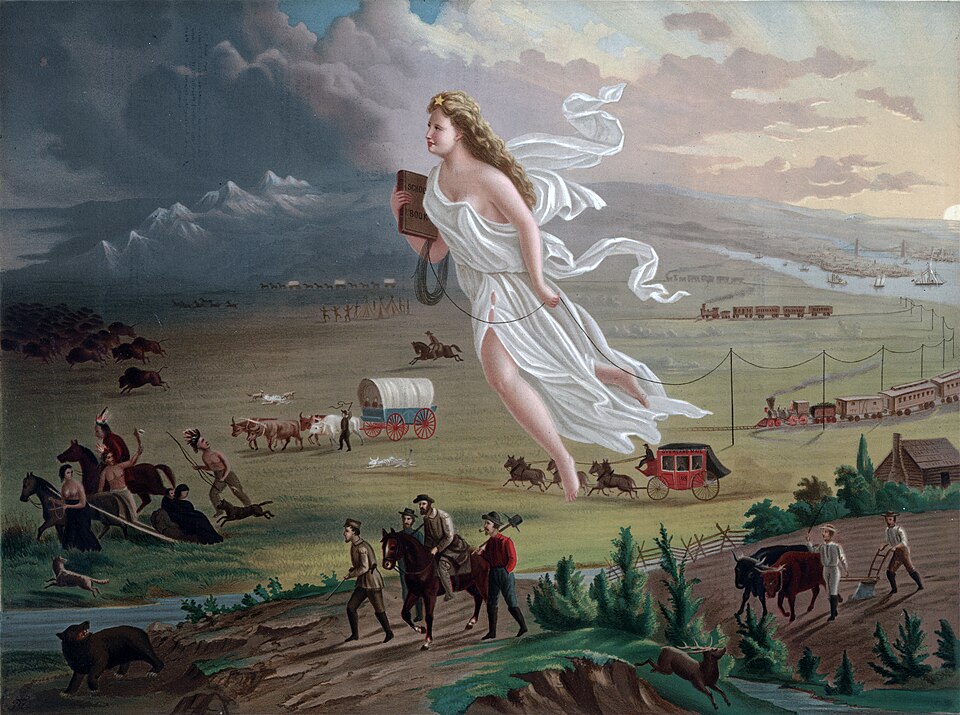
American Progress by John Gast, Public domain, via Wikimedia Commons

The slogan “Make America Great Again” confuses me. There is so much to unpack in that four word statement. It is a wide open proclamation that seems simple but in reality is so subjective it creates more questions than it can possibly answer, starting with what is great. Can “Great” even be defined and then agreed upon.

MAGA as a slogan is a historical phenomena based on the Rashomon effect. The term Rashomon effect comes from Akira Kurosawa’s 1950 film Rashomon. The movie, according to psychologenie.com, “highlights the contradictory interpretations of the same event by different people. But because these are accompanied by facts, each of these interpretations seem completely plausible … wherein lies the confusion and dilemma.”

What makes MAGA so confusing is whose interpretation of what era of American history we agree upon is or was great. Our history is comprised not of one event but a series of events that lead up to a major event–like say, the Civil War to Reconstruction.

Understanding and interpreting history comes from three sources. The University of California, Berkley’s Department of History says that Primary Sources are “The ‘raw materials’ (or the) foundation of historical research and writing.” It is observations from sources who witnessed history as it was unfolding. Sources like newspaper articles, journals, government documents and the arts all give us information from the past.

Secondary sources are the historiography produced from primary sources. It is the books and articles “that (are) anchored in primary sources and informed secondary sources.” It is the “arguments and interpretations about the past” that emerge from the “foundations of historical evidence (i.e., primary sources).” It is a process of either challenging or supplementing “prevailing interpretations that other historians have made.”

And finally, Tertiary Sources are “Books and articles based exclusively on secondary sources – i.e., on the research of others.” Basically we are dealing with numerous interpretations (sources) and outcomes depending on the combination and permutations of historical events. Like this blog.

The (Rashomon) effect of the subjectivity of perception on recollection, by which observers of an event are able to produce substantially different but equally plausible accounts of it.–Wikitionary

A lot of philosophical beliefs about government and influential individuals in our history can be hashed about as causes for “making America great” starting with the Revolutionary War all the way to someone like Henry Ford and the assembly line. It could be argued that the Louisiana Purchase was an accelerant spurring a population pinned in-between the Appalachians and the Atlantic to move west into what would be a mission of Manifest Destiny, from sea to shining sea with amber waves of grain in-between. It was going west to get to the East–the Orient, and even possibly into Central America. But first Native Americans and Mexico had to be shoved out of the way.

After the War of 1812 a spirit of nationalism took hold. For the next two decades Americans began to take their beliefs west. According to William Earl Weeks, “Manifest Destiny consistently reflected three key themes: the special virtues of the American people and their institutions; their mission to redeem and remake the world in the image of America; and the American destiny under God to accomplish this sublime task.” It was a belief in the virtues of a liberty, justice, and the republican form of government. It encompassed the two “Cs”: Christianity and Capitalism, two concept developed during Colonial times that were now ready to move beyond the Appalachian Mountains–on steroids.

The westward movement in some ways was a religious crusade spawned by the Second Great Awakening. It created a religious incentive to drive west. Indeed, many settlers believed that God himself blessed the growth of the American nation. Afterall the Native Americans were considered heathens and always subject to be converted. By Christianizing the tribes, American missionaries believed they could save souls. Unlike Mountain Men and fur trappers who preceded the missionaries, Manifest Destiny was a fulfillment of God’s will to Christianize the heathen Native American tribes.

It appeared to be America’s sacred duty to expand across the North American continent, to reign supreme in the Western Hemisphere, and to serve as an example of the future to people everywhere. This was Manifest Destiny of the American people.–Building the Continental Empire Americas Expansion from the Revolution by William Earl Weeks

Manifest destiny touched not only on religion; it was an economic and trade crusade; it was about race and patriotism. According to Weeks, “Senator Edward Hannegan of Indiana typified (the) view when in late February 1847 he proclaimed to Congress that ‘Mexico and the United States are peopled by two distinct and utterly nonhomogeneous races. In no reasonable period could we amalgamate.'” A country that depended on slave labor to generate a national income probably did not have a deep seated problem in viewing the western inhabitants, non-Anglo Saxons, Catholics as inferior. The needs of the American expansion to the Pacific generally did not include them. These religious, economic and racial differences would end up in a war with Mexico over Texas. Mexico would lose just about all of the Southwest to include California right up to the border of the Oregon Territory as a result of the Mexican-American War (1846-1848). If this could be looked as a ledger sheet, America’s great gain was Mexico’s great loss.

The Oregon Territory was a bit different then battling non Anglo Saxon Catholics and savages. Fighting over the territory was not really an option. Territorial disputes with the former Mother Country over northern and western borders was nothing new. Handling the British bulldog was different then kicking around the Mexican Chihuahua. Britain, unlike Mexico with Texas, could see that American settlers were soon going to populate the Oregon Territory. Both countries had a vested interest in not disrupting the trade between the two countries. And besides, the United States had just engaged Mexico in one war and did not need to fight the British along the northern border at the same time.

Ironing out the Columbia River was done diplomatically. Concessions were made on both sides in modifying the belligerent cry of “Fifty-four Forty or Fight” land grab. This American claim included most of the land west of Continental Divide (current British Columbia) and as far north as the Russian territory of Alaska. Cooler diplomatic heads prevailed setting the border between British North America, Canada a country that we invade twice and at present seem to want to annex, along the 49th parallel instead of the 54th.

Then there was the desire of southerners to find more lands suitable for cotton cultivation. The anti-slavery movement in Northern states was beginning to take off. There was a deep concerned about adding any more slave states to the Union. All of this new land could alter the delicate balance of power of the federal government. Adding states to the Union at this time consisted of bringing in one slave and one free state at the same time. And no president until Abraham Lincoln would consider curbing the growth of our “peculiar institution” to just the South. Settling the boundaries of slavery in these new lands would take two compromises, The Compromise of 1820 (the Missouri Compromise) and The Compromise of 1850. Both were replaced with the idea of popular sovereignty in the Kansas-Nebraska Act of 1854. The idea was that the settlers of new territories would decide. Eventually the country decided on war.

And then there was trade, particularly with China. According to The Office of the Historian, “American trade with China began as early as 1784, relying on North American exports such as furs, sandalwood, and ginseng, but American interest in Chinese products soon outstripped the Chinese appetite for these American exports.” (It seems we have always run a trade imbalance with China.) Sixty years later the United States would sign The Treaty of Wangxia that would open up five treaty ports to US trade.

The big problem in tapping into the Far East trade was the United States did not have a suitable port on the West Coast. San Diego, Los Angeles and San Francisco were all in Mexico. That would change after the Mexican-American War. Under the Treaty of Guadalupe Hidalgo Mexico cede 55 percent of its country to the US. America received California, Nevada, Utah along with most of Colorado, New Mexico and Arizona. It also settled the long standing feud over the southern border of Texas as the Rio Grande.

It could be argued that Manifest Destiny was a great moment in American history. A lot of the greatness however, was taking place East of the Mississippi. Internal improvements like canals were built to move produce and trade along the many rivers flowing to the Hudson and Mississippi Rivers, and the Great Lakes. Steamships began regular runs up and down the Mississippi and its tributaries. In 1826 in New Jersey John Stevens demonstrated the possibilities of steam locomotion. By the 1830s railroads like the Baltimore & Ohio (B & O) were surveying and laying track. Some Forty years later the railroads connected the Atlantic to the Pacific Oceans. These were innovations that would be needed to settle and develop the West.

From a certain perspective Manifest Destiny was a time when it could be argued that America being made great. Not so much for Mexico and Native Americans. Therefore greatness may very well depend on the subjective perspective taken in determining what is great as to who benefits by greatness and the stories they tell. To the contrary, there is a good possibility that someone has been disposed, denied or defeated by just standing in the way of making something great.

Making America Great: The Beginning

We have been living with the red-hatted MAGA mantra for close to 10 years. I think this shibboleth historically does the country and its people a great disservice. Yes, it is a forward thinking concept. But in many ways MAGA focuses on the foibles and glitches of the present and omits the fact that America has always been a country that is constantly under construction; progressively moving forward in science, trade, economics and human rights.

I am not sure if we have ever had a period in our history where we have stomped the mud off our boots and dusted our hands and said, “My work here is done.” The only thing that comes to mind is planting the flag on the moon. The last man on the Moon was Gene Cernan way back in December of 1972. In fact no humans have been more than 400 miles from the Earth since that Apollo 17 flight. Every country with a space program is still flying in our contrails.

There are many reason why America has progressively moved forward. The early Puritans considered the New World to be a “beacon on a hill.” Today, President Trump is putting forth the concept that improving tariffs are a mechanism to keep that beacon shining. However, many are questioning if tariffs are the right tool for the time.

Even if we look back to what has to be our darkest moment there was progress. During the Civil War when the country ripped itself apart over a slave based economic system, a time when cotton accounted for 60 percent of the country’s trade revenues, a time when hundreds of thousands of men fought over Union and slavery; America was still moving forward. And, The Homestead Act was just one part of making America great in the post Civil War era.

During the Civil War, while the country was giving its last full measure of devotion to reunite a divided country there was hope with landmark legislation like The Homestead Act 1862. The Act opened up 270 million acres to “anyone” 21 year old or the head of a household. There were two caveats: you had to be a citizen or declare the intentions of becoming one; and well, if you took up arms against or aided enemies (the Confederacy) of the United States you need not apply. A step in making America great. However, this step, a concept of an individual owning 160 acres of western land, clashed with Native American ideas of land ownership and management.

Washington [D.C.] is not a place to live in. The rents are high, the food is bad, the dust is disgusting and the morals are deplorable. Go West, young man, go West and grow up with the country.— attributed to Horace Greeley, New-York Daily Tribune, July 13, 1865

But what made this act so important is it dovetailed neatly into the concept of Manifest Destiny. A belief that America was destined to be a country from the Atlantic to the Pacific. Americans, or English Colonials, have always pushed westward through the Cumberland Gap on the Wilderness Road into Kentucky and Tennessee or the National Road out of western Maryland on into Indiana. River travel played a big role in moving settlers and goods on rivers like the Ohio and its tributaries that flowed to the Mississippi.

However, at this time the United States was hemmed in by the Mississippi River to the West and Spanish Florida to the South. Nobody was really sure what lay on the other side of the Mississippi River in 1800. For instance, the Spanish searched all over the Southwest looking for a city made of gold called Eldorado. (They were looking in the wrong places. All they really needed to do was build a sawmill in Northern California and maybe American history would have been a whole lot different.)

This belief that America was to rule from the Atlantic to the Pacific grew legs with Thomas Jefferson’s Louisiana Purchase. The cry “go west young man” and the slogan “Manifest Destiny” were still to come. But, the early 1800s was also a time of some ill conceived ideas. Americans were picking a Quasi War in the late 1790s with France and a real war, again, trying to settle old scores with Great Britain in 1812. While we were fighting the British we also took another crack at conquering Canada. it seems history has circled back again on conquering Canada, this time with tariffs.


The Homestead Act of 1862 was a revolutionary concept for distributing public land in American history. This law turned over vast amounts of the public domain to private citizens. 270 millions acres, or 10% of the area of the United States was claimed and settled under this act. Repercussions of this monumental piece of legislation can be detected throughout America today.–National Park Service

The new nation’s eyes were also focused south on the Spanish possession, the appendage we know as Florida. At that time there were two Floridas, as if one was not bad enough: an East Florida and a West Florida. It was West Florida that abutted New Orleans and the part of Florida that was not included in the Louisiana Purchase. Despite diplomatic haggling, Presidents Madison and Monroe got nowhere on changing Spain, France or Britain’s mind as to America owning what would later become chunks of Mississippi, Alabama and Florida. Spain, unlike France, was not interested in selling off its North American holdings. However that was about to change.

In 1804 Jefferson was after New Orleans, the crown jewel in the Louisiana Purchase. As long as any foreign country owned New Orleans it put a serious crimp in bottling up American trade coming down the river. Forget tarifs, the fledgling country needed an outlet for its western produce. America needed West Florida to get its goods to what would later be known as the Gulf of America and on to foreign markets or back east to New York, Boston, and Philadelphia.

The process of acquiring this chunk of Gulf Coast would take several diplomatic incidents. But it was General Andrew Jackson that got the ball rolling. During the War of 1812, while other generals were floundering in taking Canada, while the British burning Washington City; Jackson was fighting both the British and Native Americans in the South. He whipped the Native Americans in what was known as the Creek War and whipped the British in the Battle for New Orleans. Once the war with the British was over he was able to turn his full attention to the various renegades who were crossing to and fro across the the US and Spanish Florida border. (It seems like some things in history never change.)

Now, in most wars there is always at least one country ready to supply the locals with the needed provisions to wage war. Like the United States sending weapons to Ukraine. In this case it was Britain supplying the Native American tribes of the Southeast with the tools of the trade. The Spanish did not seem to mind. Nor did they care who came and went across the border. Runaway slaves from Georgia found refuge among the Native Americans. Two groups that had a vested interest in helping Spain keep Florida and keeping Jackson out.

If there is one thing that history has taught us is that Native Americans never come out on the winning side of a war involving Europeans and Americans. Once Jackson sent the British running back to the Gulf of Mexico, as it was known back then, he began chasing Native Americans and runaway slaves seeking asylum in Spanish territory. In his incursion into Spanish Florida combatants were killed, forts and personal property were destroyed. Caught up in the hostilities were two British nationals: Alexander Arbuthnot and Robert Ambrister. Both were convicted of aiding Seminoles and other Native American tribes. Jackson gave both men a short shrift and a short rope. Both ended up getting hung along with two Seminole chiefs creating an international incident. It was a diplomatic mess that Secretary of State, John Quincy Adams, had to clean up. The whole affair would become the first of three Seminole Wars.

A side note here. A small country like Denmark might want to take note. When it comes to land, Americans usually get what they want. Just ask any Native American tribe or Mexico, For instance Florida, the Monroe Administration wanted Florida. Later it was the Polk administration going after Texas. If anything, Jackson’s running around Florida made it clear that Spain could not control the border or its inhabitants. Secretary of State John Quincy Adams presented Spain with the ultimatum either control your people or we will.

If it was anybody who had the art of the deal down it was John Quincy Adams. It was the Onís-Adams Treaty of 1819, which according to history.state.gov, “Spain ceded East Florida to the United States and renounced all claim to West Florida. Spain received no compensation, but the Unites States agreed to assume liability for $5millin in damages done by (Jackson) American citizens who rebelled against Spain”

The Onís-Adams Treaty resulted in the 1821 Transcontinental Treaty. What makes the treaty important is that it “defined the western limits of the Louisiana Purchase.” It led Spain to surrender “its claims to the Pacific Northwest (Oregon Territory). In return, the United States recognized Spanish sovereignty over Texas.” A recognition that would last less than 30 years. Adams also worked out the northern boundaries of the Louisiana Purchase and the Oregon Territory with Great Britain. Once Adams set these boundaries the march to the Pacific and making America great was about to begin.

In just a little more than 10 Years America increased its size by one million square miles.

  • The Louisiana Purchase: 828,000 Square Miles;
  • The Oregon Territory: 288,000 Square Miles;
  • and Florida: 72,000 Square Miles.

And this does not include Mexican controlled California and Texas, yet to be acquired.

The biggest problem Americans faced was getting over the Mississippi River. The technology to capitalize on all of this land had yet to be developed. Canals connecting rivers to the Mississippi River had to be built. According to mississippiriver.com, “In 1814 the city of New Orleans recorded 21 steamboat arrivals, however, over the course of the following 20 years, that number exploded to more than 1200. The steamboat’s place as a transportation necessity was secured.” It was the beginning of making America great.

From Gilded Age to Golden Age

contemplative images flickr.com

In President Trump’s Inaugural Address he boldly stated, “The golden age of America begins right now.” It has a nice ring to it but when you think about it, America’s last attempt at a golden age was called the Gilded Age.

Our Gilded Age was a time that was between the Civil War and the and turn of the 20th Century. It was a time when America was unfolding itself from sea to shining sea. History.com describes it as an era where “America became more prosperous and saw unprecedented growth in industry and technology.” But it was also an era as History.com says, that “had a more sinister side: It was a period where greedy, corrupt industrialists, bankers and politicians enjoyed extraordinary wealth and opulence at the expense of the working class. In fact, it was wealthy tycoons, not politicians, who inconspicuously held the most political power during the Gilded Age.”

For a Golden Age to be golden it needs to fit the following criteria:

  • The age must have stable economic growth, trade and the creation of wealth;
  • The age must have significant advancements in the arts, literature and science that contributes to the advancement of civilization;
  • The age must be one of discovery and innovation where progress pushes the envelope of what is possible;
  • Finally, it must be an age where there are peaceful relations among citizens and other countries.

Granted very few eras in history have hit all of the above criteria in full. It could be argued that for most of the United States history the US has come close to meeting most of the criteria to some degree some of the time; and at other times completely disregarded others. But even the Gilded Age with its moments of great wealth had its moments of economic panics, followed once again with the creation of great wealth. It was a time when the captains of industry controlled entire industries creating monopolies and trusts. and full employment. But it was a time where workers barley made $500 a year.

 Like today, New York City was the center of the financial system. Between 1863 and 1913, eight banking panics occurred in the money center of Manhattan. The panics in 1884, 1890, 1899, 1901, and 1908 were confined to New York and nearby cities and states. The panics in 1873, 1893, and 1907 spread throughout the nation.–federalreservehistory.org

According to the Thomas Edison National Historical Park, “In 1879, he made an incandescent bulb that burned long enough to be practical, long enough to light a home for many hours.” Within 60 years there would be night baseball.

Louis Bachrach Studios Prints and Photographs Division, Library of Congress

It was a period of peace and innovation. Inventors like Thomas Edison and Alexander Graham Bell pushed the boundaries of science. Their inventions had a great impact on raising America’s standard of living and helped push the world into an electronic age of light and communication.

Alexander Bell places the first long-distance call from New York to Chicago in 1892. There were no free minutes at that time or unlimited texting.

Gilbert H. Grosvenor Collection, Prints and Photographs Division, Library of Congress

With the influx of immigrants, a segregated population became more segregated with laws like the Chinese Exclusion Act of 1882. It was a law that restricted Chinese laborers from entering the country, among other restrictions. It also affected Chinese immigrants already in the country by making them permanent aliens. It was an act of denying them citizenship. It was also a time where women, citizens, were denied the right to vote.

And it was a time of full employment fueled by immigrants, where workers barley made $500 a year. It was also a time dangerous working and conditions for labor. One slip or injury could cause economic devastation for a family. Unions fought for survival. However most were crushed from the weight of business interests working in conjunction with the government.

  • There was the Haymarket Riot of 1886 where workers were rallying for an 8 hour day. A bomb exploded killing workers and seven policemen.
  • There was the Homestead Steel Strike of 1892 where workers battled Pinkerton Detectives brought in by Andrew Carnegie’s chief executive Henry Clay Frick to break the strike. Eventually the Pennsylvania Militia was called out and the union organization was crushed.
  • And two years later there was the Pullman Strike. Pullman manufactured railroad cars. In 1893 George Pullman laid off seventy-five percent of the work force and reduced wages for those still working. The the American Railway Union called for a nationwide strike shutting down rail travel in 27 states. Eventually, President Grover Cleveland sent in 10,000 troops to quash the strike.

The annual income of an American worker in 1890, at the height of the Gilded Age. Adjusted for inflation, that’s just under $1,500 in today’s dollars.–Investopedia

Sticking with the railroad motif, Louisiana in 1890 passed The Separate Car Act. Railroads were required to provide “equal but separate accommodations for white and African American passengers.” Additionally, according to Britannica.com, the law prohibited passengers from entering accommodations other than those to which they had been assigned on the basis of their race.

The argument necessarily assumes … that social prejudices may be overcome by legislation, and that equal rights cannot be secured to the negro except by an enforced commingling of the two races. We cannot accept this proposition. If the two races are to meet upon terms of social equality, it must be the result of natural affinities, a mutual appreciation of each other’s merits, and a voluntary consent of individuals. (From Brown’s majority opinion in Plessy v. Ferguson. In other words, don’t trip over the color line on the way out.

Original published in The American Magazine in 1905 Frances Benjamin Johnston

It is amazing how educated legal minds can interpret the Fourteenth Amendment to the Constitution. When this law was challenged in court it made its way to the Supreme Court. In Plessy v Ferguson, the Supreme Court ruled that separate accommodations did not violate the Thirteenth or Fourteenth Amendments. Justice Henry Billings Brown wrote for the majority. He “argued, because the amendment was intended to secure only the legal equality of African Americans and whites, not their social equality. Legal equality was adequately respected in the act because the accommodations provided for each race.” The lone dissenting vote came from John Marshall Harlan who fundamentally objected to the statute because “it interferes with the personal freedom of citizens.” The ruling gave us the concept of “separate but equal.” A dogmatic principle that hung around for another 50 plus years.

A Golden Age is a term used to describe a period in history where a culture, society, or nation experiences a period of prosperity, peace, and advancements. This era is characterized by significant achievements, significant contributions, and a collective sense of prosperity and unity. Golden ages are often marked by major advances in science, technology, art, and literature.–California Learning Resource Network

Before declaring a golden age Trump and company should look at what they are up against. They may have a hard time competing with the likes of ancient Egypt’s Fourth Dynasty. We might be going back more than 4500 years but in its golden age these pharaohs put up some impressive feats, like building pyramids. According to Pharaoh.se “the pharaohs of this dynasty only ruled for a little more than a century (and we think eight years is a long time), and yet they managed to have the three pyramids of Giza built in that time.” The pharaoh Sneferu started construction of the first pyramid and built three more, (no doubt letting the Nubians to pay for last two).

The Pyramids of Giza
Ricardo Liberato, Wikimedia Commons

His son Khufu continually improved upon his dad’s work. No pressure on Don Junior. In Trump’s first term he could not complete a wall along the Southern Border. (It was foiled when Mexico reneged on its fiduciary participation.) However Trump is proposing the Stargate Initiative. According to Forbes, this is “a $500 billion private sector deal to expand U.S. artificial intelligence infrastructure. Spearheaded by tech giants OpenAI, SoftBank, and Oracle, Stargate represents the largest AI infrastructure project in history.” Move over pyramids because the Yanks are coming! The sky’s the limit when billionaires get together. (At least three have skirted outer space.)

And then there is the Golden Age of Ukraine. If Trump plans to end Russia’s conquest of Ukraine he might want to bone up on Vladimir I or just Vladimir the Great. And no, this is not Putin but the “founding father” of Kievan Rus’. Putin might be using history to repeat Vladimir I’s medieval accomplishments. We have to harken back the 10th and 11th Century when Kievan Rus’ was Europe’s most powerful European state. A state without nuclear weapons. Vladimir I is credited with expanding Christianity to that region. Originally a pagan, much like Saul of Tarsus, he saw the light. When he converted to Christianity he oversaw the conversion of Kyiv and Novgorod to Christianity as well. For kicks he had all pagan idols thrown into the Dnieper River.

And lest not forget what was once “The Red Menace” from the East, China. Any golden age today has to take into account one of the oldest cultures in human civilization. Just look to the Tang Dynasty. Its first emperor was Gaozu (also Kao-tsu, formerly Li Yuan,-tsu (618-626 C.E.). According to ushistory.org, Gaozu “granted equal amounts of land to each adult male in return for taxes and continued the trend of local government rule…he also created a monetary system of copper coins.” Maybe Trump and Friends are onto something with Bitcoin. And he wrote a set of laws that were revised every two decades that lasted into the 14th century and the Ming dynasty. Sounds a bit like our Presidential Executive Orders, subject change but more frequently.

Emperor Gaozu was a Sui military commander who led a rebellion against his former masters, seized control of the state, and founded the Tang Dynasty
Public Domain

There is a cautionary tale here: “One of Gaozu son’s, General Li Shih-min, succeeded in eliminating all political rivals of the Tang and established firm control of the Tang dynasty over the newly reunified China. He then proceeded to murder his brothers, and forced his father (Gaozu) to abdicate the throne to him. Preferring his temple name, Tai-tsung took the throne in 626 C.E. The Golden Age of China had begun.” Nothing like a little fratricide and shoving the old man off the throne to get a golden age kicked off.

And if Trump wants to purse a Mideast policy he might want to look into the Islamic Golden Age. According Islamic History this golden age “is traditionally dated from the mid-7th century to the mid-13th century during which Muslim rulers established one of the largest empires in history.” It was period when artists, engineers, scholars, poets, philosophers, traders contributed “to agriculture, the arts, economics” mathematics and science. This was a time before OPEC, BP, Mobile, Exxon and Chevron–and Israel.

A little closer to our time the Elizabethan Age between 1558 and 1603 is referred to as a Golden Age of England. “According to Britannica, “it was a span of time characterized by relative peace and prosperity and by a flowering of artistic, literary and intellectual culture.” It was a time of Shakespeare.

With America’s stable economy and government, great universities and innovative thinkers, Trump has a lot to work with in getting a golden age cranked up. A lot of the elements needed to create a golden age are already present. They just need to be combined and conducted into a fine symphony. However, it is going to take more than handing out fries under the Golden Arches to create an age greatness.

The Phony Political War is Over

Now that Donald Trump has been inaugurated and all the campaign’s bombastic swagering, threats, ranting and hectoring are over, we can get down to Trump 2.0. We have endured more than two months of Biden’s phony rule. Some of have been dreading the day when he steps down, while others have been on the Capitol steps just waiting to get started in making America great(er) again, emphasis on the again.

I liken the political time we just experienced to the lull in World War II after the fall of Poland. It was obvious that France and Britain were going to square off with Germany. But, for six months before the Battle of France both sides danced around each other with clenched fists before the beat downs began.

Phony War, (1939–40) a name for the early months of World War II, marked by no major hostilities. The term was coined by journalists to derisively describe the six-month period (October 1939–March 1940) during which no land operations were undertaken by the Allies or the Germans after the German conquest of Poland in September 1939.–Britanica

Since the election, Democrats and Republicans have been like two dogs running along the fence barking at one another. Snarling over cabinet appointments, growling about who closed the peace deal between Israel and Hamas, who caused the California Fires: the real dog fight can begin now that Trump has been unleashed. This time there will be no question about who turned the dogs loose, and there will be nobody running through the neighborhood with leashes to get them back in the yard. But that is what the people voted for, the ouster of a woke, liberal dog catcher.

The Germans were never one to forget how they were not beaten in World War I. Paybacks can be a tough check to cash. The Germans forced the French to sign an armistice at the same location and in the same railway car that the ended World War I.

For the last two months squawking heads from all points on the media scale have been pontificating on the path our country will follow in the next four years. Making predictions if the economy is going to tank or soar to even greater heights under Trump’s proposed tariffs. There is speculating on the overt reach of billionaires: is Elon Musk going to be given space grants to industrialize the exosphere much like in the 1860-80s when the government gave thousands upon thousands of square miles of federal land to railroad barons for laying tracks that crisscrossed the hinterlands. Will the Pentagon become world’s largest twenty-four hour men’s only lounge? Will the government turn the US Postal Service over Jeff Bezos, where voting by mail will be a guaranteed two day delivery where you can track your vote.

Fortunately, we are not at war. In fact Trump sounds very Wilsonesque in keeping America out of wars. Wilson tried for fours years in keeping the US out of World War I. Let us hope Trump’s art of the deal with Putin in Ukraine is better than Neville Chamberlain’s “Peace for Our Time” with Hitler in 1938. That peace lasted for about a year.

British Prime Minister Neville Chamberlain, proudly showing the Anglo-German Declaration commiting both countries to peace after his return from Munich on September 30, 1938.

The real question about peace for our time is how well Democrats and Republicans can get things accomplished now that the phony talk is over and the gavels are about to drop in Congress and in the courts. Are the MAGA forces going to try and blitzkrieg the Democrats? Are the Democrats going to roll over in the first 100 days of Trump 2.0 like France in 1940? Or, are the Dems going to proclaim they will never surrender.

A Christian Covenant of not having to vote anymore? Is the Fix in?

Recently Republican presidential candidate, Donald Trump, spoke to a group of Christians in West Palm Beach telling them that if they voted for him that they will not have again. “We’ll have it fixed so good, you’re not gonna have to vote.” I am not sure where he was going with all of that and I will not speculate what he meant by fixing “it.” “It” most often can be ambiguous and vague, as in this case.

There is nothing new about a politician seeking votes from various groups, or making promises to groups of voters. In Colonial times getting voters plastered on election day was a common practice. According to Smithsonian Magazine, “When twenty-four-year-old George Washington first ran for a seat in the Virginia House of Burgesses, he attributed his defeat to his failure to provide enough alcohol for the voters. When he tried again two years later, Washington floated into office partly on the 144 gallons of rum, punch, hard cider and beer his election agent handed out—roughly half a gallon for every vote he received.” In 1777 James Madison lost his first election because he ran a dry campaign.

Christian groups are the choir in Trump’s congregation. So, there is no surprise when he asks them to turn out in November and sing his praises. But the promise of “Christians, get out and vote, just this time…You won’t have to do it anymore. Four more years, you know what, it will be fixed, it will be fine, you won’t have to vote anymore, my beautiful Christians.” There is something ominous about “you won’t have to vote anymore.” Is this like a Monopoly “Go Directly to Jail Do not Pass Go, Do not Collect $200 Card; or is it the Get out of Jail Free Card.

There is no more important guarantee in a constitutional democracy than free, fair, and functional elections. The current Constitution is at once too vague and too specific about the electoral process. It does not explicitly guarantee the right to vote and under specifies the conditions under which elections should be conducted, but also provides for presidential election through a misguided Electoral College. National Constitution Center

When we consider voting is a fundamental right in America, how does one not vote–and still influence an election. It is interesting, however, that the Constitution does not mention the right to vote until the Fifteenth Amendment in 1870 while religion pops up from the beginning in the First Amendment. It took almost a one-hundred years after the Constitution was approved for the federal government to address voting rights. Voting was always left up to the individual colony. Later, voting, like so many other nebulus government functions, or “powers not delegated to the United States…nor prohibited” by the Constitution were “reserved to the States respectively or to the people” in the Tenth Amendment. I would assume since the Constitution does not address it, not voting is a right left up to the states, too.

Meaningful freedom requires the ability to make a decisive choice. A person does not have real religious liberty, for instance, if he has a one-in-60-million chance of being able to determine which religion to practice. Similarly, a one-in-60-million chance of deciding which views one is allowed to express in public is not meaningful freedom of speech. Even a one-in-100,000 chance (the odds of casting a decisive vote in some smaller elections) is not enough to provide anything like genuine choice. Ilya Somin Voting with Our Feet

According to Ilya Somin, writing Voting with Our Feet in nationalaffairs.com: “Most people believe ballot-box voting is the ultimate expression of political freedom. It is how we exercise the power to decide what government policies we will live under.” So why would Trump tell Christians they would not have to vote anymore. Will the rapture occur on January 20, 2025. Or, have Christians already ascended to higher plane of voting rights. And does this higher plane of voting rights require some sort of Christian ID card or special Ap not to vote? Thus, leaving non-Christians to be condemned with some sort of heretic mark, banished to a refurbished Devil’s Island as some sort of card-carrying infidel. I am just asking because this could be ripe for some sort of voting fraud and serious misunderstandings on many fronts.

But just maybe we are moving backwards in time. A time in American history when Christian governments did rule. The notion that the United States was founded as a Christian nation has some basis. Not trying to sound sacrilegious, but the big reason we believe this is because a bunch of malcontent European religious dissenters from various sects decided to establish religious colonies in the New World. In some cases, they were colonies of exclusion when religious freedom seeking, like-minded believers congregated together while excluding and forcing other nonconforming believers out. It gave new meaning to Matthew 18:20: “For where two or three gather in my name…”

Without a doubt the first Europeans who came to this shore came to get away from religious persecution, and prosecution, in Europe. Europeans knew how to torture god out of or into somebody. European history is rife with some poor unfortunate soul losing his (or her) head, being hung and then disemboweled (we hate you so much we will kill you twice) or burnt at the stake for their “misplaced” religious conviction. Voting back then was not even an issue.

Maybe what Trump is doing is sort of reverse Toleration Act of 1689 passed by the English Parliament. According to Oxford University Press the Toleration Act granted “freedom of worship to dissenters (excluding Roman Catholics and Unitarians–and no doubt Jews) on certain conditions. Its real purpose was to unite all Protestants under William III against the deposed Roman Catholic James II.” I wonder if Parliament actually defined “certain conditions.” That sounds as foggy as Trump’s “it will be fixed, it will be fine.”

It was in this atmosphere of dissent that various religious groups started voting with their feet to the New World. According to the Library of Congress: Religions and the Founding of the American Republic, “The religious persecution that drove settlers from Europe to the British North American colonies sprang from the conviction, held by Protestants and Catholics alike, that uniformity of religion must exist in any given society.” This belief resulted in some colonies establishing governments to save and protect their souls from the myriad of outside beliefs they were escaping from in Europe.

Early colonial laws had no problem defining what religion ruled the pulpit. It goes beyond a partisan divide. In many cases you either were or you weren’t. Roger Williams and Anne Hutchinson were banished from Massachusetts for who they were (or weren’t) when they started voicing their dissenting religious opinions. Hanging, pillorying and banishing nonconforming heretics from their colonies was not unheard of. Especially when the civil government, composed of “spiritually” like-minded, elected officials who were empowered to enforce religious laws. We will have no Golden Calves in our colony.

“In newly independent America, there was a crazy quilt of state laws regarding religion. In Massachusetts, only Christians were allowed to hold public office, and Catholics were allowed to do so only after renouncing papal authority. In 1777, New York State’s constitution banned Catholics from public office (and would do so until 1806). In Maryland, Catholics had full civil rights, but Jews did not. Delaware required an oath affirming belief in the Trinity. Several states, including Massachusetts and South Carolina, had official, state-supported churches.”–America’s True History of Religious Tolerance, Smithsonian Magazine

Additionally, blasphemers and heroticts “were also considered traitors to their country because they did not belong to the official state religion.” These religious freedom seekers may have been fleeing persecution but they still brought Old World ideas with them. According to thehistoricpresent.com, “This was true throughout Europe in the century following the Protestant Reformation: whatever religion the king chose became the official state religion of his country, and all other religions or sects were made illegal.” In the New World it may have been more democratic but the results could be the same.

It seems the Constitution is following the same sort of downward glide path of 15th and 16th Century religion when a king or queen not only controlled the crown but the state religion, too. Trump’s claim of fixing “it” will involve fixing the Constitution. This is not hard to fathom with the recent Supreme Court ruling making the president immune and above the law. Thus, giving us a monarch much like King George III, whom colonist called a tyrant. It makes Ben Franklin’s response when asked when leaving the Constitutional Convention what they came up with: “A Republic if you can keep.” Today that seems very prophetic.

War, What is it Good For…Absolutely Something?

In June of 1970, several months after President Richard Nixon decided that the best way to get out of the Vietnam War was to invade Cambodia, the hit song War was released. Originally a Temptation song, Edwin Stars’s version become a Billboard Number 1 hit. It held that spot for three weeks in August and September; and was later rated the Number 5 song of 1970.

Most of us are familiar with the bold drum opening and guttural question shouted out in the song: “War, huh yeah! What is it good for? Absolutely nothing uhuh…”

It must be good for something or someone because it seems as if we humans are constantly at war or continually marching towards it. If one pursues the files of history we come across several significant political and military events that occured in the month of June that sit right up with what is going on in the Ukraine and Gaza.

The first event that comes to mind is D-Day, the “Longest Day,” June, 6, 1944. It was the largest amphibious, airborne assault in history. Its aim was to liberate Europe from Nazi domination. Once the Allies established a foothold in Nazi occupied Europe, it was the beginning of the end for Hitler and his Nazi cronies quest for a thousand year Third Reich. A Germanic fascist pipe dream built from a belief that Charlemagne’s Holy Roman Empire was the First Reich.

The National Socialist German Workers’ Party, according to historians, the complicated moniker reveals more about the image the party wanted to project and the constituency it aimed to build than it did about the Nazis’ true political goals, which were building a state based on racial superiority and brute-force governance.–snopes.com

Three years earlier, on June 22, 1941, Hitler launched Operation Barbarossa, the invasion of Russia. This invasion was the largest military operation in history. The invasion had more soldiers, armored vehicles, artillery and aircraft than any offensive in WWII. It resulted in four years of brutal war. The Eastern Front racked up more death than the all the other theaters of war including the North Africa, Italy, Pacific, India and China Fronts. Russia alone lost 8.6 million soldiers and another 26 million Russians citizens were killed in WWII. It is estimated that 1,700 towns and another 70,000 villages were destroyed. This does not include a death toll from the countries that the two armies fought through to get each others homeland. I really don’t want to sound flip, but I will. It makes what is going on in the Ukraine and Gaza look more like urban renewal compared to the carnage of WWII bombing campaigns, concentration camps and nuclear attacks on Japan. But it is still War, and to those who are experiencing it–“it ain’t nothing but a heartbreaker…’cause it means destruction of innocent lives…

On June 28, 1914 “The Great War, The War to end all Wars,” was instigated with the assassination of Austrian Archduke Franz Ferdinand. For the next four years European troops gassed each other, dug trenches throughout France and Belgium and started aerial bombardment of cities: all giant steps forward for mankind. France, Britain and Germany had a whole generation gutted from their populations creating social and economic upheaval. “The point of war blows my mind, War has caused unrest within the younger generation…”

As for the Russians, the 500 year rule of the Tsars came to an end from the weight of the war. Eventually, the Bolsheviks under Lenin took control bringing about the world’s the first communist socialist government. The end of WWI just reset the pins back up to be knocked back down again in WWII.

One might have thought the Europeans would come to their senses, but not so. As the Soviet Union slowly rusted away from Cold War pressures, the grip it held behind the Iron Curtain started to disintegrate. It could be argued that the Balkan Wars of the 1990s started with the breaking apart of the six republics that made up the federated Yugoslavia. According to United Nations International Criminal Tribunal for the former Yugoslavia, “experienced a period of intense political and economic crisis. Central government weakened while militant nationalism grew apace. There was a proliferation of political parties who, on one side, advocated the outright independence of republics and, on the other, urged greater powers for certain republics within the federation.” The melting pot that was Yugoslavia was beginning to boil over.

Political leaders from used nationalist rhetoric to erode a common Yugoslav identity and fuel fear and mistrust among different ethnic groups. By 1991, the break-up of the country loomed with Slovenia and Croatia blaming Serbia of unjustly dominating Yugoslavia’s government, military and finances. Serbia in turn accused the two republics of separatism and the displacement of both Croats and Serbs. –United Nations International Criminal Tribunal for the former Yugoslavia

This nationalist rhetoric began “to erode a common Yugoslav identity and fuel fear and mistrust among different ethnic groups. On June 25, 1991, Slovenia became the first of six Yugoslav republics to declare its independence.” From there it became a domino effect with Croatia declaring its independence. Its claim for independence became a back-and-forth conflict with Serbia, which resulted in more than 20,000 deaths.

But the disintegration of Yugoslavia was just getting warmed up. As Gill Scott Heron sings in B-Movie “…first one wants freedom, then the whole damn world wants freedom…” To intensify hostilities, throw in a spark of religious difference to the already centuries of smoldering ethnic divisions. Without the central control of the communist government a flash of ethnic cleansing ignited In Bosnia and Herzegovina. “It is estimated that more than 100,000 people were killed and two million people, more than half the population, were forced to flee their homes as a result of the war that raged from April 1992 through to November 1995.”

And then there was Kosovo. “Serb forces heavily targeted (Albanians) civilians, shelling villages and forcing Kosovo Albanians to flee. NATO entered the fray with a 78-day-long campaign of air strikes against Serbian targets in Kosovo and Serbia. In response, Serb forces further intensified the persecution of the Kosovo Albanian civilians.”

This year long war, according left more than 10,000 civilians killed or missing and displacing thousands. When the shooting finally ended the UN estimated that, “Some 750,000 Albanian refugees came home and about 100,000 Serbs – roughly half the province’s Serb population – fled in fear of reprisals.

In the 19th century, the U.S. Government’s drive for expansion clashed violently with Native Americans’ resolve to preserve their lands, sovereignty, and ways of life. This struggle over land has defined the relationship between the U.S. Government and Native tribes.–National Archives

The United States had its June moment, too. This moment actually starts on April 29, 1868 with a treaty signed between the U.S. Government and the Sioux Nation at Fort Laramie. Native Americans have been scammed out of their lands signing treaties since Colonials first crossed the Appalachian Mountains. But yet here they were signing another treaty. According to the National Archives The Treaty of 1868 “recognized the Black Hills as part the Great Sioux Reservation.” The treaty “set aside for the exclusive use by the Sioux people.” That is until Gold was discovered in 1874.

It is obvious that the Plains tribes did not hear about what happened to the Cherokee and The Trail of Tears when gold was discovered on their land in Georgia in 1830. Or maybe they had and saw history repeating itself. Because when interloping miners in the Black Hills discovered gold in 1874 the land was about to change hands. By the end of 1875 and early 1876 the gold rush was on trampling The Treaty of 1868 in a cloud of gold dust.

But unlike the 1830 Indian Removal Act, the Great Plains Native Americans had no intention of walking off to reservations under U.S. Army escort. Granted, a large portion of the Native American population were on the reservation, but those that were not raised concerns among miners and the government. There were skirmishes and battles between the Army and Native Americans. But none as the the battle that would take place at the Little Bighorn River. As one Indian Inspector wrote: “The true policy in my judgement is to send troops against them in the winter, the sooner the better, and whip them into subjection.”

The U.S. Army was tasked with whipping the Sioux, Cheyenne, Crow and other tribes that refused to relocate to their reservations into submission. A military operation of three columns of infantry and cavalry were sent out from various forts and directions. Any coordination between distant columns quickly fell apart and was exacerbated when Lt. Colonel George Custer galloped off on his own. What Custer found was was a Native American encampment of about 7,000 people that included 1,500 to 2,000 warriors.

The Battle of Little Bighorn was really a minor affair compared to already mentioned battles and wars. However, it was the worst defeat the U.S. Army suffered in all of the battles fought with Native Americans; and possibly one of the most complete defeats the Army has ever suffered. Although, the casualty figures were low, it was a massacre. All 210 soldiers with Custer were killed. It is estimated that Native Americans killed was around 100. As for the duration of the battle, according to some sources, Custer’s last stand lasted less then a half-hour. One Native American survivor later said the fighting lasted only “as long as it takes a hungry man to eat a meal.”

Custer’s Last Stand shocked the nation that was celebrating its Centennial. How could such a defeat happen? If anything, Custer’s defeat, as decisive as it was, only increased the demand to relocate the Plains tribes to reservations. It may have been Custer’s last stand, but it was also the Native Americans last stand.

The Americans Indian Wars started with the massacre of the first settlers at Jamestown in 1622 when the Powhatan tribe killed nearly 350 colonists. Of course no massacre goes unpunished. Colonist began attacking Native American villages and hence the dogs of war are unleashed. For more than 260 years a crude and brutal frontier justice was practiced between Native Americans and the U.S. Army, farmers, miners and settlers moving west. The war was officially ended with another massacre at Wounded Knee in December of 1890.

Trying to answer “what war is good for” could come down to why people go to war in the first place and what they are willing to die for. Mexican revolutionary Emiliano Zapata said, “It is better to die on your feet then to live on your knees.”

Others might see war as Prussian General Karl von Clausewitz saw it, as “the continuation of politics by other means.” The definitions and the rationalization for wars are varied. Today we could ask what was Hamas thinking when it invaded Israel? What makes the Ukraine land so special that Putin would launch a “special operation” to have it become part of Russia? We could then question what good can come out of supporting combatants. What good will Iran get supporting Hamas or the U.S. supporting Ukraine?

However logical (or illogical) a war starts, it soons starts to slide down the slippery slope of faulty reasoning into some sort of elongated circular reasoning making it impossible to determine if the death and destruction, the outcome have any worth.

You say dictator I say tyrant

The assassination of Julius Caesar, led by Brutus, by the Senate
Camuccini, Public domain, via Wikimedia Commons

There has been a whole lot of talk about dictators and democracy lately. Donald Trump claims that if he is elected to a second term he would be a dictator for one day. When Americans think of dictators names like Mussolini, Hitler and Stalin come to mind. One has to take a deeper dive into history to come up with the name Cincinnatus.

Political Scientist still debate how fledgling democracies in Italy and Germany went from Fascism to dictatorships in a handful of years. Some go so far as to make comparisons to then and now and the path our democratic/republic might take to find a dictator in the Oval Office.

It is interesting to point out that when the writers of our Constitution sat down in Philadelphia in that hot summer of 1787 they were not talking dictator. More about tyrants. These men were well schooled in ways of the Roman Republic and Athenian democracy. They incorporated many of those ancient concepts and Enlightenment ideas into a working constitution. But one office they did not put into Article I or II of our Constitution is the office of dictator.

In the Roman Republic there was actually a governmental Senate appointed position for a dictator, which seems to be a creeping ad hoc possibility today. It was an office that was started around 500 BCE at the time when Rome moved from more than 200 years as a monarchy to a Republic. According to the Oxford Classical Dictionary, “The Romans introduced the office of dictator, initially to create an additional and ranking military command whenever required. Appointed by the chief annual magistrate by decree of the Senate, the dictator had no equal colleague, the main constraints on his authority being his official commission as defined by the Senate and the obligation to abdicate promptly following the completion of this specific task…dictators were mostly appointed according to the exigencies of the moment to execute one or more routine tasks ranging from military commands to the conduct of obscure religious rituals normally undertaken by consuls or praetors.” 

We have the 25th Amendment which deals when a president is unable to perform the duties of the office. It says nothing about appointing a dictator, though. The closest thing we have to a dictator is a czar. Richard Nixon appointed an Energy Czar and the first Drug Czar. Believe it or not Bill Clinton appointed the first Border Czar in 1995. How has that been working for us?

It was a Roman dictator the George Washington looked to for inspiration, Lucius Quinctius Cincinnatus. Cincinnatus was Roman senator and a farmer. In 458 was a called forth to be dictator. According to Ryan Burns, writing in Decentes, Penn’s Classical Studies Publication, “he was chosen (twice) to be dictator. Once to rescue a surrounded army. Under his command, Roman troops defeated the enemy in just sixteen days, and his victory was celebrated in a triumph in Rome. After just sixteen days as dictator, Cincinnatus stepped down from his post and returned to the countryside. Cincinnatus’ resignation from dictatorship demonstrated his support of allowing the government to run as it was intended—by the people.”

Cincinnatus Leaves the Plough to Dictate Laws to Rome
Antonio de Ribera, Public domain, via Wikimedia Commons

Cincinnatus’s actions inspired George Washington and the foundation of American democracy by relinquishing power when the job was done. In fact, the Society for the Cincinnati, founded in 1783 and named after Cincinnatus, was created to commemorate the Continental Army of the Revolutionary War. Its motto Omnia relinquit servare rempublicam (He gave up everything to serve the Republic) draws a direct reference to Cincinnatus’ influence on Washington

Ryan Burns,

Burns writes that “Cincinnatus is a figure who understood the value in a republican system of government. He knew that his duty as a Roman dictator was to ameliorate the situation as quickly as possible. When order had been restored, his job was to allow the state to return to its normal operations: one without a dictator. Cincinnatus symbolized the will of the people, and his act represents the ideals of modern American democracy.” (Today the term normal operations of government is one that no one can agree with. It is more if you are for it I am against it. Just look at the muddled mess at the border in Texas.)

Similarly, after the Revolutionary War General George Washington, like Cincinnatus, returned to his farm, Mount Vernon. And again, like Cincinnatus, he was called back to serve his country. This time as president of the newly formed United States where he set the precedent of the peaceful transferal of executive power practiced by most presidents who came after him. He then retired once more to Mount Vernon.

Although President Jackson stepped down after serving two terms, his presidency rankled his opponents, who accused him of being a monarch. They so dubbed him: King Andrew the First.

Public domain, via Wikimedia Commons

However, not all of Rome’s dictators were so virtuous. We are probably more familiar with the last two Roman dictators: Lucius Cornelius Sulla and Julius Caesar. After 100 BCE the Romans were having a hard time getting along with one another. Social disorder spilled out into civil war. In 82 BCE Sulla steps in to settle the matter as a dictator. It was more like to settle old scores. It was so bad even a young Julius Caesar had to flee for his life. His crime: not divorcing his wife, who was the daughter of one of Sulla’s enemies. Romans have always had a propensity for blood letting. This was a time of bloody political retribution in the Republic. The vengeance and political retribution was more than the Republic could stand. It fell in 27 BCE when Gaius Octavius, Julius Caesar’s adopted son, became emperor. Doing away with the need of a dictator.

Most of us are familiar with Julius Caesar through William Shakespeare or the many movies like Cleopatra, Julius Caesar and HBO’s Rome. We are familiar with the Ides of March. Scores of books have been written about rise and fall of the Roman Republic and how it turned into an Empire. An empire that both Sulla and Caesar helped usher in. Both were accused of being Tyrants.

“All in all, a tyrant is an absolute ruler who is illegitimate and/or unrestrained by law. To maintain himself in such a precarious position, he (for it is invariably a “he”) usually resorts to oppression and cruelty.”

Psychology Today

I would venture to say that most of the men who met in Independence Hall who helped draft the Constitution, were well aware of Plato’s views that “tyranny naturally arise out of democracy.” In 1776 they were able to smear King George III as the quintessential tyrant of the time. A monarch above the law. Hence, they wrote a Constitution that would attempt to keep tyrants and tyranny from forming.

In almost 240 years of Constitutional rule and legal precedent some people today are treating the Constitution like hackers trying to find a cyber backdoor to the bank vault. Nixon’s had crew of bumbling Clouseau-like Watergate Plumbers who were caught with monkey wrenches in hand breaking into the Democratic Headquarters. Trump had a cadre of second-story lawyers trying to sneak around the Electoral College. These lawyers were more like the mob in Jimmy Breslin’s book, The Gang That Couldn’t Shoot Straight. They were a group of lawyers who “couldn’t run a gas station at a profit even if he (they) stole the customers’ cars,” They should have been out chasing ambulances for an insurance settlement instead of shaking down voting machines.  

https://web.sas.upenn.edu/discentes/2022/05/19/cincinnatus-a-roman-dictators-resounding-impact/

https://www.politifact.com/article/2023/dec/07/donald-trump-was-asked-if-he-will-be-a-dictator-if