America’s World Turned Sideways–Soon to be Upside Down?

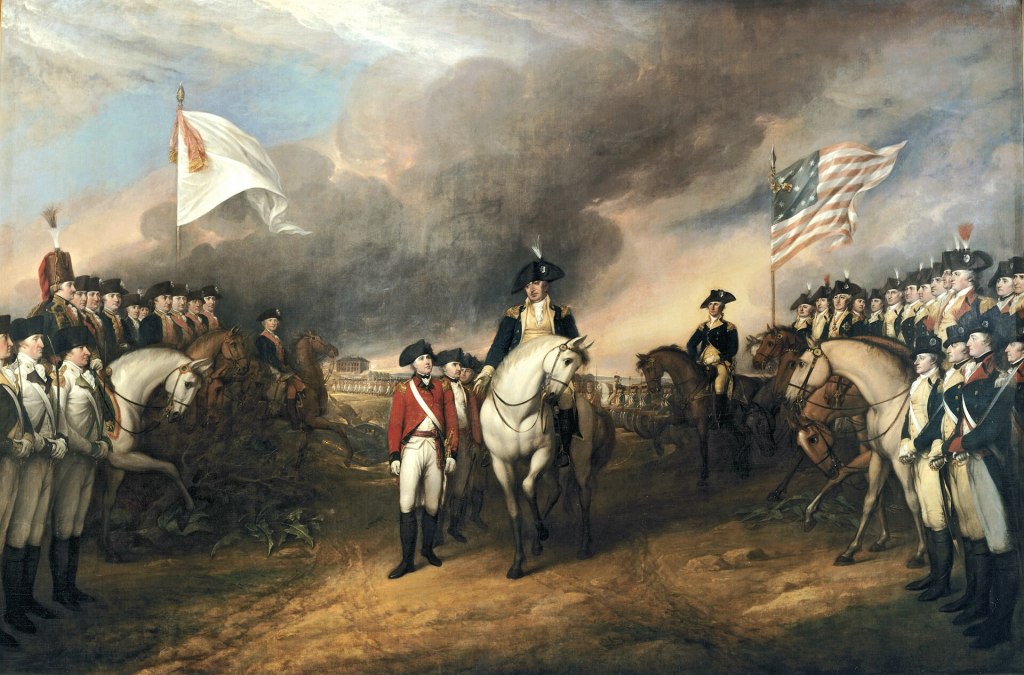
The British surrender at Yorktown by John Trumbull, Public domain, via Wikimedia Commons

I must say that the absurdity of this government is definitely going sideways, maybe even soon to be upside down.

But before I go on I want to say that I saw something the other day that put a pause in what I thought about American history. I thought it was so apropos for for today; and so historically ironic it had to be true: That the British Army after its surrendering at Yorktown to George Washington and the French Army marched out of Yorktown playing a ditty called: A World Turned Upside Down. However, it seems like this may have never happened, playing the ditty not the surrender. In fact researchers are not even sure if there ever was such a tune.

According to mountvernon.com, George Washington’s Mount Vernon, some American professional historians accepted this story “and published it in their textbooks (still without corroboration).” It goes on to say that the belief the British stacked arms and marched out of Yorktown with fifes and drums dolefully playing A World Turned Upside Down never happened and actually came from “several American novelists and one British poet, Robert Graves.” Somehow this novel idea worked its way into our historical textbooks and our mythology.

The story, according to mountvernon.com “was first published in Major Alexander Garden’s Anecdotes of the American Revolution forty-seven years after Yorktown. Garden quoted a letter from Major William Jackson who described the surrender negotiations as though he had been an eyewitness, but didn’t mention that he was in Europe, not Yorktown at the time.” Basically Garden’s assertions are based on second-hand and third hand information from sources who also were not even at Yorktown. This also makes me rethink the whole Alamo story.

It really does feel satirical and something a novelist (or Hollywood) would do to embellish a storyline. When one considers the Revolutionary War and what 13 colonies did–with the help of a global superpower, which France was in the 17th and 18th centuries–was incredible.

But defeating the British on the battlefield is not historically earthshaking. Upstarts have defeated Goliaths in the past. Look at what is happening in Ukraine today and what Vietnam did against the French, and later the US.

What turned the world upside down in the 1780s happened a decade after the Revolutionary War when those 13 states formed a more perfect union, a republic, in a monarchy dominated world. People ruling themselves was a philosophical concept batted around in coffee houses and universities of the time–but never in real time.

Now, what does this have to do with anything today. I am glad that you are thinking ahead because as I said our government has been going sideways for a long time. But the current buoyancy of the ship of state is listing heavily to the right–pun intended. I say this because of the back and forth that is going on about saving our elections from alien invasions.

There were two things that the framers of the Constitution wanted in setting up a republic, saving us from alien invasions was not high on their to-do-list. The first was tyranny. It is not a word we throw around too much today. American History Dictionary defines it as “A government in which a single ruler is vested with absolute power.” The framers realized that checks and balances were needed. They feared a government with too much power. Hence, we see the formation of two distinct levels of government. They devised a federal system that a divided governmental powers. We have state and national governments and each has certain delegated and reserved powers–powers not concentrated in one person or institution.

Unfortunately for this administration elections fall mostly under the purview of the state governments and Congress. But that is not stopping this administration’s attempt at a rolling coup using the judiciary system in an obvious effort to control the outcome or at least influence the credibility of the next election. Instead of rolling up a tank division and Seal Teams in storming up the Capitol steps, the administration is using a battalion of lawyers to pull down the government with executive orders and legal rulings. It is the simple Trumpian belief if you can’t win find a judge who will just change the rules in mid game.

The second thing the framers were concerned about was too much democracy infused into the federal government. You see that in the Electoral College electing the president, state legislatures determine who will be senators, and the president nominating judges with Senate approval. At the time the Constitution was approved the people only voted for members of the House of Representatives.

Those framers also knew too much democracy can lead to mob rule, as we saw on January 6th, 2020 when people were urged to “fight like hell.” It was a page right out of Sam Adams and the Boston Sons of Liberty play book. The Sons of Liberty had no problem summoning out the mob to obstruct British governing of Massachusetts. Even after the war the Massachusetts government had to deal with Shay’s Rebellion when farmers shut down the legal system to keep the courts from foreclosing and seizing their property for unpaid taxes. Even during his presidency George Washington led an army into western Pennsylvania to put down the Whiskey Rebellion.

Without a doubt the checks and balances and the separation of powers can make our government slow-footed. Can a king or some other sort of autocrat work quicker and maybe more efficient? Possibly. But that is not how our republic was designed. It was designed with belief that the ultimate power rests with the people and not in one person or one branch of government.

I think we are fast approaching a tipping point with this administration’s efforts to bully its way into the election process. Elections are the engines that drive a republic, a democracy. The Constitution is clear on the fact that states handle elections, No where in the Constitution is it even implied that an executive department, the Department Homeland Security or an independent agency of the executive branch, the United State Postal Service can determine who is an eligible voter.

Without a doubt our election history has had its dark moments. Has there been voter fraud? I am sure if we were to take a deep dive into City-Machine politics we would find more rats in the ballot boxes then we would like to believe. Every major city from Boston to St. Louis has had some sort of boss led city machine. Three of the most famous machines were William Tweed’s Tammany Hall during the Gilded Age, James Pendergast in Kansas City and Mayor Richard Daley in Chicago. It would be hard to believe that ballot boxes were not stuffed during their reign as “Boss.” And I am not going to talk about the opposite: voter suppression with Jim Crow in the South. When it comes to elections we have come a long way from night-riders and city-machine machinations.

What we are witnessing today is the assembling of a national machine lead by Boss Trump. A machine backed with the full force of the federal government. The only thing between the Boss and an election is the Tenth Amendment: The powers not delegated to the United States by the Constitution, nor prohibited by it to the States, are reserved to the States respectively, or to the people.

I am not a Constitutional scholar on running elections but it seems obvious elections are delegated to states and not the Executive Branch of the Republic, Homeland Security, Social Security or the Post Office. If this were to happen voters would be marching to the polls to the tune of A World Turned Upside Down.

https://www.federalregister.gov/documents/2026/04/03/2026-06601/ensuring-citizenship-verification-and-integrity-in-federal-elections

Making America Great: The Beginning

We have been living with the red-hatted MAGA mantra for close to 10 years. I think this shibboleth historically does the country and its people a great disservice. Yes, it is a forward thinking concept. But in many ways MAGA focuses on the foibles and glitches of the present and omits the fact that America has always been a country that is constantly under construction; progressively moving forward in science, trade, economics and human rights.

I am not sure if we have ever had a period in our history where we have stomped the mud off our boots and dusted our hands and said, “My work here is done.” The only thing that comes to mind is planting the flag on the moon. The last man on the Moon was Gene Cernan way back in December of 1972. In fact no humans have been more than 400 miles from the Earth since that Apollo 17 flight. Every country with a space program is still flying in our contrails.

There are many reason why America has progressively moved forward. The early Puritans considered the New World to be a “beacon on a hill.” Today, President Trump is putting forth the concept that improving tariffs are a mechanism to keep that beacon shining. However, many are questioning if tariffs are the right tool for the time.

Even if we look back to what has to be our darkest moment there was progress. During the Civil War when the country ripped itself apart over a slave based economic system, a time when cotton accounted for 60 percent of the country’s trade revenues, a time when hundreds of thousands of men fought over Union and slavery; America was still moving forward. And, The Homestead Act was just one part of making America great in the post Civil War era.

During the Civil War, while the country was giving its last full measure of devotion to reunite a divided country there was hope with landmark legislation like The Homestead Act 1862. The Act opened up 270 million acres to “anyone” 21 year old or the head of a household. There were two caveats: you had to be a citizen or declare the intentions of becoming one; and well, if you took up arms against or aided enemies (the Confederacy) of the United States you need not apply. A step in making America great. However, this step, a concept of an individual owning 160 acres of western land, clashed with Native American ideas of land ownership and management.

Washington [D.C.] is not a place to live in. The rents are high, the food is bad, the dust is disgusting and the morals are deplorable. Go West, young man, go West and grow up with the country.— attributed to Horace Greeley, New-York Daily Tribune, July 13, 1865

But what made this act so important is it dovetailed neatly into the concept of Manifest Destiny. A belief that America was destined to be a country from the Atlantic to the Pacific. Americans, or English Colonials, have always pushed westward through the Cumberland Gap on the Wilderness Road into Kentucky and Tennessee or the National Road out of western Maryland on into Indiana. River travel played a big role in moving settlers and goods on rivers like the Ohio and its tributaries that flowed to the Mississippi.

However, at this time the United States was hemmed in by the Mississippi River to the West and Spanish Florida to the South. Nobody was really sure what lay on the other side of the Mississippi River in 1800. For instance, the Spanish searched all over the Southwest looking for a city made of gold called Eldorado. (They were looking in the wrong places. All they really needed to do was build a sawmill in Northern California and maybe American history would have been a whole lot different.)

This belief that America was to rule from the Atlantic to the Pacific grew legs with Thomas Jefferson’s Louisiana Purchase. The cry “go west young man” and the slogan “Manifest Destiny” were still to come. But, the early 1800s was also a time of some ill conceived ideas. Americans were picking a Quasi War in the late 1790s with France and a real war, again, trying to settle old scores with Great Britain in 1812. While we were fighting the British we also took another crack at conquering Canada. it seems history has circled back again on conquering Canada, this time with tariffs.


The Homestead Act of 1862 was a revolutionary concept for distributing public land in American history. This law turned over vast amounts of the public domain to private citizens. 270 millions acres, or 10% of the area of the United States was claimed and settled under this act. Repercussions of this monumental piece of legislation can be detected throughout America today.–National Park Service

The new nation’s eyes were also focused south on the Spanish possession, the appendage we know as Florida. At that time there were two Floridas, as if one was not bad enough: an East Florida and a West Florida. It was West Florida that abutted New Orleans and the part of Florida that was not included in the Louisiana Purchase. Despite diplomatic haggling, Presidents Madison and Monroe got nowhere on changing Spain, France or Britain’s mind as to America owning what would later become chunks of Mississippi, Alabama and Florida. Spain, unlike France, was not interested in selling off its North American holdings. However that was about to change.

In 1804 Jefferson was after New Orleans, the crown jewel in the Louisiana Purchase. As long as any foreign country owned New Orleans it put a serious crimp in bottling up American trade coming down the river. Forget tarifs, the fledgling country needed an outlet for its western produce. America needed West Florida to get its goods to what would later be known as the Gulf of America and on to foreign markets or back east to New York, Boston, and Philadelphia.

The process of acquiring this chunk of Gulf Coast would take several diplomatic incidents. But it was General Andrew Jackson that got the ball rolling. During the War of 1812, while other generals were floundering in taking Canada, while the British burning Washington City; Jackson was fighting both the British and Native Americans in the South. He whipped the Native Americans in what was known as the Creek War and whipped the British in the Battle for New Orleans. Once the war with the British was over he was able to turn his full attention to the various renegades who were crossing to and fro across the the US and Spanish Florida border. (It seems like some things in history never change.)

Now, in most wars there is always at least one country ready to supply the locals with the needed provisions to wage war. Like the United States sending weapons to Ukraine. In this case it was Britain supplying the Native American tribes of the Southeast with the tools of the trade. The Spanish did not seem to mind. Nor did they care who came and went across the border. Runaway slaves from Georgia found refuge among the Native Americans. Two groups that had a vested interest in helping Spain keep Florida and keeping Jackson out.

If there is one thing that history has taught us is that Native Americans never come out on the winning side of a war involving Europeans and Americans. Once Jackson sent the British running back to the Gulf of Mexico, as it was known back then, he began chasing Native Americans and runaway slaves seeking asylum in Spanish territory. In his incursion into Spanish Florida combatants were killed, forts and personal property were destroyed. Caught up in the hostilities were two British nationals: Alexander Arbuthnot and Robert Ambrister. Both were convicted of aiding Seminoles and other Native American tribes. Jackson gave both men a short shrift and a short rope. Both ended up getting hung along with two Seminole chiefs creating an international incident. It was a diplomatic mess that Secretary of State, John Quincy Adams, had to clean up. The whole affair would become the first of three Seminole Wars.

A side note here. A small country like Denmark might want to take note. When it comes to land, Americans usually get what they want. Just ask any Native American tribe or Mexico, For instance Florida, the Monroe Administration wanted Florida. Later it was the Polk administration going after Texas. If anything, Jackson’s running around Florida made it clear that Spain could not control the border or its inhabitants. Secretary of State John Quincy Adams presented Spain with the ultimatum either control your people or we will.

If it was anybody who had the art of the deal down it was John Quincy Adams. It was the Onís-Adams Treaty of 1819, which according to history.state.gov, “Spain ceded East Florida to the United States and renounced all claim to West Florida. Spain received no compensation, but the Unites States agreed to assume liability for $5millin in damages done by (Jackson) American citizens who rebelled against Spain”

The Onís-Adams Treaty resulted in the 1821 Transcontinental Treaty. What makes the treaty important is that it “defined the western limits of the Louisiana Purchase.” It led Spain to surrender “its claims to the Pacific Northwest (Oregon Territory). In return, the United States recognized Spanish sovereignty over Texas.” A recognition that would last less than 30 years. Adams also worked out the northern boundaries of the Louisiana Purchase and the Oregon Territory with Great Britain. Once Adams set these boundaries the march to the Pacific and making America great was about to begin.

In just a little more than 10 Years America increased its size by one million square miles.

  • The Louisiana Purchase: 828,000 Square Miles;
  • The Oregon Territory: 288,000 Square Miles;
  • and Florida: 72,000 Square Miles.

And this does not include Mexican controlled California and Texas, yet to be acquired.

The biggest problem Americans faced was getting over the Mississippi River. The technology to capitalize on all of this land had yet to be developed. Canals connecting rivers to the Mississippi River had to be built. According to mississippiriver.com, “In 1814 the city of New Orleans recorded 21 steamboat arrivals, however, over the course of the following 20 years, that number exploded to more than 1200. The steamboat’s place as a transportation necessity was secured.” It was the beginning of making America great.