A Bridge to Far

We know that our current President is a builder. His most recent project involved knocking down of the East Wing of the White House to make way for 90,000 square foot ballroom. He is also proposing a colossal 250 foot Arc de Trump. In his first term the MAGA chant was “Build the wall.” Now, his commission for Religious Liberty is proposing to build a bridge, maybe a skyway between the hedges, over the conceptual wall that separates Church and State.

According to The Washington Post that “The Trump administration took aim at the separation of church and state Friday, issuing a draft report from the president’s Religious Liberty Commission that says the separation concept is a legal error and that Americans should view religion as an “’essential support” and always remember it is “the Creator who made us and bestows our rights.’”

I am not sure what “essential support means.” I have heard of essential oils as the chemicals from plants that can support health. And I can see where religious beliefs can be supportive in life. But I think, that despite some of our “founding documents” invoking God, the men who collaborated on those documents were not thinking about churches as part of the state. (Case in point: Iran.) But that is me. I don’t know what the committee that wrote the Declaration of Independence was thinking–other than stating the causes to break away from Great Britain.

I am not a religious philosopher or Biblical Scholar but if God is the bestower of our rights, and if God is all knowing, I just even wonder if God cares one way or another about some of man’s doings. God may not be a Micro-Manager. And I am not sure what God’s opinion is on, say, posting the Ten Commandments on a public building or classroom. Isn’t that what churches are for?

I am also befuddled a bit with the idea that the separation of church and state is a “legal error.” It is a unique concept that has been around for 200 plus years. A concept that has been fundamentally important to stability in the United States–and in our churches. And now we find that we have been believing in a fallible “assumption.” Sticking with the Ten Commandments; and using my illogic reasoning, if we can post the Ten Commandments in public places the reverse reasoning should hold true, too. What is keeping somebody from demanding that Thomas Paine’s Common Sense be placed in every church pew next to the hymnal?

It is important to note that the words, God, Jesus and Christianity are not mentioned in the Constitution as evidence that the writers of this basic governing document wanted to put up a strong wall of separation.–Bridgewater State University

GovFacts says “the phrase (separation of church and state) itself appears nowhere in the U.S. Constitution;” but instead comes “from a metaphor used by President Thomas Jefferson in an 1802 letter.” The Supreme Court since then has adopted that metaphor “as the definitive interpretation of the First Amendment’s religious clause.”

Believing with you that religion is a matter which lies solely between man and his god, that he woes account to none other for his faith or his worship, that the legislative powers of government reach actions only, and not opinions, I contemplate with sovereign reverence that act of the whole American people which declare that their legislature should make “no laws respecting and establishment of religion, or prohibiting the free exercise thereof,”thus building a wall of separation between church and State.–Thomas Jefferson in an 1802 letter to the Danbury Baptist Association in the State of Connecticut

And yes, the Declaration of Independence references God the origin of our “unalienable rights.” And yes, we can see, if we look hard enough–maybe–we will see the hands of providence in the destruction of slavery, the women’s suffrage movement and Martin Luther King’s civil rights efforts for racial equality. (Which seems to be a retrograding belief with this ideological crew in charge now.)

Some people have managed to look over the separation of church and state wall to see religious liberty as the “proper allocation of authority between religious–both individual beliefs and communal religious practices–and government power,” this according to the Presidential Religious Commission’s draft report.

I don’t know but when I hear the word “communal” I think of Hippies growing their own vegetables and naked toddlers running freely on the grass. According to the commission, like those hippie kids, “for us to have liberty, we have to allow religion to be utterly free.”

I am utterly confused because I never thought there was any problem with religious freedom. But I guess I am wrong. For instance, according to the report the public schools are rife with religious prejudices. But I am not going to go into that because it really is old hash that just attracts flies.

What I want to look at is the time is right after the publication of the Declaration of Independence. In Emily Sneff’s book When the Declaration of Independence was News she follows the trail of the Declaration from its first printings and its travels to the Thirteen states, the Continental Army, to churches, towns to be read to soldiers, citizens and church goers; and then across the Atlantic to Europe. In fact one copy of the Declaration indented for Silas Deane in France, ended up being thrown overboard to keep it out of British hands. Ironically, British ministers knew about the colonial independence before our representative in France did.

Anyone who has read anything on the our Revolutionary War has to realize that not everybody agreed with breaking ties to Great Britain. In Chapter 7: Embarrassment Clergymen Close Churches and Change Prayers Sneff describes the dilemma of Anglican clergymen who did not necessarily agree with breaking from the King and with their spiritual vows.

Sneff recounts how “The Declaration of Independence caused a moment of reckoning for…clergymen in the United State.” The reckoning had to do with the Anglican Book of Common Prayer. Then, as it is today “His Majesty the King is the Supreme Governor of the Church of England.” He gets to appoint bishops. (Today he does so with the advice of the Prime Minister–maybe not so much in 1776.)

Herein lies the dilemma. Sneff writes, clergymen, “whether they were born in the colonies or in Europe and to be ordained by a bishop in England, because there were no bishops in North America.” In addition, ministers “had to swear an oath to the king’s sovereignty over every earthly power and promise to adhere strictly to the Book of Common Prayer.”

The Book of Common Prayer guides Anglican services to “include prayers for the king to defeat his enemies.” And as Sneff says as the Revolutionary War “raged on the king’s enemies filled the church pews.” Leaving ministers to choose between three uncomfortable paths as newly formed states and parishioners demanded that prayers for the King be omitted.

The first dilemma was ministers “could change the liturgy to eliminate prayers for King George III and the royal family.” Doing this would put them at risk of “betraying their ordination oath and being excommunicated.”

Secondly, they could close their churches for the safety of themselves, their families and their parishioners.” It seemed some hardcore patriots found it counter productive to be fighting the King and then praying for his well-being in defeating his enemies. Many Anglican ministers were forced to change the liturgy to keep their churches open and for their own personal safety.

And finally, they could abandon their congregations, homes and take the first boat out to Nova Scotia.

Often time when it comes to looking at our history we miss the subtle nuances of little Jeffersonian “metaphors” like “separation of church and state.” Or the “rule of law and nobody “is above the law.” By placing a king above the law he can command anything from how people pray to the color of a reflecting pool.

When James Madison cobbled together the First Amendment words, “Congress shall make no law respecting an establishment of religion” I don’t think he did it because his cousin, James Madison was the first Bishop of the Episcopal Diocese of Virginia and president of William and Mary College, where according to Wikipedia “he occupied an influential position in the (Virginia) commonwealth, which he used to agitate for an ideology that blended radical Republicanism, Christianity, and the ideals of the Enlightenment.” Little Jemmie was probably more aware of the difficulties of keeping the pulpit out of politics and politics out of prayer.

Spanning the wall between church and state with bridge is one best left unbuilt.

https://www.justice.gov/religious-liberty-commission/media/1449896/dl?inline

God’s own Anointed

The recent memes of the President of the United States as a Christ-like entity is a unique concept for this country. It was a common in the ancient world that the leader was either a direct decedent of some sort of god or the that leader would eventually morph into a god, like the caesars of Rome. However, it was belief that never crossed the ocean. with English refugees of 17th Century.

Historians recognize the ancient world to have started around 3000 BC to around 500 AD. During that time there were a lot of god-like rulers running around. Elected presidents or prime ministers running Democratic/Republics would come later. Back then the closest thing to Democracy or a Republic was Athens and Rome. After their fall they left some nice buildings but it would be some time in the future before their governing principles would come up for discussion or consideration.

Kings, potentates, emperors, pharaohs were common rulers of the day. Some of these rulers were considered gods and looked upon as such. In Europe it was the Divine Right of Kings; in China it was the Mandate of Heaven; in Japan it was a belief that the emperor was the direct descendent of the Japanese sun god, a belief that ended with their defeat in WWII. Africa in the 1800s had Shaka Zulu. History Collection.com says that Zulu kings “were regarded as possessing special divine powers. Their leadership was deeply intertwined with religious rituals and ancestral beliefs, which reinforced their political and spiritual authority over the nation.”

Other modern day god-like leaders were Emperor Haile Selassie of Ethiopia, the “Lion of Judah.” According to History Collection.com Hailie Selassie linked “his rule to a biblical lineage said to descend from King Solomon…inspiring the Rastafarian movement, which revered him as a messianic figure.” The Dalai Lama is another modern day spiritual/political leader, “Believed to be the human incarnation of Avalokiteshvara.”

So why not the United States? In 1 Samuel the Israelites begged Samuel for a king. Even though it displeased God (it seems to me when you read this it is really a frustrated God telling Samuel go ahead and find a king. I have had enough of Israels complaining) he tells Samuel to give the people what they want.

Here in America governmentally and politically we have probably inched our way past monarchism. The next logical step is to turn the king into a god, or at least god’s representative on earth. Who needs elections, rigged or otherwise, when we can have a crown prince, a god-anointed, dancing with angeles.

If there was one place in Europe that was a hotbed of religious turmoil it was 16th and 17th Century England. Protestants had no problem loping off the heads of Catholic leaders or other heirs to the throne and vice versa. One minute you are a king or queen’s minister the next minute you are a heritic. Some Catholics sought an escape route out of England, settling in Maryland. Some Protestant sects like Quakers went to Pennsylvania and ticked-off Calvinistic Puritans headed for New England. They all felt the need to flee to the New World. This country, despite what may pass for common knowledge, was not founded on religious tolerance, it learned that tolerance was the path towards a stable civil society–and government.

Fortunately for us, In 1787 the framers of our Constitution were more hooked into Enlightenment thinkers of the time than the Calvinistic reformers riping religious dogma apart like jackals on carrion. The idea of a king never took root in the colonies after the Revolutionary War. And the whacky notion that the executive power of the new government should be held in the hands of theocratical clergy never came up. That political theory never washed upon the Eastern shore of any colony, despite that many were founded on firm religious beliefs. (A side note: Since 2001 we have engaged two ultra theocracy in Afghanistan and now Iran. If we cannot beat them maybe it is time to really get a god on our side.)

That magistrate is to be elected for four years; and is to be reeligible as often as the People of the United States shall think him worthy of their confidence. In these circumstances, there is a total dissimilitude between him and a King of Great-Britain; who is an hereditary monarch, possessing the crown as a patrimony descendible to his heirs forever;–Federalist Papers No. 14

Ask any middle school civics student and they can tell you that the “executive power shall be vested in the President.” Section II states the powers of the president as being the Commander-in-Chief of the military, the president has the power to make treaties, appoint ambassadors, judges public Ministers and Consuls. The president can even propose legislation. Simply put, he is not only the Chief Executive but also Chief of State and Chief Legislator. But nowhere does it mention that he is Healer-in-Chief or High Priest. If a president can make his son-in-law a special envoy without portfolio, why not make himself a deity. Napoleon crowned himself emperor why can’t a president issue an executive order making himself a saint.

Here is where things tend to get sticky. The Constitution never references God, Jesus or a higher divine authority. Religion is only mentioned once in Article VI stating “no religious Test shall ever be required as a Qualification to any Office or public Trust under the United States.” And in the free exercise clause in the First Amendment it states: “Congress shall make no law respecting an establishment of religion, or prohibiting the free exercise thereof…”

It would appear to me, and I am not either a Constitutional or Biblical scholar, that any president is free to proclaim his or her’s relationship to a higher divine authority, particularly in a country like ours that holds Christian values so high. It may even be spiritually logical that our president is so in-tuned with the oneness of Christ that he follows what Jesus told his disciples in Matthew 28 that a president today is like the disciples of the past, and has “All authority in heaven and on earth has been given to me. Therefore go and make disciples of all nations…” And if it takes a few Tomahawk missiles and laser guided smart bombs to enhance your ministry, so be it.

In John, Jesus says that He is the light of the world. He tells the disciple that works he has been doing “they will do even greater than these.” He says ask me for anything in my name and I will do it. Maybe not wiping out aa whole civilization, just knock the fear of god into them. Getting a god to put a Sodom and Gomorrah on Iran would ensure a regime change and help in disposing of all that enriched uranium. And it would be divinely authorized.

However, there is a catch portraying one self as a disciple; and it is more than making a catchy internet meme; or proclaiming that you are all about the Gospel or publically reading the Bible with fellow Pharisees. Because throughout the New Testament, Jesus commands his followers to love God and love one and other. Paul tells the Galatians 5:13 “serve one another humbly in love.” Which really means showing some compassion for the down trodden and the sick. Paul tells the Ephesians to “Be kind to one another, tenderhearted, forgiving one another, as God in Christ forgave you.” You never heard Jesus issuing criminal indictments to those who disagreed with him.

What good is it, my brothers, if someone says he has faith but does not have works? Can that faith save him? If a brother or sister is poorly clothed and lacking in daily food, and one of you says to them, “Go in peace, be warmed and filled,” without giving them the things needed for the body, what good is that? So also faith by itself, if it does not have works, is dead.–James 2:14-17

Christian values are not just based on faith as James writes, that faith by itself without works, is dead. In a letter to Titus Paul writes that our people should “learn to devote themselves to good works, so as to help cases of urgent need, and not be unfruitful.” I am not sure but this does not look like the America I have been living in for the last 10 or so years. And certainly seeing a the leader of the free world portraying himself as a divine being while immolating Iran with Old Testament wrath is not channeling the Christ. It makes me wonder if the presidential meme should replace Jesus with Moses or Abraham and a time when turning the wrong way would turn you into a pillar of salt.

I have to ask what is next. It would not surprise me to learn that some sort of burnt offerings and animal sacrifices are being planned on the Ellipse Grounds on the National Mall celebrating 250 years of independence–without kings and religious potentates.

Religion, Politics and the Curvature of History

I often sit down and read short sections of the Bible. A friend of mine, who became a pastor, once told me that the Bible was God’s authorized word; and written by those under God’s direction. I never thought much one way or another about who wrote the Bible. I’ll even go so far as to accept that those who wrote the Bible were listening to God as they inked the pages and bound them together. But now that I think about it, it is not who wrote the Bible but who and how it has been interpreted through the ages, particularly the New Testament.

The same is partially true for our Constitution, our legal Bible so to speak. We know who wrote the Constitution, and we know that before the ink had dried the framers were already debating various interpretations. Particularly differing views from Hamiltonian Federalists and banking and Jeffersonian Democratic-Republicans in foreign land purchases.

Early Christians/Jews could not agree on a lot of things from Mosaic law in keeping the sabbath holy to allow believing Gentiles to convert to Christianity. They debated the existence of Jesus as a man of virgin birth; or was he pure spirit; to some was he the Messiah; and then what was his relationship to God. These early Christian churches from Carthage in Africa and the Coptic church in Egypt to Roman Catholic churches in Europe to Eastern Orthodox churches of Byzantine and Antioch in Asia Minor all had differing opinions on Jesus and other conflicting dogmatic matters. It is interesting to note that Christianity is not the major religion in most of these geographical locations today.

Unlike some scientific laws, like Newton’s Laws of Motion or Kepler’s Laws of Planetary Motion, religious and political laws always seem to be up for debate. Debates that in most cases end up having somebody losing a head. As Pontius Pilate said to Jesus in Jesus Christ Superstar: And what is ‘truth’? Is truth unchanging law? We both have truths. Are mine the same as yours?

Much like the early Christians, Americans tripped over some of the same truths. For instance, for many the Constitution was nothing without a Bill of Rights. Since the first Ten Amendments the Constitution has been amended 17 times. But like early 1st Century Christians who were debating who could be a Christian, 18th Century Americans within ten years after becoming a nation were arguing the same point: who could be a citizen, who could vote and who was only a partial person.

Congress, in 1798, passed a series of laws called the Alien and Sedition Acts. The Naturalization Act, included in the Alien and Sedition Acts, upped residency requirements. To become a citizen, a person had to reside in America for 14 years, up from five years. It seems most arriving immigrants sided with Jefferson and his Republicans. Voting immigrants caused some electoral distress among Federalists.

In addition there was the Alien Friends Act. According to History.com, this “Act allowed the president to deport any non-citizen suspected of plotting against the government, even in peacetime.” It is a good thing the mob that invaded the Capitol on January 6 were citizens open to pardons instead of deportations.

But the Act that probably had the most sting was the Sedition Act. This Act, “took direct aim at those who spoke out against the president (at the time, the thinned-skinned John Adams) or the Federalist-dominated government.” History.com says, “Altogether, the federal government tried and convicted ten people under the Sedition Act, including four top Jeffersonian-Republican newspaper editors. Although the Federalists won convictions, they lost politically by creating martyrs and giving defendants a platform to defend freedom of speech and the press.”

 Ironically the Sedition Act, like one of Kepler’s planets, reappeared in 1918. According to the National Constitution Center the 1918 Sedition Act “imposed harsh penalties for a wide range of dissenting speech, including speech abusing the U.S. government, the flag, the Constitution, and the military. These laws were directed at socialists, pacifists, and other anti-war activists.” This is sort of an American Casablanca moment when Captain Renault orders: Round up the usual suspects.

The rounding up the usual suspects could be said of Christianity’s interesting interpretations of Christianity. The Romans had no trouble making sport of Christians in the Colosseum. Christians of later years learned from the Romans. Christians had no problem slaughtering and burning each other at the stake for heresy. Inquisitions were a common occurance well up into the 1970s in Ireland. Being saved was open for debate.

It took more about 300 years from Jesus’s death for churches to start singing from the same hymnal. Roman Emperor Constantine made Christianity legal in the Roman Empire with he Edict of Milan 313 A.D. Before that, the official Roman view of Christianity was religio prava: an evil or depraved religion. It gives new meaning to putting Christ back in Christmas and Nativities down at City Hall.

I am not trying to be sacrilegious but just because Christianity or the Catholic Church was street legal in Rome did not mean the various churches agreed on a lot of issues. Again, it took the Roman Emperor, Constantine, to knock heads together and get bishops in a room at the First Council of Nicea in 325 to hammer out their differences. He basically said your not finished until you come out with some sort of consensus. Hence, we got the Apostles Creed.

There were six more councils with the last or the Second Council of Nicea in 787 dealing with with icons and relics. Some religious scholars of the time, iconoclasts, believed praying to icons was parting from the Second Commandment–worshiping idols, a no-no that got the Jews in trouble with the Golden Calf while waiting for Moses to lead them into the promised land. Iconophiles, on the other hand, where a little more lenient in their views saying God told the Jews to put two Cherubims on the Ark of the Covenant. And, that icons were real proof that Jesus was a real person.

I wonder what these bejeweled bishops would have thought of Rastafari. According to Britannica. com, Rastafari “is a monotheistic religion that originated in Jamaica in the 1930s. It is centered on Africa and is based on the interpretation of the Bible, especially the Old Testament. Rastafarians believe in a single God, Jah, and that Haile Selassie I, the former Emperor of Ethiopia, is the reincarnation of Jesus Christ.” Can you imagine them imparting their religious views on ganja as the sacrament. Leonardo da Vinci’s Last Supper could have been the first pot party.

When it comes to religion and politics we rarely end up agreeing on one or two things. In most cases, we agree upon nothing most of the time. Eventually the bickering come to an end and people part ways. In 1054 the churches chucked the common hymnal. The Roman (Latin) Catholic Church split with the Eastern (Greek) Orthodox church. It had as much to do with religious dogma as shifting political winds on who would rule portions of the now defunct Roman Empire. The Roman Empire in Europe was a pile of dust that brought life to a new Holy Roman Empire with Papal powers. Also large swaths of Christian Africa and the Middle East left the church for Islam. There was a Muslim Caliphate in Egypt. In-between these two sat an Eastern Greek Orthodox,the Byzantine Empire. Religious clashes now included diametrically opposing views of God’s intentions more often than not settled with the sword.

But one good schism deserves another and the Catholic Church was not through with the splitting process. In the late 1500s the Protestant Reformation spun of all sorts of new religions into orbit. In many ways this reformation was as much a political revolution as it was an attempt at reforming religious thought. The reformation was also causing inner strife within ruling kingdoms of the time–aka Henry the VIII and his wedding/divorce woes. If you don’t like the divorce court’s rulings, start your own religion. And, oh by the way, make yourself the head of the religion.

Eventually some of those religions managed to land upon the Eastern shores of this country bringing their religious strife to the New World. Fortunately for us, political heads prevailed over fundamentalist religious preachers of the time. However, there was one Old World concept that still resonated within the New World: slavery, our original sin so to speak. Much like the Catholic Church during the Reformation, America eventually had s schism in the way it viewed the Constitution

Throughout our history we have had various and changing sects (political parties) and their absolute interpretations of the Constitution. Take the slavery issue and the Supreme Court under Chief Justice Roger B. Taney. In the 1857 Dred Scott decision Taney ruled that basically African Americans (free or otherwise) had no rights under the Constitution. Sticking to the prevailing thought at the time, Taney believed that slaves were property, and hence had no rights he or anybody else needed to respect. The only real reference to African Americans in the United States legally was that they were three-fifths of a person, an economic/political concept that worked for almost 100 years. The Civil War forced a major shift in dealing with more than four-hundred million freed African Americans. They went from property to voting citizens within a decade.

The aftermath of the American Civil War completely altered the way we would look at the law and the Constitution. It was Albert Einstein’s theory of general relativity for social sciences. According to howstuffworks.com Einstein’s theory “remains an important and essential discovery because it permanently altered how we look at the universe. Einstein’s major breakthrough was to say that space and time are not absolutes.” The Civil War changed the way America would look at human rights. It threw America’s absolute views into a world of uncertainty.

How was America to view the recently freed slaves? It is sort of like Werner Heisenberg’s Uncertainty Principle. According to scienceexchange.caltech.edu “the uncertainty principle states that we cannot know both the position and speed of a particle, such as a photon or electron, with perfect accuracy; the more we nail down the particle’s position, the less we know about its speed and vice versa. Post Civil War politics never nailed down African Americans positions in a freed society. The speed of this transition however, was known. It was slow and backwards to those halcyonic antebellum times.

In order to rectify the concept that slaves were property, the Constitution had to be amended. It had to upgrade the African American population to citizenship 3.0. They had to be set free from serving the peculiar institution they were forever indentured to. They had to be made citizens. And, they had to be given the right to vote. Most middle school civics class students would know that this is the 13th, 14th, and 15th Amendments to the Constitution, amendments needed to make Roger B. Taney’s decision null and void.

In a weird twist of property rights and logic the Supreme Court ruled in the Citizens United case in 2010 ruled that money was free speech. Interesting because money is also property. And corporations are loaded up with money. These monied interests are now granted Second Amendment rights under the law of the land. They can spend their money on elections like a kid at the county fair. Can you imagine after seeing the Israelites dancing around the Golden Calf Moses decided to amend the Second Commandment. What absolute will dissolve away next? With Artificial Intelligence right around the corner, Citizens United may have pushed the concept that if money is property will my laptop eventually get the right to vote. I am just wondering.

I am going to go off on the deep end. I think history is a lot like curved space time, not linear. History events are like Halley’s Comet. History is a giant mass. And it is not so much that history repeats itself, it is that certain fundamental so-called absolutes, human issues, rights, whatever keeping coming back around in time. These issues are caught in history’s gravitational pull spiraling in on us. Until we sort these issues out, nail down their position and velocity, they basically will keep coming back around and around until they crash in on us, whether they are religious or political.

Protecting Your Home: You’re in Good Hands with Jesus; But Colt if you are of Little Faith.

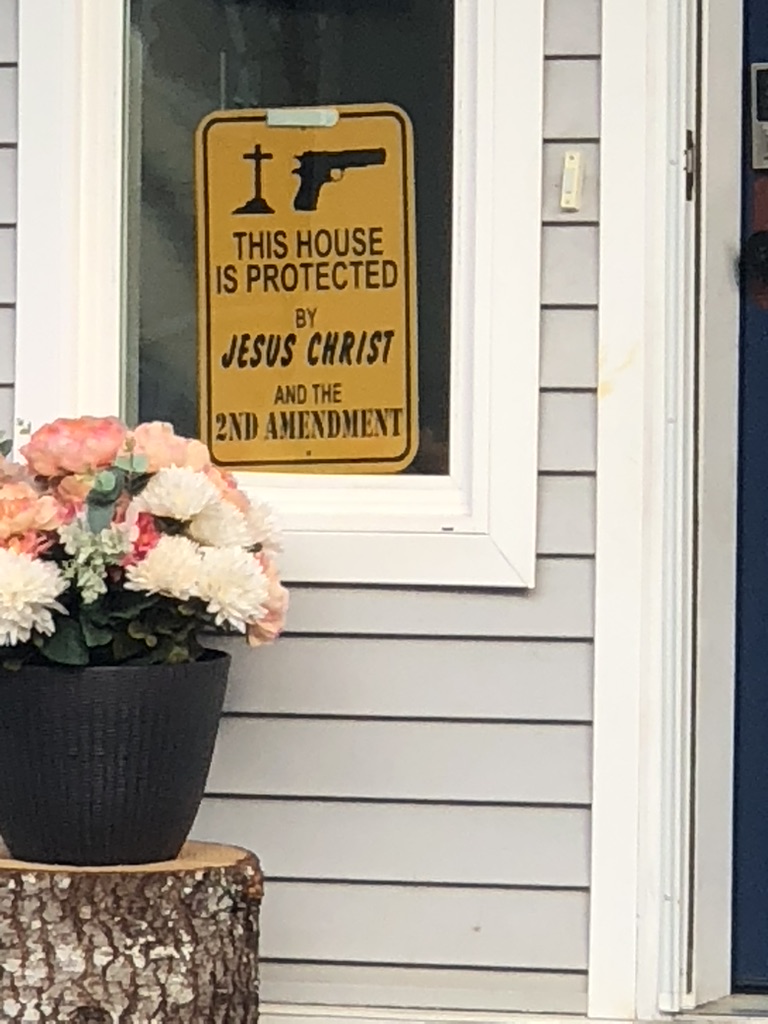
A family moved into the neighborhood not too long ago. Shortly after they moved in a sign appeared in their front window proclaiming that Jesus Christ and the Second Amendment was protecting their new home. I thought this is an absurd statement. I also thought is there a crime wave in the neighborhood that I don’t know about. A year or so ago we did have bears in a neighbor’s backyard.

There is a mutual compatibility in believing in both Jesus and the right to own a gun, and protect your property. When Jesus sent out 70 or so of his disciples to spread the word he sent them out as lambs among wolves, and unarmed. He also told them when they enter somebody’s home they should first say, “‘Peace to this house.’ If someone who promotes peace is there, your peace will rest on them…”

I just can’t help thinking there appears to be some sort of fallacious reasoning going on behind the window. First off, I am not questioning or condemning anyone’s Christian beliefs or the Constitutional right to bear arms. It is the mutual exclusivity that confuses me. It is the lumping Jesus Christ with the Second Amendment as protectors of a house.

I thought maybe it was the Fourth Amendment, the one guaranteeing us the right “to be secure in their (our) persons, houses, papers and effects against unreasonable searches…” But for some reason this does not include internet searches and hacking–something Madison and Friends were unaware of at the time of ratification. After all, this was a time of Mercantilism. The Industrial Revolution was just on the horizon and the information age a space age away.

But the Fourth Amendment really deals with government warrants and the “deep state.” Those who wrote the Constitution, in their infinite wisdom, foresaw a billowing government turning into a hidden futuristic monster. The Fourth, however, lacks the punch that the Second provides. I do not think the Fourth protects you from someone busting through your sliding glass door at 4 a.m. It would be at this time the Second Amendment might kick in.

What I find fallacious in the above sign is we are comparing a man, notably the Son of God, to 27 words in a Constitution. This fallacious equivalence makes it almost impossible to make a sane comparison. It goes way beyond “apples and oranges.” It is more like apples and orangutans. It is this sort of reasoning that is running rampant today, particularly among politicians who operate in the thin, upper stratosphere of reasoning. In this case, there is not a single shared characteristic or attribute that I can see between Jesus Christ and the Second Amendment. It is as if Jesus Christ sat on the First Congress’s Joint House Senate Conference Committee of the United States and voted to send the 12 proposed Bill of Rights Amendments to the States for ratification.

Believe me, if you are a devout Christian and you believe that you can never be out of God’s or Jesus’ watchful eye, I get it. I will not argue that point. As the song goes: “He’s got the whole world in his hands…” Using that logic it would seem to indicate if he has the whole world in his hands, and if the house is part of the world then I can see how Jesus would protect the house and those inside it, even at 4 a.m. As the psalmist says: “if I make my bed in hell, behold, thou art there.”

It reminds me of when his disciples were huddled on a boat in a “great tempest.” Nothing like water coming in over the gunnels and no life preservers on board to get your heart racing, to put the fear of God in a man’s soul. Those swimming lessons at the YMCA would have come in handy right about now. For those disciples they did not have to search far for God. At some point in the storm they decided it was time to wake Jesus up yelling, “Lord, save us: we perish.” Jesus sat up, looked around and said, “‘Why are ye fearful, O ye of little faith?’ Then he arose, and rebuked the winds and the sea; and there was a great calm.” If you have faith that Jesus can calm a storm I think you can go ahead and cancel your homeowner’s insurance. Unfortunately, mortgage companies do not have that kind of faith.

There is so much going on in that sign. I just don’t get the juxtaposition of a cross with a gun, and not just any cross, the symbol of Christianity. As if one is dependent on the other. If this were a Venn Diagram where would the Jesus circle intersect with the Second Amendment circle? It would seem to me that if Jesus was protecting the house, Jesus, a man who could cast multiple devils out of one man, head those demons into a herd of swine and then off a cliff; a man who could feed thousands would have little need of a gun. If guns were around in 33 AD. So, protecting a house would be nothing to him.

Then there is the Second Amendment. It is only 27 words:

A well regulated Militia, being necessary to the security of a free State, the right of the people to keep and bear Arms, shall not be infringed.

It could easily be said that they are the most picked over 27 words written in the Constitution. Some argue that the Amendment is anachronistic and incongruous with the present times. The Second Amendment was written when powerful European countries were perched on our borders like alligators hanging under an Egret’s nest waiting for a falling fledgling. It was a time when a well armed “regulated “(and I use regulated losely) citizenry was the first line of defense. Taxing for a standing Army and a 300 ship navy, national defense, wouldn’t come until post WWII.

The British have come and gone and we have been at peace with Canada for the better part of 200 years. The National Guard is our well regulated militia today. If the Russians are coming they are not coming by land or by sea. Red Dawn was a great movie but I do not think Cubans and Russians–Iranians or North Koreans–are going to be falling out of the sky any time soon. It will more likely be through cyberspace.

Yes, it could be argued that things are not so swell south of the Rio Grande. We are dealing with what some would call a “crisis,” an invasion at our Southern border. However, it is not an armed-hostile attack. It is not even like 1916 when General John Pershing and the 13th Cavalry were chasing Pancho Villa all over Mexico after Villa raided Columbus, New Mexico. The Second Amendment may have kicked in with armed citizens rallying in a moments notice to defend hearth and home. Villa wasn’t escorting new settlers. It was probably the last time individual Americans had to face down a foreign attack. My question is why did Villa pick a town where an US Army base was.

But it really is not so much about foreign invasions today that our personal weapons would supposedly be used for. Some will argue the Second Amendment is the only thing keeping the “deep state” from enslaving us all into some sort of socialistic, DEI, wokism state. Take away our guns and you take away the right to protect our freedoms. This sort circular reasoning is pointless. The Second Amendment will never be repealed so we will never know if owning guns or not goes beyond fending off Big Brother or Pancho Villa. If anything, it enhances the belief without any real proof that God, guns and guts made America free–let’s fight to keep all three–and Jesus will lead the charge. A nifty statement but is it really provable.

Now here is where it really gets dicey. Some Second Amendment advocates try to use the Bible to back up their beliefs that Jesus would be an advocate of gun ownership. Depending on what Bible you want to use there are nearly 800,000 words, give or take a couple thousand in both Books. The Old Testament ,”eye-for-an eye, has more than 600,000 words compared to the New Testament’s “love thy neighbor’s” 180,000.

Now it is obvious there were no handguns, long rifles, assault rifles in First Century AD. In the Holy Land during this era it’s more than likely that the Roman short sword was the personal weapon of choice. Easily concealed under a tunic or a cloak, and possibly easily acquired on the black market. In fact when the Jews came to arrest Jesus it was Peter who pulled out a sword “and struck the high priest’s servant, cutting off his right ear”. It would not be until the 1850s that the pistol would be the real choice for in close killing. But a cross? You don’t hear about too many people being clubbed to death with a cross. And crucifictions went out with the Romans.

Of the 180,000 words in the New Testament it is 30 that basically form the intersection of Jesus and the Second Amendment. Luke 22:36: He (Jesus) said to them, ‘But now if you have a purse, take it, and also a bag; and if you don’t have a sword, sell your cloak and buy one.’” Biblical scholars can pick that verse apart much like Constitutional scholars pick apart the Second Amendment. And since I am neither I am going to let it go at that.

And now it is my turn to make a ridiculous comparison. One might channel Han Solo just after eluding Imperial forces. He tells Luke Skywalker that: “Hokey religions and ancient weapons are no match for a blaster at your side.” In our time and galaxy that might be a Glock 19. Or you can channel the father who was seeking out Jesus for relief of his son, who was afflicted with “a dumb spirit.” Granted, it was not Darth Vader. The father said:  “And ofttimes it hath cast him into the fire, and into the waters, to destroy him: but if thou canst do anything, have compassion on us, and help us.”

Jesus said unto him, “If thou canst believe, all things are possible to him that believeth.” If you believe Jesus protects your house why do you need a gun. Or if you have a gun do you really need Jesus. I am just asking.

A Christian Covenant of not having to vote anymore? Is the Fix in?

Recently Republican presidential candidate, Donald Trump, spoke to a group of Christians in West Palm Beach telling them that if they voted for him that they will not have again. “We’ll have it fixed so good, you’re not gonna have to vote.” I am not sure where he was going with all of that and I will not speculate what he meant by fixing “it.” “It” most often can be ambiguous and vague, as in this case.

There is nothing new about a politician seeking votes from various groups, or making promises to groups of voters. In Colonial times getting voters plastered on election day was a common practice. According to Smithsonian Magazine, “When twenty-four-year-old George Washington first ran for a seat in the Virginia House of Burgesses, he attributed his defeat to his failure to provide enough alcohol for the voters. When he tried again two years later, Washington floated into office partly on the 144 gallons of rum, punch, hard cider and beer his election agent handed out—roughly half a gallon for every vote he received.” In 1777 James Madison lost his first election because he ran a dry campaign.

Christian groups are the choir in Trump’s congregation. So, there is no surprise when he asks them to turn out in November and sing his praises. But the promise of “Christians, get out and vote, just this time…You won’t have to do it anymore. Four more years, you know what, it will be fixed, it will be fine, you won’t have to vote anymore, my beautiful Christians.” There is something ominous about “you won’t have to vote anymore.” Is this like a Monopoly “Go Directly to Jail Do not Pass Go, Do not Collect $200 Card; or is it the Get out of Jail Free Card.

There is no more important guarantee in a constitutional democracy than free, fair, and functional elections. The current Constitution is at once too vague and too specific about the electoral process. It does not explicitly guarantee the right to vote and under specifies the conditions under which elections should be conducted, but also provides for presidential election through a misguided Electoral College. National Constitution Center

When we consider voting is a fundamental right in America, how does one not vote–and still influence an election. It is interesting, however, that the Constitution does not mention the right to vote until the Fifteenth Amendment in 1870 while religion pops up from the beginning in the First Amendment. It took almost a one-hundred years after the Constitution was approved for the federal government to address voting rights. Voting was always left up to the individual colony. Later, voting, like so many other nebulus government functions, or “powers not delegated to the United States…nor prohibited” by the Constitution were “reserved to the States respectively or to the people” in the Tenth Amendment. I would assume since the Constitution does not address it, not voting is a right left up to the states, too.

Meaningful freedom requires the ability to make a decisive choice. A person does not have real religious liberty, for instance, if he has a one-in-60-million chance of being able to determine which religion to practice. Similarly, a one-in-60-million chance of deciding which views one is allowed to express in public is not meaningful freedom of speech. Even a one-in-100,000 chance (the odds of casting a decisive vote in some smaller elections) is not enough to provide anything like genuine choice. Ilya Somin Voting with Our Feet

According to Ilya Somin, writing Voting with Our Feet in nationalaffairs.com: “Most people believe ballot-box voting is the ultimate expression of political freedom. It is how we exercise the power to decide what government policies we will live under.” So why would Trump tell Christians they would not have to vote anymore. Will the rapture occur on January 20, 2025. Or, have Christians already ascended to higher plane of voting rights. And does this higher plane of voting rights require some sort of Christian ID card or special Ap not to vote? Thus, leaving non-Christians to be condemned with some sort of heretic mark, banished to a refurbished Devil’s Island as some sort of card-carrying infidel. I am just asking because this could be ripe for some sort of voting fraud and serious misunderstandings on many fronts.

But just maybe we are moving backwards in time. A time in American history when Christian governments did rule. The notion that the United States was founded as a Christian nation has some basis. Not trying to sound sacrilegious, but the big reason we believe this is because a bunch of malcontent European religious dissenters from various sects decided to establish religious colonies in the New World. In some cases, they were colonies of exclusion when religious freedom seeking, like-minded believers congregated together while excluding and forcing other nonconforming believers out. It gave new meaning to Matthew 18:20: “For where two or three gather in my name…”

Without a doubt the first Europeans who came to this shore came to get away from religious persecution, and prosecution, in Europe. Europeans knew how to torture god out of or into somebody. European history is rife with some poor unfortunate soul losing his (or her) head, being hung and then disemboweled (we hate you so much we will kill you twice) or burnt at the stake for their “misplaced” religious conviction. Voting back then was not even an issue.

Maybe what Trump is doing is sort of reverse Toleration Act of 1689 passed by the English Parliament. According to Oxford University Press the Toleration Act granted “freedom of worship to dissenters (excluding Roman Catholics and Unitarians–and no doubt Jews) on certain conditions. Its real purpose was to unite all Protestants under William III against the deposed Roman Catholic James II.” I wonder if Parliament actually defined “certain conditions.” That sounds as foggy as Trump’s “it will be fixed, it will be fine.”

It was in this atmosphere of dissent that various religious groups started voting with their feet to the New World. According to the Library of Congress: Religions and the Founding of the American Republic, “The religious persecution that drove settlers from Europe to the British North American colonies sprang from the conviction, held by Protestants and Catholics alike, that uniformity of religion must exist in any given society.” This belief resulted in some colonies establishing governments to save and protect their souls from the myriad of outside beliefs they were escaping from in Europe.

Early colonial laws had no problem defining what religion ruled the pulpit. It goes beyond a partisan divide. In many cases you either were or you weren’t. Roger Williams and Anne Hutchinson were banished from Massachusetts for who they were (or weren’t) when they started voicing their dissenting religious opinions. Hanging, pillorying and banishing nonconforming heretics from their colonies was not unheard of. Especially when the civil government, composed of “spiritually” like-minded, elected officials who were empowered to enforce religious laws. We will have no Golden Calves in our colony.

“In newly independent America, there was a crazy quilt of state laws regarding religion. In Massachusetts, only Christians were allowed to hold public office, and Catholics were allowed to do so only after renouncing papal authority. In 1777, New York State’s constitution banned Catholics from public office (and would do so until 1806). In Maryland, Catholics had full civil rights, but Jews did not. Delaware required an oath affirming belief in the Trinity. Several states, including Massachusetts and South Carolina, had official, state-supported churches.”–America’s True History of Religious Tolerance, Smithsonian Magazine

Additionally, blasphemers and heroticts “were also considered traitors to their country because they did not belong to the official state religion.” These religious freedom seekers may have been fleeing persecution but they still brought Old World ideas with them. According to thehistoricpresent.com, “This was true throughout Europe in the century following the Protestant Reformation: whatever religion the king chose became the official state religion of his country, and all other religions or sects were made illegal.” In the New World it may have been more democratic but the results could be the same.

It seems the Constitution is following the same sort of downward glide path of 15th and 16th Century religion when a king or queen not only controlled the crown but the state religion, too. Trump’s claim of fixing “it” will involve fixing the Constitution. This is not hard to fathom with the recent Supreme Court ruling making the president immune and above the law. Thus, giving us a monarch much like King George III, whom colonist called a tyrant. It makes Ben Franklin’s response when asked when leaving the Constitutional Convention what they came up with: “A Republic if you can keep.” Today that seems very prophetic.

Listen to the Writing on the Wall.

A lot is being said about the recent assassination attempt on former President Donald Trump. The political oricales are out in force trying to interpret what effect this will have on the presidential campaign.

Security analysts are deep in review of what the Secret Service, state and local law enforcement should have done that they didn’t do. Investigators are now swarming all over Thomas Crooks like locusts on a wheat field. He is the slain, lone gunman on the roof who police believe was the shooter. They are picking apart his electronics devices –even possible purchases at Home Depot–looking for a motive.

Eventually these experts will come up with some sort of narrative. If it is one thing we are good at, it is creating an explanatory narrative.–a timeline with a story. In the past NASA come up with a narrative on how the Apollo 1 fire occurred killing three astronauts. The message of that investigation: We might be in a race but we have to slow down if we want to win. Later, they created a commision to determine the destruction and the death of seven crewmen of the Space Shuttle Challenger. One thing that came out of its investigation was the need for better communication between managers and engineers. (Something Boeing is experiencing.) The Shuttle was a complex machine. The whole program ground to a halt from the failure of a simple O-ring; and the lack of communication, particularly the part of communication that involves listening.

Explanatory narrative “is the mechanism used by historical studies to create reasonably justified truths about the past. It describes the idea that a narrative has an inherent ability to carry an explanation of why things happened or why historical agents acted in a particular way.–IGI Global

President Lyndon Johnson authorized the Warren Commision “to investigate the assassination of President John Fitzgerald Kennedy… “to evaluate matters relating to the assassination and the subsequent killing of the alleged assassin, and to report its findings and conclusions to him,” according to the National Archives. (I italicized matters because in the minds of many conspiracy theorists, the Commission created an 880 page report that created more questions than it answered. Everybody has a theory on who killed Kennedy.)

But maybe we should take another tack at looking at the attempted Trump assassination. Sure, there is plenty of human activity to evaluate, the what ifs, why was this done or not done, what can be done to prevent this in the future. All needed, relevant and purposeful investigations in trying to keep presidents from a person with a gun who’s on mission. Particularly if this person is an armed-young man looking for the basement of a Washington DC pizza parlor; or crossing state lines with a long gun looking to join in on a riot.

Without a doubt there are enough crazies out and about to go around for any event at any time or any where. But what about the more rational people who join the crazies. What were they listening to when they began storming the Capitol looking for somebody to hang. Is this our new normal: hanging vice presidents and shooting former presidents.

It has to go deeper. There has to be a cosmic reason that will never be found in a six-month, 1,500 page government investigation. It goes deeper than an Incel with a weapon. Maybe the universe keeps trying to tell us something and we are just not listening or seeing it.

It reminds me of Daniel in the court of King Belshazzar, son of Nebuchadnezzar, the Babylonian king who sacked Jerusalem. Ole Belsh and his nobles, his wives and his concubines where having a grand old party. The band played on, and to add some more glitter to festivities, it was decided that they should be drinking from something better than the Big Red Cups they picked up at Costco. Belsh calls the Royal Cup-bearer to get the good cups from the royal vaults. Bring up the gold goblets: The one father looted from “the temple of God in Jerusalem.”

I want to a pause here for a moment and explain something. There are many things in life where commons sense comes in. Some are just little sayings like don’t count your chickens until they hatch. Jim Croce sang a song about tugging on Superman’s cape and spitting into the wind. There is always a line we should not cross. No matter how invisible that line is, we know it is there. And we have all known when we have crossed it, felt that warm saliva dripping down our face.

The Royal Cup-bearer returns with the silver and gold goblets from the Jews. The Party was crossing that cosmic line when they started drinking from those looted-gold goblets. To add insult to cosmic injury, as Ole Belsh, along with “his wives and his concubines drank, they praised the gods of gold and silver, of bronze, iron, wood and stone.” It is one thing to drink from your defeated advisories’ cups, but do you have to mock them as you do it.

Here is where the mysticism, the supernatural part of the Bible kicks in. Belsh’s sacreligious good time was suddenly ruined when “fingers of a human hand appeared and wrote on the plaster of the wall…The king watched the hand as it wrote.” Needles to say he freaked out.

Like any good government official, King Belshazzar set up a commission to determine what this bodiless hand just scrawled on the wall. He called for his enchanters, astrologer and diviners–today’s pundits, podcasters and cable news squawking heads. But, much like Humpty Dumpty, whose king’s men had no idea how to put an egg back together, Belshazzar’s wise men hadn’t a clue what was scrawled on the wall. Despite seeing the writing, it went beyond the scope of their visual interpretation.

There was one person in the kingdom that had some experience in dealing with dreams and interpreting the supernatural. Daniel, a kidnapped Jew from Jerusalem who was sent to learn Babylonian ways. And here again I want to take a moment for people who have doubts about the authenticity and the verity of Biblical narratives. I am not trying to preach. However, there is a deeper secular meaning and message that can be applied without getting into the whole “God Thing.”

Sometimes trying to interpret human activities and events goes into another dimension. We have all zoned out once or twice and snapped to with some authority figure, usually a parent, asking forcefully: What were you thinking? Lines are easily crossed in moments of mild cognitive impairment. It is when our mind wanders off to who knows where. It is a place where our senses abandon us to the gray areas of different mental realities–off in the ozones racing around with our heads in a cloud.

The first thing Daniel tells Ole Belsh is you “have not humbled yourself, though you knew all this.  Instead, you have set yourself up against the Lord of heaven.” Here again, let’s not get bogged down with the Lord of heaven but let’s look at the reality of that invisible line of reality that the universe puts before us. It is line that we should not cross any more than sticking a nail in an electric socket. Nothing good really comes from that whether you believe in God or not.

Daniel interpreted the writing on the wall telling King Belshazzar that “God has numbered the days of your reign and brought it to an end. You have been weighed on the scales and found wanting. Your kingdom is divided and given to the Medes and Persians.”

That, however was not all. Unlike some fairy tales with happy endings where the king lives happily ever after, according to Daniel, “That very night Belshazzar, king of the Babylonians, was slain, and Darius the Mede took over the kingdom, at the age of sixty-two.”

Let me make one thing perfectly clear. In no way am I suggesting, equating, comparing, associating or lumping together anybody of today with King Belshazzar and his merry band of nobles, wives and concubines. All I am implying is that maybe there is a greater message for us. There is a deeper metaphysical, cosmic meaning to Trump’s assassination attempt that goes beyond the observations and understanding of the physical and political senses. I find it interesting that Trump was shot in the ear. Is the universe sending us a message. Telling us to listen. (Maybe Biden got the message.)

For instance, people are talking about dialing down the violent rhetoric that has been building for more than a decade. I hate to say it but that bull is already in the ring. Donald Trump did not create the foundations for our dysfunctional political and judicial environment we have today. He is, however, the poster person for it with his irreverent comments, particularly those aimed at immigrants, opponents and black cats that cross his path. His comments are often laced with hostility and are aimed to either agitate and antagonize most everybody. It is just not good karma. He plays upon this negative narrative like Keith Moon drumming during a Who concert.

Maybe we should forgo the explanatory narrative. Instead, listen to the universe’s writing on the wall. Its giving us wake up call. A call for all of us to just shut the f**k up and listen for change. It is calling us to listen to that small voice of sanity within each of us.

Gaza: A Battle of Biblical Proportion*

If the Abel-Shittim area east of the Jordan River had a newspaper in 1400 BCE, the headlines one day might have read: Joshua defeats Canaanites at Jericho. Israelites burn the whole city.

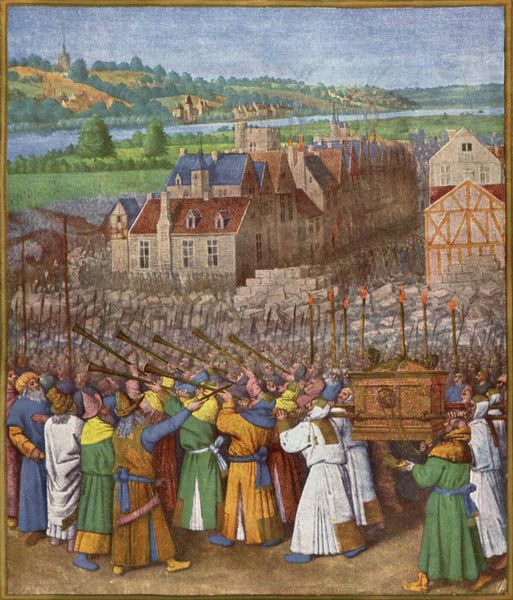
The Israelites storm Jericho with the Ark of the Covenant.

Jean Fouquet, Public domain, via Wikimedia Commons

Joshua’s march into the Promised Land had just began. However, the second battle at Ai did not go so well for the Israelites. It is hard for me to say because I was not at Joshua’s war councils. But I would assume that most Israelite leaders of the time were familiar with Deuteronomy Chapter 20:10, “When you march up to attack a city, make peace…If they refuse to make peace and they engage in battle lay siege to the city. When the Lord your God delivers it into your hands, put it to the sword all men in it. As for the women and children, the livestock and everything else in the city, you may take these as plunder for yourself.”

But, if you read down to verse 16 it says if “God is giving you an inheritance, do not leave alive anything that breathes. Completely destroy them–Hittites, Amorites, Canaanites, Perizzites, Hivites and Jebusites–as the Lord your God has commanded you.” It doesn’t look like the verse mentions Palestinians. Not being familiar with Middle East ethnic descent and genealogy, I will not speculate on any sort of Biblical DNA connection to today’s Palestinians.

However, according to the National Institute of Health’s Pubmed National Center for Biotechnical Information, “Archaeologic and genetic data support that both Jews and Palestinians came from the ancient Canaanites, who extensively mixed with Egyptians, Mesopotamian, and Anatolian peoples in ancient times. Thus, Palestinian-Jewish rivalry is based in cultural and religious, but not in genetic, differences.”  Talk about an ancient melting pot.

But keep away from the devoted things, so that you will not bring about your own destruction by taking any of them. Otherwise you will make the camp of Israel liable to destruction and bring trouble on it.

Joshua 6:18 New International Version

It appears to me that the God of the Old Testament had some serious issues with the Israelites of that era. Take the Ten Commandments. The first two deal with God. He flat told the them I didn’t bring you out of the clutches of Egyptian deities, so don’t think about having other gods before me. And don’t let me catch you dancing around idols and wearing amulets. I think this is why God instructed them to what may be called devoted destruction. Basically, don’t be carrying back any of that junk from your conquered people. In Exodus 20:20 God tells Moses, “Whoever sacrifices to any god other than the Lord must be destroyed.” Maybe it is a short jog from carrying off idolitory war booty to finding yourself on the wrong side of the First and Second commandment.

For instance, Saul, the chosen King of Israel, ran afoul of God. In 1 Samuel 15 Saul was told to “attack the Amalekites and totally destroy all that belongs to them. Do not spare them; put to death men and women, children and infants, cattle and sheep, camels and donkeys.”

But Saul did not listen to his marching orders from God. He spared Agag, king of the Amalekites and took with him the “best of the sheep and cattle, the fat calves and lambs—everything that was good. These they (the Israelites) were unwilling to destroy completely, but everything that was despised and weak they totally destroyed.”

After the battle the prophet Samuel shows up in Saul’s camp. He ask Saul about “all this bleating of sheep in my ears? What is this lowing of cattle that I hear?” Saul like any good leader caught not following orders, blamed it on his underlings, his soldiers.

Samuel, however, was having none of it. He said, “Let me tell you what the Lord told me last night…he sent you on a mission, saying, ‘Go and completely destroy those wicked people, the Amalekites; wage war against them until you have wiped them out.’  Why did you not obey the Lord?”

Saul was not talking his way out this. In fact, he may have done his best Flip Wilson imitation, if Flip was around at that time, saying the “Devil made me do it.”

Let’s fast forward to the present day. There is nothing flip about what is happening in Gaza. The death and destruction could easily be compared to the Romans salting Carthage; or some of the bombing campaigns of World War II; or what is taking place is parts of the Ukraine. It is easy to say that this all started with hang gliding terrorist flying into Israel on October 7. But did it?

Senate Majority Leader Chuck Schumer is calling for new elections in Israel to replace Prime Minister Benjamin Netanyahu. Schumer says, “The world has changed — radically — since then, and the Israeli people are being stifled right now by a governing vision that is stuck in the past.”

Schumer might be right, although, he did not indicate how far in the past. According to the highest elected Jewish official in the United States government, Netanyahu is allowing “his political survival to take precedence over the best interests of Israel ” But is his he?

I don’t know that much about Netanyahu’s right wing religious leaning government. But if the Zionists are as dedicated to God as some of our Evangelicals here in America, they may be more worried about running afoul of God then world opinion. Especially when Hamas is preaching “From the River to the Sea.”

God sent them into the Promised Land and a multitude of people from Joshua’ time to now have run them out what they believe is rightly theirs. The long Biblical story of this area has the Jews going up against some of the strongest empires in history: Assyrians, Babylonians, Persians, Greeks and Romans to name some of the ancients they battled. And now Hamas.

I am not condoning or defending Israel’s actions in Gaza; but from an Old Testament point of view it does not surprise me.

*As little as I know about the Bible I know even less about the Koran and Islamic writings and history. So this blog may sound one sided. I am sure if it were the Israelis being pushed into the sea we could find numerous Islamic writings that would religiously justify Palestinians’ actions if the tables were reversed.

https://www.timesofisrael.com/senior-hamas-leader-quran-tells-us-to-drive-jews-out-of-palestines-entirety

pubmed.ncbi.nlm.nih.gov