A Christian Covenant of not having to vote anymore? Is the Fix in?

Recently Republican presidential candidate, Donald Trump, spoke to a group of Christians in West Palm Beach telling them that if they voted for him that they will not have again. “We’ll have it fixed so good, you’re not gonna have to vote.” I am not sure where he was going with all of that and I will not speculate what he meant by fixing “it.” “It” most often can be ambiguous and vague, as in this case.

There is nothing new about a politician seeking votes from various groups, or making promises to groups of voters. In Colonial times getting voters plastered on election day was a common practice. According to Smithsonian Magazine, “When twenty-four-year-old George Washington first ran for a seat in the Virginia House of Burgesses, he attributed his defeat to his failure to provide enough alcohol for the voters. When he tried again two years later, Washington floated into office partly on the 144 gallons of rum, punch, hard cider and beer his election agent handed out—roughly half a gallon for every vote he received.” In 1777 James Madison lost his first election because he ran a dry campaign.

Christian groups are the choir in Trump’s congregation. So, there is no surprise when he asks them to turn out in November and sing his praises. But the promise of “Christians, get out and vote, just this time…You won’t have to do it anymore. Four more years, you know what, it will be fixed, it will be fine, you won’t have to vote anymore, my beautiful Christians.” There is something ominous about “you won’t have to vote anymore.” Is this like a Monopoly “Go Directly to Jail Do not Pass Go, Do not Collect $200 Card; or is it the Get out of Jail Free Card.

There is no more important guarantee in a constitutional democracy than free, fair, and functional elections. The current Constitution is at once too vague and too specific about the electoral process. It does not explicitly guarantee the right to vote and under specifies the conditions under which elections should be conducted, but also provides for presidential election through a misguided Electoral College. National Constitution Center

When we consider voting is a fundamental right in America, how does one not vote–and still influence an election. It is interesting, however, that the Constitution does not mention the right to vote until the Fifteenth Amendment in 1870 while religion pops up from the beginning in the First Amendment. It took almost a one-hundred years after the Constitution was approved for the federal government to address voting rights. Voting was always left up to the individual colony. Later, voting, like so many other nebulus government functions, or “powers not delegated to the United States…nor prohibited” by the Constitution were “reserved to the States respectively or to the people” in the Tenth Amendment. I would assume since the Constitution does not address it, not voting is a right left up to the states, too.

Meaningful freedom requires the ability to make a decisive choice. A person does not have real religious liberty, for instance, if he has a one-in-60-million chance of being able to determine which religion to practice. Similarly, a one-in-60-million chance of deciding which views one is allowed to express in public is not meaningful freedom of speech. Even a one-in-100,000 chance (the odds of casting a decisive vote in some smaller elections) is not enough to provide anything like genuine choice. Ilya Somin Voting with Our Feet

According to Ilya Somin, writing Voting with Our Feet in nationalaffairs.com: “Most people believe ballot-box voting is the ultimate expression of political freedom. It is how we exercise the power to decide what government policies we will live under.” So why would Trump tell Christians they would not have to vote anymore. Will the rapture occur on January 20, 2025. Or, have Christians already ascended to higher plane of voting rights. And does this higher plane of voting rights require some sort of Christian ID card or special Ap not to vote? Thus, leaving non-Christians to be condemned with some sort of heretic mark, banished to a refurbished Devil’s Island as some sort of card-carrying infidel. I am just asking because this could be ripe for some sort of voting fraud and serious misunderstandings on many fronts.

But just maybe we are moving backwards in time. A time in American history when Christian governments did rule. The notion that the United States was founded as a Christian nation has some basis. Not trying to sound sacrilegious, but the big reason we believe this is because a bunch of malcontent European religious dissenters from various sects decided to establish religious colonies in the New World. In some cases, they were colonies of exclusion when religious freedom seeking, like-minded believers congregated together while excluding and forcing other nonconforming believers out. It gave new meaning to Matthew 18:20: “For where two or three gather in my name…”

Without a doubt the first Europeans who came to this shore came to get away from religious persecution, and prosecution, in Europe. Europeans knew how to torture god out of or into somebody. European history is rife with some poor unfortunate soul losing his (or her) head, being hung and then disemboweled (we hate you so much we will kill you twice) or burnt at the stake for their “misplaced” religious conviction. Voting back then was not even an issue.

Maybe what Trump is doing is sort of reverse Toleration Act of 1689 passed by the English Parliament. According to Oxford University Press the Toleration Act granted “freedom of worship to dissenters (excluding Roman Catholics and Unitarians–and no doubt Jews) on certain conditions. Its real purpose was to unite all Protestants under William III against the deposed Roman Catholic James II.” I wonder if Parliament actually defined “certain conditions.” That sounds as foggy as Trump’s “it will be fixed, it will be fine.”

It was in this atmosphere of dissent that various religious groups started voting with their feet to the New World. According to the Library of Congress: Religions and the Founding of the American Republic, “The religious persecution that drove settlers from Europe to the British North American colonies sprang from the conviction, held by Protestants and Catholics alike, that uniformity of religion must exist in any given society.” This belief resulted in some colonies establishing governments to save and protect their souls from the myriad of outside beliefs they were escaping from in Europe.

Early colonial laws had no problem defining what religion ruled the pulpit. It goes beyond a partisan divide. In many cases you either were or you weren’t. Roger Williams and Anne Hutchinson were banished from Massachusetts for who they were (or weren’t) when they started voicing their dissenting religious opinions. Hanging, pillorying and banishing nonconforming heretics from their colonies was not unheard of. Especially when the civil government, composed of “spiritually” like-minded, elected officials who were empowered to enforce religious laws. We will have no Golden Calves in our colony.

“In newly independent America, there was a crazy quilt of state laws regarding religion. In Massachusetts, only Christians were allowed to hold public office, and Catholics were allowed to do so only after renouncing papal authority. In 1777, New York State’s constitution banned Catholics from public office (and would do so until 1806). In Maryland, Catholics had full civil rights, but Jews did not. Delaware required an oath affirming belief in the Trinity. Several states, including Massachusetts and South Carolina, had official, state-supported churches.”–America’s True History of Religious Tolerance, Smithsonian Magazine

Additionally, blasphemers and heroticts “were also considered traitors to their country because they did not belong to the official state religion.” These religious freedom seekers may have been fleeing persecution but they still brought Old World ideas with them. According to thehistoricpresent.com, “This was true throughout Europe in the century following the Protestant Reformation: whatever religion the king chose became the official state religion of his country, and all other religions or sects were made illegal.” In the New World it may have been more democratic but the results could be the same.

It seems the Constitution is following the same sort of downward glide path of 15th and 16th Century religion when a king or queen not only controlled the crown but the state religion, too. Trump’s claim of fixing “it” will involve fixing the Constitution. This is not hard to fathom with the recent Supreme Court ruling making the president immune and above the law. Thus, giving us a monarch much like King George III, whom colonist called a tyrant. It makes Ben Franklin’s response when asked when leaving the Constitutional Convention what they came up with: “A Republic if you can keep.” Today that seems very prophetic.

War, What is it Good For…Absolutely Something?

In June of 1970, several months after President Richard Nixon decided that the best way to get out of the Vietnam War was to invade Cambodia, the hit song War was released. Originally a Temptation song, Edwin Stars’s version become a Billboard Number 1 hit. It held that spot for three weeks in August and September; and was later rated the Number 5 song of 1970.

Most of us are familiar with the bold drum opening and guttural question shouted out in the song: “War, huh yeah! What is it good for? Absolutely nothing uhuh…”

It must be good for something or someone because it seems as if we humans are constantly at war or continually marching towards it. If one pursues the files of history we come across several significant political and military events that occured in the month of June that sit right up with what is going on in the Ukraine and Gaza.

The first event that comes to mind is D-Day, the “Longest Day,” June, 6, 1944. It was the largest amphibious, airborne assault in history. Its aim was to liberate Europe from Nazi domination. Once the Allies established a foothold in Nazi occupied Europe, it was the beginning of the end for Hitler and his Nazi cronies quest for a thousand year Third Reich. A Germanic fascist pipe dream built from a belief that Charlemagne’s Holy Roman Empire was the First Reich.

The National Socialist German Workers’ Party, according to historians, the complicated moniker reveals more about the image the party wanted to project and the constituency it aimed to build than it did about the Nazis’ true political goals, which were building a state based on racial superiority and brute-force governance.–snopes.com

Three years earlier, on June 22, 1941, Hitler launched Operation Barbarossa, the invasion of Russia. This invasion was the largest military operation in history. The invasion had more soldiers, armored vehicles, artillery and aircraft than any offensive in WWII. It resulted in four years of brutal war. The Eastern Front racked up more death than the all the other theaters of war including the North Africa, Italy, Pacific, India and China Fronts. Russia alone lost 8.6 million soldiers and another 26 million Russians citizens were killed in WWII. It is estimated that 1,700 towns and another 70,000 villages were destroyed. This does not include a death toll from the countries that the two armies fought through to get each others homeland. I really don’t want to sound flip, but I will. It makes what is going on in the Ukraine and Gaza look more like urban renewal compared to the carnage of WWII bombing campaigns, concentration camps and nuclear attacks on Japan. But it is still War, and to those who are experiencing it–“it ain’t nothing but a heartbreaker…’cause it means destruction of innocent lives…

On June 28, 1914 “The Great War, The War to end all Wars,” was instigated with the assassination of Austrian Archduke Franz Ferdinand. For the next four years European troops gassed each other, dug trenches throughout France and Belgium and started aerial bombardment of cities: all giant steps forward for mankind. France, Britain and Germany had a whole generation gutted from their populations creating social and economic upheaval. “The point of war blows my mind, War has caused unrest within the younger generation…”

As for the Russians, the 500 year rule of the Tsars came to an end from the weight of the war. Eventually, the Bolsheviks under Lenin took control bringing about the world’s the first communist socialist government. The end of WWI just reset the pins back up to be knocked back down again in WWII.

One might have thought the Europeans would come to their senses, but not so. As the Soviet Union slowly rusted away from Cold War pressures, the grip it held behind the Iron Curtain started to disintegrate. It could be argued that the Balkan Wars of the 1990s started with the breaking apart of the six republics that made up the federated Yugoslavia. According to United Nations International Criminal Tribunal for the former Yugoslavia, “experienced a period of intense political and economic crisis. Central government weakened while militant nationalism grew apace. There was a proliferation of political parties who, on one side, advocated the outright independence of republics and, on the other, urged greater powers for certain republics within the federation.” The melting pot that was Yugoslavia was beginning to boil over.

Political leaders from used nationalist rhetoric to erode a common Yugoslav identity and fuel fear and mistrust among different ethnic groups. By 1991, the break-up of the country loomed with Slovenia and Croatia blaming Serbia of unjustly dominating Yugoslavia’s government, military and finances. Serbia in turn accused the two republics of separatism and the displacement of both Croats and Serbs. –United Nations International Criminal Tribunal for the former Yugoslavia

This nationalist rhetoric began “to erode a common Yugoslav identity and fuel fear and mistrust among different ethnic groups. On June 25, 1991, Slovenia became the first of six Yugoslav republics to declare its independence.” From there it became a domino effect with Croatia declaring its independence. Its claim for independence became a back-and-forth conflict with Serbia, which resulted in more than 20,000 deaths.

But the disintegration of Yugoslavia was just getting warmed up. As Gill Scott Heron sings in B-Movie “…first one wants freedom, then the whole damn world wants freedom…” To intensify hostilities, throw in a spark of religious difference to the already centuries of smoldering ethnic divisions. Without the central control of the communist government a flash of ethnic cleansing ignited In Bosnia and Herzegovina. “It is estimated that more than 100,000 people were killed and two million people, more than half the population, were forced to flee their homes as a result of the war that raged from April 1992 through to November 1995.”

And then there was Kosovo. “Serb forces heavily targeted (Albanians) civilians, shelling villages and forcing Kosovo Albanians to flee. NATO entered the fray with a 78-day-long campaign of air strikes against Serbian targets in Kosovo and Serbia. In response, Serb forces further intensified the persecution of the Kosovo Albanian civilians.”

This year long war, according left more than 10,000 civilians killed or missing and displacing thousands. When the shooting finally ended the UN estimated that, “Some 750,000 Albanian refugees came home and about 100,000 Serbs – roughly half the province’s Serb population – fled in fear of reprisals.

In the 19th century, the U.S. Government’s drive for expansion clashed violently with Native Americans’ resolve to preserve their lands, sovereignty, and ways of life. This struggle over land has defined the relationship between the U.S. Government and Native tribes.–National Archives

The United States had its June moment, too. This moment actually starts on April 29, 1868 with a treaty signed between the U.S. Government and the Sioux Nation at Fort Laramie. Native Americans have been scammed out of their lands signing treaties since Colonials first crossed the Appalachian Mountains. But yet here they were signing another treaty. According to the National Archives The Treaty of 1868 “recognized the Black Hills as part the Great Sioux Reservation.” The treaty “set aside for the exclusive use by the Sioux people.” That is until Gold was discovered in 1874.

It is obvious that the Plains tribes did not hear about what happened to the Cherokee and The Trail of Tears when gold was discovered on their land in Georgia in 1830. Or maybe they had and saw history repeating itself. Because when interloping miners in the Black Hills discovered gold in 1874 the land was about to change hands. By the end of 1875 and early 1876 the gold rush was on trampling The Treaty of 1868 in a cloud of gold dust.

But unlike the 1830 Indian Removal Act, the Great Plains Native Americans had no intention of walking off to reservations under U.S. Army escort. Granted, a large portion of the Native American population were on the reservation, but those that were not raised concerns among miners and the government. There were skirmishes and battles between the Army and Native Americans. But none as the the battle that would take place at the Little Bighorn River. As one Indian Inspector wrote: “The true policy in my judgement is to send troops against them in the winter, the sooner the better, and whip them into subjection.”

The U.S. Army was tasked with whipping the Sioux, Cheyenne, Crow and other tribes that refused to relocate to their reservations into submission. A military operation of three columns of infantry and cavalry were sent out from various forts and directions. Any coordination between distant columns quickly fell apart and was exacerbated when Lt. Colonel George Custer galloped off on his own. What Custer found was was a Native American encampment of about 7,000 people that included 1,500 to 2,000 warriors.

The Battle of Little Bighorn was really a minor affair compared to already mentioned battles and wars. However, it was the worst defeat the U.S. Army suffered in all of the battles fought with Native Americans; and possibly one of the most complete defeats the Army has ever suffered. Although, the casualty figures were low, it was a massacre. All 210 soldiers with Custer were killed. It is estimated that Native Americans killed was around 100. As for the duration of the battle, according to some sources, Custer’s last stand lasted less then a half-hour. One Native American survivor later said the fighting lasted only “as long as it takes a hungry man to eat a meal.”

Custer’s Last Stand shocked the nation that was celebrating its Centennial. How could such a defeat happen? If anything, Custer’s defeat, as decisive as it was, only increased the demand to relocate the Plains tribes to reservations. It may have been Custer’s last stand, but it was also the Native Americans last stand.

The Americans Indian Wars started with the massacre of the first settlers at Jamestown in 1622 when the Powhatan tribe killed nearly 350 colonists. Of course no massacre goes unpunished. Colonist began attacking Native American villages and hence the dogs of war are unleashed. For more than 260 years a crude and brutal frontier justice was practiced between Native Americans and the U.S. Army, farmers, miners and settlers moving west. The war was officially ended with another massacre at Wounded Knee in December of 1890.

Trying to answer “what war is good for” could come down to why people go to war in the first place and what they are willing to die for. Mexican revolutionary Emiliano Zapata said, “It is better to die on your feet then to live on your knees.”

Others might see war as Prussian General Karl von Clausewitz saw it, as “the continuation of politics by other means.” The definitions and the rationalization for wars are varied. Today we could ask what was Hamas thinking when it invaded Israel? What makes the Ukraine land so special that Putin would launch a “special operation” to have it become part of Russia? We could then question what good can come out of supporting combatants. What good will Iran get supporting Hamas or the U.S. supporting Ukraine?

However logical (or illogical) a war starts, it soons starts to slide down the slippery slope of faulty reasoning into some sort of elongated circular reasoning making it impossible to determine if the death and destruction, the outcome have any worth.

You say dictator I say tyrant

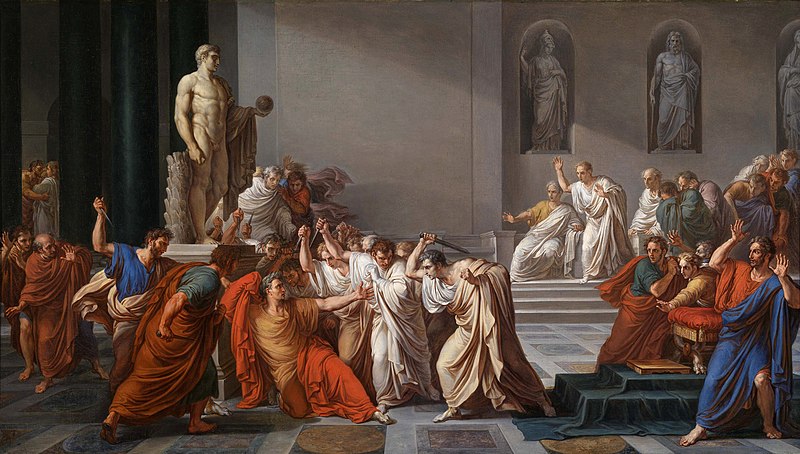
The assassination of Julius Caesar, led by Brutus, by the Senate
Camuccini, Public domain, via Wikimedia Commons

There has been a whole lot of talk about dictators and democracy lately. Donald Trump claims that if he is elected to a second term he would be a dictator for one day. When Americans think of dictators names like Mussolini, Hitler and Stalin come to mind. One has to take a deeper dive into history to come up with the name Cincinnatus.

Political Scientist still debate how fledgling democracies in Italy and Germany went from Fascism to dictatorships in a handful of years. Some go so far as to make comparisons to then and now and the path our democratic/republic might take to find a dictator in the Oval Office.

It is interesting to point out that when the writers of our Constitution sat down in Philadelphia in that hot summer of 1787 they were not talking dictator. More about tyrants. These men were well schooled in ways of the Roman Republic and Athenian democracy. They incorporated many of those ancient concepts and Enlightenment ideas into a working constitution. But one office they did not put into Article I or II of our Constitution is the office of dictator.

In the Roman Republic there was actually a governmental Senate appointed position for a dictator, which seems to be a creeping ad hoc possibility today. It was an office that was started around 500 BCE at the time when Rome moved from more than 200 years as a monarchy to a Republic. According to the Oxford Classical Dictionary, “The Romans introduced the office of dictator, initially to create an additional and ranking military command whenever required. Appointed by the chief annual magistrate by decree of the Senate, the dictator had no equal colleague, the main constraints on his authority being his official commission as defined by the Senate and the obligation to abdicate promptly following the completion of this specific task…dictators were mostly appointed according to the exigencies of the moment to execute one or more routine tasks ranging from military commands to the conduct of obscure religious rituals normally undertaken by consuls or praetors.” 

We have the 25th Amendment which deals when a president is unable to perform the duties of the office. It says nothing about appointing a dictator, though. The closest thing we have to a dictator is a czar. Richard Nixon appointed an Energy Czar and the first Drug Czar. Believe it or not Bill Clinton appointed the first Border Czar in 1995. How has that been working for us?

It was a Roman dictator the George Washington looked to for inspiration, Lucius Quinctius Cincinnatus. Cincinnatus was Roman senator and a farmer. In 458 was a called forth to be dictator. According to Ryan Burns, writing in Decentes, Penn’s Classical Studies Publication, “he was chosen (twice) to be dictator. Once to rescue a surrounded army. Under his command, Roman troops defeated the enemy in just sixteen days, and his victory was celebrated in a triumph in Rome. After just sixteen days as dictator, Cincinnatus stepped down from his post and returned to the countryside. Cincinnatus’ resignation from dictatorship demonstrated his support of allowing the government to run as it was intended—by the people.”

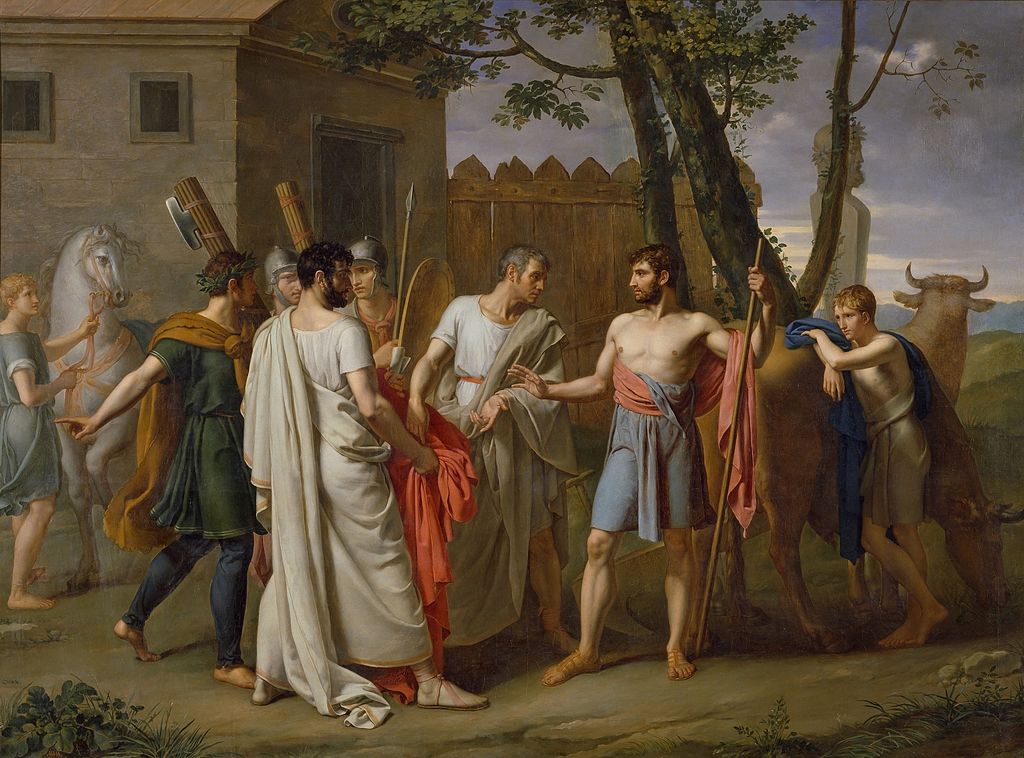
Cincinnatus Leaves the Plough to Dictate Laws to Rome
Antonio de Ribera, Public domain, via Wikimedia Commons

Cincinnatus’s actions inspired George Washington and the foundation of American democracy by relinquishing power when the job was done. In fact, the Society for the Cincinnati, founded in 1783 and named after Cincinnatus, was created to commemorate the Continental Army of the Revolutionary War. Its motto Omnia relinquit servare rempublicam (He gave up everything to serve the Republic) draws a direct reference to Cincinnatus’ influence on Washington

Ryan Burns,

Burns writes that “Cincinnatus is a figure who understood the value in a republican system of government. He knew that his duty as a Roman dictator was to ameliorate the situation as quickly as possible. When order had been restored, his job was to allow the state to return to its normal operations: one without a dictator. Cincinnatus symbolized the will of the people, and his act represents the ideals of modern American democracy.” (Today the term normal operations of government is one that no one can agree with. It is more if you are for it I am against it. Just look at the muddled mess at the border in Texas.)

Similarly, after the Revolutionary War General George Washington, like Cincinnatus, returned to his farm, Mount Vernon. And again, like Cincinnatus, he was called back to serve his country. This time as president of the newly formed United States where he set the precedent of the peaceful transferal of executive power practiced by most presidents who came after him. He then retired once more to Mount Vernon.

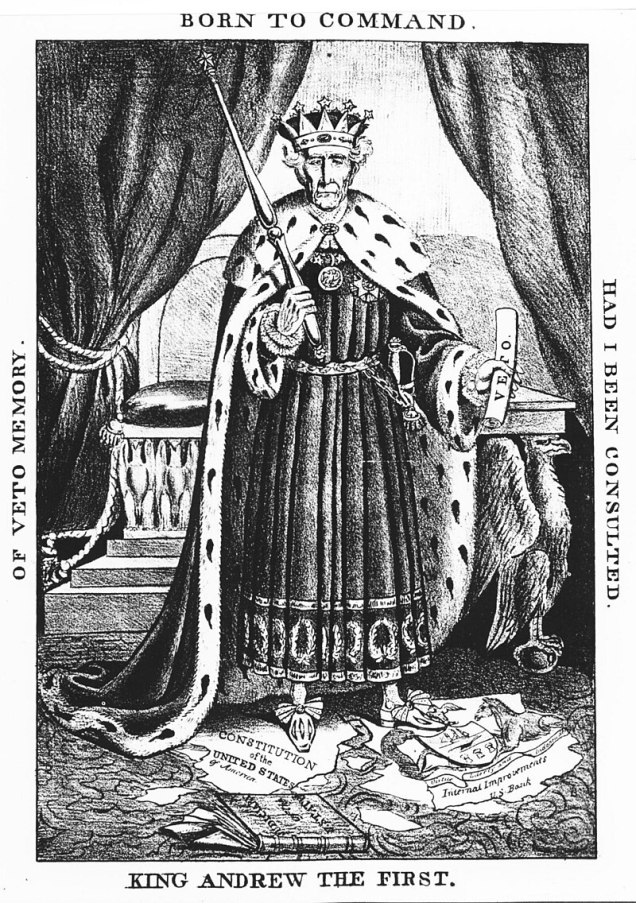
Although President Jackson stepped down after serving two terms, his presidency rankled his opponents, who accused him of being a monarch. They so dubbed him: King Andrew the First.

Public domain, via Wikimedia Commons

However, not all of Rome’s dictators were so virtuous. We are probably more familiar with the last two Roman dictators: Lucius Cornelius Sulla and Julius Caesar. After 100 BCE the Romans were having a hard time getting along with one another. Social disorder spilled out into civil war. In 82 BCE Sulla steps in to settle the matter as a dictator. It was more like to settle old scores. It was so bad even a young Julius Caesar had to flee for his life. His crime: not divorcing his wife, who was the daughter of one of Sulla’s enemies. Romans have always had a propensity for blood letting. This was a time of bloody political retribution in the Republic. The vengeance and political retribution was more than the Republic could stand. It fell in 27 BCE when Gaius Octavius, Julius Caesar’s adopted son, became emperor. Doing away with the need of a dictator.

Most of us are familiar with Julius Caesar through William Shakespeare or the many movies like Cleopatra, Julius Caesar and HBO’s Rome. We are familiar with the Ides of March. Scores of books have been written about rise and fall of the Roman Republic and how it turned into an Empire. An empire that both Sulla and Caesar helped usher in. Both were accused of being Tyrants.

“All in all, a tyrant is an absolute ruler who is illegitimate and/or unrestrained by law. To maintain himself in such a precarious position, he (for it is invariably a “he”) usually resorts to oppression and cruelty.”

Psychology Today

I would venture to say that most of the men who met in Independence Hall who helped draft the Constitution, were well aware of Plato’s views that “tyranny naturally arise out of democracy.” In 1776 they were able to smear King George III as the quintessential tyrant of the time. A monarch above the law. Hence, they wrote a Constitution that would attempt to keep tyrants and tyranny from forming.

In almost 240 years of Constitutional rule and legal precedent some people today are treating the Constitution like hackers trying to find a cyber backdoor to the bank vault. Nixon’s had crew of bumbling Clouseau-like Watergate Plumbers who were caught with monkey wrenches in hand breaking into the Democratic Headquarters. Trump had a cadre of second-story lawyers trying to sneak around the Electoral College. These lawyers were more like the mob in Jimmy Breslin’s book, The Gang That Couldn’t Shoot Straight. They were a group of lawyers who “couldn’t run a gas station at a profit even if he (they) stole the customers’ cars,” They should have been out chasing ambulances for an insurance settlement instead of shaking down voting machines.  

https://web.sas.upenn.edu/discentes/2022/05/19/cincinnatus-a-roman-dictators-resounding-impact/

https://www.politifact.com/article/2023/dec/07/donald-trump-was-asked-if-he-will-be-a-dictator-if

Caution, Federal Cases at Work–Let the Dunking begin

Former President Donald Trump is often going on about his legal troubles as if it was a witch hunt. At first glance when somebody says witch hunt they probably think of America’s most famous witch hunt: The Salem Witch Trials. These trials took place in 1692 and according to the The National Endowment for the Humanities, “19 (people) were hanged, one pressed to death and five others died in jail.”

According to NPR the last known witchcraft trial was in Virginia in 1706. Grace Sherwood was subjected to the only known way, at the time, to determine if she was a witch. The locals tied her up, and tossed her into the Lynnhaven River. Unfortunately for Sherwood, she floated, “which meant that the devil must be supporting her and therefore she was guilty as charged.” As far as I could tell that is still the only method around to determine if someone is a witch.

Since Trump has repeatedly called his legal woes a witch hunt, it might be reasonable to assume he is trying to avoid some sort of skulduggery that is akin to witchcraft. I have never witnessed a witch hunt but I am willing to bet that most witch hunts have been unsuccessful in actually bagging a real witch. It is like someone saying they rode a unicorn. This may be a good legal tactic on the part of the former president. If he can keep his legal woess in the realm of witchcraft, it is highly unlikely he will be convicted. Unless prosecutors are able to tie him up and chuck him into the Potomac to see if he floats.

But to think that Trump’s attorneys would play the witch card is ridiculous. It is more likely he is going to pursue a different definition of a witch hunt. The one we are more familiar with in modern times. Cambridge Dictionary states that a witch hunt is “an attempt to find and punish people whose opinions are unpopular and who are said to be a danger to society.” This definition is more akin to Senator Joseph McCarthy’s shaking the apple tree in the 1950s trying to see how many delicious pinko reds would fall to the ground.

That definition definitely works for some people. However, I think Trump is using the  Merriam-Webster definition that states a witch hunt is “the searching out and deliberate harassment of those (such as political opponents) with unpopular views.” This definition fits Trump better as he campaigns around the country. He can cast himself off as a victim of socialist regime hell bent on purging the country of people hell bent on making America great again. I think this definition is the paranoid Orwellian looking over his shoulder. What are you hiding in your basement?

The former president is facing some serious federal criminal indictments. Mixing federal cases and witchcraft makes little sense at first glance. But it really is ingenious. The last convicted witch was at the turn of the beginning of the 18th century. Federal cases, however, are a different matter.

Many years ago I heard a lawyer say if the Feds want you the feds will get. Trump has to realise this. He has mentioned Al Capone several times in speeches. Capone, one of the notorious and vicious mob bosses of the 1930s, gets convicted on income tax charges. Really. At least Hunter Biden has some gun charges thrown in with his tax fraud case. FBI.gov says, “Capone was convicted after trial and on November 24, (1931) was sentenced to eleven years in federal prison, fined $50,000 and charged $7,692 for court costs, in addition to $215,000 plus interest due on back taxes.” And to add a cherry on top, the feds threw in an extra six months for contempt of court.

In the past decade sports analytics have been used to improve teams performance on and off the field. I am sure high-priced law firms have an analytics department. “Legal analytics,” according to LexisNexis.com are “tools (to) help lawyers make data-driven decisions on which to build their legal strategies. That could mean things like knowing the probability of a specific motion outcome, how seemingly unrelated cases connect, or how much a settlement award could be.” A little bit more sophisticated than seeing if a person accused of witchcraft floats or not.

What is interesting is that Trump’s lawyers have to be aware of the success rate the Feds have when they go to trial. First off it appears that the Feds are always the home team. It is their ball, their court and their rules. According to pewresearch.com they have a huge winning percentage, too. “In fiscal year 2022, only 290 of 71,954 defendants in federal criminal cases – about 0.4% – went to trial and were acquitted, Another 1,379 went to trial and were found guilty (1.9%).”

But here is the kicker, almost 90% of defendants in 2020 didn’t even go to trial. They pleaded guilty “while another 8.2% had their case dismissed at some point in the judicial process.” Just looking at the percentages less than 9% of those defendants in a federal criminal case came out on top.

Witch hunts hardly, if ever, turn up a real witch let alone convict someone of some sort of sorcery. However, a witchcraft trial is an iffy outcome. If you float you are guilty. And, well, if you don’t, you drown. Despite the 50-50 odds of winning neither verdict generates a positive outcome. Analytics can’t be telling Trump’s lawyers to take those long shot odds in Federal court. Whichever course he takes it looks like he is going to get dunked in the Potomac River; or spending time in Secret Service protection, just not in the Oval Office