Recently, the Wisconsin Supreme Court overturned the governor’s shut-down and stay-at-home order during the coronavirus pandemic. Wisconsin of late has been in a state of partisan political infighting between the two in-breeding political bases for some time. We now have masked-armed men walking around state capitals either intimidating the democratic process or trying to overthrow it–or at least unmask the sinister aspects of a deep state.
What got my squirrel running was not armed men on the capitol steps but that one of the Wisconsin Supreme Court was comparing the stay-at-home order to President Franklin Roosevelt’s executive order to intern Japanese American citizens in 1942. I sort of get the analogy to question governmental power that could force its citizens either out of their homes or to stay at home during a crisis. And this pandemic racing around the world is a crisis. They pondered what would stop the government from ordering people out of their homes and into “centers where are they are properly social distanced in order to combat the pandemic?”
I think that from a legal and political standpoint the Japanese internment might look like a good one to compare the stay-at-home orders; but I think there is a much better example. Instead of citing Korematsu v U.S., as an example of excessive government power. The court should have used was Edgar Allan Poe’s The Mask of the Red Death. It demonstrates the consequences of sheltering-in-place during a pandemic better than interning Japanese Americans during a war.

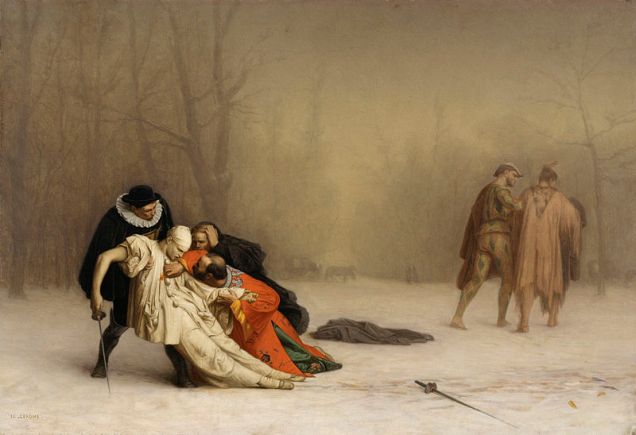
Poe’s Red Death has a pandemic ravaging the countryside. Prince Prospero and large group of his costumed-noble friends are sheltering-in-place in his fortified castle. It has all the hallmarks of Florida hurricane party up until the roof flies off and the flood waters pour through the door. In this case, its when disguised Death shows up. Prospero, with dagger in hand, chases the black shrouded death figure demanding to know who dares interrupt the festivities. The Prince pursues the black shrouded figure through the six rooms of the castle and into the most sinister room: the seventh room. This room is lite up by a scarlet light and decorated in black. It is here where Prospero and his masquerading guest unveil the dark figure before the ticking clock. When he is unmasked there is nothing revealed but an empty costume. The prince and his guest are infested with the red death and die leaving “Darkness and Decay and the Red Death” holding court in the castle.
The Wisconsin court could be saying is it is time to get the fraze out of the house! But they were citing Korematsu v U.S. as a reason to unbolt the doors. Fred Korematsu was a 23 year-old Japanese-American citizen was balking at leaving home and hearth for the wilds of Wyoming or the piney woods of Arkansas, the far off places that Japanese Americans were being interned.
Korematsu’s case went to the Supreme Court where he lost and had to load up the homestead. What makes his situation a tad different from today is that it had strong racial implications. Roosevelt’s order singled out Japanese Americans. The coronavirus is not singling out people for their race, religion or gender–maybe income level. The Supreme Court basically said that Korematsu’s case was not really a constitutional racial discrimination case. And since we were at war with Japan there was the possibility of espionage and sabotage, military matters trump civil rights.
All of this paints a dark dystopian image of what could happen when “they” come for you. It becomes spine chilling when we think that it could happen here. But it has.
The root of today’s protests over the stay-at-home orders has nothing to do with race or rights or who is masked or unmasked. It is about the mass disruption of business. If average Joe was offered corporate bailout money or a Powerball jackpot winnings to stay at home and wear a mask nobody would be complaining. If there is no money on the table then there is no trump in the deck. And with the GOP Senate dealing the cards it’s always Jacks or better to open.
But our history is laced with stay-at-home orders and lock down orders. Conservative business types have known all about internment to make a buck. Take the Triangle Shirtwaist Factory Fire in 1911. A fire broke out in a dustbin of a multi-storied New York building where more than 500 people, mostly immigrant women, were working in locked down conditions. When the fire was finally put out a 146 were dead — 53 jumping to their death.

Southern plantation owners know about keeping workers at home, too. They practiced forced interment for centuries to make a buck. Their stay-at-home orders for African Americans made them and the country millions. When threatened to open up their plantations they armed themselves; went to their respective state capitals; and decided to go war and hang onto their internment camps and keep their racial stay-at-home policies. This turned out to be a failed plan. It would create a century long economic downturn and lead to a second wave flaring up 100 years later.

All three of these events targeted specific groups of people to be confined–and it was not for public health reasons or civil liberties. The last two were just for money. I am not a legal scholar but I think it would be safe to say that most today’s state stay-at-home orders are not targeting a specific group of people. Unless you consider the poor and those over 65 hunkering down in nursing homes or at home in their rocking chairs binge watching Netflix as a targeted group.
 mystoryorhistory