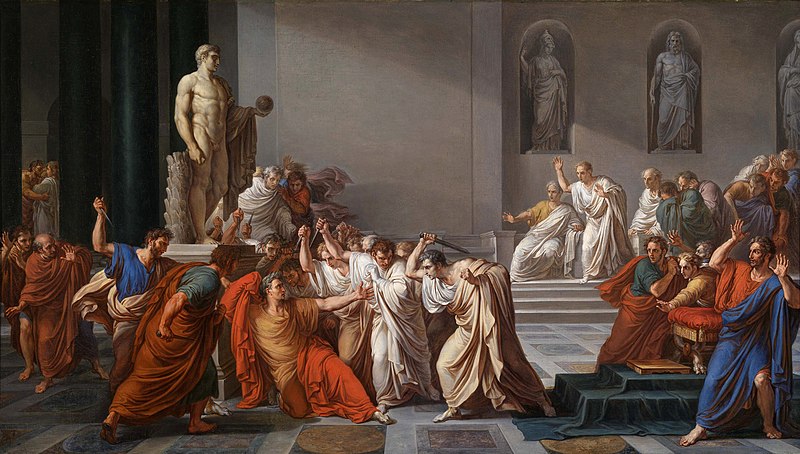
Camuccini, Public domain, via Wikimedia Commons
There has been a whole lot of talk about dictators and democracy lately. Donald Trump claims that if he is elected to a second term he would be a dictator for one day. When Americans think of dictators names like Mussolini, Hitler and Stalin come to mind. One has to take a deeper dive into history to come up with the name Cincinnatus.
Political Scientist still debate how fledgling democracies in Italy and Germany went from Fascism to dictatorships in a handful of years. Some go so far as to make comparisons to then and now and the path our democratic/republic might take to find a dictator in the Oval Office.
It is interesting to point out that when the writers of our Constitution sat down in Philadelphia in that hot summer of 1787 they were not talking dictator. More about tyrants. These men were well schooled in ways of the Roman Republic and Athenian democracy. They incorporated many of those ancient concepts and Enlightenment ideas into a working constitution. But one office they did not put into Article I or II of our Constitution is the office of dictator.
In the Roman Republic there was actually a governmental Senate appointed position for a dictator, which seems to be a creeping ad hoc possibility today. It was an office that was started around 500 BCE at the time when Rome moved from more than 200 years as a monarchy to a Republic. According to the Oxford Classical Dictionary, “The Romans introduced the office of dictator, initially to create an additional and ranking military command whenever required. Appointed by the chief annual magistrate by decree of the Senate, the dictator had no equal colleague, the main constraints on his authority being his official commission as defined by the Senate and the obligation to abdicate promptly following the completion of this specific task…dictators were mostly appointed according to the exigencies of the moment to execute one or more routine tasks ranging from military commands to the conduct of obscure religious rituals normally undertaken by consuls or praetors.”
We have the 25th Amendment which deals when a president is unable to perform the duties of the office. It says nothing about appointing a dictator, though. The closest thing we have to a dictator is a czar. Richard Nixon appointed an Energy Czar and the first Drug Czar. Believe it or not Bill Clinton appointed the first Border Czar in 1995. How has that been working for us?
It was a Roman dictator the George Washington looked to for inspiration, Lucius Quinctius Cincinnatus. Cincinnatus was Roman senator and a farmer. In 458 was a called forth to be dictator. According to Ryan Burns, writing in Decentes, Penn’s Classical Studies Publication, “he was chosen (twice) to be dictator. Once to rescue a surrounded army. Under his command, Roman troops defeated the enemy in just sixteen days, and his victory was celebrated in a triumph in Rome. After just sixteen days as dictator, Cincinnatus stepped down from his post and returned to the countryside. Cincinnatus’ resignation from dictatorship demonstrated his support of allowing the government to run as it was intended—by the people.”
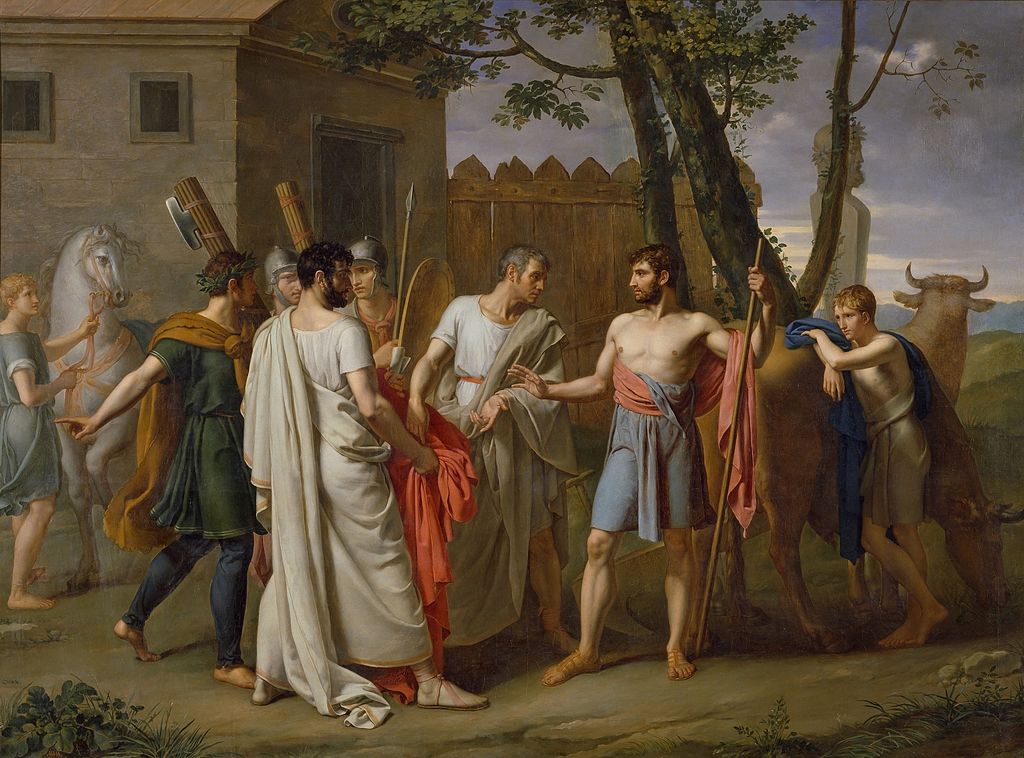
Antonio de Ribera, Public domain, via Wikimedia Commons
Cincinnatus’s actions inspired George Washington and the foundation of American democracy by relinquishing power when the job was done. In fact, the Society for the Cincinnati, founded in 1783 and named after Cincinnatus, was created to commemorate the Continental Army of the Revolutionary War. Its motto Omnia relinquit servare rempublicam (He gave up everything to serve the Republic) draws a direct reference to Cincinnatus’ influence on Washington
Ryan Burns,
Burns writes that “Cincinnatus is a figure who understood the value in a republican system of government. He knew that his duty as a Roman dictator was to ameliorate the situation as quickly as possible. When order had been restored, his job was to allow the state to return to its normal operations: one without a dictator. Cincinnatus symbolized the will of the people, and his act represents the ideals of modern American democracy.” (Today the term normal operations of government is one that no one can agree with. It is more if you are for it I am against it. Just look at the muddled mess at the border in Texas.)
Similarly, after the Revolutionary War General George Washington, like Cincinnatus, returned to his farm, Mount Vernon. And again, like Cincinnatus, he was called back to serve his country. This time as president of the newly formed United States where he set the precedent of the peaceful transferal of executive power practiced by most presidents who came after him. He then retired once more to Mount Vernon.
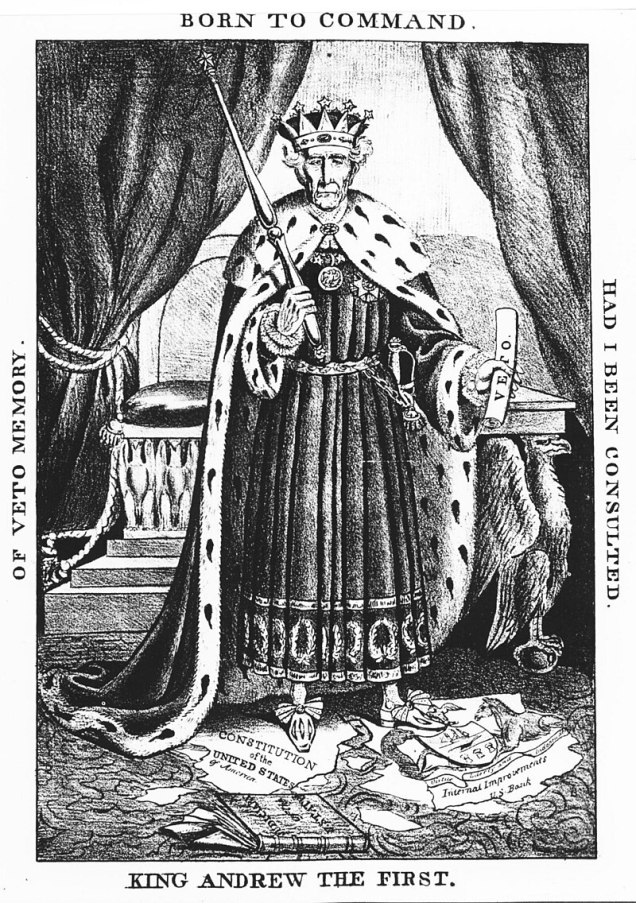
Although President Jackson stepped down after serving two terms, his presidency rankled his opponents, who accused him of being a monarch. They so dubbed him: King Andrew the First.
Public domain, via Wikimedia Commons
However, not all of Rome’s dictators were so virtuous. We are probably more familiar with the last two Roman dictators: Lucius Cornelius Sulla and Julius Caesar. After 100 BCE the Romans were having a hard time getting along with one another. Social disorder spilled out into civil war. In 82 BCE Sulla steps in to settle the matter as a dictator. It was more like to settle old scores. It was so bad even a young Julius Caesar had to flee for his life. His crime: not divorcing his wife, who was the daughter of one of Sulla’s enemies. Romans have always had a propensity for blood letting. This was a time of bloody political retribution in the Republic. The vengeance and political retribution was more than the Republic could stand. It fell in 27 BCE when Gaius Octavius, Julius Caesar’s adopted son, became emperor. Doing away with the need of a dictator.
Most of us are familiar with Julius Caesar through William Shakespeare or the many movies like Cleopatra, Julius Caesar and HBO’s Rome. We are familiar with the Ides of March. Scores of books have been written about rise and fall of the Roman Republic and how it turned into an Empire. An empire that both Sulla and Caesar helped usher in. Both were accused of being Tyrants.
“All in all, a tyrant is an absolute ruler who is illegitimate and/or unrestrained by law. To maintain himself in such a precarious position, he (for it is invariably a “he”) usually resorts to oppression and cruelty.”
Psychology Today
I would venture to say that most of the men who met in Independence Hall who helped draft the Constitution, were well aware of Plato’s views that “tyranny naturally arise out of democracy.” In 1776 they were able to smear King George III as the quintessential tyrant of the time. A monarch above the law. Hence, they wrote a Constitution that would attempt to keep tyrants and tyranny from forming.
In almost 240 years of Constitutional rule and legal precedent some people today are treating the Constitution like hackers trying to find a cyber backdoor to the bank vault. Nixon’s had crew of bumbling Clouseau-like Watergate Plumbers who were caught with monkey wrenches in hand breaking into the Democratic Headquarters. Trump had a cadre of second-story lawyers trying to sneak around the Electoral College. These lawyers were more like the mob in Jimmy Breslin’s book, The Gang That Couldn’t Shoot Straight. They were a group of lawyers who “couldn’t run a gas station at a profit even if he (they) stole the customers’ cars,” They should have been out chasing ambulances for an insurance settlement instead of shaking down voting machines.
https://web.sas.upenn.edu/discentes/2022/05/19/cincinnatus-a-roman-dictators-resounding-impact/
https://www.politifact.com/article/2023/dec/07/donald-trump-was-asked-if-he-will-be-a-dictator-if
 mystoryorhistory