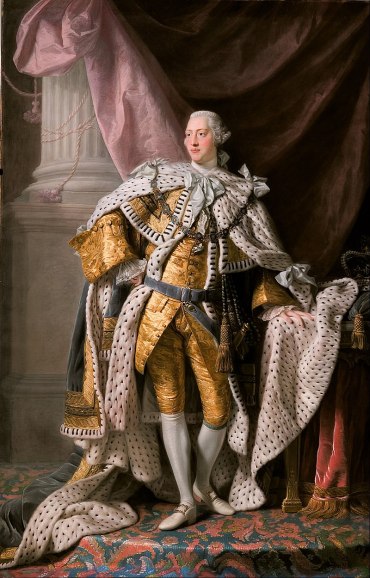
Don’t let your Praetorian Guard down


Roman Praetorian Guards circa 50 AD


The recent deployment of federal law enforcement officers to protect federal property in cities that are suffering through what some have called an increase in violent and heinous crimes perpetrated by  urban terrorists could be the beginning of establishing a 21st Century style Roman imperial Praetorian Guard.  A guard that was responsible only to the emperor .

It would be interesting to ask how many Americans even knew that the Department of Homeland Security, Border Patrol and the US Marshals had camo-decked deployable urban shock troops.  It never entered my mind. Besides having Secret Service protection, and being in control of the military, the president now has at his disposal what looks like his own federal militia; or a Praetorian Guard to go out and do his political dirty work.

BBC


Today, some  people’s association with Praetorian Guards  may come from Star Wars. These are the crimson-clad warriors in the recent Star Wars movie: The Last Jedi.  They were Supreme Leader Snoke’s highly trained bodyguards.  How he ended up with eight elite Praetorian Guards I don’t know. All I know is it was “A long time ago in a galaxy far, far away….” For all their hype as being bad asses, one disgruntled dark-sided Jedi and a truth-seeking Jedi trainee managed to kill all eight guards with a pair of lightsabers.

More of an action figure than a threat to civil liberties.; or a tree trimmer looking to lop off a few limbs.

I have seen all the Star Wars movies. I have not figured out the timeline on any of them past the one where a group of teenagers blew up the first Death Star. I sort of get the concept  of the Force but Jar Jar Binks, clone wars, trade federations, and the First Order just puzzle me.

In any case, from watching the previous Star Wars movies it would seem to me that the Supreme Leader should have had a lot more of these guards looking after his imperial property. Considering that the Empire already lost several Dark Lords of the Sith and two Death Stars to intergalactic, outside agitators.

But losing two Death Stars, that had to be a huge budget hit to the Empire.  That would be like the US suffering the loss of two Space Shuttles. But unlike the US, they had numerous galaxies to fund their space efforts. After the Shuttles were grounded, we had to “Uber” our way to get a “Lyft” into space on a Russian Soyuz. Talk about taking a back seat after winning the space race.


It may have been a bunch of wrapped up sticks with an ax attached to it but when a Roman saw this coming it was time to step aside. The magistrate coming behind it had unquestionable powers.

But back on Earth, we first bounce into Praetorian Guards in Rome, before it was a Republic. These fasce-carrying “lictors” actually go back to the first Roman king, Romulus, who had 12 lictors. Some say it was 12 because in an omen he saw 12 birds flying off.  Before he was king, Romulus and his brother, Remus, disagreed on which of the seven hills to build their city. Legend has it that Romulus either killed his twin brother or had one of his supporters do the job. Remus’ death settled which hill the future city of Rome would be built on; and maybe this gave us the term: is this the hill we want to die on.  In any case, the control of the known world at that time was centered on those seven hills. And I know, in today’s revised look at history, the term “known world” is probably the wrong term to use.

However, we must agree that Romans were a straightforward group. For instance, most of the roads they built were straight with few curves or bends. For them it was never straight but always forward. It was from point A to point B as quickly as possible. And when they got there they could be a ruthless group to cut a trade deal with. Their labor relations could be suspect, too. They had no problem removing indigenous defeated people to Rome. After all, the Colosseum and those Aqueducts were not going to build themselves. Roman emperors liked to be known for the things they built.

And Roman intrigue is something to write about. They had it all at one time or another: mob rule, assassinations, and only Romans could turn religious dissidents into great sporting events.  I can just hear Shakespeare saying to his editor when penning Julius Caesar“This stuff writes itself.”  After Caesar was killed on the Senate floor the idea of having a handful of veteran, loyal Legionaries hanging around watching your back seemed like a good idea.  The need to sleep with one eye open became a political necessity. So, when one magistrate has a dozen guards they all wanted a fasces-carrying entourage. I guess the tradition stuck; and before long Roman legates had bodyguards.

As generals became more powerful they also saw the need for bodyguards. Generals used bodyguards to guard them in camp.  No midnight sneak attacks from a daytime “smiling face.” Camp life was one thing but it was during battle that the general also needed protection from capture and maybe a rogue assassin taking advantage of the fog of war.  Soon the Praetorian Guards took on military attitude and went from a handful to the size of a regular Roman military unit.

Before long there were several legions of these guards protecting emperors. They were also used for keeping the city of Rome and its environs peaceful.  No graffiti on the Circus Maximus. It did not take long before they became institutionalized as part of the government. These hand-picked veterans of the Roman legions soon became not only a military force to reckon with but a political one, too.  In some ways they become the eyes and the ears–and the enforcers of imperial rule of law. But whose law.

During the final years of Caligula’s rule both the Praetorian Guards and the Roman Senate were questioning how to get rid of the highly “toxic” bully  with perverted and vindictive tendencies.  An emperor who wished to be deified; and had no problem mocking and belittling fellow Romans. While the Senate pondered the situation the Praetorian Guard acted. The Senate, without Legions of their own, lacked the muscle needed to topple an emperor.

One Roman Caligula  should not have mocked was Cassius Chaerea. According to Roman history Cassius Chaerea had a high squeaky voice. Cassius was also a Praetorian Guard Tribune who didn’t like being publicly ridiculed.  It was Cassius and another guard who met Caligula one night in an underground passage. The pair assassinated him while other guards  killed Caligula’s family. The Praetorians then installed  Caligula’s uncle Claudius as Emperor. The Roman Senate had no choice but to accept the Praetorians’ actions.

After settling with Caligula the Praetorian Guard found Claudius, Caligula’s uncle cowering behind a curtain. They were not looking to kill Claudius, but to make him Emperor.


Caligula was not the last emperor to run afoul of  the Praetorian Guards. In good time  emperors made sure they were compensated for their loyalty: Better pay and accommodations could find the Praetorians shifting their allegiance. The political intrigues could run deep and bloody as loyalties shifted.  It was not until 300 AD that Constantine, during a period of political instability in Rome, came west and defeated the Praetorians’ choice of emperor. The Praetorians were then disbanded.

Jumping to today, our laws restrict the use of military troops to enforce civil laws. The Posse Comitatus Act allows the President to call out troops or federalize the National Guard when  “unlawful obstructions, combinations, or assemblages, or rebellion against the authority of the United States, make it impracticable to enforce the laws of the United States.” And he can use these forces “as he considers necessary to enforce those laws or to suppress the rebellion.”

It would be hard to compare a group of people, even if they were anarchists, spray painting graffiti on a federal building  as an assembly that makes it “impractical to enforce the laws” as a reason to call out the 82nd Airborne. But hey, the next best thing: Checkout Homeland Security, the department designed to keep us safe from airplane flying terrorists. Let’s put the Border Patrol and the US Marshals in unmarked vans…

As Shakespeare probably would say:  You can’t make this shit up.  It writes itself. And why not? Because its been done before.


A World Turned Upside Down

General Benjamin Lincoln accepts the British surrender at Yorktown from General Charles O’Hara

When the British army marched out of Yorktown after surrendering to a colonial upstart nation in October of 1781 they shouldered arms and marched into defeat, supposedly, playing a tune called the “World Turned Upside Down.”  I would assume it was a popular 18th Century ditty at the time or just maybe apropo for the moment. But this was a truly a moment when the bottom rail was on top.  A change in the world order took place.  Shortly after the American Revolution there was a far more radical French Revolution that decapitated many French traditions that easily dated back to the 14th Century. France literally lost its head with change.

I feel that we all should bone up on the “World Turned Upside Down.” The world is changing quickly with the Covid-19. Add the recent cries of racism to the turbulence swirling around us and we are  like an airplane in a flat spin. We see people rushing to judgment on all sorts of issues.  Opening businesses back up and then reeling them back in. We have turned simple traditional health practices like wearing a mask into a public debate on civil liberties equivalent to free speech.  One woman, complaining at a Florida county commission meeting,  compared wearing a mask to wearing underwear. Everything has got to breathe, she said.  This really has me asking which end is really up. It is hard to believe that this is the same country that helped wipe out smallpox and could vaccinate its citizens from polio. That we could build health care systems and sewage systems to control dysentery, yellow fever, and cholera.

Americans complaining about public health and safety concerns is nothing new.  In the 1970s we squawked about seat belt buzzers and bells in our cars reminding us to buckle up.  Finally states started passing mandatory seat belt laws. But we resisted, feeling it was our God-given-right to implant our face on the windshield of our car when we experienced a sudden and abrupt stop.  I recall a classic bumper sticker in Florida from the 1980s.   It simply said: “I’ll Buckle Up When Bundy Buckles Up. It’s the Law.” This was in reference to serial killer Ted Bundy, who like so many of our country’s conmen, miscreants, weirdos and psychopaths end up in Florida. Some even get elected governor.  Bundy spent 10 years on death row after being convicted of his killing spree in Florida. He kept appealing his date with the hangman.  Finally on January 24, 1989 he was executed in “Old Sparky,” Florida’s electric chair.  This was an era before drugs were used to execute a death penalty sentence.

According to DBK Concepts “In June 1974, Marsh Supermarket in Troy, Ohio, installed a prototype system. The very first barcode-scanned item was a 10-pack of Juicy Fruit gum.”

It’s ironic how we Americans embrace change.  Sometimes we move fairly quickly.  We went from price tags being stamped on canned goods at the grocery store to bar codes, chip reading credit cards, and now smart phone payments.  Who writes a check? But the Covid has turned businesses upside down.  We have  airlines filling the coach section of the plan at 60 percent capacity and first class at 50 percent. What happened to overbooking? Baseball is talking about  a 60-game schedule.  In fact, the Covid may finally kill off the 150 year tradition of pitchers batting in baseball altogether.  The National League, probably the last league in the world not to use a Designated Hitter to replace the pitcher in the lineup, is finally coming around in a short season. Sometime change is slow in coming. Golf tournaments are back, too. Without crowds and some obnoxious fan screaming his guts out to be heard on TV: “In the hole!”

Without a doubt small businesses have been sliced into the the high fescue grass. There are so many small businesses “in the hole” it is doubtful they will ever reach the fairway let alone the green. Forget par. And Congress is stuck on a third stimulus package because it will increase a multi-trillion-dollar deficit. Get with the program.  We quit counting after billions. This reminds me of the movie Butch Cassidy and the Sundance Kid when they are contemplating jumping off the cliff and into the river below to escape the posse that has been following them for days and now has them trapped. In  fit of desperation a reluctant Sundance tells Butch he can’t swim. Butch laughs and tries to reassure Sundance that the fall will kill us. Well, we fell off the fiscal cliff 10 years ago and survived. Meanwhile some poor schmuck, who cannot “tax and spend” his way into  or out of debt cannot pull $1,000 together to stave off eviction and a life on the street is drowning.

We have been told that the Covid would miraculously be gone in the summer heat in a belief businesses could attempt to open. While many are crying for more money to help businesses there is a huge demand to defund the police.  In Seattle a group even took over a police precinct. Some have called them terrorists, anarchists; but nobody has called them entrepreneurs.  But why not? In a time when things are going upside down, opening up your own cop shop goes beyond a Libertarian belief. It is pure Reaganism. It is  getting government out of your back pocket.  It is good for everybody. It is teaching a man to fish for his dinner. It is putting your money or lack of it where your mouth is. I am surprised more conservatives have not embraced this concept.

What is equally disturbing is the systemic overt and benign racism that is flipping old embraced beliefs and traditions. For more than 150 years since the end of the Civil War Americans have either blatantly ignored or just turned a blind eye to our country’s racial inequality.  The country’s check engine lights that have been lit up for so long but we keep driving.  The state of Mississippi is just now removing the Confederate Battle flag from its canton on its state flag. As much as Robert E, Lee is (or was) beloved it really is time for him and his fellow Confederates to come down off their pedestals. They have finally had their 150 years of fame turned to shame–to say the least.

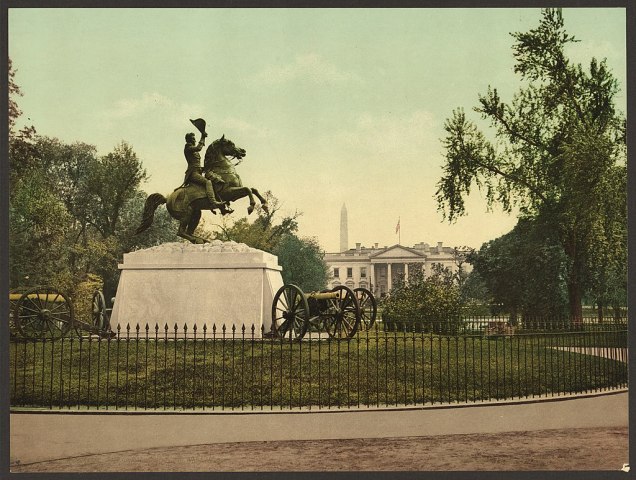
President Andrew Jackson’s has been doffing his hat in front of the White House since 1890. But recently crowds tried to pull the statue down. It is not a good day to be a dead slave owner.

These racist icons are going off all across the nation, and in some cases physically being pulled down. Statues in town squares or in front of courthouses that we drove by every day, never really paying attention to,  have gone from amber to red to being gone.  Those statues are making Americans question the past and how it influences the present. As much as we may try to deny it, the old plantation belief still survives in our nation’s consciousness.

As conquering heroes at the end of World War II we had no problem turning Germany and Japan upside down by eradicating Nazi fascism and Japanese imperialism. It is easy to enforce change from the end of gun barrel.  The Union Armies may have drove old Dixie down, destroying a slave economy.  But it did not institute lasting economic and equality changes that the country needed. The South, however, managed to throw off the yoke of Reconstruction and reestablish and institutionalize slavery beyond the plantation in all but name. What happened was the infusing of segregation, suppression and inequality deep into our country’s muscle memory. Today, we are now dealing with up righting the changes that should have taken place 150 years ago.

A Compromise to decide if the Glass is three-fifths full or two-fifths empty

“Vertic of the People” by Caleb Bingham 1854


The recent deaths of Blacks at the hands of police has stoked up  the concept of equality into a bonfire with protests and demonstrations across the nation stating that Black Lives Matter. The problem is that equality got buried in Article 1, Section 2 of the Constitution way back in 1787. Better known as the three-fifths compromise, counting slaves as three-fifths of a person for tax and representation purposes. 

Most middle school students are familiar with John Locke and Montesquieu’s concepts on equal justice and the rule of law. These concepts moved us away from autocratic laws, orders and decrees put forth arbitrarily from on high.

Thomas Jefferson wrote in 1776  in our Declaration of Independence: “that all men are created equal.”  Strangely that concept went out the window in just over a decade when 50 of the best minds in the original 12 states (Rhode Island did not send a delegation to Constitutional Convention in Philadelphia) tried to form a more perfect union with “We the People.”  The Constitution was intended to break away from a loose confederation of independent states serving in their best interests to a federation of states with a stronger national government instead.  These men (sorry ladies it was different era and  a battle to be fought later) hammered out a series of compromises on how a new government should be formed. 

The Continental Congress grappled with the three-fifths ratio but could not amend the Articles of Confederation because it took an unanimous decision of all 13 states to approve amendments. The 1787 Constitution is comprised of compromises. The three-fifths compromise found its way into the approved Constitution. It is the a compromise that negates the Jeffersonian concept that all men are created and ties voting and representation to wealth and human ownership. After all the South was operating under a slave economy that profited from cash crops like tobacco and cotton.

Slavery and racial inequality is our original sin.  It started with the Native Americans and continues today still causing  racial, gender and socio-economic problems. As a nation we hardly got out of the starting gate in dropping the old British social class structure before we put a numerical value on people. While many other groups in our country may have been undervalued for doing work “Americans” won’t do, none has had a numerical value placed on them, except Blacks. It could be argued that as long as one group is being valued less it devalues everybody. The opposite holds true, too. A multi-millionaire sex offender can push through a revolving door of justice and walk right in and out of jail while others are put into the gulag to rot.  It puts us all on some sort of nebulous sliding scale of justice instead of a balanced set of scales. Equal justice under the law becomes a tilted roulette wheel that excludes many from sitting at the table let alone buying a chip in a rigged game

Chief Justice Roger B. Taney took the stance that Black lives do not matter under any law of the land.

Now some scholars say the three-fifths compromise was a way to appease the South to accept the new Constitution. Had those men in Philadelphia not addressed slavery at all, a slave would not have been counted as anything.  This would have given real meaning to Roger B. Taney’s ruling in the Dred Scott Supreme Court case where he ruled that slaves were property. This went beyond three-fifths. It negated the belief that slaves were even people. And Taney’s decision was in 1856, almost 80 years after the ratification of the Constitution.

The three-fifths compromise allowed the South to count three-fifths of each slave as a person for representation and tax purposes. This really turns out to be a halfway measure in dealing with the economic wealth slaves were generating for the nation.  It will fester up in the Union through a series of additional compromises until the first shots are fired at Fort Sumter.  The three-fifths compromise assured that from the 1800 election to the 1856 election that there would be enough Electoral College votes in the South that a pro-slavery president would always be elected. The Senate, by design, was always evenly split between Free and Slave states. It was not until the North’s population grew to a point were the balance of power in the House was shifting northward that Northern population growth broke the South’s voting grip in the Electoral College and brought in the first anti-slave president, Abraham Lincoln, a Republican.

This really is not hard to understand when we look at say one state: South Carolina, the first state to leave the Union in 1860. In 1790 South Carolina’s Black population was about 43 percent of its total population. By 1860 the Black population was closing in on 60 percent. Under the three-fifths compromise that Black population would equal close to 248,000 people; just under half of South Carolina’s total population for tax and representation purposes. Black lives have always mattered. What mattered was how they were counted.

Once the Civil War was over and the South and slavery were defeated, counting freed Blacks was not the problem. It was a problem of suppressing a large portion of the Black population. Two concepts that needed to be suppressed were the one-man-one-vote concept and equal justice under the law.  By 1900, states like Mississippi and South Carolina had Black populations that were nearly 60 percent. Other Deep South states  had Black populations well over 40 percent.  For the defeated ruling elite of the South, this was not the sort of democracy or society they envisioned. Rule of law became a rule of repression.

The National Civil Rights Museum: The 1968 Memphis Sanitation Workers Strike.

Thirty-five years after the end of the Civil War Jim Crow laws are firmly in place and a rebirth of Confederate pride builds up with statues honoring those who fought in the “Lost Cause.” A Confederate mystification sweeps the South. And with it, it brings in a new breed of Klansmen enforcing laws at the end of a rope. And this, only 25 to 30 years after passing the civil rights amendments: the 13th, 14th and 15th Amendments. It would take another 65 years for these Amendments to be federally enforced. And many would argue that they are still not being enforced to the full extent of their intentions.

For many, the compromising and suppression is over. The three-fifths compromise may not be in the forefront of today’s protests. But since 1789 when the Constitution was approved it seems that Blacks Americans are still waiting for that other two-fifths to matter.


https://www.theusconstitution.org/news/understanding-the-three-fifths-compromise/

http://www.digitalhistory.uh.edu/disp_textbook.cfm?smtID=3&psid=163

https://www.sciway.net/afam/slavery/population.html

The Masquerade of the Red Death in Wisconsin and Unlocking Business

Recently, the Wisconsin Supreme Court overturned the governor’s shut-down and stay-at-home order during the coronavirus pandemic. Wisconsin of late has been in a state of partisan political  infighting  between the two in-breeding political bases for some time. We now have masked-armed men walking around state capitals either intimidating the democratic process or trying to overthrow it–or at least unmask the sinister aspects of a deep state.

What got my squirrel running was not armed men on the capitol steps but that one of the Wisconsin Supreme Court was comparing the stay-at-home order to President Franklin Roosevelt’s executive order to intern Japanese American citizens in 1942. I sort of get the analogy to question governmental power that could force its citizens either out of their homes or to stay at home during a crisis.  And this pandemic racing around the world is a crisis. They pondered what would stop the government from ordering people out of their homes  and into “centers where are they are properly social distanced in order to combat the pandemic?”

I think that from a legal and political standpoint the Japanese internment might look like a good one to compare the stay-at-home orders; but I think there is a much better example. Instead of citing Korematsu v U.S., as an example of excessive government power.  The court should have used was Edgar Allan Poe’s The Mask of the Red Death. It demonstrates the consequences of sheltering-in-place during a pandemic better than interning Japanese Americans during a war.


It was not a stay-at-home order for the 120,00 Japanese Americans interned during WWII but a 1942 order saying grab your stuff and go.


Poe’s Red Death has a pandemic ravaging the countryside. Prince Prospero and large group of his costumed-noble friends are sheltering-in-place in his fortified castle. It has all the hallmarks of Florida hurricane party up until the roof flies off and the flood waters pour through the door.   In this case, its when disguised Death shows up.  Prospero, with dagger in hand, chases the black shrouded death figure demanding to know who dares interrupt the festivities. The Prince pursues the black shrouded figure through the six rooms of the castle and into the most sinister room: the seventh room. This room is lite up by a scarlet light and decorated in black. It is here where Prospero and his masquerading guest unveil the  dark figure before the ticking clock.  When he is unmasked there is nothing revealed but an empty costume. The prince and his guest are infested with the red death and die leaving “Darkness and Decay and the Red Death” holding court in the castle.

The Wisconsin court could be saying is it is time to get the fraze out of the house!  But they were citing  Korematsu v U.S. as a reason to unbolt the doors. Fred Korematsu was a 23 year-old Japanese-American citizen was balking at leaving home and hearth for the wilds of Wyoming or the piney woods of Arkansas, the far off places that Japanese Americans were being interned.

Korematsu’s case went to the Supreme Court where he lost and had to load up the homestead.  What makes his situation a tad different from today is that it had strong racial implications.  Roosevelt’s order singled out Japanese Americans. The coronavirus is not singling out people for their race, religion or gender–maybe income level. The Supreme Court basically said that Korematsu’s case was not really a constitutional racial discrimination case.   And since we were at war with Japan there was the possibility of espionage and sabotage, military matters trump civil rights.

All of this paints a dark dystopian image of what could happen when “they” come for you.  It becomes spine chilling when we think that it could happen here. But it has.

The root of today’s protests over the stay-at-home orders has nothing to do with race or rights or who is masked or unmasked.  It is about the mass disruption of business. If average Joe was offered corporate bailout money or a Powerball jackpot winnings to stay at home and wear a mask nobody would be complaining. If there is no money on the table then there is no trump in the deck. And with the GOP Senate dealing the cards it’s always Jacks or better to open.

But our history is laced with stay-at-home orders and lock down orders.  Conservative business types have known all about internment to make a buck. Take the Triangle Shirtwaist Factory Fire in 1911. A fire broke out in a dustbin of a multi-storied New York building where more than 500 people, mostly immigrant women, were working in locked down conditions. When the fire was finally put out a 146 were dead — 53 jumping to their death.

For some in the locked down building jumping was the only way out.

Southern plantation owners know about keeping workers at home, too.  They practiced forced interment for centuries to make a buck. Their stay-at-home orders for African Americans made them and the country millions. When threatened to open up their plantations they armed themselves; went to their respective state capitals; and decided to go war and hang onto their internment camps and keep their racial stay-at-home policies. This turned out to be a failed plan. It would create a century long economic downturn and lead to a second wave flaring up 100 years later.


Interned Southern workers not keeping social distances in 1862.


All three of these events targeted specific groups of people to be confined–and it was not for public health reasons or civil liberties. The last two were just for money. I am not a legal scholar but I think it would be safe to say that most today’s state stay-at-home orders are not targeting a specific group of people. Unless you consider the poor and those over 65 hunkering down in nursing homes or at home in their rocking chairs binge watching Netflix as a targeted group.


Nature against Man, Time for Payback

The Covid-19 pandemic has been sometimes been referred to as a war.  President Donald Trump once referred to himself as a wartime president. But  despite more than 60,000 deaths, 30 million people out of work and armed protesters mobbing state capitols,  we are not really at war. If this were a narrative conflict plot line in a novel or a movie it would be man versus nature. War is a man versus man affair.

First off, we cannot take this war-like analogy literally because people start wars. According to Cambridge dictionary war is “armed fighting between two or more countries or groups.” Globally we have not stooped to that–at least not yet.

Pandemics on their own do not start wars or declare war.  Wars in most cases cause death and destruction, disease and pestilence, food shortages and a complete disruption of normal life as well as disruptions in business and other economic activities.

It is true that the Covid-19 has killed many around the globe, disrupted our daily lives and  our economic activities.  Unemployment is heading to an all new high. But what we are really talking about is attacking a virus with a war-like attitude. And right now our sheltered-in-place tactics are more of a siege mentality that is frustrating some.  The virus is like an attacking foe that surrounds the castle and everybody digs in. But when you look over the parapet you do not see a surrounding army. Some people, however,  have  left the castle and taken to the streets in protest to this strategy and the economic devastation it has wrought. This introduces a side conflict of man versus government to reopen business. I am not sure how this tactic of reopening business neutralizes the coronavirus’s effects of just plain old death. 

One thing that really hasn’t happened is a nationwide call to arms.  The call to arms has been left up to governors of individual states who are now starting to catch blow back for shutting down their states and how to reopen them.  A Wednesday night bowling alley league mentality seemes to have embraced us more than a logical then our nationwide coronavirus strategy.

Dudley Castle: Once a formidable place to shelter-in-place. Not so much now.

In war one of the first things that is needed to rally the nation is to demonize your enemy not your comrades.  In most cases this is not too hard to do.  We fall into it very easily. Our enemy’s activities can easily paint them as worthy barbaric opponent that needs to be totally defeated.

For instance, on the build up to World War II  during the Sino-Japanese War in December of 1937, Japanese General Matsui Iwane decided to destroy the Chinese capitol Nanking in what would later be called the Massacre of Nanking or the Rape of Nanking. It was estimated that Japanese soldiers killed between 30,000 and 400,000 civilians and captured Chinese soldiers.  A huge discrepancy but who was really counting those killed at the time. Japanese troops even used some POWs for live human bayonet practice. After World War II General Iwane was tried, convicted and executed for war crimes. No one was ever convicted of a war crime for shutting down a beauty salon unless…

In December of 1938, a year after the Rape of Nanking,  in Germany, Nazi Stormtroopers would  lead parading Germans through the streets of Germany in Kristallnacht, destroying Jewish homes, business, hospitals and synagogues.  Thirty thousand men were arrested.  Sometimes an enemy is so easily demonized that it leaves no choice but to go to war. 

But how do you demonize a microscopic virus? Covid-19 is more akin to a science fiction novel like Michael Crichton’s  Andromeda Strain, hence the man versus nature conflict. In this book and film scientists are battling some sort of extraterrestrial microbe. The microbe was brought back from space by a military satellite.  The microbe gets loose and ends up killing all but two people in an Arizona town. This makes for a good story but it is also where the coronavirus becomes goofy with a variety off-the-wall cures and conspiracy theories. This leads us into good demonizing entertainment and alternative realities. This has us pointing fingers. A  juicy conspiracy theory needs a few grains of truth to fly around the “not me but you” circle of finger pointers.  With today’s talk radio and social media the theories have left the starting blocks and are racing down the track. We go from a virus escaping a Chinese biological lab and then on to a wet market and off into the realm of all sorts of batty beliefs of political exploration.

Theories and rampant speculation are good for ratings and inciting the lunatic fringe. However, they sow confusion and hamper true science.  One thing is sure, the coronavirus is the perfect stealth attacker.  It stalks unaware humans much like the cloaked alien visitor that returns to Earth to hunt humans. Arnold Schwarzenegger battled this bad guy in the movie Predator.

Since we cannot see the coronavirus it is hard to demonize it, let alone fight it. It is easier to turn our demons loose on human organizations  rather than the virus itself. Here is where the conspiracy theories come in. Some have tagged the World Health Organization or the Chinese as demons because the WHO is an over-funded United Nations organization and China because the virus originated there in some bat cave labrotory. But no matter what is said,  it is the virus not the WHO or China causing the deaths.

One thing is certain the virus has been almost as lethal as the Japanese army was in Nanking. Here in the US the virus in about three months has killed more than 50,000 people with the death toll steadily moving upward.  This is a horrific death toll has surpassed the total of combat deaths America suffered in Vietnam.  Most Americans who lived through the Vietnam War remember the weekly death counts given on Friday night newscast.  The worst week in Vietnam was February 11-17th during the Tet Offensive: 543 Americans were killed. According to The Washington Post those figures pale to the 12,392 Americans that died from the coronavirus between April 6 – 12. That is an average of more than 1,700 Americans dying in one day.  And this count is just for the United States, forget Italy and Spain.

We have long surpassed the total American combat death level during the Vietnam War. I mention combat deaths because killing in war is a physical exercise. The coronavirus seems to kill with ease.  The Vietnam War for Americans started with the Marines landing in Danang in March of 1965 followed with a steady escalation of millions of soldiers coming in and out of Vietnam until it ended with the last combat troops leaving Vietnam in March of 1973. According to the United States Archives 47,000 military personnel were killed in combat in Vietnam. And this does not include Vietnamese deaths. What took eight years of war the coronavirus is did in several months. The Vietnam War was an open-ended war with no real light at the end of the tunnel. There is speculation as to when we will flatten out the coronavirus death curve, a home for Christmas belief.   However,  fears of a fall and winter assault in fall leave us wondering are we in for a viral Battle of the Bulge. It leaves us wondering when will this come to pass.

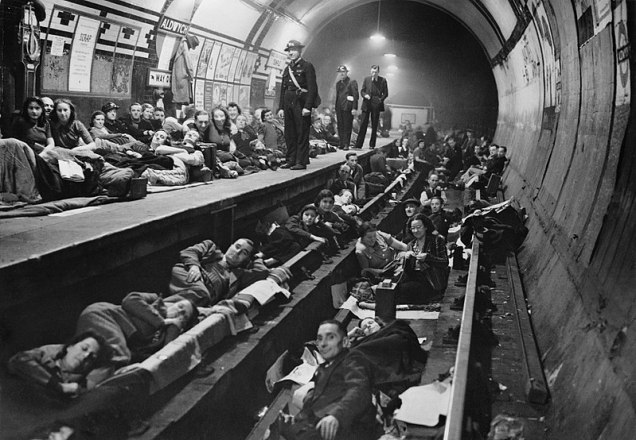
Brits sheltering-in-place during the Blitz

What frustrated military planners in the Vietnam War was the inability to knock out key installations vital to the war effort. One government official likened the coronavirus as the sneak attack on Pearl Harbor. There are some similarities, I guess. But the Covid-19 does not have a command-and-control center planning its next assault. If the virus is trying to win a war, attacking one of our main front line installations is a strategic imperative as was Pearl Harbor in World War II.  This was what the Japanese had hoped for at Pearl Harbor.

Destroying or controlling key facilities is essential in war. The coronavirus is incapable of this. All it really needs is a human host to control. However, it is assaulting our hospitals and degrading our medical personal. This will weaken our defenses and lead us open to unchecked attacks. The movie Independence Day had attacking aliens taking control of orbiting communication satellites to attack Earth. Once the satellites were captured it was like cracking an egg open for frying. Ironically, in that movie it was technological virus that brought the aliens down. Our problem is that it will take some time to come up with a vaccine for the virus. The only defense is to hunker down like Londoners spending the night in the Tube during the Blitz.

During the waning days of World War II more than 1,300 Allied heavy bombers went on fa our day bombing spree, dropping nearly 4,000 tons of high-explosive and incendiary bombs on Dresden that created a firestorm that destroyed nearly 1,700 acres of the city and killing well over 23,000 people.

Fortunately, the coronavirus has spared us the wanton wholesale destruction that war brings. When we wake up in the morning there is no disbelief of coming up from a night of sheltering-in-place as if we were coming up from the air raid shelter and seeing the rubble that was once our neighborhood destroyed from last night’s bombing.

But here is an alternative theory.  Maybe Donald Trump is a wartime leader and maybe this is a life or death struggle between man and nature.  Maybe this is war. The coronavirus is just one of nature’s weapons waging a war along with killer hurricanes and raging wildfires.  This is not a geopolitical, economic or cultural war.  It could be a war of revenge.

The plastic seaborne invasion hitting the beaches. A million year D-Day.

Just maybe this is one phase of nature’s counter attack for 30,000 years of human assault on the Earth.  Maybe it is payback for hunting species to extinction for feathered hats or shoes; pumping millions of gallons of toxic chemicals into rivers and oceans for plastic bags; dumping millions of tons of garbage into landfills and polluting the skies with carbon and other carcinogenic pollutants and greenhouse gases for a two-SUV garage; or leaving floating islands of plastic bottles to circle the oceans for a million years.  Maybe this is nature’s way of telling us to cool it for a while, stay at home, and give the Earth a few months to catch its breath.

https://www.archives.gov/research/military/vietnam-war/casualty-statisticshttps://www.washingtonpost.com/outlook/2020/04/16/coronavirus-leading-cause-death/?arc404=true


What “Is” a Constitutional Conservative?

Progress of America by Domenico Tojetti

With the passage of the $2 trillion coronavirus stimulus package it made me wonder where did all those fiscal deficit hawks fly off to. When the whole country falls into the category “too big to fail” the wallet really opens up.  And some economists and financial gurus say it might not be enough. It appears that our governments, state and federal, are overwhelmed on how to move forward in dealing with the pandemic we are facing.

In this shelter-in-place time I found myself taking longs walks. On one of these walks through my neighborhood I came across a lawn filled with political yard signs for the up and coming primary elections. One sign in particular piqued my imagination in today’s pandemic. It was a sign with no candidate’s name posted, just initials, and no party affiliation. It simply said “Constitutional Conservative.” And I thought what is a Constitutional conservative and considered what President Bill Clinton said in his impeachment defense “It depends upon what the meaning of the word ‘is’ is.”

The conundrum  I had with the sign was that it was next to two red signs: one proclaiming  “Make America Great Again” (which makes me wonder when we became not great– maybe just after the first case of coronavirus); and the second red sign simply advertising “Trump 2020.” Nothing personal against President Trump but I never really considered him Constitutional anything.  More of Constitutional Compass in a magnetic storm. But the signs did give me a rough bearing to follow.

It is not my intention to to weigh in on the pros and cons of the Trump Administration or rehash the last three years of political discourse or even the last three months. Much wiser men and women have taken that cross upon their shoulders.  However, what I find puzzling is how to reconcile the past three years; or any three years after the approval of the Constitution for that mater, with the term “Constitutional Conservative. ”  As far as I know this could be a marketing scheme, a sort of joint branding taking place between a nebulous (or obvious) group of Constitutional Conservatives and the Trump name  Maybe its just political happenstance like the Whig party and the Know Nothings way back in the 1850s. We may ask ourselves, How did that work out?

This makes me wonder what Constitutional conservative means in the crisis we are now in. Does a strict view of the Constitution have any bearing on what is going on? In a time of crisis the Constitution tends to get stretched.  Abraham Lincoln took liberties expanding the traditional role of the presidency.  His views on secession differed with the Constitutional viewpoint of say his counterpart, Jefferson Davis, who looked at the Union as a compact of states that could be undone. And Lincoln really waded into constitutionality with his Emancipation Proclamation freeing slaves in states that left the Union or were in open rebellion against the Union.  But Lincoln kept it all within the guideposts of the rule of law. Lincoln knew the law and he knew where he could bend it with out breaking it. But none the less, he took a lot of heat from the Democrats for the way he conducted the war .

Our Constitution calls for a bicameral legislative body and a Supreme Court to interpret what is constitutional. Nowhere in the Constitution does it mandate a two party system. Unlike other countries with a multitude of parties, particularly those with a Parliamentary form of government, when an election has no majority winner, then various parties come together to form a majority coalition to run the government, as in the recent elections in Israel. Here, in the US, third party ideas get absorbed into one of the main parties. The Tea Party movement, for example,  got pulled into the GOP like a black hole sucking in a nearby planet. Unlike a black hole, where we are not sure what comes out the other end, here on terra firma we get to see the end results.

Arizona Senator, Barry Goldwater, the face of the conservative movement in the 1960s.

So who or what is a Constitutional Conservative?  Right off the bat I would say Alexander Hamilton or George Washington.  Washington simply because he was the president of the Constitutional Convention and the first President of the United States. Doing a quick internet search, George’s name does not pop up as Constitutional Conservative. This, despite, the many references to the “intent” of the Founding Fathers. Here again, no Washington but you will find Senator Barry Goldwater and President Ronald Reagan’s smiling faces popping up as disciples of original intent.

From what I can glean a Constitutional Conservative is somebody who believes in in low or no taxes, limited government,  Christian family values, and sees liberals as a threat to American Exceptionalism.  I am going to stop there on American Exceptionalism because that is another political black hole concept that is easy to fly into with no idea where you will come out–that is if you come out. In the short, it looks like the old belt buckle proclaiming God, guns and guts–let’s fight to keep all three.

Once again, it is not my intention to deride conservative values.  But when it comes to taxes what American in their right mind  would turn down the option of legally not paying taxes?  Just look at the lengths the current president has gone to keep his tax returns secret.  It’s called tax evasion. Evading taxes is like avoiding the coronavirus–shelter your returns in a safe place.  Remember,  tax evasion is how the Feds got Al Capone.

We also have to remember we are a country founded on smugglers and tax evaders.  The guy who signed his name so boldly to the Declaration of Independence, John Hancock, was one of the biggest tax cheats in the Colonies.  I am sure if King George III could have gotten a hold of Hancock he would have done several eons in irons as a permanent resident of the Tower.

Washington marshaling troops to quash the Whiskey Rebellion. Now that there is representation taxation is not so easily evaded.

But avoiding taxes was not just for rich merchants. We even had  western farmers in the early stages of the nation balk at taxes. The Whiskey Rebellion took place from 1791 to 1794 when farmers refused to pay newly levied taxes on whiskey.  Before there was high fructose corn syrup and ethanol, there was corn liquor. A very lucrative way to turn surplus corn into cash. As a Constitutional Conservative, President George Washington, led an army out into Pennsylvania to collect the taxes and put the rebellion down in person.

One of the remarkable qualities of America, and its Constitution, is our Christian values that allowed us to set up a government where religion and politics tried to stay out of each others bailiwick or diocese.  The questioning of one’s beliefs or no belief at all has not pillared anybody at a burning stake. Although there were some fanatical Puritans in pre-constitutional times  roaming around in the late 1600s looking for witches. Here again Christian values have evolved through time with the rule of law.  We no longer hunt witches or Irish immigrant papists down.

Chief Justice Roger B. Taney took a radical look at who was three-fifths of a person.

As for the “intent” of those who wrote the Constitution,  eleven members of the convention were either slave owners or associated with the “peculiar institution” of slavery. This is the paradox of American exceptionalism.  In one document we proclaim boldly “all men are created equal” and then in another we decide that some men will be considered “three-fifths of a person.” This seems arbitrary. But it is not. All that would change in the Dred Scott decision.   Chief Justice Roger B. Taney’s court even went beyond a strict Constitutional conservative decision definitively saying that Dred Scott, a slave, had no rights at all under the Constitution. He turned Scott into property except when it benefited the purposes of their slave owners for tax purposes and representation. Taney and associates were no doubt following a close interpretation of the Constitution. But was this interpretation the intent of all the signers of the Constitution?

Even the founders found ways to get around a strict interpretation of the Constitution.  Alexander Hamilton used the “necessary and proper” clause to get a national bank.  It makes sense.   Congress can coin money, set and collect taxes but there is no mention of banking. Hamilton reasoned that a bank was needed to put the nation’s money in. There was no Goldman and Sachs back then. No Federal Reserve and no quantitative easing.

As much as President Trump proclaims he is a great builder and developer Thomas Jefferson has him beat hands down with the Louisiana Purchase.  Jefferson, who had a strict view of the Constitution, found no Constitutional way to get this land deal done.  But there was a twist in the Constitution.  The president can negotiate treaties.  Looking beyond the limitations, Jefferson made the land deal with Napoleon a treaty. Then got Congress to approve it.  Talk about the art of the deal.

And then there is Andrew Jackson.  I am not sure if this populist president would fall into the Constitutional conservative file or not. He did not, however, look fondly upon Henry Clay’s concept of the American System. Clay proposed using tax revenues from tariffs for internal improvements such as roads, bridges and canals. Jackson felt that funding these sorts of projects, particularly Clay’s Maysville Road Bill that would tie various roads in Kentucky to the Ohio River and the Cumberland Road System, as unconstitutional. Jackson promptly vetoed the bill. Of course there was a deep political animosity between the two political rivals that grew throughout their public life.

It is interesting to note that 120 years later President Dwight Eisenhower took a completely different view. In 1956 Eisenhower signed one of the greatest infrastructure deals in history with the Federal-Aid Highway Act. This act create 41,000 miles of interstate highways  with  I-90 being more than 3,000 miles long running from Seattle to Boston.

So, I am not sure about strictly holding on to old ideas.  There is some comfort in knowing rules hold up over time.  But even baseball has changed. It has a Designated Hitter, football players don’t have to play both ways, basketball has a three point line; and to make sure every call is correct, we now have instant replay review. So much kicking for arguing and kicking dirt on an umpires shoes.

I often think that most people who spout off about the Constitution forget the Preamble part where the purpose of the Constitution is laid out.  With all the yammering about abortion and gun rights we forget that the reason our government was founded was “to establish Justice, insure domestic Tranquility, provide for the common defense, promote the general Welfare, and secure the Blessings of Liberty.”  It is a tall order without a doubt trying to meet these demands. Those who wrote the Constitution during that hot Philadelphia summer had no idea there would be space travel or instantaneous communication.

But now that we are engulfed in a pandemic maybe we should look to the Preamble of our Constitution as a beacon of hope. The government has the task of balancing justice, tranquility, and the general welfare all the while trying secure our liberties.  Is this the time to take a 19th Century approach to a 21st Century problem? Or look forward to progress.


https://www.ushistory.org/us/24e.asp

https://www.fhwa.dot.gov/interstate/history.cfm

https://www.popularmechanics.com/technology/infrastructure/g2827/7-of-the-longest-us-interstates/

https://www.nationalreview.com/magazine/2019/01/28/toward-a-constitutional-conservatism/

https://theweek.com/articles/654508/what-exactly-american-exceptionalism

The Covid-19 World War

I was not around during the beginning of World War II when Germany invaded Poland in September of 1939.  The Nazis had belief in the need for Lebensraum. Eminent domain was one of their many ethos that was backed up by force of arms. Simply put, they needed more living space and Poland and most of Central Europe was condemned property waiting to be re-developed

It is the post Polish invasion that reminds me of today’s battle with the coronavirus: Corvid-19. After Germany invaded Poland, France and England declared war on Germany. All sides sat around looking over their gun barrels for the next eight months in what was called a Phoney War.  There were a few minor battles but all sides were content at this time to prepare.  Britain began preparations for an aerial blitz that was sure to come. A conscription was put into place as well as rationing and the commandeering of public transportation for military use.  The Phoney War put them at ease, and made them little disgruntled with government efforts in the lew of any real combat.

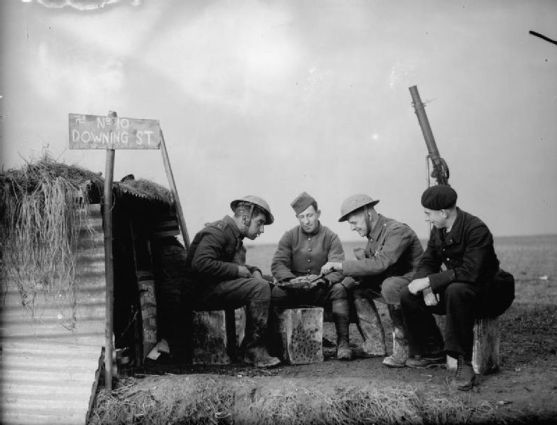
Allied troops sheltering in place

Despite the preparations neither side had any idea how this Phoney War turned out to be a life and death struggle. Little did France realize what would hit them in May of 1940.  German tanks rolled through France and on to the Atlantic in less than a month pulling France down.  The British barely had enough time to get their troops off the continent and  began the process of sheltering in place on their island fortress .

Before I go on any further there is no way that I am comparing the Nazi swarm to a coronavirus–the Black Death maybe.  But France and Britain  had eight months to prepare for war in which they declared. And the way the Germans rolled them up makes you wonder how well they used that time getting ready for the inevitable, particularly after witnessing how quickly the German army and Luftwaffe–along with the Soviets–put Poland in a box.

What puzzles me is that we watched what happened in China as the coronavirus roared through Wuhan, a city of eleven million. And much like the British and French in 1939, we just looked with unmasked faces during the month of January and February watching and waiting as the coronavirus marched through Italy.

For most of our history as a nation the two oceans have protected us from all foreign enemies.  These oceans may have even protected us to some extent from viral airborne invasions.  But the global world in which we live events and diseases can jump oceans and continents over night. A slow moving local disease can now become a blitzkrieg.

It was not long before the United States was dragged into the world at war. Much like our other Allies we were not prepared for battle. To quote a turn-of-the century Secretary of Defense who said before launching the nation into a decade of war in the Mideast: “You go to war with the army you have, not the army you might want or wish to have at a later time.”

Unfortunately, that is true and can be said about many things. But in World War II the United States got up from being sucker punched and began producing enough war material to supply not only our own armies but our Allies, too.  It was Rosie the Riveter: “We can do it.”

It brings to mind the story of the aircraft carrier USS Yorktown.  Badly damaged at the Battle of the Coral Sea, the Yorktown managed to get back to Pearl Harbor for repairs.  Engineers determined it would take at least two weeks around-the-clock to make the repairs needed. The problem was Naval Intelligence discovered that the Japanese Imperial Navy was in the process of invading Midway Island. They did not have two weeks. Admiral Chester Nimitz told the Navy Yard that the Yorktown was needed and that they had two days to get the Yorktown out to sea. Much to the surprise of the Japanese navy, the Yorktown was there and played a significant role in America’s victory, a victory considered the turning point of the war in the Pacific.

During that war we were cranking out tanks, airplanes and ships by the thousands not to mention all the other necessities.  I find it difficult to believe a country that could build a space program from the ground up, put a man on the moon and bring him back safely today cannot provide enough surgical masks, cotton swabs, and other simple medical needs to combat covid-19.

Granted, we might not have the necessary equipment now but in the past we could and did what needed to be done get the job done.  We may be going to war with the health system we have, but that needs to change. It is time to step up the A(merican)-game. Instead of talking about making America great again, realize We can do it!

Art of the Deal or a New Dealer

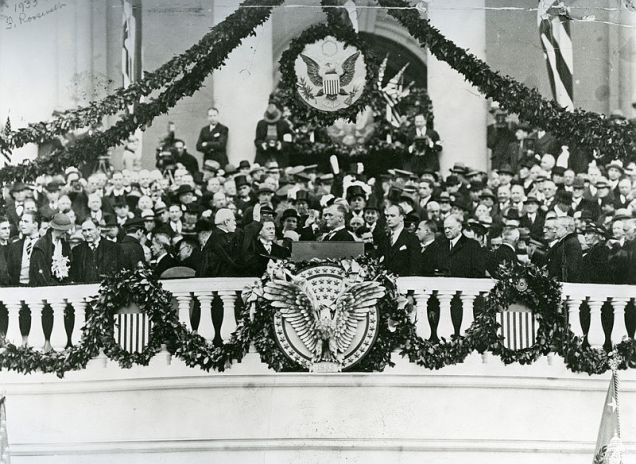
It is ironic that it was March 4, 1933 that Franklin Roosevelt gave his first Inaugural Speech. Most historically cognizant Americans may know only one thing from this speech and that is when Roosevelt told the country: “let me assert my firm belief that the only thing we have to fear is fear itself.”

The difference between now and then is that in 1933 the country was in the grip of the worst depression or panic the country has ever faced. More than 25 percent of the work force was out of a job. Businesses took it on the chin, too, losing $6 billion. Six billion sounds like chump change today. And it sort of is. When you adjust the 1933 loss for inflation that is close to throwing  $115 billion out the window today.  Jeff Bezos alone is worth close to $120 billion.

Today, we are witnessing a stock market collapse that is a throw back to the last recession but this time we can add a little oil to the fuel as the energy markets melt down. And of course the  pandemic virus adds to our economic woes with the possible overwhelming of our healthcare system.

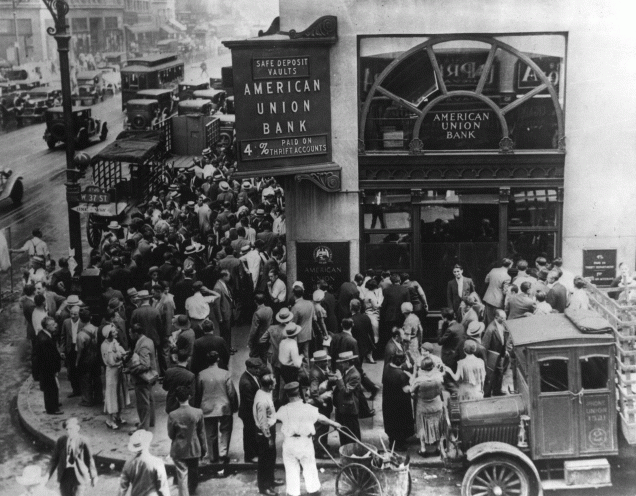
A bank run during the Great Depression or as Yogi Berra would say “A nickel ain’t worth a dime anymore.” If you could get a nickel for your dollar.

Historians say that the Great Depression kicked off on October 24, 1929 during Herbert Hoover’s Administration when the stock market tanked. Five days later the Dow Jones Industrial  had dumped 22 percent of its value.  This was a time investment bankers saw their portfolios go out the window. Contrary to popular belief, only two people literally followed their investments out the window


That was just the start. The Hoover Administration’s laissez faire affair approach did not help.  The idea of letting the markets do as they will was not working.  By 1930 consumer confidence went out the window with the Dow Jones. Interest rates were at rock bottom levels. production fell as did wages. Before long the country was in a deflationary spiral. Demand for goods fell, prices fell, wages kept falling and so did the Gross Domestic Product. Some estimated it fell by 15 percent. And we argue about 2 percent growth in the GDP as being a bad thing. Are things sounding familiar?

In the 1928 Presidential campaign Hoover campaigned on the promise of a “chicken in every pot and a car in every garage.” Boy would those roosters come back to peck Hoover. That little slogan sounded good at the time but I am sure it did not play well when people started bum rushing  banks trying to get their money out before banks defaulted. Forget about the car in the garage. When this was done people would be lucky to have a pot to piss in

Hands in pockets maybe but John D Rockefeller’s net wealth adjusted for today’s inflation was close to $420 billion.

Blaming Herbert Hoover for the Great Depression would be like blaming Donald Trump or even Barack Obama  for the coronavirus. The 1930s global economy was global pandemic waiting to happen. It was cooking off like a steaming tea pot.  Like the good business conservative Hoover was, he followed the belief of cheerful optimism that things are going to get better. And they usually do. But face it, when you have an old business tycoon worth $1.4 billion like John Rockefeller, probably the richest American ever,  sayingThese are days when many are discouraged. In the 93 years of my life, depressions have come and gone. Prosperity has always returned and will again.”  And he was right.  The business cycle is a double feature much like a roller coaster. It is a sure thing if it is going up at some point in time it will come back down and vice versa. However, for the out-of-work souls standing in a soup line that sounds encouraging but the real question was when. In the meantime, “brother can you spare a dime.

Today’s creeping coronavirus and the collapse of the oil market has not created soup lines or a rush on hospital beds–yet. It is, however playing havoc with the fear factor.

In his first Inaugural Address not only did FDR address fear but he also said, “Only a foolish optimist can deny the dark realities of the moment.” The dark realities of the Coronavirus may be embedded in its DNA but its stark realities are more than likely going to manifest in our bastardized healthcare economic system. Much like the 1929 stock market and banking collapse our healthcare system is humming along making profits for insurance companies, medical companies, pharmaceuticals and just about anybody else who can tag on to the medical gravy train. The question is if this pandemic gets out of hand what will happen to this single-payer profit system. It’s not where the buck stops put who will pick up the check.

In the Democratic debates we have heard a lot about “progressive ideas” that to some, border on socialism; or worst communism. One campaign slogan: “Medicare for all”  or “Universal Healthcare” already has people heading the Sheep’s Gate waiting for the stirring of the waters at the Pool of Bethesda to make them well of whatever disease they have.

Maybe one of the first National Healthcare Plans:The healing waters at the Pool of Bethesda

What Roosevelt stressed was a New Deal “because the rulers of the exchange of mankind’s goods have failed, through their own stubbornness and their own incompetence, have admitted their failure, and abdicated. Practices of the unscrupulous money changers stand indicted in the court of public opinion, rejected by the hearts and minds of men.”  We might not be there yet when it comes to healthcare. But we could be one patient away from a run on hospitals.

Now far be it for me to say what is what in the Healthcare Industry. It does, however, seem to be a system run for and by “unscrupulous money changers.”  I would venture that in the hearts and minds of most Americans there is some sort of agreement about changes to a system that favors profits over health. For some reason people are leery of a single payer national healthcare system. I think I can bastardize Churchill’s quote on capitalism and socialism by inserting the current healthcare system  is the unequal sharing of blessings (profits) with the inherent virtues of the equal sharing of miseries (lack of actual care).

I am not advocating for a single payer government system. However, the idea of national health insurance is nothing new.  FDR’s cousin Teddy Roosevelt, another reformer,  was bouncing the idea around when he ran for president in 1912.  Harry Truman tried unsuccessfully in 1945. John Kennedy floated the concept about, too. It was President Lyndon Johnson, a Roosevelt New Dealer, who managed to pull it off in 1965 for people over the age of 65. And here we are in 2020 debating the merits of Medicare for all.

At this moment there is a lot of speculation as to the short term and long term effect of the coronavirus on the world’s health as well as the economy.  Some countries have taken drastic quarantine measures. China even built two coronavirus hospitals in one week. Granted, this pandemic could be like a 25 year storm, but if it becomes worse it could possibly swamp our healthcare system creating a real need for a “new deal.”

We the People or Tyranny

The recent impeachment debate reminds me of why those who wrote the Constitution kept the people as far away as possible from the seat of power. This, despite two of our nation’s founding and guiding documents that are laced with references to “we the people,”but are designed to keep angry farmers with pitchforks away from the county courthouse–as in Shay’s Rebellion. It was also designed to keep greedy despots and tyrants at bay with an impeachment clause.

The Declaration of Independence has slightly more than 1,400 words.  The document is laced with words like fellow citizens, our coasts or we and us. And of course the curse phrase “all men are created equal.” This little phrase so succinct wrapped tight in the logic of  Enlightenment gives us the indefensible “all” not “some” and no indication at all of the royal “we” but” all.” That little phrase has had this country back peddling on a lot issues starting with counting slaves as three-fifths of a person to women’s rights and immigrants rights. Somehow along the way we have managed to rope in non-people and corporate rights, into “We the People.”  Go figure.

The Constitution starts out with “We the People of the United States, in order to form a more perfect Union…” telling us that government derives its just powers from the people. This is a unique concept that has evolved throughout the centuries but has yet come to full fruition. One of the greatest republics in history was the Roman Republic. It lasted almost 500 years from 509 BC to 27 BC.  But the Romans, like the men who put our Constitution to paper, realized that it was vital to keep the masses as far away as possible from Forum. But yet, the Romans knew how to use the masses to manipulate “public policy”  for personal gain. At times the Roman Republic was rocked with public mayhem, mob murder and several civil wars, which would have been impossible without “we the people.

The  big difference between the Roman Republic and ours is “We the people” is a fine example of well-reasoned rhetoric.  After all, the men who crafted the new government and the Constitution were educated in the Age of Enlightenment or Reason, which came about 1,700 hundred years–give are take a decade or two–after the fall of the Roman Republic.   The Roman Empire, however, lived on for another 500 years before falling like a straw castle to barbarian hordes whose public policy was pillage and personal gain.

Those who wrote our Constitution looked back to the Roman Republic and Athenian democracy to form a our new government, as witnessed in the Classic Roman-Greco architecture style of a lot of our public buildings. They took many of the ideas from Enlightened thinkers like John Locke, Montesquieu and Rousseau, as well. But between all of that, Western Europe experienced a heavy dose of feudalism. I am not sure if feudalism is more of social system than it is a form of government. To quote Merriam-Websters  a government is “a small group of persons holding simultaneously the principal political executive offices of a nation or other political unit and being responsible for the direction and supervision of public affairs.” 

King Henry the II, possibly the first feudal Plantagenet king that started a dynasty that ruled for more than 300 years.
Here is where  things get a bit murky: public affairs. Was there any consideration for public affairs in Medieval Europe?  This social structure of the time started basically with one man at the top:  the king or the crown. What makes public affairs questionable is that the crown handed out land to the nobility. The nobility in turn handed land down to the vassals who in turn worked the land with serf or peasant labor.  Serfs were tied to the land in fealty to the lord and master. This quid pro quo was based on loyalty and obligation to the next guy up on the social rung with not a whole lot coming down. This required nobles to pony up knights, archers and pikemen in the crown’s defense in a semi-military society. This included peasants and any yeoman farmers, and the fruits of their labor, too.

Here is another hitch in this quasi military social structure.  If we assume that a Medieval king was a government (unto himself) then the question is what is public affairs or in the public interest. Granted, we cannot impose 21st Century beliefs on 14th Century man.  It is unfair.  It would be easier said, that any sort of public interest  or public policy was really the crown’s interest or what the king said it was.  There were no polls in the field to gauge public perception on, say, going on a Crusade to the Holy Land; or the public’s views on the Hundred Year’s War where the English House of  Plantagenet fought with the French House de Valois over who would  rule France.  And we think 20 years in Afghanistan is a stretch.

I wonder what  a serf would care about who controlled France? Think about it, this is a person who lived and died five miles from where he was born. That is, unless he got dragooned into the front lines fighting Saracens. Then he probably had the opportunity to die hundreds if not thousands of miles from where he was born, in the interest of one man’s personal gain.  Public policy was really how far a king could go in pursuing his own ambitions.

Eventually, the nobles got fed up with this sort fealty to the king. In 1215 a group of English noblemen sat King John down at Runnymede and had him sign the Magna Carta Libertatum, which translates from Latin the Great Charter of the Liberties.  This is looked as a great moment in history when a group of men tried to check the unbridled power of a king. Interesting the Great Charter does not make too much reference to we the people: the serfs or the peasants.  But it was a start and was just a speed bump in royal self-interest.

Pre-Constitutional impeachment process
If we move ahead about five centuries and shift continents to North America we witness a group of colonials trying to sit a truculent king down with the Olive Branch Petition to discuss their rights as British subjects. The king, being king, saw no advantage in discussing public policies with a group of rebellious, second-class colonial  citizens. One thing that must have chafed the Crown was how the colonials used mobs to intimidate his  tax collectors and other governmental officials, particularly in Boston. In 1715 the British Parliament passed what was officially known as “An Act for Preventing Tumults and Riotous Assemblies.”  We simply know this today as “The Riot Act.” The Act allowed for the quick and speedy dispersal of any group of more than 12 people gathered on the street corner. I am not sure how effective this act was at curbing Boston’s Waterside gangs.

Nothing like a new coat of feathers and rope hanging from the Liberty Tree to change somebody’s opinion.

The Sons of Liberty in Boston, could sum up mobs almost at will. They could whip up a rowdy crowd comprised from either the Northend or Southend gangs. These gangs of out-of-work- sailors, rope walkers and local toughs could tar and feather some poor unfortunate British official, ride his feathered  backside out of town and be in the Pub knocking back rum before sun down. This was sending out an intimidating message. It could be the precursor of “Don’t mess with the US.” The Sons of Liberty were very successful in manipulating public opinion with the use of “we the people.” But they were also well aware of the dangers of controlling the wild horses that were pulling their wagons.

There are two interesting points we can gather from the use of mobs to influence public policy. One, is that when it came time to write a Constitution, it was obvious that the people needed to be included, mobs and all. The question is how and what role do the people play in the process without giving them too much power that translates into mob mentality.

One of the ways to dilute the power of the people was the Electoral College. This way of electing the president was sort of letting the “we the people” in through the front door while showing us the back door quickly. The people, however, could elect local officials, members to the House of Representatives but not judges, senators or the president.

The second point is how do the people deal with an unresponsive government official without taking to the streets. The struggle with King George III taught them that they could not count on a loss of  a horseshoe to unhorse a king. Hence, the new Constitution included Biennial elections. It also included an impeachment clause in Article I Section 2 Clause 5.

The one thing that those Enlightened thinkers did not incorporate from the Roman Republic was a Dictator. According to Encyclopedia Britannica a Roman dictator was “a temporary magistrate with extraordinary powers, nominated by a consul on the recommendation of the Senate and confirmed by the Comitia Curiata (a popular assembly).” It is interesting to note that a dictator was nominated and approved “only in times of military and later internal crises.” (It is interesting to note that this is how Hitler became Chancellor of Germany during a time of financial upheaval.)

In theory, a Roman dictator’s  term was only six months or until the crisis passed. The Romans. like English colonials, had toppled Roman kings to form a republic. And like there past Republicans, American colonials feared the unbridled power of a  king.  The Romans, however, saw a need for one man taking charge in a crisis much like when Secretary of State, Al Haig, stepped in for the wounded President Ronald Reagan telling the American people “I am in control here.”

The problem is one man’s crisis could also be his opportunity. An opportunity that could be fudged as in the case of two of the more famous Roman Dictators Lucius Cornelius Sulla and Julius Caesar. Sulla was granted broad powers which included rewriting the constitution. But it was more in the unique way in which he went after his political rivals with proscription.  This was a “judicial process.” All Sulla needed to do was simply post names of people he considered “deplorable.” These undesirables who got tagged with with the term “enemies of the state” risked losing everything including life and limb.  According to the website UNRV.com Sulla’s rule became a bloody affair:  “A reign of terror ensued with rewards offered for the death or capture of any name on the list.”  The end result was “as many as 40 senators and 1,600 members of the equestrian class (the property owning social class just below senators) were murdered.”

For those who found themselves on the top of his hit list:  “There was simply no place to hide or run. People taking refuge in the temples were murdered; others were lynched by the Roman mob. An intricate network of spies kept Sulla informed and at his whim, tracked down anyone who might be considered an enemy of the state.”

Caesar’s popularity as a dictator took a slightly different turn and ended up with him flat on the Senate floor, bleeding away the last remnants of a Republic, that eventually gave rise to the Roman Empire.

King Louis XVI doing the Perp Walk as his executioners prepare the Guillotine.


It should not come as a surprise that those Enlightened thinkers who wrote the Constitution put the beginning of the impeachment process in the  people’s chamber of the Congress: The House of Representatives and not the Senate. It is  interesting to note just about the time these Enlightened thinkers were writing our Constitution  the reign of terror was being nurtured in the beginnings of the French Revolution. It was mob rule on steroids and  guillotine. Four years after the ratification of our Constitution the French lopped the head off head of their king and displayed it for all to see.

The impeachment threshold is a major cliff to climb. And yes, it does nullify an Electoral College election, which sounds a hell of lot more civil than putting a ruler’s head on a pike. The Electoral College vote is one of the few elections in the world where having a majority of a popular vote can have you coming in second. Impeachment is the people’s way of rectifying an election through their representatives. It is “We the People” trying to rein in the reign of a president who may be acting more in his personal interest than the public’s.  It is a way of keeping a waterside mob forming onto Boston wharf, storming onto  the Beaver, Dartmouth, and Eleanor and chucking 342 tea chests into the harbor.

As Winston Churchill said: Many forms of Government have been tried, and will be tried in this world of sin and woe. No one pretends that democracy is perfect or all-wise. Indeed it has been said that democracy is the worst form of Government except for all those other forms that have been tried from time to time.…


https://www.history.com/this-day-in-history/congress-adopts-olive-branch-petition

https://www.history.com/this-day-in-history/adolf-hitler-is-named-chancellor-of-germany

https://web.cn.edu/kwheeler/feudalism.html

http://sageamericanhistory.net/colonies_empire/topics/enlighten.htm

https://www.newyorker.com/magazine/2015/04/20/the-rule-of-history

https://www.unrv.com/empire/lucius-cornelius-sulla.php

https://www.opensecrets.org/overview/reelect.php

It is a “Divine Right” to a Family Affair or when Harry met Meghan.


The Imperial State Crown of the United Kingdom

Recently, Prince Harry, the Duke of Sussex and his wife Meghan said they were stepping back from their duties as “senior royals.”  This has caused a stir and appears to be a major fissure oozing out ages of monarchical rule. It reminds me of the English ballad A World Turned Upside down. This was the ditty that Lord Cornwallis played as his soldiers marched out of Yorktown to surrender to a bunch of upstart colonials.

Our  Lords and Knights, and Gentry too, doe mean old fashions to forgoe:
They set a porter at the gate, that none must enter in thereat.
They count it a sin, when poor people come in.

In today’s more democratic political climate the word conservative base or liberal base is being bandied about  like a shuttlecock across a net in a badminton game.  As this political shuttlecock flies it leaves a trail of conservative or liberal vortices  that float invisibly down towards center court where the masses, the middle or the silent majority look up to see the little birdy fluttering by. In American politics it is said that elections are won, much like in chess, by controlling the center.  I think that this a mistaken myth. It is a myth right up there with “toads cause warts.”

For centuries people lived in  kingdoms, empires that were under the rule of some sort of paternal ruling elite whose real aim was to hold onto power and more than likely gave little thought to the masses in the middle and what they thought. It was a “let them eat cake” attitude. So when a pair of “royals” walk away from the castle much like his great uncle, King Edward VIII did for the love of a woman, it is a big deal. To rule over a nation as a king or a queen is considered a godly duty.

In the  ancient kingdoms Pharaohs were gods.  The Greeks took the gods and made them as human as possible while putting them high on Mount Olympus.  The key to success in ancient Greece was don’t piss off the gods. The Romans took a different twist to it and made their human emperors divus or divine upon their death.  This also included family members.

Then the ancient  Hebrews changed things up with believing in one God. I guess maybe when they  were tired of being ruled by a mish-mash of judges they demanded of God  the need for  one king.  The prophet Samuel asked them are you sure about this?  Think about it this before I hit send. Saul was God’s “anointed one” way back in 1000 BCE. This is a different take on the king being god. Saul was never a god but appointed by God.

King James I of England championed the idea of God’s grace in the ordination of kings. It put no earthly authority over him and hence, he was not subjected to his subjects. Only God could remove an unjust king. But then who gets to actually say what is unjust?

Saul, however, did not work out to well for the Israelites. Maybe from that time on people believed in the divine right of kings, that kings and the ruling elites were the anointed ones. What other justification could there be? But jumping ahead 3,000 years it becomes a huge leap of faith believing somebody like  Friedrich Wilhelm Viktor Albert, a Hohenzollern, was divinely authorized to be King of Prussia and Emperor of Germany. Those who believe in the fallibility of a supreme being have a good argument on the process of picking a ruler.

So, Europe at the beginning of the 20th Century finds itself in family way.   Here is the first grandchild of Queen Victoria, an heir apparent simply because his mother was the eldest daughter of the Queen — a product of selective breeding. Cambridge Dictionary defines selective breeding as the “process of choosing only plants and animals with desirable characteristics to reproduce.” This may be a good way to improve wheat yields but there has to be better ways picking a leader. When it comes to royal inbreeding it is hard to make this definition stand up. What were the desirable characteristics gleaned from Wilhelm?

The dapper looking aristocrat turned emperor.
What makes this generational transfer of power even more absurd is the future Kaiser of Germany, when he was a little tike,  was also sixth in line of succession to the British throne. And to throw a massive wrinkle into this divinity belief, the Kaiser was third cousin to Czar Nicholas of Russia, who was also first cousin to George the V of England who was also first cousins to Willy and Nicky. It would be unfair to blame the three cousins for the carnage of World War I but one has to wonder what a Thanksgiving Dinner would have been like with all of them gathered around the festive table of Europe instead of entrenched for four years on a battlefield.

And simply put, there were no way to popularly remove any of these incompetent divinely mandated rulers. There were no midterm elections. It was up to God. Any attempt by a mere mortal to do so  was a at least a treasonable  offense at worst a major offense against God. In less legalistic eras the poor misguided miscreant attempting to undo God’s work could end up in a quick trip to the Tower, or a deep dungeon on the rack, possibly being drawn and quartered or some other sort of gruesome public execution. Followed by an even quicker condemned trip to hell.

Using a divinely authorized form of picking world leaders can end up badly. I can only imagine God, hand to forehead, saying to himself, “not again.” This played out in the Balkans in June of 1914 when a ticked-off nineteen year-old  Bosnian Serbian, Gavrilo Princip, decides to negate a heavenly mandate by killing Archduke Franz Ferdinand. Ferdinand’s death, the Habsburg heir to the the already dying Austrian Hungarian empire, plunged Europe into fours years of trench warfare resulting in more than 20 million dead. The end result for two of the three cousins is they lose everything: Nickolas his life and Wilhelm is forced into exile and disappears to history altogether.   The Habsburgs, like the ruling Romanovs in Russia, lose  their  500 years of family rule in four years.  As ruling elites they placed themselves and their families above the common man and law.

In previous eras of institutional religious mysticism, getting the uneducated to believe that “God” put a certain family in power for generations was an easy sell. Take Papal rule, for example, the Conti Family, and they may have no  affiliation with any New York mob, had four members of its family to reign as heir to Saint Peter in Rome.  The Medici and the Orisini families each had three popes each to sit on the Vatican throne of the Catholic Church. This was a time before mass communication. A time when heretical thoughts could get person excommunicated at best tortured at worst. The Church controlled social media with various feast days, religious obligations and indulgences. Any person straying from the flock could possibly find themselves in a visit to the Inquisitor General’s office for reeducation.

And woe to those who begged to challenge certain dogmatic beliefs embedded into the conservative core faith and doctrine of the time. Much like today’s scientific evidence about climate change, the Catholic Church stood  firmly behind the geocentric model that the Earth is the center of the universe. Scientist like Copernicus and Galileo turned the conservative world upside down, inside out and all around with scientific observations that shifted the Earth from  the center of the known world.  However, this did not hinder the Church. In 1616 the Catholic Church went full in on the geocentric belief and declared that any yammering about heliocentrism, the Sun being the center of the universe was simply heresy.

Pope Urban VIII says you can talk about Copernicus and the Sun but only in theory.

Unfazed with possibility of torture for espousing heretical nonsense, Galileo published Dialogue Concerning the two Chief World Systems in 1632.  Galileo had already been warned once for his heliocentric views back in 1616. Dropping two differently weighted cannon balls from the Leaning Tower of Pisa to see which would land first was one thing, but Earth going around the Sun was a cannon ball  gone too far. Besides, nobody likes a loose cannon, a know-it-all . Despite  the growing scientific evidence to support his claims, Galileo was convicted of heresy in 1633 and sentenced to life imprisonment.  Fortunately, he served his sentence under house arrest dying in 1642.

This sort of heresy still exists today.  In 2017, then Governor of Florida, Rick Scott , banned state agencies and contractors from using the terms “global warming” and “climate change.” in state documents. According to The Guardian,  “In 2017, he approved Florida’s so-called “anti-science law”, which critics say was aimed at allowing legal challenges to the teaching of the realities of climate change and global warming in the state’s classrooms.” Pope Urban VIII’s logic lives on, in theory.

In Galileo’s case, the conservative efforts could not keep his ideas under house arrest. They could claim that these ideas were heresy but not fake. Today it can be argued that climate change is fake but Florida, with 8,436 miles of coastline, and the highest point being 312 feet above sea level,  is subjected to all sorts of tidal changes from storm surges to saltwater intrusion. Banning a phrase is not going to hold back the Atlantic Ocean any more than it will change the positions of the Earth and the Sun.

In 20 or 30 years the Miami Dolphins might be playing in Orlando Map: Climate Kids NASA.gov


The state of conservative ruling elites, and let me be clear I am not  just talking about politics and religion or our conceptual beliefs on liberalism or conservatism. The real trend is that conservative ideology tends to hang on more and eventually rolls back liberal principles. In 1792 the French National Convention, a product of the French Revolution, banned the monarchy. In 1793 they executed the king  for treason.  Twenty-three years later France brings back a new king to the throne. Granted, France was not the same and without a doubt some liberal changes  of “liberty, equality, fraternity” stuck.

Today, we are bombarded with legalistic, economic and political mantras.  Liberal chants like “free college tuition” or “medicare for all” that get quickly branded as socialism, a condition worse than the plague. But somehow we buy into “money is free speech”  or economic concept “to big to fail.” In response to the Great Recession the federal government passed a variety of banking laws to check the greed of various banking interests.  Most of those laws have either been repealed or eviscerated. The government  gave out more than $400 billion to various banks and corporations to keep them afloat. And yes, most of this money was paid back.  But could you imagine if  our government would have taken Marie Antoinette’s advice and handed out some of that cake to the middle. Even if they would have distributed a fraction of that money, say one-fourth directly into the hands of the middle it would have proved  a favorite conservative mantra of the 1980s  that “a rising tide lifts all boats.”

These modern day conservative myth, some  validated by the  Supreme Court, others beaten into our  brains by political pundits and yammering talking heads, are foisted upon us much like the god-driven Medieval monarchical chant of “divine rights of kings” and the Earth is the center of our little corner of the universe seems absurd.  Unlike the past, watching the today’s shuttlecock fly over the net from one-side-to-the-other keeps the majority of the people believing that they are in the game.  Are they? Or is it still more of a family affair.

ttps://www.miamiherald.com/news/state/florida/article13576691.html