A Crowded Field a Muddy Track


photo NBC Sports
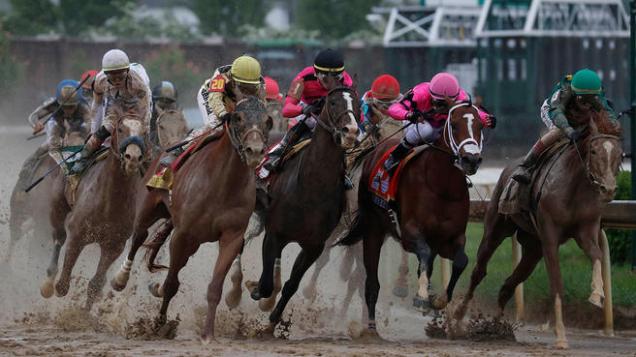
2019 Kentucky Derby Photo NBC Sports

The Democrats could learn a thing or two from the 145th  running of the Kentucky Derby–and possibly the GOP 2016 Presidential Primaries. Both races were run with a crowded field and a on a sloppy, muddy track.

The crowded Democratic field just got a front runner now that former Vice President Joe Biden officially joined the mob of hopefuls lining up like jockeys looking for the starting gate at Churchill Downs. The crowded Derby field and sloppy track conditions made for an exciting Kentucky Derby but track stewards had to adjudicate the race when the leader and favorite, Maximum Security, jumped lanes causing chaos among the field which lead them to disqualify the winner and name a long shot “Country House” the winner.   It was a tough call even using instant replay.  At least in football and baseball there are lines and definitive bases to be touched.  The Derby was a mass of equestrian flesh doing a mud-running-slide dance to the right.  It was first time in Kentucky Derby history that winner was disqualified.

But just maybe the race was similar to the 2016 GOP Presidential Primaries except without instant replay.  It would be an understatement to say that most people were mystified to see Donald Trump break from the pack and win the GOP Derby. Some may have considered his campaign a swerving mud-sliding race. It held up and he was able take the national race, too.
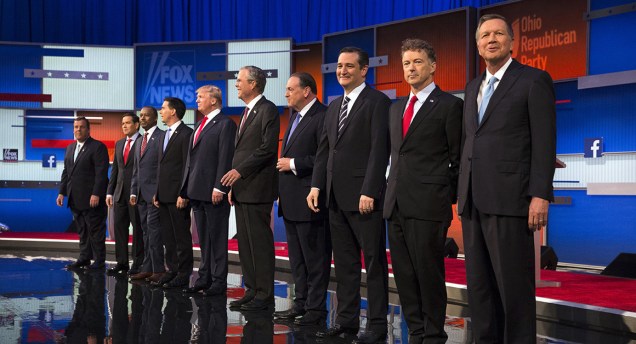
2016 GOP Presidential candidates looking for the starting gate. Politico

It could easily be argued that in the 2016 Presidential race there was no Secretariat running. One of the greatest races horses ever, Secretariat, won the Derby in 1973 with the fastest time ever: at 1:59.4. In that race “Big Red,”  Secretariat’s affectionate nickname, was challenged by Sham. Sham came in second and finished the race under two minutes, a time that would have put him in the winning circle in just about any other Derby.  Two weeks later Secretariat won the Preakness Stakes and then set another record at Belmont’s mile-and-a-half race winning easily by 31 lengths. No question about who won that race.

Unfortunately  for us, the last couple of Presidential races have not featured a Secretariat or a Sham. To make matters worst the upcoming political race can be counted not in minutes but days–more than 500 days. November 3rd 2020 is when we cross the finish line. The race for the Triple Crown takes about a month.

There are a lot of things that I am interested in.  Most of the time I know very little about them. But that does not keep me from acting like a know-it-all. For instance, I know very little about horse racing and its sister activity gambling. Two things I am clueless about.  I once read the book Seabiscuit: An American Legend.  I also saw the movie.  That would hardly make me a handicapper at the next Preakness.  I have been to one race track and have seen the ponies run–and a wiener dog race, too!  I even looked at the racing program It made me feel like a parakeet looking at himself in a mirror.  It was the closest thing to hieroglyphics without needing a Rosetta Stone published in the modern world.

I looked a plethora of coded racing information buried on those pages.  Information from previous races, winnings that also included  track conditions and when the last time the horse was exercised.  I am sure somewhere in there it had what the horse ate for breakfast. Some sort of oats I would assume.  To a novice  bettor only three things really stuck out in my mind: the name of the horse, the number of the horse and of course, the odds.  The only real information in the program that I could somewhat understand and that made any sense to me.

As I perused field prior to the running of the Kentucky Derby the name that jumped out at me was Long Range Toddy. He was running in the 18th position with odds 50:1.  I would think those odds are in the deep end of the betting spectrum  and equivalent to high risk junk bonds in investing–something else I know little about.

This leads me to another area of interest: math. My understanding of math is limited. My cursory knowledge of odds and probability comes from math classes with the classic flipping a coin or rolling one die. Two dice becomes a bit more complicated and can be likened to juggling with three or more objects–something I have not mastered.
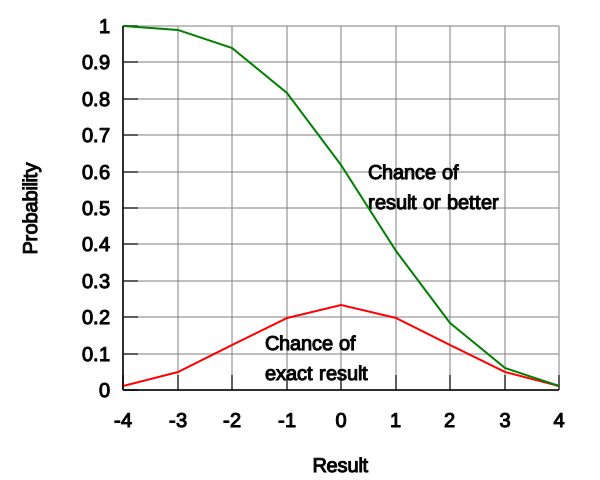
Green line “Go!” Red line “Stop!?” Go figure.


How horse racing odds are originally set is beyond me. I do know that the odds eventually come down to how much money people are betting on one horse compared to other horses. The more money bet on a horse the lower the odds and the lower the payout if the nag wins.  It all seems very democratic, sort of a peoples’ choice. A real money is free speech movement without Citizens United and the Supreme Court. The bettors set the odds. In the case of Long Range Toddy I would assume that people were not really that confident about where he will finish after running 10 furlongs.

This brings me to a furlong. What the hell is a furlong?  According to Britannica, a furlong is “old English unit of length, based on the length of an average plowed furrow.” Really.  So the distance of the race is going to be based on the average length of what a plow horse plodded back in the time when King John was signing the Magna Carta, which was 1215 for those scratching their heads on that one.

No track records being set here.

Not being a plow boy I had no idea that a furrow in Merry Old England in the Feudal era was 40 × 4-rod acre, or 660 modern feet. Here is where I get a bit confused because most corn fields, wheat fields that I have seen are square and most race tracks are round. This brings me to the question of how that translates to the oval track at Churchill Downs.  Did somebody square a circle in making 10 furlongs a mile-and-a-quarter round-about. If so, shouldn’t this sort of think be studied in school.  Who gets credit for rounding the square? Is this similar to what we learned in elementary school about Ben Franklin and electricity? Or is it more like the Electoral College, which is not an institute of higher learning, but more of  the racing stewards of elections.  The scholars wizards that ultimately decide who wins the race after all the people have laid down their bets. Or is that the Supreme Court?

This brings me to politics.  A different kind of horse race. The more I read and see the more perplexed I get. There is nobody yelling “Get your programs! You can’t tell the candidates without a program!” But even with a program I doubt if I could tell one candidate from another. We should give them numbers and fancy jockey uniforms. But rest assured, any political program would be just as confusing as watching Fox and Friends and then turning to Rachel Maddow. Are we all seeing the same race?

Say what you will about racing programs there is a consistency to the information lodged in those pages. In some ways, though, candidates  have their own programs. They come out in hardback, paperback, Kindle and Audiobook editions.  I am not sure how many people plow through or listen to these “why me now America” books. But what I have decided is that I will pick my favorite candidate by the title of their book.  It is the same way I pick races horses: by their name.

After looking at some of the books candidates have written it is no wonder Donald Trump won in 2016.  His book by far had the best title: The Art of the Deal.  The perceived front runner at the gate was Jeb Bush but his book was Immigration War combined two objectionable topics. Immigration is always an American hot button topic in any time.  War?  The war part reminds me of FDR’s 1936 where he proclaims that he hates war “Eleanor hates war, and our dog, Fala, hates war.” Jeb! that dog just didn’t hunt.

Trust in me, just in me.

And Ted Cruz’s book was even worst: A Time for Truth. Really? From a politician, truth? I hate to say it but if Trump got one thing right it was his moniker for “lying” Ted Cruz.  I am not sure how Ted even qualified to run in that race. Wasn’t he a Canadian?

Another candidate that should have been scratched from the field from the get go is Ben Carson.  Suffice it to say I am not going to go into all of  Carson’s books but I think the 2015 book, “A More Perfect Union,” was phrase already taken. No originality at all.  And after seeing Lindsay Graham’s book, “My Story,” I would ask who would really wants to know his story. When I see Graham I cannot help but think of  James Louis Petigru’s  Antebellum era statement:  “South Carolina is too small for a republic and too large for an insane asylum.”  Sad to say but Petigru was a fellow South Carolinian.
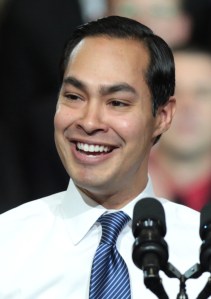
Julian Castro may be smiling now but it may be a very unlikely race.

I feel the Democrats are headed in the same direction as the GOP and the Kentucky Derby. After  looking at the names of some of the books I have to wonder who will run wire-to-wire.  I think I will play a long shot with Julian Castro with “An Unlikely Journey.” I hate to say it but after watching the 10 furlongs of the last Kentucky Derby it sounds like the next 500 days will be an unlikely journey.  But the title also sounds very Tolkin.: “The Hobbit” or There and Back Again.”  Who could not find inner strength from that brave Hobbit Bilbo Baggins.

“Where We Go From Here.” Yes , Bernie Sanders  follows up that phrase with “Two Years in the Resistance.”  This sounds like we are in the French underground fighting Nazis.  And maybe we are and I just don’t know it. But if we are,  I do not want my cause sounding anything like a question. The phrase where we go from here sounds too much like Bugs Bunny saying “I should have taken a left turn in Albuquerque.” Some think Bernie has already turned too far to the left.

Sorry Elizabeth Warren.: “This Fight is Our Fight.” I am curious about “our” in this.  I think it really means “your” as it being my fight. For those of us old enough it smacks of the 1970 TV show Chico and the Man with the late Freddie Prinze’s familiar quote: “It’s not my job man”; I get the feeling that we will get more of the fight than we signed up for. Tell it to the Marines, Lizzy. We need something more Churchillian like: Deserve Victory or (Let us go) Forward Together.

My other long shot favorite is Kristen Gillibrand’s “Off the Sidelines.” Unlike Sanders and Warren’s book titles this one sounds more like getting into the game than fighting a war. It also reminds me of being on a team:  put put me in coach.  Everybody wants to be in the game.  There are not many of us who want to ride the bench or be in the “Resistance.” What you resist persists.

Other books that won’t run are Beto O’Rourke’s “Dealing Death and Drugs.” That smacks of street gang movie that has been done many times. It’s a no brainer.  John Hickenlooper’s alcohol tinged book gives way to the Days of Wine and Roses:  “The Opposite of Woe.”  I am pretty sure I would not put any money on that horse especially with  “My Life in Beer and Politics” behind it. That sounds more like the follow up to Bret  Kavanaugh’s “I like beer” speech to the Senate Judiciary Committee. Peter Buttigieg’s “Shortest Way Home” sounds like a short cut there are no short cuts on the race track. Its a circle and everybody is going the same way from the same spot to the same ending.  You stay in your lane and you do the 10 furlongs.  Besides it sounds very Nixonian to me.  “Just get in the helicopter Dick.”

Finally, there is the front runner Joe Biden’s  “Promise Me Dad.”  I just have a feeling like Maximum Security, Joe Biden is going to end up out of the money, beaten by a Country House candidate running at 65-1. I am not sure if Horse racing has finally caught up to Presidential racing or the other way around. It’s a time where the winner or the favorite is the loser. Oh, and Long Range Toddy was way out of the winning come in 16th a long range off the lead.
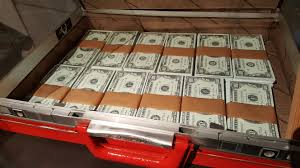
 

“Follow the Money”


Forget the collusion, if Watergate taught us anything  it was: Follow the Money.

“It’s money that matters in the US A”

It is sad to say but America is due for a big-time governmental/economic scandal of tsunami proportions. And whatever happens in the next couple of years can very well be one of seismic proportion.  Like most scandals, the next one could push the political process until it is flooded with ethical questions on government and making money.  Of course, this  is not new to America. It’s what Americans do. Push the boundaries until they snap.

Political scandals seem to roll around every 50 years or so.  What may start out as easy money in a  get-rich scheme usually turns into a Hansel and Gretel investigation of greed, which becomes a follow-the-money trail; but to those being followed it may seem like a “witch hunt.”

For instance, the United States was experiencing great growth after the Gold Rush in 1849.  Shortly thereafter, the term “Go West, young man, go West” was coined. Early pioneers went west on the Oregon Trail, a slow and a fatal trip for some. In the 1860s Horace Greeley would add to the phrase “and grow with the nation.”  But spreading Manifest Destiny via oxen driven wagons was a slow go–west.  The need for speed was apparent and wagon trails just did not meet the need.

Despite the country splitting apart fighting a Civil War,  Congress in 1862 passed the Homestead Act.  This act encouraged people to do just that:  go west.  It allowed any citizen to carve out 160 acres of public domain land and own it if they toughed it out for five years. The ultimate and probably the first no money down and zero interest deal (without a balloon payment). But farmers were not the only ones competing for these lands.  So were the newly growing corporate giants: Railroads. But their deal was a whole lot sweeter. 

Land grants to railroads started in the 1850s with the government paying railroads tens of thousands of dollars per mile to build roads, which was as good as gold to some.  The Civil War did nothing to slow this down.  In fact, with the South out of the Union, Southern opposition to northern routes was gone. It could be said that the need for speed increased as quickly as Southern states left the Union.

There is some room to  argue that railroads had played an indirect role in the start of the Civil War. Slave owners would have corporate competition for federally owned Western land and some serious “Yankee ingenuity” to contend with developing the lands. It is believed that Sectional interest on what a transcontinental railroad route should take: a southerly route out of New Orleans and through Texas and on out to San Diego;  or a more northerly one leaving out of Chicago to Sacramento. All of this just added to the fuel of the free-state slave-state balance-of-power that played into just about every government decree made; starting with the approval of the Constitution, which when simply put, was how to ensure slavery as a viable economic system well into the future.

Once the South  decided to seceed from the Union, with the belief that cotton was king, and that an enslaved workforce would generate the needed money to fight a war against a growing industrial giant, they simply forfeited any opportunity to profit in the upcoming land grab and industrialization the Gilded Age would have to offer. During this time, and into the post Civil War era, the government would give away  more than 155 million acres of land, or almost a one-third of the Louisianan Purchase.  And just as important as the land in all of this were government bonds issued to various railroads and construction companies as well as corporate stocks and bonds issued by the railroads to link the Atlantic and Pacific Coasts. These stocks and bonds could be offered to willing speculators and officials at “very attractive” prices to get the trains rolling. However, not a penny of it went to enrich or perpetuate slave owning.

When Congress passed the Pacific Railway Act in 1862, it created a race between the Union Pacific heading west from Chicago and the Central Pacific building east out of Sacramento in an effort to connect the country on a string of metal, in a 19th Century equivalent of the  Space Race that would take place 100 years later on who would get to the moon first.

Upfront construction costs had to be covered to attract investors and get the trains rolling.
The real problem was not only engineering. It was financing and getting investments for a project that was not going to return quick profits in a large amounts. Just like going to the moon,  the government was funding this coast-to-coast race. Building the railroads, like building rockets,  incurred a lot of upfront costs with very little upfront profit to attract investors.  There was no real investment infrastructure developed to build something of this size and scope.  If there was good ole American engineering know-how taking place on the construction site, there was also skillful financing taking place back East to keep the money flowing. Stocks and bond offerings and huge dividend payouts were issued and exchanged to keep money moving –even if the trains were not.  Despite government backing, the problem was always raising the needed funds. Providing the short-term profits that would create dividends to attract investors was crucial. It has been said that accounting is more of an art than a science. The principles of accounting can be as flexible as the times allow. Just look at Enron.

Never indicted, future President James Garfield took stock options that some say was a bribe.

To solve the problem The Union Pacific created the Credit Mobilier of America, a conduit to show a profit. The company was basically the Union Pacific’s private construction company that could show a construction profit despite the fact that the Union Pacific losing money. By separating the Union Pacific from the construction it still owned and controlled the construction company, Credit Mobilier. A viable company the Union Pacific could use to attract investors.  The Union Pacific could sell its and Credit Mobilier’s stocks and bonds, set up towns and sell the lots as well as sell the land granted to it from the federal government.  Nothing illegal at the time. However, Credit Mobilier also allowed the Union Pacific to divert funds from its construction company to pay dividends, sell stocks and bonds below par as a way of lining the pockets of Union Pacific’s directors and stockholders–who also owned Credit Mobilier and its stock.

To keep the rolling stock wheels greased it was important to keep Congress greased of the possible profits to be made as well with Union Pacific stocks. In an effort to keep the construction contracts coming close to  a dozen members of the House of Representatives, including the Speaker of the House, and future president James Garfield along with the sitting Vice President were buying Union Pacific’s stocks and bonds below par. As Massachusetts Congressman Oakes Ames, who was heavily invested in building the railroad, and one of its chief financial wheeler and dealers said, he wanted the stocks  “to go where it will do us the most good”: Congress.

Former Speaker of the House and Grant’s Vice President, Schuyler Colfax was accused of taking $4,000 in cash stuffed in envelopes.
In September of 1872, the birth of muckraking journalism was taking place.  The New York Sun opened up the scandal with a headline: “The King of Frauds.” This was the Gilded Age where government oversight was a concept; a time of little or no governmental banking, ethics, policies or regulations; a time when Jay Gould almost cornered the Gold Market. It was a time when Boss Tweed and his ring were ripping off New York City for millions and  “scalawags and carpetbaggers cashing in on Reconstruction.

Soon, journalist soon began asking questions about the financial comings and goings of the era.  The Union Pacific’s business practices came into questions.  In the end, the Union Pacific and Credit Mobilier fraudulently overcharged the government close to $50 million dollars, which in the Gilded Age was good business and not a crime.  It may have been hard to tell where the Union Pacific ended and Congress began.  No laws were “really” broken and only two Congressmen were censured for their profit takings.

It was during this era that the Grant Administration was hit with another scandal, The Whiskey Ring. This one actually lead to indictments  and convictions for manipulating whiskey taxes.  But it was the Teapot Dome Scandal 50 years later that saw the first Cabinet member jailed: Secretary of the Interior Albert Fall.

Here again, the country was making a shift in technology.  It was moving away from coal to oil. In 1910 the US Navy was converting its warships to oil.  Congress passed the Pickett Act that allowed the President to set aside land so that the Navy would have a reserve source of oil. The scandal gets its name from the Teapot Dome Rock in Wyoming near where the oil deposits were located.

A 1900 era Battle ship could burn 10 tons of coal in an hour.

One of the problems that plagued President Warren G. Harding was those he surrounded himself with. His campaign manager was twice investigated for federal corruption and the head of the Veterans Bureau was once found guilty  of bribery and corruption.  These “loyal” but shady characters may have had private monetary agendas in pursuing their public service.

Maybe a storm warning flag should have been hoisted up the Navy Department’s mast when Secretary Fall convinced  President Harding to transfer Navy oil reserve lands in Wyoming and the Elk Hills in California to the Interior Department. Once under Fall’s control, he leased the The Teapot Dome oil reserves out to Harry F. Sinclair’s  Mammoth Oil Company, which was a subsidiary of Sinclair Oil Corporation.  He also leased the Elk Hills oil reserve to Edward L. Doheny’s Pan American Petroleum and Transport Company, both in non competitive bidding.

Secretary of Interior Albert Fall personally cashed in on leasing oil lands

Oddly, leasing the lands was not illegal under the Mining Act of 1920. The real problem with these sorts of scandals is creative art of accounting and somewhere somebody is left out of the deal.  It only takes one disgruntled individual, in this case a left out oilman to start following a money trail of  illegal interest free loans and bribes that Fall received as compensation for his generosity to Sinclair’s  Mammoth Oil Company and Doheny’s Pan American Petroleum and Transport Company. Complaints ended up on the desk of  Senator Robert LaFollet who was chairman of the Senate Committee on Public Lands. What set the investigation off was the ransacking of LaFollet’s office. A sort of reverse follow the money investigation.

A Senate investigation revealed that Fall’s sudden increased standard of living was a bit too much. Fall, in the short time as Secretary of Interior, received more than $400,000, which is about $5 million in today’s bucks in interest free loans, cash and bonds. Something he may have gotten away with in the Gilded Age but not so much even in the Roaring Twenties.

Fall was eventually convicted of accepting bribes and paid a $100,000 fine and served nine months of a one-year sentence. Oddly his benefactors, Sinclair and Doheny were acquitted of such charges of criminal conspiracy and bribery.  However, Sinclair did spend more than six months in jail for contempt of court and contempt of the Senate.

Moving on from the Roaring Twenties to the turbulent times of Peace and Love brings us to the whopper of all scandals: Watergate.  Unlike the previous scandals that enriched those in power, Watergate was more about enriching the political power of those already in power with overwhelming amounts of cash to remain in power.  As journalist and Watergate investigators started following President Nixon’s campaign money trail a simple mantra was echoed: follow the money.

Much like the ransacking of LaFollett’s office, this scandal started as a bungled campaign-financed burglary of the Democratic Headquarters in the Watergate Building. It was an attempt to sabotage the Democrats.  Of course anyone who has followed politics for any length of time knows the Democrats do not need any help in sabotaging their efforts.  They do very well on their own.

Three convicted Nixon advisers: H.R. Haldeman, Dwight Chapin, and John D. Ehrlichman meet with the President.


But not to be deterred, and flush with cash CREEP, the Committee to Reelect the President, moved forward with other nefarious efforts like bugging phones and breaking into anti-war activists’ psychiatrist’s offices.  After various court battles over secret tape recordings, executive privilege,  a number of Nixon’s inner circle of officials and close advisers were indicted and convicted of felonies, Nixon found himself isolated in the Oval Office like a besieged Medieval king.

President Nixon’s Attorney General and Campaign Manager.
When the House Judiciary Committee approved five Articles of Impeachment Nixon was forced to flee a burning White House. He chose to fall on his sword and resign instead of standing for an impeachment trial in the Senate for high crimes and misdemeanors. However many of his close inner circle  did not escape jail. In the end,  69 people were indicted with 48 being convicted on charges ranging from burglary, conspiracy, perjury and obstruction of justice. Two of Nixon’s top aides were convicted; campaign manager and former Attorney General, John Mitchell served 19 months; and H.R Haldeman, White House Chief of Staff, did 18 months of jail time.

It could be said that both Credit Mobilier and Teapot Dome were associated with technical  advance as the country moved west or shifted its economy to a petroleum based one. A lot of the controversy surrounding the 2016 election revolves around the technical advances of the digital information age:  hacking and posting fake news items on social media. The collecting and analyzing of data and using it on a social network platforms to push sales or ideas can be done almost instantaneous.

Past scandals rubbed up against the creative art of accounting. Unlike Nixon’s reelection bid the 2016 presidential election swirls around First Amendment rights.  In the era that money is free speech social media has a lot of latitude to disseminate fake, fraudulent and downright erroneous stories without concern of any jail time or fines–and pull a profit at the same time.

Likewise the argument that there is no collusion might be easily defended  in court. There is no federal crime for collusion. According to USLegal, Inc. collusion “occurs when two persons or representatives of an entity or organization make an agreement to deceive or mislead another. Such agreements are usually secretive, and involve fraud or gaining an unfair advantage over a third party.” The third party in this case is the American voter.

Even in the digital age of information it will come down to old school money crimes of bribery and who is getting the money.  It will come down to legal crimes of  obstruction, conspiracy and perjury and not who let the trolls out from under the bridge.

The first possible waves of the next scandal could be the netting of  six former Trump advisers that include his former campaign manager and personal lawyer.  Both pleaded guilty to old fashioned money charges: bank fraud, tax fraud, illegal campaign contributions and making flat out false statements. Politics and money create some nasty campaign tactics that go beyond simple mud slinging.  Testifying before a grand jury in 1975  President Nixon said,  “It is time for us to recognize that in politics in America…some pretty rough tactics are used not that our campaign was pure…but what I am saying is that having been in politics for the last 25 years, that politics is a rough game.”

Prior to his resignation Nixon was asked if he was involved in the Watergate break in Nixon said, “The American people have got to know whether or not their President is a crook. Well, I’m not a crook. I’ve earned everything I’ve got.” Albert Fall may have agreed. He went to his grave proclaiming his innocence, saying: “My version of the matter is simply that I was not guilty.” History says otherwise to both men.


A good book to read on the transcontinental railroad is Stephen Ambrose’s “Nothing Like it in the World.”

https://www.britannica.com/list/9-american-political-scandals#googDisableSync

https://millercenter.org/issues-policy/us-domestic-policy/making-teapot-dome-scandal-relevant-again

https://www.wyohistory.org/encyclopedia/teapot-dome-scandal

https://www.americanheritage.com/node/132684

http://www.washingtonpost.com/wp-srv/politics/special/watergate/part1.html

https://www.nydailynews.com/news/politics/major-figures-watergate-scandal-sentenced-1975-article-1.2537923

https://www.nydailynews.com/news/politics/major-figures-watergate-scandal-sentenced-1975-article-1.2537923

https://www.cnn.com/2014/01/23/us/watergate-fast-facts/index.html

https://omegaworldnews.com/?p=7814

https://www.u-s-history.com/pages/h234.html

https://www.npr.org/2018/12/09/643444815/all-the-criminal-charges-to-emerge-so-far-from-robert-muellers-investigation

http://theconversation.com/theres-a-dark-history-to-the-campaign-finance-laws-michael-cohen-broke-and-that-should-worry-trump-102024

Nixon to grand jury: $100,000 cash contributions and rewarding donors with ambassadorships

https://www.vox.com/policy-and-politics/2018/2/20/17031772/mueller-indictments-grand-jury


Government shuts down newspaper after four days


Buying ink by the barrel is the easy part. Getting the newspaper printed and on the streets can be a rough be business.  We take it for granted today that freedom of information is a Constitutional protection; it was not always that way even in America.


News the government could not use.

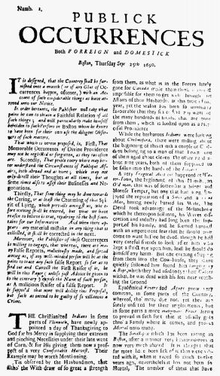
The first newspaper printed, Public Occurences, both Forreign and Domestik, hit the streets of Boston, Massachusetts on September 25, 1690 and was shut down four days later when the governor and council deemed the news printed was “sundry, doubtful” and contained “uncertain Reports.”  They also said in the decree that stopped the presses that they “do hereby manifest and declare their high Resentment and Disallowance of said Pamphlet.”

Ooo, “high resentment and disallowance.” Is that just another way of putting your fingers in your ears and repeating over and over again: I hate what you’re saying and don’t believe a word of it.

The old English writing style of the time, sounds so much more civilized using those long words with multi-syllables that just roll off the tongue like water coming down a rain spout instead of those short harsh staccato-sounding words we use today.  Much more elegant then yapping: “fake news” over and over again like a chained dog.

The end result for Public Occurences was quick and effective as the governor and his minions went about collecting and destroying all copies of the printed pamphlet. Today there is only one copy and it is stashed away in a British Museum.  This, however, was not the first time Benjamin Harris, the editor of Public Occurences, ran into government troubles with his publishing. He left Britain with similar governmental/publishing problems.

In his first and only issue of Public Occurences Harris stated three objectives. The first “that Memorable Occurences of Divine Providence may not be neglected or forgotten as they too often are.”  I am not sure what a memorable occurrences of the divine providence would be or how they are forgotten. There is, however, a story about how “The Devil took advantage of a Melancholy widower.”  This, “despite neighbors looking in on him” the old man managed to get “into the Cow-House” where they “found him hanging by a Rope…he was dead with his feet near touching the Ground.”

Public Occurences even had a health beat story about small pox ravaging the Boston area, along with other various “Epidemical Fevers and Agues (that) grow very common, in some parts of the Country.” There was even a story about two fires, one that burnt five or six houses and nearly took down the “South-Meeting-House.” All of this sounds like any “eyewitness” news report at Six O’clock with film at 11.  Hardly news that could be considered “high Resentment and Disallowance” and enough of a reason to shut down a newspaper.


A royal cocks-man and Sun King? Louis XIV

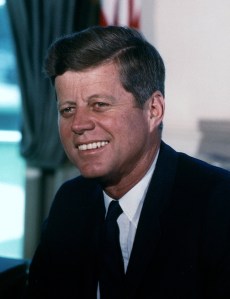
Maybe the governor and council took umbrage to the story of the sexual exploits of the French royalty.  Nothing new here. Although we lack royalty, our news is coated with sexual peccadilloes of our elected officials and business leaders. Maybe Harris knew way back in the 17th Century that sex sells. But shutting down a paper because it was reporting on the sexual indulgences of the French king does not make much sense. The French and English had been battling each other for centuries in Europe and now it is spilling over into the New World and India.  Beside the French were Catholic and the British at this point were, for the most part, Protestant with a strong dislike of the Pope.  Again nothing new here.  It was not until 196o that we elected our first Catholic president; and he had to make a public affirmation he was not under the papist spell of Rome.  No collusion there.

“I want a chief executive whose public acts are responsible to all groups and obligated to none;

Harris’s second goal was a little easier to understand. He writes “That people everywhere may better understand the Circumstances of Public Affairs, both abroad and at home.”  There was a story about the abuse and mistreatment of captured French soldiers and clashes and revenge for the numerous acts of barbarity with and against Native Americans.  This preoccupation of Native Americans would consume not only the colonial British but non-Native Americans for well into the 19th Century.  Both sides were recruiting these “miserable Savages” to fight into what really was a global struggle between the French and British.

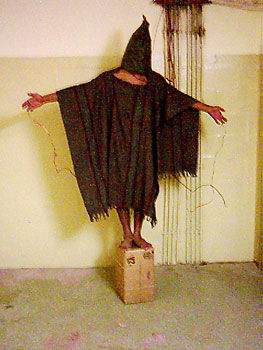
Maybe what really ticked the governor off was Public Occurences carried a story about possible abuses of French prisoners and Native Americans by the British. Again, nothing really new here.  In any war there is always a few miscreants who enjoy witnessing the discomfort and sufferings of their enemies.  Just think of the pictures of Iraqi prisoners in Abu Ghraib prison after Shock and Awe. So,  maybe the governor and council did have beef with Harris in not wanting the people to understand the particular circumstances of affairs “both home and abroad.” Sometimes it is best if the public just does not know what is really going on, or give them just all the news they see fit to print.

An Iraqi scare crow? Not hardly.
Harris also stated that his paper would print the kind of news that could at times assist people in their “business and negotiations.”  Sound like the Nightly Business Report in a pre-bull stock market era. Maybe Harris was a forward thinker in a time of growing a colonial Mercantilism system; and the governor and council felt a closed economic system would be a better benefit for the status quo investor.

Finally, and I think this is the kicker that put him over the edge with the authorities, was that Harris felt that something had to be done with the “Curing, or at least the Charming of that Spirit of Lying, which prevails amongst us.”  And with that spirit Harris says “nothing shall be entered, but what we have reason to believe is true, reparing to the best fountains of our Information.” However, if that information is incorrect he promises to correct incorrect misinformation.

Some called him “Tricky Dick” and he was known to play quick and loose with the news of the day, and had his run ins with the press.

Harris, though, takes it one step further with that belief that had to shake the powder right off governor’s curled wig.  In what could have been the first attempt at investigative journalism, a Colonial 60 Minutes, he says his paper will take “pains to trace any such false Report so far as to find out and Convict the First Raiser… (and) expose the Name of such person as A malicious Raiser.” What a concept.

It was not the news or Harris’s mission that brought his press to a halt after a four-day run.  It was the rules and regulations of the time. Harris simply printed his broadside “Without the least Privity or Countenance of Authority” The governor added the council was “strictly forbidding any person or persons for the future to Set forth any thing in Print without Licence first obtained from those that are or shall be appointed by the Government to grant the same.” What better way to stamp out “fake news,” or control any news and information, then have those with the most to hide determine who gets a license to print?

Hence, one hundred years later James Madison would add to what we now know as the First Amendment to the Bill of Rights that: Congress shall make no law …prohibiting the free exercise thereof; or abridging the freedom of speech, or of the press.”

No matter how much the powers to be claim the information to be “sundry, doubtful” and containing “uncertain Reports.” or squawking “fake news.”

Some websites to see:

https://www.massmoments.org/moment-details/first-newspaper-published-in-the-colonies.html

http://www.ushistory.org/us/7c.asp


Dueling Pistols without the Tweets

The Hero of New Orleans not only fought the British but at least 100 duels


“My God! have I missed him?”  These may have been Charles Dickinson’s last words as he looked about 20 paces from a still standing Andrew Jackson.

What started as horse racing bet gone awry, ended up as a war of words traded publicly and not via a tweet or social media.   Jackson called Dickinson a “coward and an equivocator.” Dickinson replying with a statement in the Nashville Review saying Jackson was a “worthless scoundrel” and a “poltroon coward.” And just to add some sting to the whole affair, Dickinson did not hesitate to take a swipe at Jackson’s wife, Rachael, and their marital status.

In a time before Twitter and social media,  scurrilous personal remarks could find a person, like Jackson and Dickinson, standing early one morning at Harrison’s Mills on the Red River in Logan, Kentucky starring down the barrels of loaded dueling pistols.

Dickinson was a noted crack shot and his bullet hit its mark. This 70 caliber tweet hit Old Hickory square in the chest. Jackson, however, was just too stubborn to fall.  Honor demanded a re-tweet. His shot, like Dickinson’s shot, hit its mark.  Dickinson would bleed to death and Jackson would carry around a bullet inches from his heart for the rest of his life. Eliciting a remark from an amazed doctor at the duel how Jackson managed to stand after taking a slug to the chest.

Before there were laws outlawing dueling, there were rules for how duels were to be conducted so that honor could be defended and upheld. In the Irish Code of Duello there are 25 rules outlining the proper order of restoring honor to those who feel slighted. Rule Seven is a tough one, and more than likely got Alexander Hamilton killed on the Heights of Weehawken, New Jersey. It states that “no apology can be received in any case after the parties have actually taken the ground without exchange of fires.”

It is ironic, both Tennessee and New York had laws at the time against dueling.  Both the Hamilton/Burr duel and the Dickinson/Jackson duel had to be fought in neighboring states.

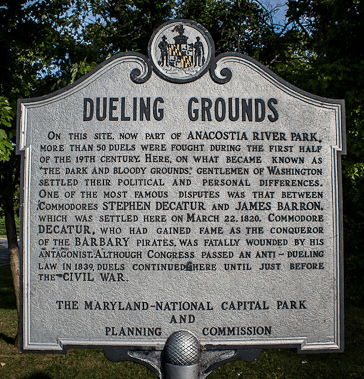
Bladensburg, Maryland was a hot spot for settling disagreements

Dueling hearkens back to classical times when established codes of honor existed: Medieval knights and damsels in distress or the Western sheriff standing down a hired gun. A code of honor, no matter how misguided we view it today, created standards on how an individual can earn honor, respect and maintain rank, particularly within a group. This respect is predicated on the “assumption” that there is equality among those who adhere to the code. It also lets everybody know when they crossed a line and the prescribed consequences that could follow after that line was crossed.

But maybe in the age of tweets and social media there is no code of honor among tweeters. Today elected leaders can exchange banalities like calling a Congressman a liar and a leaker with the same ease as ordering a pizza online. Disparaging someone’s charter online may or may not have the same repercussions as in days gone by.

For instance, one would think that the floor of the Senate would be a safe haven for social comment.  But for one Senator, it held no sanctuary  for disparaging the character of fellow senator. In 1856, Congressman Preston Brooks took his cane to Senator Charles Sumner’s head on the Senate floor after Sumner insulted his relative, and fellow South Carolinian, Senator Andrew Butler.  Sumner said that Butler had taken a mistress . . . who, though ugly to others, is always lovely to him; though polluted in the sight of the world, is chaste in his sight—I mean,” added Sumner, “the harlot, Slavery.”

According to the Senate Select Committee charged with investigating the bludgeoning, “The cause of the assault was certain language used by Mr. Sumner…which Mr. Brooks considered libelous to the State of Carolina and slanderous to his near kinsman.”

If Representative Brooks thought Sumner was a man of honor or a gentleman who adhered to a code, he may have challenged him to a duel. Instead,  he beat him about the Senate floor like an unchained dog with his cane, which is not an appropriate dueling weapon. There was no mutual respect and hence no shame in Brooks’ action.

However, when rude behavior deforms the rule of law and overwhelms proper deportment; and when a  Congressman’s actions , like Brooks’, goes unchallenged and unpunished the the rule of law becomes contorted.

Today, forget about simple etiquette there is little chance that the sender of a slanderous tweet will be publicly canned.  At worst the miscreant may lose his or her job. Shame may have been served but what about the besmeared character and honor of the victim in a time with?

Merriam-Webster says that etiquette is a French word meaning “ticket” or “label attached to something for identification.”  The French borrowed  the word etiquette from Spain where it refers “to the written protocols describing orders of precedence and behavior demanded of those who appeared in court” … “court ceremonies” “as well as the documents.” 

A bitter twitter

The French took it one step farther and applied it to “proper behavior.”  When it comes to to today’s social media there seems to be no etiquette.  It is our version of the wild, wild West without the horse and saddle. There is no code of honor among those who tweet.  This is self-evident when leaders tweet insults demeaning the character of an individual by calling them repeatedly crooked; disparaging their physical appearance by calling them fat or little; or questioning their intelligence by calling them a clown or a real dope. 

So, now it is alright to identify or tag  somebody as disabled, fat or any other school yard attribute meant to malign an individual for ridicule. There is little repercussion but a collective social media laugh.

There is no credible argument for dueling in 21st Century. It is archaic as believing in the curative properties of mercury or bleeding a person to release the accumulation of black bile in the body.  Today, we disagree with these drastic health beliefs just as much as we do dueling a way to settle an argument and maintain one’s honor, respect and integrity. The problem is complete lack of  mutual respect and a lack of shame for crude behavior.  We have no minimum standard of honor and civility just continuing downward spiral of degradation.

But just maybe there is hope after all.  ABC canceled  Rosanne Bar’s top-rated show after she tweeted a dishonorable tweet of a former government official. This was a serious foot-in-mouth racist tweet that was supposed to be taken as humor but wildly missed its mark.  For ABC,  this tweet could amount up to $60 million in lost revenue.  Fortunately for Rosanne, there is no Preston Brooks  around to beat her about the head with a cane.  Or worst, an Andrew Jackson ready to take her to the dueling grounds and educating her on the Irish Code of Duello.

Some websites to visit

https://www.geriwalton.com/irish-dueling-code-or-irish-code-duello/

https://news.sky.com/story/sad-pathetic-a-history-of-donald-trumps-twitter-insults-11123543

https://www.nytimes.com/interactive/2016/01/28/upshot/donald-trump-twitter-insults.html

https://www.history.com/this-day-in-history/andrew-jackson-kills-charles-dickinson-in-duel

https://www.artofmanliness.com/articles/manly-honor-part-i-what-is-honor/

https://www.senate.gov/artandhistory/history/minute/The_Caning_of_Senator_Charles_Sumner.htm


The Mother of all Shutdowns

Romulus leads Rome to victory

So we endure another governmental calamity: the federal government shutting down. With our love for drama nothing sells better than doomsday stories.

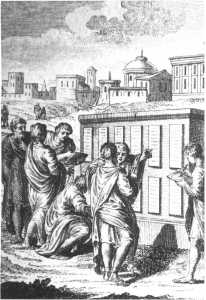
Shutting the government down is nothing new. At the beginning of the 5th Century BC Rome’s under class, the plebeians,  decided they had enough of upper class, patrician rule. They simply stomped out of Rome setting up a possible doomsday scenario.

The plebeians pitched camp on the Sacred Mount demanding that their rights and interests be addressed.  Since plebeians made up most of the soldiers in the Roman Army at the time, and since the expanding Roman city-state was constantly at war with one of its neighbors, the plebeians figured it was a good time to initiate negotiations in what could easily be called the first pre-union, sit-down strike in history. Oh, and it left Rome some-what defenseless.  Always a good bargaining chip to play in the art of the deal.

It would be a far stretch to call this the first socialist demonstration but the march out of Rome started a 200 year Struggle of Orders or the Conflict of Orders.  It  was the classic rich, noble, land-holding aristocrats versus the poor workers and farmers that also included a few non-noble well off citizens in the plebeian fold. Like most privileged-ruling elites throughout history, Roman patricians controlled most of the wealth and simply closed governmental doors behind them once they overthrew and consolidated power from the Etruscan kings who once ruled over them.

We have no Etruscan kings to overthrow.  In fact, historians are not sure what really happened to the Etruscans after the Romans wrestled control from them.  Just like the past, though, we do  have a burgeoning group of (patrician) billionaires with “charitable” trust funds that have put a firm down payment on our republic. And, although they may not shut the government down per say, their sponsored-elected elites have no problem pulling the power plug for them. This allows them to avoid the embarrassment of stomping across the Potomac like a bunch of demonic minions cast out the promised land.

Government shut downs are not new. They do seem to happen more often.  Shut downs occurred in Gerald Ford’s and Jimmy Carter’s administrations in the 1970’s and again in the ’80s  during Ronald Reagan’s administration; and twice under Clinton and once under Obama.

This does not include the numerous primate-like chest thumping rituals  the two parties  demonstrate across the aisle at one an other. Each side threatening to let the banana bunch in the middle rot so nobody gets any bananas. This lopsided-logic that a bunch of rotten bananas is worth more than one good banana is baboon backwards. And then when the media gets into the swing of things the treetop chatter soon becomes a blame game of he-said, she-said, “what about…”  and “I know you are but what am I…” in an ever spiraling drama filled-debate to sell a story and keep everybody agitated.

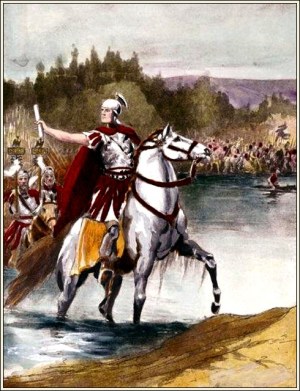
Caesar crossing the Rubicon The beginning of the end to the Republic?

Now most of us have heard about the fall of the Roman Empire but not so much about the fall of the Roman Republic.  The Roman Empire got started during the 1st Century BCE. It was teetering when Julius Caesar crossed the Rubicon River after being in Gaul. His return to Rome created a free for all civil war on who would control Rome.  Shortly there after, and for all practical purposes, Rome’s government shut down as various factions fought it out not with ballots but armies.

We are all familiar with Caesar’s assassination in 44 BCE.  Two of Caesar’s stanch allies, Mark Antony and Octavian, vindicated his death and defeated Caesar’s assassins:  Brutus  and associates. Mark Antony and Octavian then divided the former Republic between them.  But two men with  grand imperial plans soon proved that greed gets the better of any governmental agreements.  It was to be a short-lived arrangement and could be argued a pre-imperial shut down. Octavian later defeated Antony and Cleopatra in 31 BCE to become sole ruler of the newly-founded empire.  The Roman Senate then made him princeps or “first citizen” and gave him the name Augustus. After nearly a century of civil wars the Republic was dead.

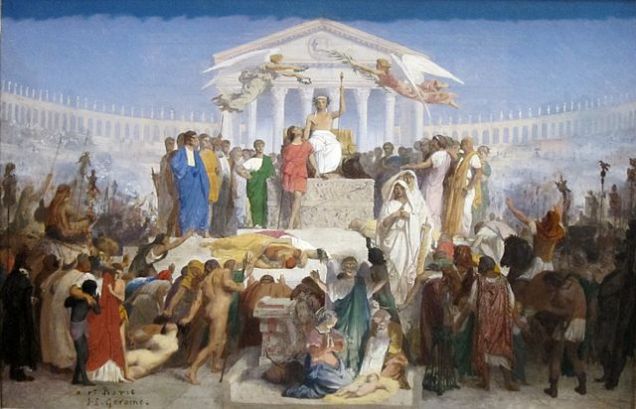
The Age of Augustus and the Birth of Christ And the death of the Repbulic

The Republic, however, began in 509 BCE when the Romans over threw of the Etruscan kings who had ruled over them for hundreds of years. Once free of the Etruscans, the Romans established a republic. One institution that carried over from the overthrow was the Senate.  This appointed body of 100 well-heeled advisers to the king was soon to be expanded to 300 of Rome’s noblest and wealthiest men.

One thing that did not carry over was a codified system of written law.  This is not to say that these patricians of the Republic were not civic or legally minded; it was more about their interest in maintaining their social position, wealth and prestige in the new republic the than putting  something legal in writing.

As Rome expanded and defeated other near-by enemies, it began creating new cities and a complex society.  Rome’s influence was growing beyond the Tiber River. Security was a prime concern as Rome had to continually defend itself against the various tribes and Gauls that would attack and plunder Rome. The security of the Republic fell on the shoulders of the farmer/soldier — the plebeian.

One vexing problem to the citizen soldier was debts.  It was not uncommon for plebeians to lose everything, including their freedom, from debt accrued while serving in the army defending the Republic. Since the Roman army at this time was made up of mostly farmers, and since Rome was at war most of this time, soldiers were not around to bring in a crop.  Also, Rome’s  invading  and marauding enemies could lay waste to soldiers’ farms putting them further in debt.

These continued wars meant that a farmer could be called into service at any time. Not only was this farmer still responsible for paying his taxes, he was also responsible for his military kit: weapons, armors etc.  Eventually these citizen-farmer/soldiers fell further into debt.  The debt left him with only one asset: his person as collateral for his debt.

There were several options open to the creditor.  However, there was very little wiggle room for the defender of Rome who now found himself in debt to his patrician overlord. The insolvent soldier could find himself without his farm, in prison, flogged or as a patrician’s indentured servant working off his debt.

Rome’s military success also brought in more public land for the growing Republic.  The problem was that these newly acquired large tracts of lands were often rented out to the wealthy patricians and not to the debt-ridden farmer/soldier. The classic scenario of the rich get richer simply because they can.

Another consequence of  Republic’s military success  was immigration. With less land available more people began to crowd into Rome increasing the urban populations. Despite the increase in the plebeian population, they were still under represented in government. The were also out voted at the polls. Roman voting was broken down in an electoral-like tiered-class structure that was heavily skewed in favor of the patrician classes with the plebeians voting last.  With majority rule it was not uncommon for the election to be decided well before the plebeians even had a chance to vote.

Laws posted on the Twelve Tables in Rome.

Eventually the plebeians were able to convince the patricians to give them government representation in the newly created office of tribune.  Tribunes had had veto power over laws. Rome also established the Twelve Tables in 450 BCE. On these tables laws and procedures were written down for all to read creating a “rule of law.”  It was the beginning of codifying Roman laws much like Hammurabi’s codes.

Unlike the plebeians march out of Rome 2,500 years ago, our governmental shut downs   are political grand stand events. It is the play of recalcitrant politicians fighting to get 15 minutes of stage time. The shut down quickly ends out of fear that maybe the plebes will realize  that we  do not need a group of spoiled patricians prancing around trying to fix some self-created government crisis.


https://nvdatabase.swarthmore.edu/content/plebeians-win-victory-rule-law-ancient-rome-449-bce-see-also-494-campaign

https://scholarship.law.nd.edu/cgi/viewcontent.cgi?referer=https://www.google.com/&httpsredir=1&article=4440&context=ndlr

http://sites.psu.edu/struggleoftheorders/

http://www.vroma.org/~bmcmanus/orders.html

http://www.historyguide.org/ancient/12tables.htm

http://avalon.law.yale.edu/ancient/twelve_tables.asp

http://news.gallup.com/poll/218984/congress-approval-remains-september.aspx?g_source=Politics&g_medium=newsfeed&g_campaign=tiles

https://www.zerohedge.com/news/2015-05-18/79-members-congress-have-been-office-least-20-years


To Boldly Earn What No Woman has Earned Before

Near the border dividing Europe and Asia south of the Ural Mountains lies the Kazakh Steppe. In this vast 800,000 square kilometer region is the Earth’s largest dry steppe. It is also the site of Baikonur Cosmodrome the world’s largest space port. It was here on June 16, 1963 that Vostok 6 launched carrying the first woman, Cosmonaut Valentina Tereshkova, into space.

Cosmonaut Valentina Tereshkova

Tereshkova’s flight was a dual mission.  She launched two days after Cosmonaut Valeriy Bykovsky left Baikonur in Vostok 5. The two later rendezvoused coming within three miles of each other. Tereshkova made 48 orbits and spent more than 70 hours in space.

Time warp to June 18, 1983. The Space Shuttle Challenger (Space Transportation System or STS) carries Sally Ride, America’s first woman in space. As a Mission Specialist on STS-7, Ride helped launch two communication satellites, made 97 orbits and spent more than six days in space.

Astoraunat Sally Ride

Two years down the flight path, on October 5, 1984, Challenger STS-41-G is launched. This is NASA’s 13th Shuttle mission and Challenger’s sixth flight.   This is Ride’s second flight on the Challenger and with her this time is Mission Specialist, Kathryn Sullivan. This is the first NASA mission with two women on board. On this mission Sullivan would become the first American woman to walk in space. Sullivan, however, is not the first woman to walk in space.  That was Cosmonaut Svetlana Savitskaya on Soyuz T-12 on July 25, 1984.

Astronaut Peggy Whitson

And just this year Astronaut Peggy Whitson broke Jeff Williams’ record of 534 days in space. Whitson is now the longest serving American in space.  She passed Williams on April 24. Whitson is due back on terrafirma from a tour on the International Space Station in September 2017.

While  women have boldly chosen to go “where no man has gone before,” four women  have died trying to go there. Two, Christa McAuliffe and Judith Resnek were on the Challenger (STS-51-L) when it exploded shortly after launch; and Kalapana Chawla and Laurel Blair Salton Clark died when Columbia (STS-107) broke apart on reentry.

Astronaut Tracy Caldwell Dyson, flight engineer, ponders the view from the Cupola of the International Space Station.

The Final Frontier does not discriminate.  The finality of space is uncompromising and unforgiving for both men and women. It deals with all on an equal footing.  But back on Earth equality is debatable. For instance, President John F. Kennedy dropped the flag on the space race with his challenge to go to the moon and back: safely.  We did this. He may have launched us into the Final Frontier but it is here on Earth his “New Frontier” was intended to bring forth civil and economic rights. A part of that program was to raise the minimum wage and for equal pay for women. Something we are still grappling about as we ponder missions to Mars and back.

A gender wage gape existed then and today that gap still exists.  A recent executive order rolled back a previous executive order dealing with the Fair Pay and Safe Workplaces order. This previous executive order was created in 2014 to ensure that companies doing businesses with the federal government adhere to labor and civil rights laws.

Women on any space-time continuum have made less then men. Women today make 80 cents on the $1 compared to men. This may not seem like a lot of money but over the span of a working career it adds up. The gender-wage gap is felt not only in a weekly paycheck but on a family’s standard of living. It also effects retirement and Social Security benefits working woman will receive. Particularly, if these benefits are based on an employees five highest years. According to median income statistics,  women make less than $11,000 a year or about a half-million dollars less over their careers then men.

It was six days before Tereshkova’s flight in 1963 that President John F. Kennedy signed the Equal Pay Act that mandates that men and women get equal pay for what is called “substantially equal” work at the same place of business. According to the Institute for Women’s Policy Research, this gap will not be closed until 2059 — almost 100 years after Kennedy signed the bill.  That would be 43 years from now — or at least a another working career. Woman may have conquered the Final Frontier but its the old frontier that pulls equal pay into a Black Hole only to be lost in space.

Some sites to visit

http://www.space.com/21571-valentina-tereshkova.html

https://www.nasa.gov/topics/history/features/ride_anniversary.html

http://www.huffingtonpost.com/entry/peggy-whitson-breaks-record-for-longest-time-in-space-by-a-us-astronaut_us_58fd9a7ee4b06b9cb917d74d

http://news.nationalgeographic.com/2016/11/astronaut-peggy-whitson-flies-iss-sets-record-longest-american-in-space-speeddesk/

https://history.nasa.gov/women.html

http://www.nbcnews.com/news/us-news/trump-pulls-back-obama-era-protections-women-workers-n741041

https://iwpr.org/issue/employment-education-economic-change/pay-equity-discrimination/

https://www.forbes.com/sites/janetwburns/2017/04/04/trump-order-drops-pesky-regulations-on-equal-pay-sexual-harassment/#1eb01385c100

Click to access gender-pay-inequality—-us-congress-joint-economic-committee.pdf

Photo Credits

Wikipedia:  International Space Station,  Sally Ride, Valentina Tereshkova

Flickr: Peggy Whitson

Money Wall


lascar_the_great_wall_of_china_4475570857
There are no figures for the unemployment rate during the Great Wall’s construction.

There has been recent talk about fulfilling a campaign promise to build a wall protecting the 2,000 mile border between the United States and Mexico from mass immigration and terrorists. A big part of the argument is who will pay for it.  It has been suggested that Mexico put up the pesos for the wall.

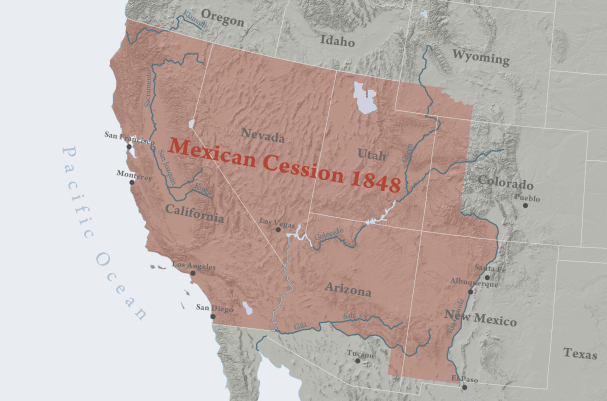
Oddly enough it was this month in 1848 the United States and Mexico signed the peace Treaty of Guadalupe Hidalgo ending the Mexican War. Part of the treaty gave Mexico $15 million and the U.S. got its Manifest Destiny “from sea to shining sea” fulfilled.

The U.S. took parts of or all of the present day states of California, Nevada, Utah, Arizona, New Mexico, Colorado, Wyoming, and Texas. Ironically, it was same year that gold was discovered in California that set the ‘49s off on the same quest for Eldorado that had the first Spanish Conquistadors two centuries earlier tramping about the Southwest in search of the lost city of gold.

The treaty basically set the borders of the two countries and set up terms of trade and commerce along the new border.  It also allowed Mexicans in the newly acquired territories to remain in what is now the United States.  Within a year these Mexicans would become citizens. Of course that was 169 years ago.

mexican_cession
Manifest Destiny fulfilled.

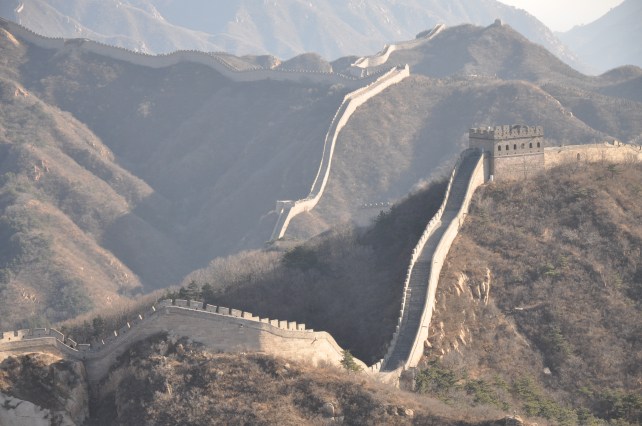
This campaign-inspired 2,000 mile wall would be the most ambitious under taking of constructing a wall since the first emperor of China, Qin Shi Huang, ordered nearly 300,000 soldiers, peasants and convicts to begin building the 3,000 mile wall known as The Great Wall. The Great Wall was started around 220 BCE and it would be safe to say this was not a jobs project despite the longevity.  It took centuries to complete, rebuild and maintain.  The wall was intended to keep back invading hordes.  Later it was to protect trade and commerce along the Silk Road.  It is believed that 400,000 people died building the wall and according reference.com to this centuries-long construction project set the Chinese back about $360 billion. Now, China is cashing.  The wall is a tourist destination with more than 10 million visitors a year.

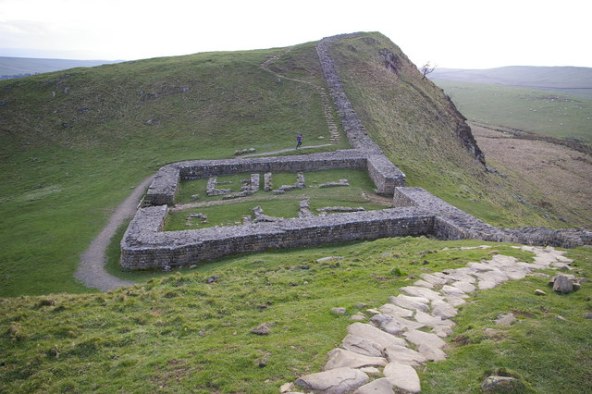
Another tourist destination is on the other side of the Earth is in England: Hadrian’s Wall. Roman Emperor Hadrian came to the outer most reaches of the empire in Britannia in 122 AD. And again it was to keep the uncivilized rabble out. He decided that a wall was needed to keep Britannia barbarians at bay.

hadrins-wall
Hadrian’s wall now is a great walking path.

Although not as ambitions as the Great Wall, this 73 mile wall runs from sea-to-sea and was designed in efficient Roman style.  Roman military engineers and soldiers of three legions systematically placed gates, mile castles, observation points and forts along the wall to allow rapid deployment of troops.

It took 14 years to build the wall. It is probably safe to say this was not a jobs project any more than the Great Wall  Romans had no problem putting conquered people to work. Hadrian’s Wall was one of the biggest building projects undertaken up by the Romans. That is saying a lot because the Romans were not shy about civil engineering, or the use of slave labor for infrastructure projects like aqueducts and roads, public baths and sewer systems. Today tourist can take a 10 day walking tour along the paths trodden by legionaries and barbarians alike.

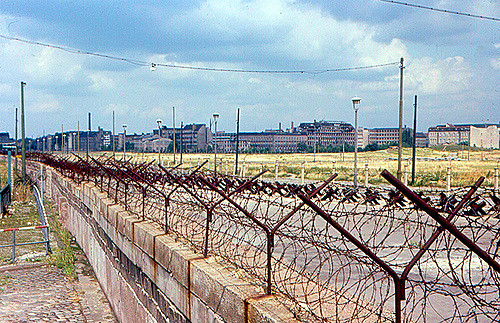
Historians have debated how successful these walls were in keeping people out.  But if a wall keeps people out the converse is true. East Germany, under Soviet Union’s control, saw the exodus of nearly 3 million people from 1949 to 1961 into West Germany.  In June of 1961 19,000 people left East Germany through un-walled portions of West Berlin. On August 12, 2,400 people, the most ever to leave in a single day crossed over to West Berlin.

When it was first built the Berlin Wall was not tourist friendly

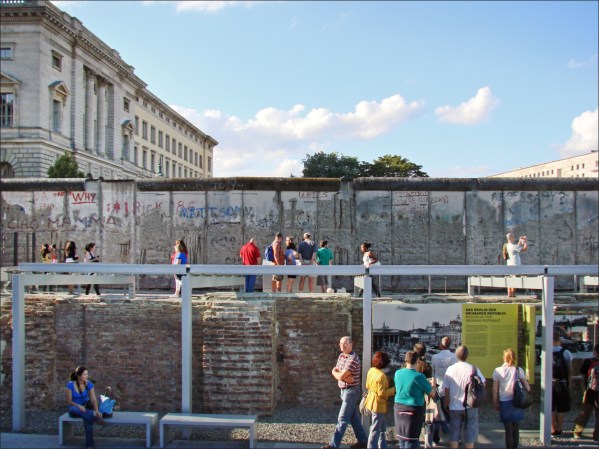
The East Germans had had enough of this mass exodus. On August 13, East German soldiers, policemen and “volunteer” construction workers began sealing off the two halves of Berlin with barbed wire and concrete block walls. It only took the Germans two weeks to get the make-shift wall up.  By 1980 there would be 90 miles of walls with, electric fences, and barbed wire and watch towers splitting the two Berlins and surrounding West Berlin.  According to CNBC this splitting cost $25 million or $200 million adjusted for inflation.  Today, ten to twenty million people annually visit Berlin, and no doubt a few stop off to see sections of what is left of the Berlin Wall.

topographie_de_la_terreur_berlin_6329720680
Fascists viewing the wall?

East Germany said the wall was designed to keep the fascist West out.Official figures  list 139 people were killed trying to cross the wall.  There is no record of a West Berliner climbing over the wall to get into East Germany. The grim reality was to keep East Germans in.

Walls by their very nature attract people. When these walls were built they were not designed to attract tourist but were built with a military purpose to keep people out. When it comes to building “The Wall” on our Southern Border maybe we should skip the security aspect of “The Wall” and go right to the tourist attractions.

Instead, make it a “jobs” project. At a recent press conference President Donald Trump said he was going to be the “greatest jobs producer that God ever created.” Creating “The Wall” could send tens of thousands of unemployed and underemployed Americans to the border for jobs. Politician from California to Texas and then some could join the president in boasting about how many new jobs they have created.

But jobs are just the beginning. It seems apropos that a real estate mogul, a builder of sky scrapers, golf courses and casinos would propose building a 2,000 mile wall.  A recent estimate is it will cost more than $21 billion dollars to build and take at least four years to complete.  A simple solution to defer some of the cost is to privatize “The Wall.”   Instead of strategically placed forts let developers and corporations bid to build casinos, spas, amusement parks  and golf course that could attract international tourists.

Companies could lease out sections of wall plastered with their logos much like cities do with football and baseball stadiums.   Wall artists could buy sections and paint “The Wall.” There could be Mexican Wall Marathons.   Hollywood could use sections  of “The Wall” for outdoor theater openings for movies.  There are endless possibilities. Building “The Wall” creates jobs and could be a prefect public/private partnership that could be profitable for everybody — even Mexico.

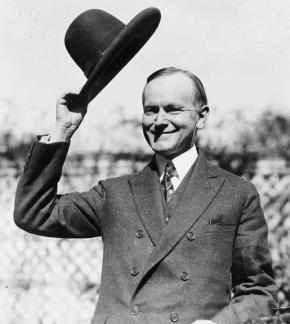
coolidge_after_signing_indian_treaty
Silent Cal smiling away.


We should all remember the words of our 30th president, Calvin Coolidge: “The business of America is business.”  No country in the world does business better then US.

Websites to check out

http://www.reference.com

http://www.english-heritage.org.uk/visit/places/hadrians-wall/history/

http://www.history.com/topics/cold-war/berlin-wall

http://www.history.com/news/history-lists/7-famous-border-walls

https://10mosttoday.com/10-most-famous-walls-in-the-world/

http://www.cnbc.com/2015/10/09/this-is-what-trumps-border-wall-could-cost-us.html