Nazis and the black hole of historical analogies

“Say what you want about the tenets of National Socialism, Dude, at least it’s an ethos.”

Walter Sobchak from the movie “The Big Lebowski

I think anytime anyone starts to use the words Nazis and Hitler as some sort of reference point in any situation they should stop. Disengage mouth. Whatever you where about to say, make as some sort of observation or association to, compare and contrast to, or make a general opinion, or bloviate on about the Naizs and Hitler it should be swallowed and properly evacuated from your mind and body. Do not regurgitate or cogitate on it or even think about mentioning it because it is going to get you in trouble. Particularly, if you are about to make some sort of comparison and contrasting about Nazis to the present day. It will never work. There tenets or ethos do not fit anything. Nazis do not have a place in the modern world any more than a buggy whip has a use in rush hour traffic.

There is this huge fascination with Hitler and Nazis. Walter Sobchak is probably right that the Nazis had an ethos. American Heritage Dictionary says that an ethos is “the disposition, character, or fundamental values peculiar to a specific person, people, culture, or movement.” By that definition Hitler and his fellow fascists have created continual character-cultural upheaval in historical interpretation.

It is always perplexing, but not surprising, how easily people fall into the Nazi abyss. Numerous politicians and celebrities have jumped into this historical black hole. It is a place where intellect and understanding go to die. That is as far as I am going to go in my Nazi comparing and contrasting. It is way too easy to get sucked into the void. And there never is a good explanation as to why you decided to go there. In most cases it ends up as half-witted apology for being historically challenged and somewhat ignorant.

A black hole is a place in space where gravity pulls so much that even light can not get out. The gravity is so strong because matter has been squeezed into a tiny space. This can happen when a star is dying.

Because no light can get out, people can’t see black holes. They are invisible. Space telescopes with special tools can help find black holes. The special tools can see how stars that are very close to black holes act differently than other stars.

NASA.com

We are fortunate not to have to deal with black holes at this time in our human existence. It is, unfortunate however, that we still have to deal with Nazi ideology and its ability to squeeze intelligence into a tiny space. A good example is former President Trump’s take on Hitler and his relations with his officers. In their book, The Divider, published online by The New Yorker, Peter Baker and Susan Glasser recount how, Trump brought up a comparison to Hitler and his generals. According to The New York Times, “The excerpt depicts Mr. Trump as deeply frustrated by his top military officials, whom he saw as insufficiently loyal or obedient to him.”

The Times of Israel reported that the “Former US president Donald Trump clashed repeatedly with his generals over his desire to hold a huge military parade in Washington, DC, lamenting that they weren’t showing the same devotion that he claimed Hitler enjoyed.”

“I swear to God this holy oath
that I shall render unconditional obedience
to the Leader of the German Reich and people,
Adolf Hitler, supreme commander of the armed forces,
and that as a brave soldier I shall at all times be prepared
to give my life for this oath.”

Wehrmacht Oath of Loyalty to Adolf Hitler

Trump was after a Fourth of July grand spectacle on the lines of Roman Triumph that would make France’s Bastille Day look like a Little League opening-day parade. According to excerpts, the Vice Chairman of the Joint Chiefs of Staff, Air Force General Paul Selva suggested it was not such a good idea to have a grand military review: “it’s what dictators do.”

According to The Israel Times, “Trump grew “frustrated.” He felt “the generals were not exhibiting blind loyalty to him.” He asked his Chief of Staff, retired Marine Corps general John Kelly: You fucking generals why can’t you be like the German generals?” A reference to Hitler’s Wehrmacht generals of World War II.

Trump should have stopped his comparison and stepped back from the abyss. It was too late. The Nazi black hole was now sucking all of the light, intelligence out of the room, and in particularly Trump’s brain. Nobody is immune. It does not matter if you are an Ivy League graduate or a plumber’s helper, there is no vaccine for this sort of absurdity. Kelly’s response reveals just how little Trump knew about the Nazis when, Kelly told Trump, “You do know that they tried to kill Hitler three times and almost pulled it off?”

This sort of imbecility is not constrained to one party or even one continent. Politicians from both parties have said stupid stuff interpreting current events and then comparing them with Nazi ethos and imagery. Politicians have compared border detention facilities to concentration camps, vaccines to the identifying yellow star worn by German Jews. Others have said “while I don’t agree with Hitler, you have to admit what he accomplished in his lifetime is impressive.” There is so much wrong with that statement I cannot begin to comment except: the black hole. One Tennessee state politician saw Hitler as a rags to riches success story of true inspiration. Hitler, rising from homelessness to greatness. The brainless politician did not stop there but continued on saying that living on the street “it’s not a dead end.” That homeless people can draw inspiration from the life-and-times of an Austrian vagabond. “They can come out of these homeless camps and have a productive life.” I am not sure how productive Hitler’s life was but then I guess it is how you view a productive life and “impressive” accomplishments.

And then there are people who have handlers like the British monarchy. For instance in 2005 The Sun reported, along with a photo, that Prince Harry was at a party dressed in a Nazi “uniform… under the headline ‘Harry the Nazi.'”

“The Duke was later photographed wearing the uniform at a party causing public outrage, according to royal biographer Robert Lacey.” You think?

“Many observers, however, missed the point: obviously the 20-year-old Harry wasn’t really a neo-Nazi, as one Labour MP alleged….The lad was naughty, not a Nazi.” There is no point to be made. Stupid is a better description. I do not think it was gravity that squeezed the gray matter between his ears to a point of “what was I thinking?” He wasn’t. And I do not think anybody, even the Brits, considers the House of Windsor a citadel of intellect.

What people tend to forget is the death struggle taking place between Britain and the Nazis in World War II. Winston Churchill spurred on the his country telling them that they would fight on the beaches, on the landing grounds, in the fields, streets and hills:. To paraphrase Churchill we shall never surrender…into the grip of the Gestapo and all the odious apparatus of Nazi rule.

There really is no comparison or contrasting National Socialism ethos. It’s a warped understanding of Social Darwinism: racial superiority, ethnic cleansing and biologically improving the human race with selective beliefs on human existence. It has a complete contempt for democratic principles based on the rule of law.

National Socialism and Hitler stand alone in history. And, yes, they need to be studied and understood not compared to. Unless it is to Stalinism.

https://www.timesofisrael.com/report-trump-demanded-his-generals-be-loyal-like-german-generals-were-to-hitler/

https://www.newyorker.com/magazine/2022/08/15/inside-the-war-between-trump-and-his-generals

The Ever Shifting Political Winds of Original Intent

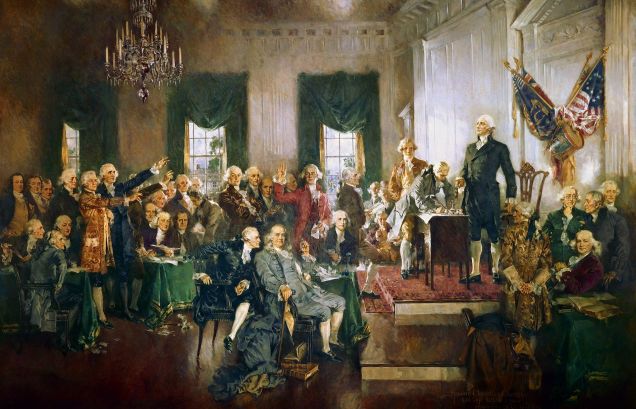
Signing of the United States Constitution with George Washington, Benjamin Franklin, and Alexander Hamilton left to right in the foreground.
Public domain, via Wikimedia Commons
Howard Chandler Christy.

Whenever a big issue comes before The Supreme Court, the phrase “original intent” gets smacked around like an air hockey puck in an arcade. I am always perplexed as to what that actually means. There were 70 men appointed to revise the Articles of Confederation in 1787. Of those 70, 55 really showed up–most of the time– and of the 55 only 39 actually signed onto the new Constitution. Of the 55, none were whisked into the future or clairvoyant enough to say, “what a minute guys I think we may have to rethink this privacy issue. And while we are at it we might want to rethink the gun thing.”

My guess is we would be lucky if most Americans could name more than five or six men from 12 states that gathered to amend the Articles of Confederation for a new Constitution. I would guess that most Americans would be able to name James Madison. He is a no brainer. Most of us learned in history class he was the father of the Constitution. Then there was the 81 year-old Ben Franklin. Most people probably associate him with flying a kite in a lightning storm but he was there. George Washington was the president of the convention as was one of his surrogate sons, Alexander Hamilton.

After that I would say most Americans are going to start guessing. If you were to guess two of the more prominent men of the times: Thomas Jefferson and John Adams you would be wrong. Jefferson was ambassador to France and Adams was in England. Patrick Henry of “give me liberty or give me death” fame was a no show. He stayed in Virginia, saying he smelled a rat.

For those that really paid attention in their history classes they might be able come up with Roger Sherman or William Patterson. Both of these men proposed plans to counter Madison and George Mason’s idea on representation called the Virginia Plan. Sherman from Connecticut, proposed the bicameral compromise we see today in Congress. According to the State of Connecticut Judicial Branch Law Library Services Sherman’s compromise “prevented a stalemate between states during the creation of the United States Constitution.” The stalemate was between the more populous state and the less populated states on how to determine representation in the new Congress. In the unicameral Congress of the Articles of Confederation each state had one vote. Interestingly today, people are questioning how two states like North and South Dakota have four Senators while California has just two. Go ask Roger Sherman. It was his idea.

But what do we really about the other members of the convention. What was the intent of William Few of Georgia or Luther Martin of Maryland? Few signed off on the Constitution while Martin left Philadelphia and went back to Baltimore distressed with the proposed governments powers over “states’ rights.” Several other delegates left over the same concerns. Others because there was no bill of rights.

A shallow dive into the internet on the Constitution will lead us to the premise that there were plenty of rats in the walls–and disagreements from the beginning, particularly how to determine representation in the Congress. It took a long hot summer but those who roughed it out came up with a bunch of compromises some call “original intent.”

One thing the Framers could agree upon was the financial shortcomings of the Articles of Confederation. Government spending and revenues is an issue for any government and the states struggled individually and collectively to fund a central government. Plus, private business and commercial transactions suffered under 13 different interests, particularly those commercial dealings between states and foreign trade. The states didn’t need an Articles of Confederation upgrade 2.0. What was needed was a complete new application. Basically, the original intent of the Framers of the Constitution was to come up with workable form of government that they all could agree on–something that we lack today–to replace a cumbersome confederation. It would be safe to say that not all of them got all of what they wanted. Hence, compromise all the way up and down the process.

What is interesting about “original intent” is that it took less than 20 years after the Constitution was approved before men like Alexander Hamilton and Thomas Jefferson separated the country into factions–or what we would call political parties. George Washington was not even in his grave before these two, and their followers, began feuding over original intent of the Constitution, and what the new government was to be. Hamilton wanted a bank and Jefferson wanted to buy the Louisiana Territory from France. Neither desire was a power expressly delineated in the 4,543 word Constitution. Both used original intent to get what they wanted.

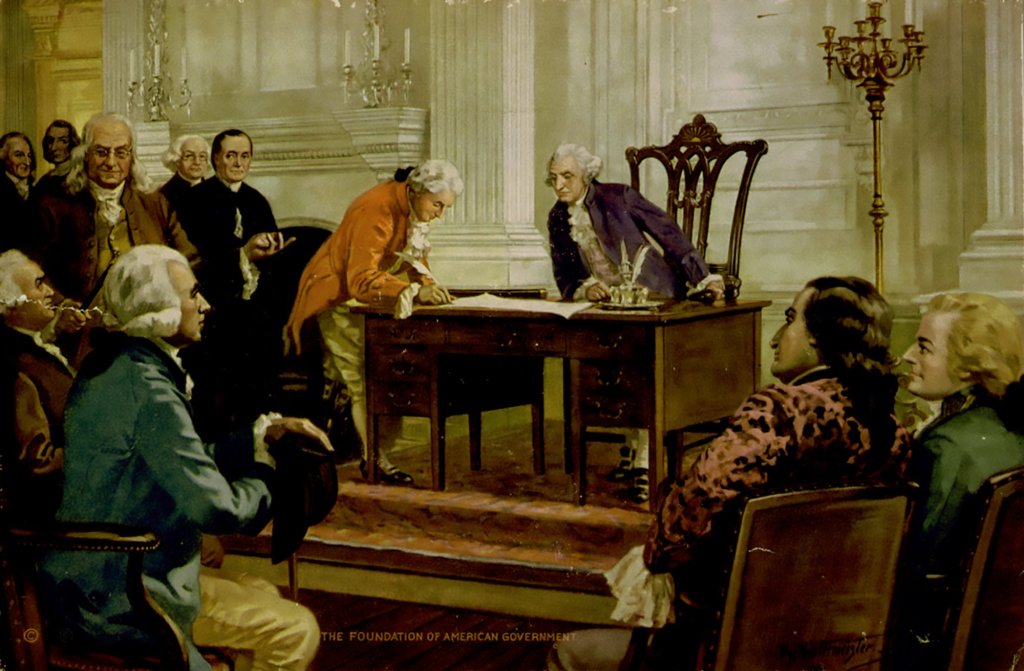
“Signing of the Constitution. At the desk sits Washington watching Gouverneur Morris sign; behind Morris are Roger Sherman, Ben Franklin, Robert Morris, Madison and others, and at right Alexander Hamilton and Edmund Randolph. Sherman and Robert Morris were the only two framers that signed the Declaration of Independence, The Articles of Confederation and the Constitution.
Foundation of the American Government by John Henry Hintermeister by Published by the Osborne company, Newark, N.J. From the painting’s copyright description:

We can surmise that the framers intended the Congress to be the real seat of power in the new government. The first Article in the Constitution deals with the legislature–Congress. Afterall it was the King’s unchecked executive power that got them all up in arms in 1776. And remember, The Articles of Confederation was a government that had no executive authority (Article II of the Constitution).

The one place that original intent gets thrown around the most concerns Supreme Court decisions, and rightly so. Take the recent overturning of Roe v Wade and repealing of a half century old the New York gun control law. The Framers did not put a whole lot of intent into Article III (the Judicial Branch) except to say “The judicial Power of the United States, shall be vested in one supreme Court, and in such inferior Courts as the Congress may from time to time ordain and establish.

Although the Constitution provided important details for the legislative and executive branches, it did not flesh out the judicial branch of the new national government. For example, no one knew whether there would be any federal courts other than the “one Supreme Court” mandated by the Constitution, or how many judges would sit on the Supreme Court, or what sorts of jurisdiction any lower federal court might have. So, one of the First Congress’s first and most important duties was to establish the federal judiciary.

Encyclopedia.Com

Article III is about 500 or so words. When it came to dealing with the courts, the Framers either took a knee or punted the ball to the future Congress. In 1789 Congress approved the Bill of Rights and passed the Judiciary Act of 1789. It created the position of Attorney General and the beginnings of a court structure. From the time the first Congress met, there have been at least 10 Judiciary Acts passed and one in 1802 which repealed some provisions of the act passed in 1801.

The Judiciary Act of 1801 makes Senator Mitch McConnell’s yo-yo approval of justices during an election year look minor league. It was a last gasp grasp to hold onto judicial power. The Federalists could see which way the power was flowing on the Potomac. Thomas Jefferson’s presidential victory over John Adams was the beginning of the end of the Federalist Party. However, in their dying days, just before Jefferson was sworn in, they passed an act that was referred to as the Midnight Judges’ Act. It reduced the number of Supreme Court justices from six to five. It also increased the number of federal judgeships to 16, all filled by Federalists. Original intent or power politics?

Currently there is a proposal in Congress that would expand the Supreme Court from nine judges to 13. So what is “original intent” but the ever shifting political winds. In this case the political winds coming from the Senate in deciding when to approve Supreme Court justices to control the political aims of a particular party. Is this advice and consent?

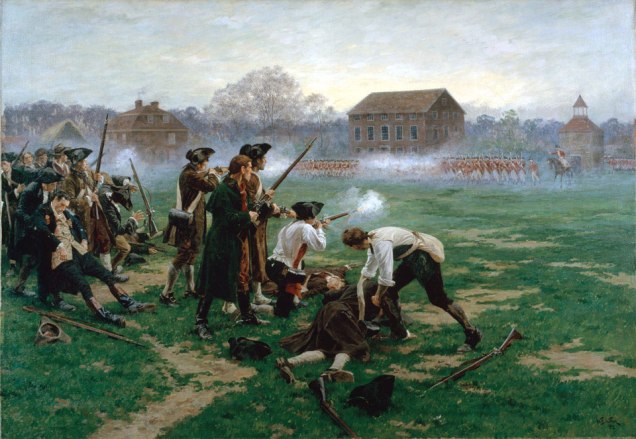
It becomes difficult to determine what the Framers intended. The Constitution is a broadly written document. For instance Article II, Sec. 2 gives the president power to appoint government officials, like judges with “the advice and consent of the Senate.” That’s it. The Second Amendment is another example of broad reading with the first phrase of “a well regulated Militia” getting read out of the equation. Modern warfare, like so many other aspects of our lives today, has changed drastically since 1700 that men forming up with arms on the town’s Common Green is as anachronistic as a Knight of the realm defending a damsel in distress. Under the auspices of the Second Amendment’s “right to bear arms” original protects a 17 year-old boy to cross state lines with an automatic weapon to participate in a civil disturbance. A far cry from those who mustered on Lexington to meet the British in 1776.

The Battle of Lexington
William Barnes Wollen National Army Museum Wikimedia Commons

Which brings us to the Fourth Amendment which states: “The right of the people to be secure in their persons, houses, papers, and effects, against unreasonable searches and seizures, shall not be violated…” Let’s keep this context of the time. The Constitution was written in the time of hand press printing machines. It was not until 1843 when newspapers could print out a million pages using the steam-powered rotary press. We now have satellite technology, digital mail and instant electronic communications. We have witnessed the extinction of the evening newspaper; the disappearance of local newspapers and the slow disintegration of the Postal Service. These are 19th, 20th and 21st Century difficulties, events and advancements unforseen by the 18th Century Framers.

“All printing was still done on hand presses, the output of which remained 200-250 copies per hour, a rate essentially unchanged since the invention of printing in the second half of the 15th century.”

HistoryofInformation.com

The genius in the Framers’ original intent were the compromises, being specific enough to establish a workable government but yet vague enough to allow Hamilton to establish the Bank of United States and for Jefferson to double the size of the United States and kick off Manifest Destiny. What makes the Constitution one of the greatest documents written is its flexibility to adapt to the times the Framers could not have intended or foreseen.

https://www.jud.ct.gov/lawlib/History/Sherman.htm

https://www.archives.gov/founding-docs/founding-fathers

A Broken Social Contract

There is something fundamentally wrong in this country when a school, or a place of worship, a hospital, or a grocery store becomes the hill to die on. These are not the places in which we should make our last stand as if we were manning the parapets of the Alamo. The children in the Uvalde, Texas elementary school did not volunteer to be on the front lines of a mass shooting. 

There is something fundamentally wrong when we even think about hardening schools and other places to protect ourselves from assaults that should never happen. It seems as if our right to assemble is being infringed upon by the a belief in a right to bear arms anywhere one please. 

Our government is based upon a social contract between the people and its government. Congress is failing to uphold its end of our social contract. Its do nothing attitude only exacerbates the situation. 

In order to protect ourselves and our property, we may not know it but we agree to a social contract. It is not the sort of contract one would sign in a business deal or for a home mortgage loan. And probably for the most part, this contract can be as fuzzy as the terms and conditions every time we click agree to download an app—we have a vague idea of what we are agreeing to, despite it being written down.

A social contract is something handed down. As long as humans have huddled together going as far back as hunters and gatherers; or associated in more formal settings in villages. We agree to some sort of social structure that holds the community, and eventually a country together. At first it was understood. Later it was a formally written social contract. 

Our Declaration Of Independence is based on the Enlightenment reasoning of a social contract between, in this case, a king and his colonies. The Declaration of Independence presents many ideas from the Enlightenment, particularly the concept that the founding principle of a government shall be to effect the “safety and happiness” of the people. And the people, have a natural right to life, liberty and property.

For those that have forgotten their middle school civics, a social contract is pact between the government and the governed. It is a concept developed from Enlightenment thinkers. The individual gives up some of their personal freedoms to the government so that the government can protect and maintain social order. This concept, when you think about it, was contentious and dubious to those in power. Look at how King George the III balked at being told how to run his empire, particularly by a bunch of upstart colonials. 

It ancient times it was probably very hard to establish an equitable social contract when pharaohs were considered gods; and kings, who may not have been gods, were authorized to rule in a belief of some sort heavenly “divine right” of kings. Crossing the king, after all, could lead to earthly vengeance, which was nothing compared to eternal damnation from a god and a king. A lethal combination in the hands of a tyrant.

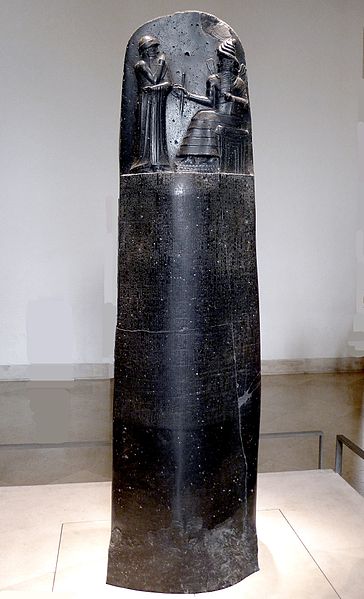
Hammurabi’s seven foot basalt stele at the Louvre with his famous codes chiseled in stone.
Hammurabi, CC BY 3.0 https://creativecommons.org/licenses/by/3.0, via Wikimedia Commons

The establishing of some sort of rule of law began around 1750 BCE. Babylonian King Hammurabi chiseled 282 laws into a stele column known as Hammurabi’s code. The code began to establish a rule of law over business, family, property and commercial activities. The dos and don’ts of the civilized man were starting to be cast in stone. The Old Testament tells of Moses coming down Mount Sinai with the Ten Commandments binding the Israelites to a religious/social code. 

Around 450 BCE the Romans would codify the beginnings of Western law with the Twelve Tables. According to World History Encyclopedia “the Twelve Tables was a first step which would allow the protection of the rights of all citizens and permit wrongs to be redressed through precisely-worded written laws known to everybody.” 

At times it appears as if our social contract is vague with ever changing attitudes and opinions shifting like the sands of a desert. These brings new meaning to old beliefs.  What is unique about our social contract is that it can be examined with reason forcing us to critically evaluate simple phrases and beliefs like: “separate but equal.” It is also flexible enough to move with the times and can be amended for those times.

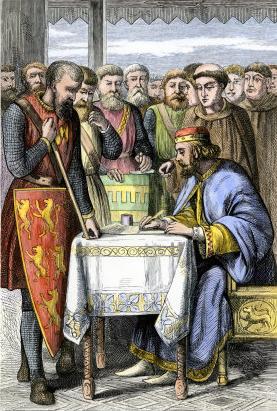
For example, in June of 1215, in the midst of a civil war, English barons wanted the king to shift his attitudes in respect to certain rights and privileges the barons felt needed addressing. Without knowing it these barons expanded the concept of a social contract. The barons, tired of King John’s divine rule, forced him to accept the idea that fealty needs to run both ways. King John signed the Articles of the Barons later known as the Magna Carta. 

King John being showed where to sign the Magna Carta.
unknown, held by The Granger Collection, New York

According to history.com, Of its 63 clauses, many concerned the various property rights of barons and other powerful citizens, suggesting the limited intentions of the framers. The benefits of the charter were for centuries reserved for only the elite classes, while the majority of English citizens still lacked a voice in government.” For the “lower classes” of English society the concept was most of us are so far “under the law” it does not even apply to us. Pity the poor farmer who killed a baron’s stag for dinner. 

Beginning in the 1600s a period of  Enlightenment and the Scientific Revolution, an era of reason took hold in Western Europe. Old beliefs like the solar system revolving around the earth were spiked through observation, moving thinkers of the time away from religious and Medieval mysticism. From this reasoning came a belief that man had natural rights that could not be taken from him. This reasoning developed new ideas on economics that helped to stimulate trade and industry. It birthed new ideas on the relationship between the governed and those doing the governing.

History.com says,  “There was no single, unified Enlightenment. Instead, it is possible to speak of the French Enlightenment, the Scottish Enlightenment and the English, German, Swiss or American Enlightenment. Individual Enlightenment thinkers often had very different approaches. John Locke differed from David Hume, Jean-Jacques Rousseau from Voltaire, Thomas Jefferson from Fredrick the Great. Their differences and disagreements, though, emerged out of the common Enlightenment themes of rational questioning and belief in progress through dialogue.” 

Today we lack that type of dialogue where rational reasoned thought can create an environment of accomplishment. Instead, we look at winning and losing as the only acceptable dialogue. And then, we still dispute the results. Fox News commentators spew their comments and opinions out during the day to be taken up later on by late night talk show hosts, who then roast these comments over the open pit of comedy. This is not reasoned dialogue. It does not promote “the general welfare or secures the blessings of liberty to ourselves” or anybody else. 

Politicians and pundits from the left and the right throw out all sorts of reasons —and conspiracies theories, modern mysticism—for the cause of what is going on in our governments, communities and generally our day-to-day lives. Social Media then reenforces and puts everything on hyperdrive. These opinions and jokes become facts. Most of these opinions are unsubstantiated beliefs and go beyond jokes to the ridiculous. Some pontificate and dream about the way things use to be (but never really were).  And how they should be now. These opinionated misconceptions have shaken the social contract that holds our country together. 

Our social contract is our Constitution. It established a system of government that enacts laws and enables that government to operate with the consent of the people. But as of late we have too many elected officials, urged on by the lunatic fringe, reevaluating how to use the Constitution to twist what the social contract means to their specific beliefs. It is about winning and owning the other side that reenforce their beliefs and what our social contract means. Winning allows them to control who should be judges and how election results are counted. Our social contract is not a belief to the victors go the spoils.

When is reasonable behavior, logical and justifiable for an 18 year-old boy to cross state lines with an assault weapon to confront demonstrators. We get bogged down in what one or two clauses in an Amendment. We pull it, play with it and stretch it around like a ball of Silly Putty as to what we want it to mean. We completely disregard the Preamble of the Constitution, our country’s mission statement. 

 …establish Justice, insure domestic Tranquility, provide for the common defence, promote the general Welfare, and secure the Blessings of Liberty to ourselves and our Posterity,…

Preamble to the Constitution

The recent mass shootings is probably the most obvious breach in the social contract. Today people cannot go out in public without the possibility of being in the middle of a shoot out that makes the O.K. Corral gun fight look like a tea party. The social contract works best when a majority of the people agree to the contract and the government responds to that agreement. 

To often the contract is tacitly understood. But in reality we know what is right and what to expect.  This is a mark of civilized country when people have a basic understanding of what is right for the majority. When we refuse to surrender a small portion of our individual freedoms for the greater good, and believe it is more important of have political victory instead of reasoned thought we subvert the concepts espoused in the Declaration of Independence and the Preamble to the Constitution. When we feel that “the right to bear arms”—assault weapons— is a Constitutional and natural right, and non-negotiable we refuse to look at the greater good of “promoting the general welfare” of our nation, and the social contract that allows our government to ensure that welfare. Nothing is cast in stone.

Our Constitution’s Second Amendment “the right of the people to keep and bear Arms” was penned more than 230 years ago. A time before metallic cartridges and breech loading rifles let alone machine guns and assault rifles. Killing 20 people with a muzzle loading rifle took the work of more than one man. An 18th Century musket cold be reloaded in about 15 seconds. A trained soldier could accomplish the task in five-to-eight seconds. This was the reality of constitutional original intent.

A well regulated Militia, being necessary to the security of a free State, the right of the people to keep and bear Arms, shall not be infringed.

The Second Amendment

Logic and reason would tell us that individuals do not need assault weapons for security any more than one would need a flamethrower or Claymore mines to protect their home. The Second Amendment becomes a black hole of debate that pulls in states’ rights, militia, National Guard, deep state paranoia and what Congress can and cannot “infringe” upon.

It is interesting that we do not have any debate about the Eighth Amendment’s “cruel and unusual punishment”clause. Our social contract forced the Bush Administration to stop using what was called “enhanced interrogation techniques” on suspected terrorists. There was some debate as to what was “cruel and unusual.” But eventually there was a consensus.

Excessive bail shall not be required, nor excessive fines imposed, nor cruel and unusual punishments inflicted.

Eighth Amendment

Our government regulates and outlaws a variety of activities, products and goods. We do not have a Constitutional right to get stoned. The federal government, however, has made first-time possession of small amounts of marijuana a misdemeanor that can land you in jail for up to a year with a $1,000 fine. Attitudes and beliefs about marijuana have changed drastically. The same may be said about guns.  Most Americans would agree that we have the right to own guns.  The social contract looks to the government to protect that right.  However, the social contract also protects our right to assemble safely. Therefore reason would dictate it is also a part of the social contract to control what kinds of arms the citizenry should have; who can own them; and where those guns can be carried. 

Dark Horse Candidates and the Odds a Florida Man will be President

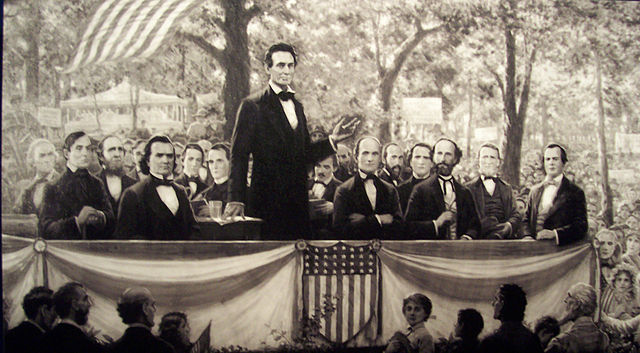
Abraham Lincoln and Stephen Douglas debating 1858 Illinois Senate race.
Cool10191, Public domain, via Wikimedia Commons

It was in May of 1859 in Chicago that the Republican Party nominated Abraham Lincoln, a one-term Congressman to be their presidential candidate. He was just the second Republican to run for president, the first was John C. Fremont. Lincoln snagged the nomination from several more promanitanely known candidates like New York governor William Seward. As a dark horse candidate, he ended up beating his long-time Illinois Democrat adversary, Stephen Douglas and a host of other presidential contenders to become the 16th president.

Back in August of 2018 I wrote: It’s 20/20 Trump in 2020. Now that he is a Floridian it adds a whole new dimension to the headline: “Florida Man…” I have never been one to make predictions, particular political outcomes involving the intelligence or intent of the voting American. But with Trump and Governor Ron DeSantis as possible candidates we have just added another joker into the presidential political deck. It was only a matter of time. Florida is too large a state for its lunacy to be contained to a peninsula dangling off the southeast coast.

I am not the gambling type to run out and place a bet on any sort of game of chance. The reason I would never go beyond speculation, particularly on a political outcome, is because there are so many unsuspecting people ready to hit on any colorful looking bait put in front of them. Particularly with DeSantis starting to chum up the social waters with one-sided issues. Baseless conspiracy theories have always been around but they are now the creed of the day. As P.T. Barnum said so “many people are gullible, and we can expect this to continue.” DeSantis is like Orson Welles in War of the Worlds. Only he is creating a “woke” Armageddon invasion instead of Martians from outer space. DeSantis is spewing social frenzy instead of some alien death ray. He has produced political panic and has both sides running from the end of the world as they perceive it. It is like two dogs chasing the same tail in different directions.

“All voting is a sort of gaming, like checkers or backgammon, with a slight moral tinge to it, a playing with right and wrong, with moral questions.”

On the Duty of Civil Disobedience, Henry David Thoreau

Although I did not wager any money on the 2020 election, it did appear to many that Trump was the odds on favorite against Joe Biden. Unlike, Trump who looked like he would go from wire-to-wire, Kentucky Derby winner, Rich Strike, came from way in the back as an 80-1 odds on favorite to win. It was an amazing race. Watching Rich Strike move up through the pack, a dark horse running down the leaders. Unfortunately for the country, Trump and his followers could not invision “45” being run down. To many, it was obvious that the only way Old Slow Joe could win was if the election was rigged–or just outright stolen.

I don’t think the election was stolen. The reason has more to do with the theory of large numbers, which in my non-mathematical mind explains several events. The theory, according to learning-theories.com, “states that the greater number of times an event is carried out in real life (in this case people going to the polls to vote) the closer the real-life results will compare to the statistical or mathematically proven results.” Simply put, when 150 million plus people vote, we realize that there are more Democrats or non-Republicans voters than there are Republicans. The GOP comes up short. Hence, the great unequalizer: The Electoral College to the GOP rescue.

The 2020 election was a real wake up call for the GOP. Since 2000 they have lost all but one of the popular vote in Presidential elections. They do however, manage to squeak out Electoral College victories. When nearly 67 percent of eligible voters vote, we realize that the theory of large numbers dooms them. Hence, the cry of stolen election: the need to control the judiciary branch, Gerrymandering, and enacting voting laws to control and restrict voter turn out to around 45 percent. This evens out supposedly left-leaning the playing field.

When scientists complete research studies, they make decisions about how many people will be in the study. This is an important decision because small sample sizes can greatly skew results due to the presence of anomalies. The larger the sample size, the more the results will reflect the true nature of the population that is being studied.

learning-theories.com

But every now and then a dark horse, a candidate, like Derby winner Rich Strike comes a long, a horse that runs the field to win it all. It is strange how in sports we can accept the “Cinderella” team the underdog, the dark horse that comes in and takes it all. In the 1980 Winter Olympics America, and the world, watched as a group of college kids and amatures beat a professional Soviet Union hockey team in a game that was later called “The Miracle on Ice.” The Soviet hockey team had won four Olympic Gold Medals beginning in 1964. The last time this team lost an Olympic hockey game was in 1968. To many it was a miracle; but sometimes the longshot pays off big. Despite the game being played in America, nobody claimed the USA’s 4-3 victory was rigged.

We always have had long-shot presidential candidates, too. Every election has at least one or two. Most never make it out of the primaries and past the clubhouse turn. However, there have been several dark horse candidates that won the presidency. The first was James K. Polk who upset The Great Compromiser, Henry Clay, in the 1844 election. There have been others.

Dark Horse Presidents

  • James K. Polk 1844
  • Franklin Pierce 1852
  • Abraham Lincoln 1860
  • Rutherford B Hayes 1876
  • James Garfield 1880
  • Warren G. Harding 1920
  • Harry S Truman 1948
  • Jimmy Carter 1976
  • Barack Obama 2008
  • Donald Trump. 2016
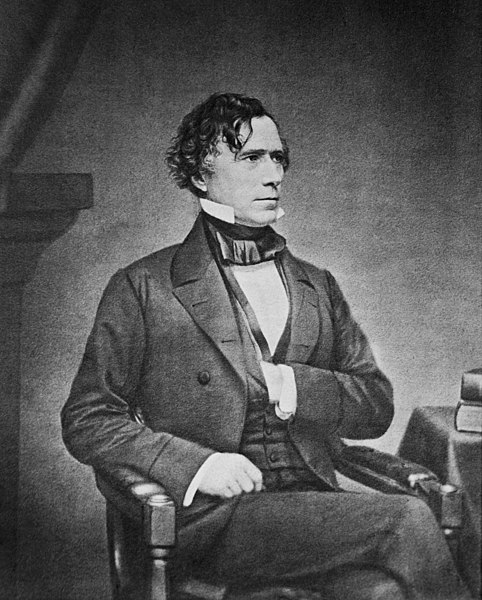
Franklin Pierce, the 14th President defeated James Buchanan and Sam Houston for the Democratic nomination for president in 1852.
Wikimedia Commons

A side note to the list, and not a real pleasant one is that two of the dark horses were assassinated: Lincoln and Garfield and a third, Harding, died in office from a heart attack. Another was impeached–twice. And as of now, Polk, Pierce, Hayes, Carter and Trump were all one-term presidents.

It would seem to me that it is even money that both Trump and Biden will both be one-term presidents simply because of their ages. Trump is 75 and Biden is 79. Both of these old over-the-hill Plugs are way past their prime racing years. Granted, the issue of either of them running is not settled. It could become, literally and figuratively, a question of them simply making the walk to the starting gate let alone actually run in a race.

In 2016 there were crowded fields in both parties primaries. According to an ESPN article from August 2016, Hillary Clinton was coming off at 1-1, Jeb Bush 7-2, Bernie Sanders at 12-1 and Ben Carson as the long shot at 100-1. At the time Joe Biden was a 14-1 odds on favorite to win the 2016 election. Trump was considered a long shot. However, some may argue Donald Trump is never a long shot despite coming in at 14-1, like Old Slow Joe in the 2016 election.

There is a possibility that the 2024 election could be a repeat of the 2016 primary elections–a crowded field loaded with dark horses. And it could be a messy, muddy race. The 2016 primaries, particularly the Republican party’s looked more like some sort televised professional wrestling match with candidates smashing each other over the head with folding chairs and then being tossed over the top rope like somebody emptying a garbage can over their fence and into their neighbor’s backyard: in broad daylight.

A real GOP donnybrook primary could pit, Trump ensconced in his Palm Beach Mar-a-Lago citadel against two other Floridians: Governor Ron DeSantis and a real dark horse, one who is so dark he is dark matter, Senator Rick Scott.

If we look to P.T. Barnum for wit and wisdom we can find some possible descriptions for their campaigns. Trump’s could be that “More persons, on the whole are humbugged (that is bombarded with deception, deceived for the advantage of others) by believing nothing than by believing too much.”

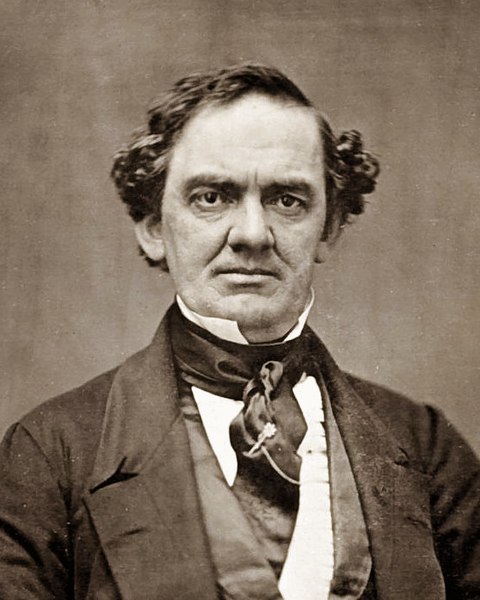
P.T. Barnum: “The common man, no matter how sharp and tough, actually enjoys having the wool pulled over his eyes, and makes it easier for the puller.”
Harvard Library.Public domain, via Wikimedia Commons

Trump is all about the humbug. Trump has a lot to say. But what he says is like drinking a Diet Coke with a bag of Doritos and a Snickers bar for breakfast. It tastes good and will fill you up–with empty calories. There is plenty there but nothing of any nutritional value. It certainly is not the “Breakfast of Champions.” As long as Trump is around our intake of empty rhetoric will just bloat our minds with empty ideas: sweet to the brain but void of substance. The more he dishes out the more America wants. Trump’s rhetoric keeps America on some sort of sweet and sour sugar high. He fogs the brain. It is like when Moe of The Three Stooges asked Curly what was the matter and Curly replies, “I am trying to think but nothing is happening.”

There’s no way to sugarcoat the truth–Americans are eating more sugar than ever before. Researchers from the University of North Carolina at Chapel Hill determined that, on average, Americans are consuming 83 more calories per day from caloric sweeteners than they did in 1977. And those extra 83 calories a day turn into a whopping 2,490 calories per month.

NorishWebMD.com

DeSantis on the other hand is more like “without promotion something terrible happens, nothing.” For the longest time the GOP was the party of limited government. It took Thoreau’s concept “that government is best which governs least.” DeSantis legislative self-promotion style proves that a lot of ideas go from debatable to terrible. He is in some sort of pre-presidential race with the master self-promoter, Trump and Governor Greg Abbott of Texas. DeSantis’ is in a right-wing downwind race with Abbott. It is a promotional campaign gone goony. They both seem to be at their best pushing vindictive policies. One clogs the border crossing with trucks backed up for miles causing Texas, businesses and the country billions of dollars. DeSantis meanwhile is chasing Tinkerbell around the Magic Kingdom. Both states probably would be better off if their governors just did nothing. Basically they prove what Thoreau said that “it is the fault of the government itself that the remedy is worse than the evil. It makes it worse.”

Then there is Rick Scott. He is the real Flori-duh man. A dark horse. He falls into the category: “You know, I had rather be laughed at than not noticed at all.” Somehow he keeps getting re-elected in Florida. He is a curious political phenomenon and proves what Barnum said that “Nobody ever lost a dollar (or an election) by underestimating the taste of the American public.” In this case the Florida voter.

Scott is like dark matter. Scientist really do not know what it is. And I am not sure Florida voters know what Scott really is either. According to spaceplace.nasa.gov, “Dark matter is stuff in space that has gravity, but it is unlike anything scientists have ever seen before.” That sort of explains Scott’s rise to power in Florida. He is an unknowing political game of 20 Questions: Is he corporate billionaire; a possible CEO Medicare fraudster; a sentient being; or leader of the growing lunatic fringe?

Astronomy.com says that “most astronomers say the majority of the cosmos consists of dark matter and dark energy… Dark matter works like an attractive force.” This may explain how Scott keeps getting re-elected. The dark energy of the universe pulls in unsuspecting voters. Conversely, Scott, like dark matter, “doesn’t reflect, absorb or emit light” so it might be tough to notice him. Until he becomes president.

Forget about a dark horse winning the next presidential election. Without a doubt we will probably elect somebody who is more dark matter than dark hours. Especially if we have two, possibly three, Floridia men running for the GOP Presidential nomination in 2024. We will then learn that there is a deeper meaning to the headline: Florida man…

https://www.espn.com/chalk/story/_/id/13386269/donald-trump-odds-improve-12-1-win-us-presidential-race-2016-chalk

https://www.history.com/this-day-in-history/u-s-hockey-team-makes-miracle-on-ice

https://www.nbcnews.com/politics/elections/sen-rick-scotts-agenda-seen-challenge-mcconnell-gop-rcna17435

https://www.webmd.com/diet/features/beware-empty-calories

Is there anything in Ukraine that Russia makes better?

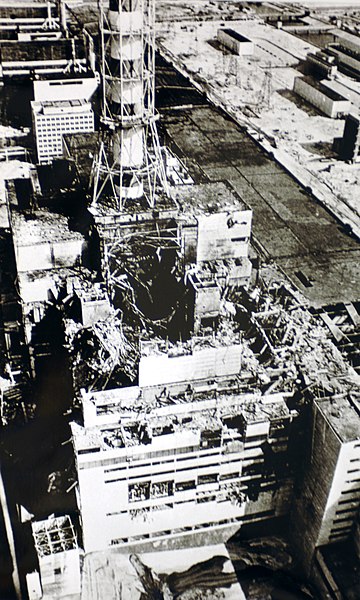
Not too long after the Russian army attacked Ukraine, in its special operation, Russian troops entered the nuclear exclusion zone and then seized control of the Chernobyl Nuclear Power Plant. It was 36 years ago this month that the Unit Four Reactor took a major nuclear dump. I am not sure what an armored unit would want with the plant. One could only hope it was some sort of weird dark ecotourist excursion to observe wildlife. Some believe that they may have gone into Chernobyl to retrieve or destroy data stored at the site. Or maybe just to see what happens when a tank column drives over radioactive ground. Or maybe they were just plain stupid. In any case, they stayed long enough to expose troops to one of the most toxic places on earth before they left.

Reactor Unit 4 shortly after it blew its top.
IAEA Imagebank, CC BY-SA 2.0 via Wikimedia Commons

The Chernobyl Nuclear Power Plant basically melted down and then blew its top on April 26, 1986 sending clouds of radiation debris 30,000 feet into the sky across Europe. About 650 miles away, at Sweden’s Forsmark Nuclear Power PLant, alarms went off. When no radiation leak was detected the Swedes looked southeast to the prevailing winds. The Swedes caught the Russians hanging out their radioactive laundry in the breeze, creating what is possibly the worst nuclear disaster on the books. Today we are seeing a different kind of Russian-made disaster in Ukraine. And so far, it is not nuclear.

At the time of the Chernobyl meltdown, Ukraine was just one of 15 republics that comprised the Union of Soviet Republics, or simply the USSR. When the Berlin Wall fell in December of 1989, the USSR as we knew it started to crumble–but did it. In August of 1991 Ukraine declared its independence. By December the other 14 former republics followed.

Russia’s is once again hanging out its dirty laundry. Its military meltdown in Ukraine begs the question: has Russia learned anything from history in the past 40-to-50 years. It seems they forgot about their Afghanistan debacle to add another defacto communist republic to their empire. Their efforts failed miserably on indoctrinating the tribal people of the Hindu Kush to the Soviet/Marxist brand of worker solidarity and socialism. But probably one reason they failed in Afghanistan was the lack of urban centers they could disintegrate.

And to further prove a point, they did not garner anything from our 20 years of failed nation building in Afghanistan. Twenty years of running down the Taliban and we are almost at the same place we started. And lest not forget our eight year attempt in Iraq to make the world safe for democracy–and from terror. But it could be possible that Russians did learn something from our adventures of in trying to avoid collateral damage and civilian deaths in Afghanistan and Iraq. Russian battle doctrine appears to be all out death and destruction. Of course all of this is open for future historical debate.

I cannot help but think that the recent Russian invasion of Ukraine is their Chernobyl of military disasters. You would have to go back to the Russian-Japanese War in 1904 to see a real Russian beat down. Czar Nicholas II picked a fight with the Japan and their newly Westernized navy. The Japanese sunk both Russia’s Pacific Fleet and its Baltic Fleet. The Baltic Fleet had to travel 20,000 miles to join the Pacific Fleet at the bottom of the ocean. Nicki-two, like Putin, was looking to expand Russia’s empire. Both leaders were convinced that their adversary would roll over and beg for terms. Putin’s court eunuchs do not appear to be anymore clairvoyant than Nicholas’s when it comes to picking fights with palookas.

Ukraine is a Russian created humanitarian crisis just shy of Biblical proportions. All the while, a disbelieving world watches and wonders: how could this be. Targeting and destroying civilian infrastructure may have been a winning strategy in World War II, Chechnya and Syria; but pounding away at urban areas and cities with rockets and artillery is not winning over the hearts and minds of anybody. It has created a women and children exodus. According to the UN refugee agency more than 4.6 million Ukrainians have left Ukraine. That’s around 10 percent of the population escaping a Russian created hell. For Putin, I would say he is somewhere in Dante’s Seventh Ring of Hell, violence, working his way to down the to center of hell to join the ultimate sinners like Judas Iscariot.

Speaking of Biblical proportion, when you look to the past it is not hard to see why the Ukrainians do not want anything to do with the Russians. Joseph Stalin’s famines of 1932-33 ranks up their as a Category Five disaster. According to History.com: “The Ukrainian famine—known as the Holodomor, a combination of the Ukrainian words for “starvation” and “to inflict death”—by one estimate claimed the lives of 3.9 million people, about 13 percent of the population. And, unlike other famines in history caused by blight or drought, this was caused when a dictator wanted both to replace Ukraine’s small farms with state-run collectives and punish independence-minded Ukrainians who posed a threat to his totalitarian authority.” This is what passes for a comprehensive Five-Year Russian agricultural plan–kill anybody that wants something to eat.

And then there is Chernobyl. I have recently started reading Adam Higginbotham’s book: Midnight in Chernobyl, The Untold Story of the World’s Greatest Nuclear Disaster. I did not get far into the book when I realized that some things have changed in Russia, but a lot of things have stayed the same. Higginbotham writes that: “Advancement in many political, economic and scientific careers was granted only to those who repressed their personal opinions, avoided conflict and displayed unquestioning obedience to those above them…blind conformism had smothered individual decision making at all levels of the state and Party machine, infecting not just the bureaucracy but technical and economic disciplines.” This is the Soviet Union in the 1970s and ’80s. But could very well be Czarist Imperial Russia of the past or Putin’s Russia federation of today; and Uncle Joe Stalin’s Soviet Union in-between.

There is a general belief that in a closed autocratic government there is no free flow of ideas moving up and down the chain of command. As Higginbotham writes about the USSR in the 1970s: “Party leaders and the heads of large enterprises–collective farms and tank factories, power stations–governed their staff by bullying and intimidation.”

Higginbotham also writes that: “Lies and deception were endemic to the system, trafficked in both directions along the chain of management: those lower down passed up reports to their superiors packed with falsified statistics and inflated estimates, of unmet goals triumphantly reached, unfulfilled quotas heroically exceeded. To protect his own position, at every stage, each manager relayed the lies upward or compounded them.” The question has to be asked: Are these the guys you want designing, building and operating the nuclear power plant down the street; or in the next country over.

“This short sequence indicates the reactor floor and steam tanks overlaid over the explosion crater. It is an extract from the full video “Chernobyl – an inside look 3d” – all own work by Tadpolefarm.”
Tadpolefarm, CC BY-SA 4.0 https://creativecommons.org/licenses/by-sa/4.0, via Wikimedia Commons

When Unit Four at the Chernobyl Nuclear Power Plant blew its top at least two people died in the explosion and another 30-50 died soon after. According to the World Nuclear Association, world-nuclear.org, “The plant operators’ town of Pripyat was evacuated on 27 April (45,000 residents). By 14 May, some 116,000 people that had been living within a 30-kilometre radius had been evacuated and later relocated.” Within a month, less than 90 miles from Chernobyl, more than 360,000 children and pregnant woman began evacuating Kiev. Ukrainians have had practice in trying to outrun Russian mistakes and aggression.

“Soviet physicist had been so confident of the safety of their own reactors that they had never bother indulging in heretical theorizing of beyond design-basis accidents*.

Midnight in Chernobyl

With Chernobly there was lingering health problems from the radioactive contamination. It is believed that it took 600,000 “liquidators” to clean up the nuclear debris caused by the meltdown. It is possible that at least 6,000 of those liquidators died from the clean-up effort.

Today in Ukraine, the UN High Commissioner for Human Rights estimates that there have been at least 4,232 civilian casualties: 1,793 killed and 2,439 injured so far in the so-called Russian denazification of Ukraine. However, some Ukrainian leaders in besieged town of eastern and southern Ukraine believe that number to be much higher, particularly after the discovery of massed graves in the city of Bucha. Some Ukrainian officials believe Russian troops have killed close to 400 civilians there.

All of this makes you wonder if Putin and his generals bothered to indulge in heretical war games as to possible outcomes in developing their special operations that bears more like an apocalyptic science fiction alien invasion . And if war itself is not brutal enough it looks to get worse, Putin’s new Ukrainian general, Alexander Dvornikov, known as the “Butcher of Syria” for his penchant at targeting civilians is now in command in Ukraine. Retired US Navy Adm. James Stavridis, a former Nato commander, told NBC News: “He is the goon called in by Vladimir Putin to flatten cities like Aleppo in Syria,” Stavridis said. “He has used tools of terrorism throughout that period, including working with the Syrian forces, torture centers, systematic rape, nerve agents. He is the worst of the worst.” A comedian once joked that we should never challenge worse by saying it can’t get worse.

The question that needs to be asked: Is there anything in Ukraine that the Russians have made better?

*Design-basis accident is “a postulated accident that a nuclear facility must be designed and built to withstand without loss to the systems, structures, and components necessary to ensure public health and safety.” United States Nuclear Regulatory Commission

https://www.history.com/topics/japan/russo-japanese-war

https://www.bbc.com/future/article/20190725-will-we-ever-know-chernobyls-true-death-toll

https://world-nuclear.org/information-library/safety-and-security/safety-of-plants/chernobyl-accident.aspx

Again with the Russians

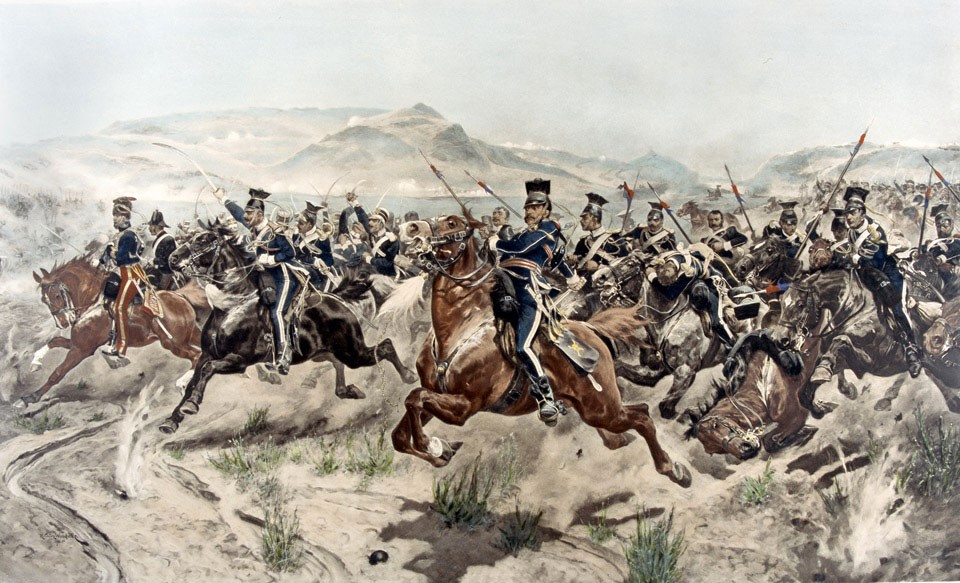
“The Charge of the Light Brigade” British Cavalry attacking Russian guns in October of 1854 during the Crimean War Richard Caton Woodville, Jr., Public domain, via Wikimedia Commons

“Plus ça change, plus c’est la même chose “ – the more things change, the more they stay the same.

French writer Jean-Baptiste Alphonse Karr, 1849

Once again European countries are trying to contain Russia. This time in Ukraine. Countries like Poland and Ukraine sit at the crossroads of history. This inevitable scenario has played out many times before with the Huns in ancient times heading west, to Napoleon in 1812 and Germans in 1914 and 1940 in modern times moving east.

Containing the Russian bear has been the task of many European powers for generations going back as far as Peter the Great and Catherine the Great. In the 1850s it was The Crimean War. European powers contained Czarist Russia from moving into the Middle East. There were religious overtones to this conflict as Czar Nicholas I wanted more rights and access for Orthodox Christians in the Holy Land, which at the time was under the Turkish Ottoman Empire. Plus, Russia was looking to Constantinople, (now Istanbul) as a ticket through the Bosphorus Straits and into the Eastern Mediterranean Sea. Something the British, in particular, did not want to see happen.

Before long Britain, France, the superpowers of the time, joined and Sardinia joined Turkey in checking Czarist ambitions. The British, in particular feared that any Russian expansion could jeopardize their trade with Turkey and India. Add to that, neither Britain nor France liked the idea of Russian ships in the Mediterranean Sea. The land war turned to siege and trench warfare. A battlefield ground plan that would be later played out in WW I. Although the death toll in this war pales to later European wars, this three-year war from 1853 to 1856 killed an estimated 650,000 people.

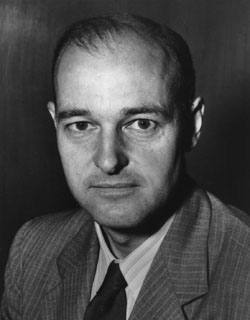
Jump forward about 100 years to February of 1946. George Kennan, charge d’affaires in Moscow and diplomat who helped establish the US Embassy in the Soviet Union in 1933, wrote a “long telegraph,” to the US State Department. According to history.com, the telegraph was 8,000 words. History.com summarized by writing: “The lengthy memorandum began with the assertion that the Soviet Union could not foresee “permanent peaceful coexistence” with the West. This “neurotic view of world affairs” was a manifestation of the “instinctive Russian sense of insecurity.” It went on to say that “Kennan was convinced that the Soviets would try to expand their sphere of influence, and he pointed to Iran and Turkey as the most likely immediate trouble areas.” Leading the West to believe that the communist threat had to be contained.

US diplomat, George Kennan, who realized first hand the need to contain Russian territorial ambitions.

Kennan writes that, “Soviet pressure against the free institutions of the western world is something that can be contained by the adroit and vigilant application of counter-force at a series of constantly shifting geographical and political points…” Although the Soviet Union as we know it is not around now, the pressure on free institutions is still being applied with either cyber applications and political interference of free elections; or as in Ukraine: tanks.

“Russian rulers,” Kennan wrote, “have invariably sensed that their rule was relatively archaic in form fragile and artificial in its psychological foundation, unable to stand comparison or contact with political systems of Western countries.” And granted, Kennan is writing about Marxist, communist leaders like Josef Stalin. Vladimir Putin may not be a Marxist in the old traditional way. The question arises is there a hair’s difference between him or any past Russian ruler, czar or otherwise.

For those who lived during the Cold War it was always an international incident away from a hot war, one with nuclear weapons. Kennan’s idea of “containment” was one that kept the lid on explosive tensions for most of post World War II. But there were incidents with Russian tanks rumbling through Eastern European capitals to quell a popular uprising: East Germany in 1953, Hungary in 1956 and Czechoslovakia in 1968. The Ukrainie invasion or as Putin is calling it is not an invasion or war but a “special military operation.”

Call it what it really is, an invasion, a war. Putin’s invasion falls into the same overt aggressive overtures that the West was facing after WW II. To counter those communist threat to war torn Europe, President Harry Truman in May of 1947 announced The Truman Doctrine. According to the State Department’s Office of the Historian The Truman Doctrine “established that the United States would provide political, military and economic assistance to all democratic nations under threat from external or internal authoritarian forces. The Truman Doctrine effectively reoriented U.S. foreign policy, away from its usual stance of withdrawal from regional conflicts not directly involving the United States, to one of possible intervention in far away conflicts.”.

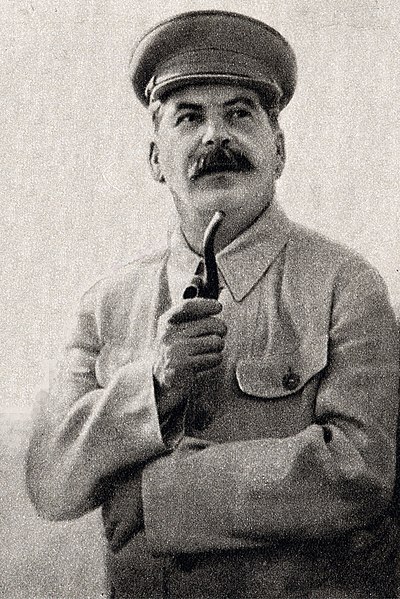
Uncle Joe Stalin. Always gazing off to the West. Unknown author, Public domain, via Wikimedia Commons

One leader who took exception to this new doctrine was Josef Stalin. Officially the “General Secretary of the Communist Party of the Soviet Union and Chairman of the Council of Ministers of the Soviet Union, premier. To most he was just a brutal dictator.

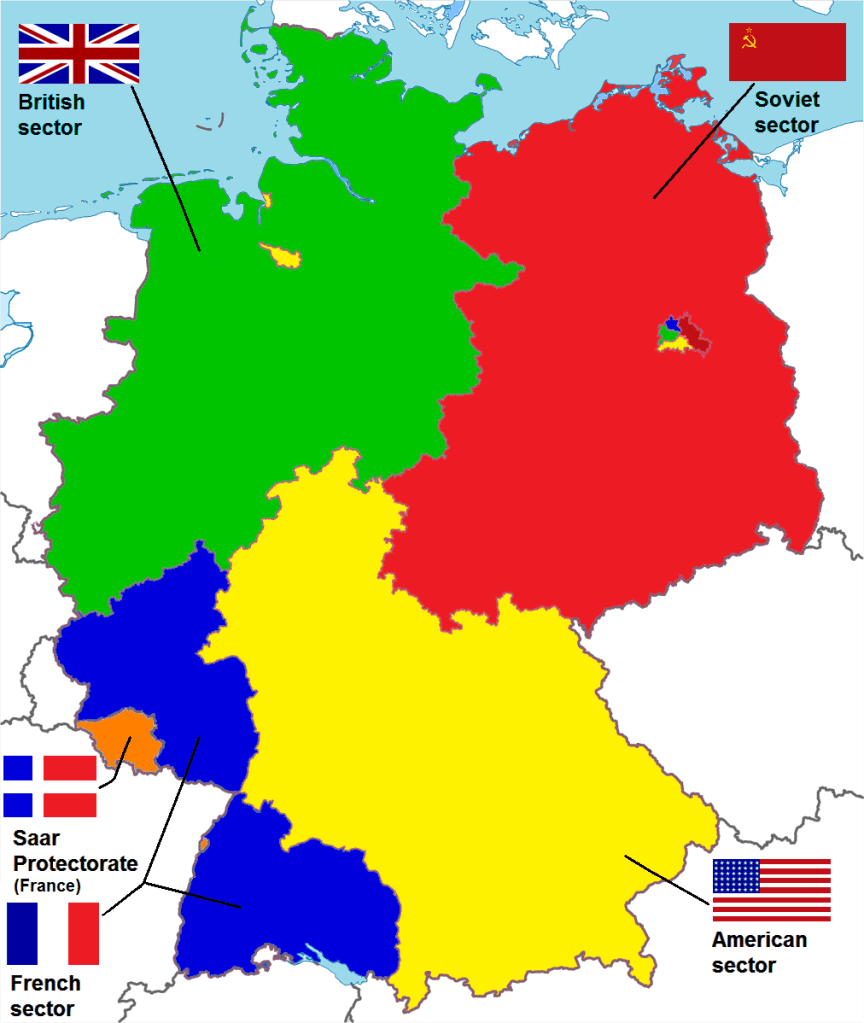
The East-West tension really started with the Berlin Airlift in June of 1948. The Soviet Union decided to cut off ground and water transportation to Berlin. The divided city, for those who too young to remember, was 100 miles deep inside Soviet controlled Germany–soon to be East Germany. Germany was divided among the victorious allies. In order to keep West Berlin from starving, President Truman ordered the military to begin flying in supplies to the surrounded city. The airlift lasted for almost a year before Stalin opened the road back up to Berlin.

There was a lot going on at this time. The United States, along with Britain and France was moving forward to unify the western zones of occupation into West Germany. A move to stabilize Europe and to thwart further Soviet conquests and revolutions that they may wish to dabble in. Of course this new German country did not sit well with Uncle Joe. Meanwhile relations between East and West just kept getting frostier.

A US Air Force Douglas C-54 “Skymaster lands at Berlin’s Tempelhof Airport during the Berlin Airlift. At its peak US Air Force, RAF, Canadian, Australian, and other air force planes were reaching Berlin every 30 seconds delivering more than 2 million tons of provisions. Henry Ries / USAF, Public domain, via Wikimedia Commons

At the time Eastern Europe–later The Warsaw Pact nations– was in the firm grip of Stalin. Greece was trying to fend off a communist take over. Truman went to Congress asking for aid to both Greece and Turkey. There is some debate to how much assistance Stalin was giving Greek communists. But Truman argued that if there was a communist victory in the Greek Civil War this “would endanger the political stability of Turkey, which would undermine the political stability of the Middle East.” As if stability is a word that could ever be used to describe the Middle East at anytime in history.

But European stability was on the mind of Secretary of State George Marshall when he spoke to the Harvard graduating class in June of 1947 calling “for a comprehensive program to rebuild Europe.” This would become the Marshall Plan. With “the fear of Communist expansion and the rapid deterioration of European economies in the post WW II winter of 1946–1947, Congress passed the Economic Cooperation Act in March 1948 approving funding that would eventually rise to over $12 billion for the rebuilding of Western Europe.” That $12 billion would be about $140 billion in today’s dollars. Not a bad deal when consider building back America could run us into the trillions–and we are not even devastated from four years of world war. Just 50 years of infrastructure neglect, changing technical needs and political dissention.

And this brings us to NATO. According to DW (Deutsche Welle) Germany’s international broadcaster, “NATO, the North Atlantic Treaty Organization, was formed in 1949 with the aim, first and foremost, of acting as a deterrent to the threat of Soviet expansion in Europe after World War II. Beyond that, the United States saw it as a tool to prevent the resurgence of nationalist tendencies in Europe and to foster political integration on the continent.” * see below website for article and maps

Allied Occupation of Germany 1945 Berlin is deep inside the Soviet Zone
wikimedia commons author Paasikivi

The ’40s, however, quickly became the ’50s and a whole new set of Capitalism vs Communism battle grounds emerged across the globe and into space: the Communist takeover of China, the Korean War, the testing of nuclear weapons, the forming of the Warsaw Pact in 1955 and the Space Race to name a few.

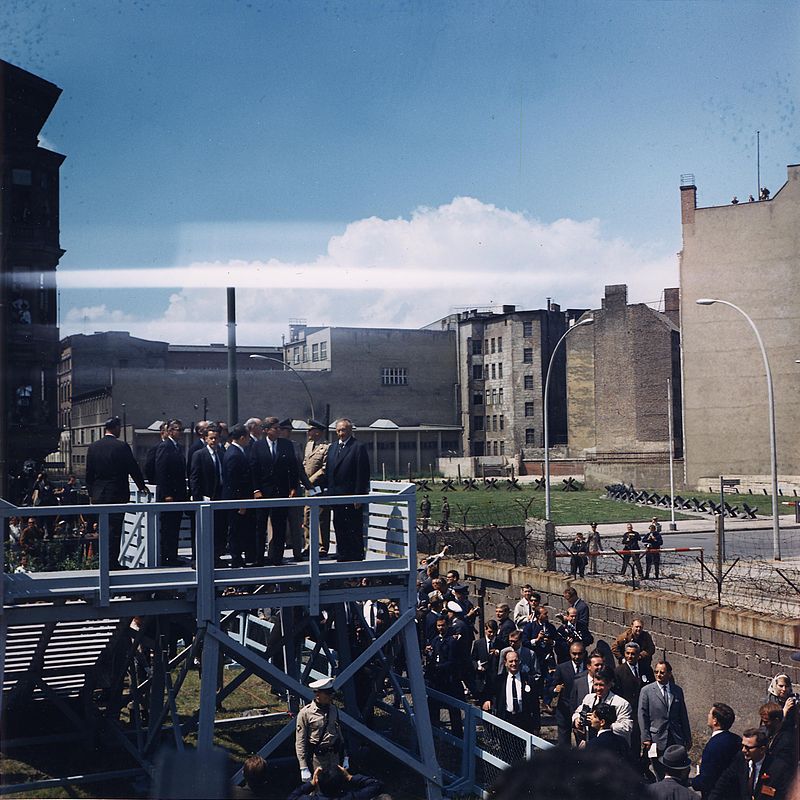
And who can forget the ’60s. In August of 1961 Russia built the wall: The Berlin Wall separating West Berlin from East Berlin. In June of 1963, President John Kennedy visited West Berlin telling the surrounded citizens, “Today, in the world of freedom, the proudest boast is “Ich bin ein Berliner.” I am a Berliner. He further said “There are many people in the world who really don’t understand, or say they don’t, what is the great issue between the free world and the Communist world. Let them come to Berlin.” It would take 30 years before that 27 mile wall patrolled by dogs, guarded by more than 40,000 border troops, and supplemented with more than 500,000 land mines would come down in 1989.

President Kennedy looking over the Berlin Wall. Robert Knudsen, White House, in the John F. Kennedy Presidential Library and Museum, Boston., Public domain, via Wikimedia Commons

Russia’s ambitions were not just in Europe. Soviet missiles were placed in Cuba and in October of 1962, there was the quintessential standoff between East and West: the Cuban Missile Crisis. The nuclear war card was face up and on the table. Kennedy and Soviet Premier, Nikita Khrushchev, stood eyeball to eyeball waiting to see who would blink first. The Soviets blinked and the missiles would leave the New World but the standoff in the Old War continued.

I could go on about the Communist threats. But Mother Russia is not a communist country any more than it is a czarist one. That, however, does not seem to have changed Putin’s “neurotic view of world affairs” from any of his predecessors. He is still operating under old school Russian paranoia that seems to plague some modern Russian leaders much the same way hemophilia was passed along from one generation-to-another generation of czarist rulers.

With the collapse of communist economies in the late 1980s, Russian domination of Eastern Europe slipped away along with its empire. Russia saw its European allies looking for greener economies. Its buffer zone of satellite states joined either the European Union and or NATO. With so many Eastern European and Baltic countries in NATO, and the prospects of Ukraine becoming a member, is a just and East-West bridge too far for Putin.

According to National Geographic, Ukraine and Russia’s “shared heritage goes back more than a thousand years to a time when Kyiv, now Ukraine’s capital, was at the center of the first Slavic state, Kyivan Rus, the birthplace of both Ukraine and Russia.”

It is not a far Troika-sleigh ride from the Ukrainian border to Moscow, just under 500 miles. Ukraine was absorbed into Russia shortly after the Russian Revolution of 1918. It then suffered under Stalinist rule. In the 1920s and 30s millions of Ukrainians starved to death. In an effort to repopulate the eastern part of the country, Stalin brought in Russians to eastern Ukraine. People who had no cultural or language ties to Ukraine. Maybe this is why Putin feels that this “special military operation” is necessary, to reinforce the belief that “Russians and Ukrainians are one people, a single whole.” Putin appears to live with the attitude of a long lost Russian Empire. What was once mine (Russian) is still mine; a prospect that most Ukrainians today seem to disagree with.

What is puzzling is that there are so many examples of recent military adventurism failing miserably: Israel’s occupation of the West Bank, the Soviet Union in Afghanistan; the US in Afghanistan and Iraq are just a few examples for Putin’s perusal.

Putin’s special Ukrainian military operation is a continuing quest for a Russian empire. One that Europe has been able to roll back or contain for centuries. If history is any indication Putin’s success will most likely be short lived. President Kennedy had three short years in office but had several negotiated close encounters with Russia’s “neurotic view of world affairs”. He said of the Russians: “We cannot negotiate with people who say what’s mine is mine and what’s yours is negotiable.” Putin seems to have outrun reality where negotiations have dried up to the point where “yours” is not even negotiable.

https://history.state.gov/milestones/1945-1952/berlin-airlift

https://history.state.gov/milestones/1945-1952/truman-doctrine

https://history.state.gov/milestones/1945-1952/marshall-plan

* https://www.dw.com/en/what-is-nato-and-why-was-it-created/a-60688639

https://nsarchive2.gwu.edu/coldwar/documents/episode-1/kennan.htm

https://millercenter.org/the-presidency/presidential-speeches/june-26-1963-ich-bin-ein-berliner-speech

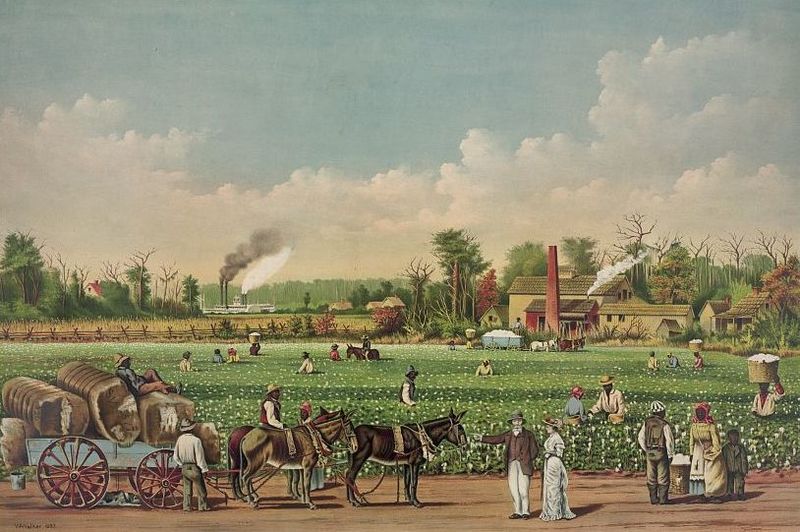
“Still longing for de old plantation…”

A romanticized depiction of a cotton plantation being worked by slaves in the antebellum Southern United States.
Currier & Ives, Public domain, via Wikimedia Commons

There is a certain passive/aggressive intransigence built into the American psyche. For the most part it lays dormant like a virus waiting for the right host or set of events to bring it out. The January 6th assault on the Capitol of the United States is perfect example of the aggressive egotistical character of certain people to poison the normal placid disposition of most Americans. Logic, compromise and sanity goes out the window, leaving ideologies and common values set—like bricks in a wall. 

When these sorts of walls go up they are hard to bring down. In the last year or so there have been various public opinion polls that indicate that Americans believe there is a distinct possibility of a civil war in the near future. It is not unusual to see polls that show 70 percent of Trump’s supporters and 40 percent of Biden’s supporters feel that hostilities are about to break out. The Who may have been prophetic when they sang “we’ll be fighting in the streets…and the men who spurred us on, sit in judgement of all wrong, they decide and the shotgun sings the song.”

This is not a joke.  A North Carolina Congressman, somebody elected to uphold and defend the Constitution says: “Because, you know, if our election systems continue to be rigged and continue to be stolen, then it’s going to lead to one place — and it’s bloodshed.”(I emphasises continue because this is new to me. Does this Congressmen know something we don’t!) Elections in Russia are probably rigged. Here in America, if it is anybody that knows how to rig an election, it is a conservative from North Carolina. North Carolina may not have invented Gerrymandering but they have sure made it performance art.

The irony of all of this talk of civil war in many ways centers around bogus claims that the 2020 election was rigged. It could be argued that the cause of “The Civil War,” I refrain from using The First Civil War, was the 1860 election of Abraham Lincoln—the first president to take a firm policy stand against slavery. It sounds incredulous that in the land of the free that 12 of the first 18 presidents were slave owners.

I do not think there were too many claims that 1860 election was stolen. It was just a plain old loss stemming from demographics and an ever so slight change in the attitude of the American people to slavery. It was an electoral defeat Southern Democrats could not fathom. Much like today, some people cannot grasp the changing demographics and more broad-minded attitudes. In reality it was inevitable. Slavery may have built the ancient world and kick started the New World; but it had no place in the new economics and industrialize world that was coming of age in the 19th Century. But old ways die hard.

Meanwhile, European countries were abolishing slavery.  In 1811 Spain abolishes slavery; in 1833 Britain passes Abolition of Slavery Act, setting aside 20 million pounds to slave owners in  compensation for their loses; in 1848 France abolishes slavery.  By the time of the Civil War most European countries had abolished the slave trade.

Instead of letting slavery go as dying economic system and looking forward to the upcoming 20th Century, the South doubled down on human bondage to get their work done. They decided to take their electoral votes and start a new country. Keeping their slaves and old agrarian ways, as if cotton would be king for ever.  Nothing wrong with agriculture but it seemed like the only culture the South would recognize is agriculture and an enslaved workforce. And those newly approved Constitutional Amendments after the Civil War, they were just roadblocks from keeping freedmen from the polls. 

The South may have won the lighting rounds early on in the Civil War, which may have given them false hope in victory.  But eventually the South took a real beat down, in particularly during the last year of the war from the more economically diverse North. 

Alexander Stephens said that the cornerstone of the Confederate government was the inequality of the races and ” is the first, in the history of the world, based upon this great physical, philosophical, and moral truth.”
Unknown author Unknown author, Public domain, via Wikimedia Commons

In February of 1865 Lincoln and Secretary of State William Seward met with the Vice President of the Confederacy, Alexander Stephens, and several now-long forgotten rebels (one of whom was a former US Supreme Court justice) in Hampton Roads on the steamship River Queen. Their objective, to seek some sort of negotiated end to the war. The four-hour conference yielded no results as both sides, after four years of war, were no closer on slavery than when the war started. Neither side was in a mood to compromise on their views on Southern independence and slavery. 

But when you think about it, the South really did not have any bargaining chips on the table. By this time the North’s stranglehold on the South was an ever tightening death grip.  Slaves were flocking to the US Army, which now was besieging Richmond, the Confederate capitol; The US Navy had every major port in the South blockaded; Sherman had marched to the see and already made “Georgia howl;”  General Phil Sheridan left the Shenandoah Valley “a barren waste” to such an extent that crows would have to bring their own provisions; the western half of the Confederacy was cut off from the eastern half. If  it is believed that the English hang on in quiet desperation then the Southerners fight on in dying desperation. In three months time the Union Army would decide the matter: an end to the Confederacy and slavery. But did it? They may have “drove old Dixie down” but the lingering Antebellum beliefs festered in the mindset of those who refused to see the winds of change were upon them.

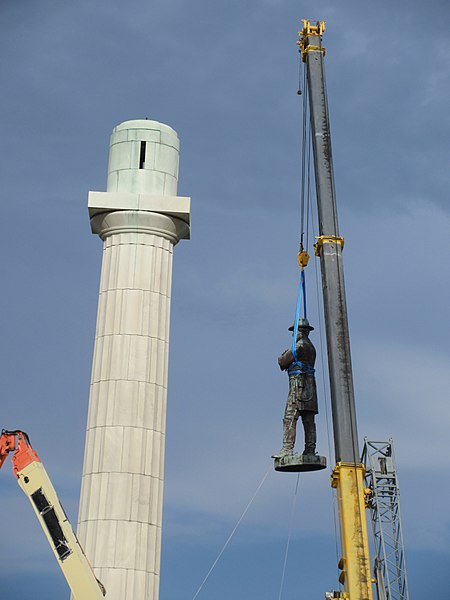
Marble and bronze vestiges of the Old South representing their lost cause were erected perpetuating the conviction of a separate but equal United States. Those statues are just now being pulled down from city squares and court houses across the country. These monuments have been around for more than 100 years. It is a representation that  the Civil War narrative still runs deep in the recesses of our national thinking. It comes out easily in what some say is a slip of the tongue. But is it? Take Senator Mitch McConnell’s recent gaffe talking about African Americans and voting, as only a true Southern can. He said, “Well the concern is misplaced, because if you look at the statistics, African American voters are voting in just as high a percentage as Americans.”

Robert E. Lee is removed from his granite pedestal in New Orleans on May 19, 2017. He stood there for 133 years facing north–staring down the yankees.
Infrogmation of New Orleans, CC BY-SA 4.0 https://creativecommons.org/licenses/by-sa/4.0, via Wikimedia Commons

That statement can be corkscrewed around like a rollercoaster at Six Flags over Texas.  McConnell said it was an “outrageous mischaracterization of my record as a result of leaving one word out inadvertently the other day, which I just now have supplied to you, is deeply offensive.”  There are a lot of things deeply offensive about his omission of one word. It sounds more like something from Shakespeare: “The (Senator) doth protest too much methinks.” 

It is similar to when President Bill Clinton was skewered for trying to weasel out of his alleged sexual relation by saying: “It depends on what the meaning of the word ‘is’ is.” If Mitch was a Senator from the Pacific Northwest instead of Kentucky it might be easier to go along with his one word omission.  But there is a history of omission.

“Because history gives us the tools to analyze and explain problems in the past, it positions us to see patterns that might otherwise be invisible in the present – thus providing a crucial perspective for understanding (and solving!) current and future problems.”

The University of Wisconsin Department of History web site: Why you should study history?

Mitch’s slip and the January 6th assault on the Capitol are those passive/aggressive yearnings for the days of cotton embedded in our national psyche. There just bricks in a wall that still needs to be brought down. 

What would the American epoch be if when writing the Declaration of Independence Thomas Jefferson wrote that “We hold these truths to be self-evident, that men are created equal… Jefferson was a Southern slave owner. But, in seeking independence from Great Britain those who wrote and signed the Declaration of Independence knew it had to be “all” inclusive. It can be argued that in this case the concept “all” goes beyond Americans. It was a concept that was not achieved with the first stroke of the pen.  It still is a principle that we strive to reach. A simple slip of the tongue reveals more than one might think about how far we still need to go. 

https://www.nps.gov/foth/hampton-roads-peace-conference.htm

https://quod.lib.umich.edu/j/jala/2629860.0021.104/–hampton-roads-peace-conference-a-final-test-of-lincolns?rgn=main;view=fulltext

Southeast Conference’s Great Awakening

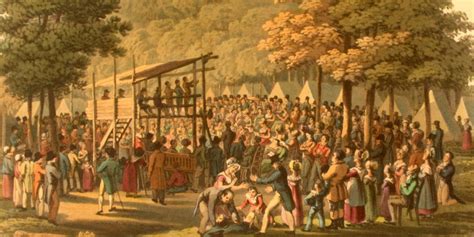
1819 Engraving of a Methodist camp meeting
Library of Congress, Prints and Photographs Division
Author Jacques Gérard Milbert (1766-1840)

Whether you are a football fan or not it is impossible to get through the holiday season without seeing a couple of minutes of football. Afterall, there are about 40 college bowl games on TV starting with the Bahamas and Tailgreeter Cure Bowls on December 17 and ending with the National Championship Game on January 10. If baseball is the national pastime than football is the national religion.

I do not mean any disrespect to any particular religion, but according to vox.com, “The popularity of American sport culture is deeply rooted in the history of a particular kind of American muscular Christianity a conflation of nationalism, nostalgia, piety, and performative masculinity. From the football stadium to the basketball court, American sports have been as much about defining a particular kind of male and typically Christian identity as they have been about the game itself.”

Now, I am not a diehard football fan. I am more of a casual observer of the game. It really is hard for me to get revved up over a match between Western Michigan and Nevada. But I probably will watch some of the College Football National Championship Game between Alabama and Georgia–two Southeast Conference teams. I will admit my interest in the game became more intense when I was in college at the University of Florida. It is hard not to get excited about football in a college town. And Gator football, like many other university football programs, has been around for more than 100 years.

Game day in a college town has the same exuberance and exhilaration, and mysticism of a medieval religious holiday. Not that I have been to an actual medieval fair. However, Gainesville does hold annual Hoggtown Medieval Faire with jugglers and such, but not during football season; but I digress. In a college town just about everything is geared for that Saturday game. Gainesville, like so many other college towns, becomes a sporting Mecca as 90,000 people pack the stadium. That is like putting one-third of the county’s population in one place for the better part of a Saturday. People tailgate with generators, set up outdoor canopies. The landed gentry can come from far away in their RVs. The booster elites seated up on high in their sky boxes. And those not in the stadium are at pubs and such; or home in front of a TV. It is a spectacle with a marching band.

It is also a day you can walk into just about any theater in Gainesville and actually yell “fire” without incurring panic. The panic-like conditions comes after the game moving 90,000 people from the stadium. Gainesville lives for those Saturday games. If the University of Florida left Gainesville and packed up like some NFL teams, the city would be just another rest stop on I-75.

The Florida Gators is a team that is in the Southeast Conference. A conference that was conceived in the old Confederacy. It is a conference that takes football seriously. Every Saturday when two SEC teams meet on the gridiron it can seem like the Vidalia Sandbar fight fought on an island in the Mississippi River. The Vidalia Sandbar duel that took place on September 19, 1827. It was the fight that made Jim Bowie a Southern legend. He was seriously wounded, two others were slightly injured and two others killed. It was this fight that started the myths of Jim Bowie and his famous knife. Southern tempers have simmered since then but the ferocity can be just as intense, particularly when two SEC rivals clash. As in the upcoming national championship game.

College football as a fall collegiate contest is undergoing a dramatic economic shift. It is not unusual for head coaches to have $8 to $10 million contracts and million dollar plus buyouts. States are now passing laws allowing players to earn money on their image and likeness blurring the age old divide between amateurs and professionals–as if that even matters anymore.

This concept of amatures has been long debated. For instance, was the Soviet Union National Hockey Team a team of amateurs or professionals? They were so good that ABC News wrote that “In February 1979, they (the Soviet team) faced an NHL All-Star team that featured an astounding  20 future Hall of Famers in a three-game series. The Soviets won two of the matchups, (tied one) including Game 3 at Madison Square Garden in a 6-0 rout.” Today there are 38 Russian players in the NHL. Sort of reverse if you can’t beat ’em join ’em.

The amature status debate goes even further back. Take Jim Thorpe, the best athlete of his time, and a gold medal winner in the 1912 Olympics. Thorpe, a pentathlon winner, was eventually stripped of his gold medals when it was learned that he was paid to play baseball in 1909 and 1910.

Jim Thorpe’s professional baseball career wasn’t nearly as golden as his amature career. circa 1913 Sporting News photographer unknown.

It is hard to imagine how “professional” baseball was at the turn of the century. This, in an era where owners, for all practical purposes, owned their players’ contracts for life. There was no collective bargaining and no marketing of players’ images. Take the 1919 Chicago White Sox known as the “Black Sox.” Eight players on this team were accused of consorting with gambler Arnold Rothstein and others to throw the game “for money.” A unique concept. This was a time of strikes: The Great Anthracite Coal Strike of 1902, the West Virginia “mining wars” that took place for 1912-22 and the Steel Strike of 1919.

Although the National Guard was not called in on the Black Sox, none of the eight were convicted in the trial that followed. However, Judge Kenesaw Mountain Landis banned the players from baseball for life. Getting paid very little to play a sport back then may have made you a professional; it just didn’t make you rich. But for some college athletes not getting paid at all is about to change.

Some may argue that college football players are already defacto professionals, NFL minor leaguers. NFL teams get to pick colleges’ cream of the crop players while letting the universities develop them for nothing. That nothing is the buffer between professional and amature.

Now, most college football pundits agree that the SEC is the best overall conference in college football. All university programs compete for the country’s best players. To appeal to these young squires universities need to raise millions from boosters to improve football facilities and to pay coaches. It is not unusual for head football coaches to be the highest paid state employee. In return the boosters demand victories. Not just wins but championships for their well-donated money. And the SEC does this extremely well, particularly in football by getting teams into championship games. And, at the beginning of the 2021 NFL season there were 1,696 roster players on NFL teams. Three-hundred and thirty-five of those players, almost 20 percent, are from the SEC.

To keep its preeminence the SEC is pushing out just like the Old South did. In recent years the SEC has pursued a Manifest Destiny mentality in its approach to dominate college football. It may not want to control college football from sea to shining sea but it is definitely preaching its football beliefs and culture. It is pulling in other schools like a traveling minister dunking converts into the healing waters at a camp revival. First it added Arkansas and South Carolina into the league in 1991 as sort of First Great Awakening.

Then Second Great Awakening occurred in 2012. In what seemed like the Missouri Compromise all over again when the conference expanded north of 36 degree latitude to bring Missouri into the fold. It then crossed Sabine River and annexed Texas A & M. Both teams were pulled from the Big 12. This expanded the SEC to 14 teams.

By crossing the Sabine River the SEC had a toe hold in Texas. In its Third Great Awakening the SEC annexed another big chunk of the state pulling in the University of Texas. It then moved north in a “take me to the river and drop me in the water” moment when the conference jumped over the Red River and on to the University of Oklahoma campus. Both teams are scheduled to begin conference play in 2025. Thus, leaving the Big 12 Conference without a big box football program to anchor the league.

According to Forbes “The move means the SEC will have nine of the 12 most valuable college football programs, which generate far more money than any other collegiate sport, while The Big 12 would be left without a single member among the 25 most valuable programs.”

The SEC’s moves have forced the other major conferences to protect their turf. College Football has seen the disintegration of The Big East Conference football and now the disfiguring and stripping away of valuable teams from The Big 12. The other conferences have reason to be concerned, And rightfully so. In the last 10 years the SEC has one seven championship titles with Alabama collecting five of them. Auburn and LSU each of won one. And, oh by the way, we can add Georgia to that list after its 2021 win over who else: Alabama.

https://247sports.com/LongFormArticle/Ranking-college-footballs-most-valuable-programs-Alabama-Michigan-Texas-Georgia-Ohio-State-Oklahoma-178007658/#178007658_1

https://www.forbes.com/sites/nicholasreimann/2021/07/30/texas-and-oklahoma-to-join-sec-in-colossal-shakeup-of-college-sports/?sh=204beb5021d8

https://247sports.com/LongFormArticle/Highest-paid-college-football-coaches-by-salary-for-2022-179113242/#179113242_1

https://www.vox.com/identities/2017/9/27/16308792/football-america-religion-nfl-protests-powerful

A Republic, if you can keep it.

Independence Hall
publicdomainpictures.net

One of the many stories handed down about Benjamin Franklin is the one when he was asked coming out of Independence Hall about the new government that was hammered out during that long hot summer of 1787. He replied, “A republic, if you can keep it.”

Just about every news cycle carries at least one story or an editorial about how America’s democracy is in jeopardy. It is not democracy that is in harm’s way. It is our federal Republic form of government that we should be concerned with. Most people will still be able to vote. The question is who will end up representing them.

The government that got the states through the Revolutionary War, The Articles of Confederation, the “Join or Die” motto that held the the states together in war, was a loose confederation and not collectively or commercially effective at keeping them united in peace.

A quick review of 7th Grade Civics and history would indicate that the those who sweltered away in Philadelphia that summer did not trust each other any more than they trusted King George III. In some cases they trusted each other less. At least George III was 3,000 miles away and weeks away by ship. To Marylanders, Virginians were just a ferry boat ride across the Potomac River.

Walt Kelly distribution by the Post-Hall Syndicate.

With the King out of the picture it was sort of a Pogo moment between the states: “We have met the enemy and he is us.” The solution: A new form of government. What Franklin did not explain when asked what they came up with was actuality a federal republic. As further review, a republic is a government where the officials are elected by the citizens to represent them. Our republic is designed where governmental power is shared between local, state and federal authority. For instance, FBI agents do not go around issuing parking tickets and deputy sheriffs do not investigate espionage. It is a government where nobody has to much power. It is a government with checks and balances and all sorts of stated and implied, but yet elastic and nebulous interconnected-powers that makes sure everybody is going to play nice. It was, and still is, a unique sharing concept for the times with the various branches and levels of government given specific delegated powers.

However, any document written in 1787 is bound to have holes in it. For instance, the Constitution does not address how governments deal with a pandemic. In many ways that is the genius of the Constitution. It is flexible enough to allow governments to do what is “necessary and proper.”

But here again, what is necessary may not be proper to some. Today, certain politicians are sniffing around the Constitution like Rat Terriers hunting vermin. One hole that they have found is the Tenth Amendment to the Bill of Rights. In order to get the new government approved a Bill of Rights had to be added. And probably the most nebulous amendment in the Bill of Rights is the Tenth.

The powers not delegated to the United States by the Constitution, nor prohibited by it to the states, are reserved to the states respectively, or to the people.

Tenth Amendment

According to Legal Information Institute: “The Tenth Amendment helps to define the concept of federalism and the relationship between Federal and state governments. As Federal activity has increased, so too has the problem of reconciling state and national interests as they apply to the Federal powers…” The power to tax and set regulations like mask and vaccination mandates, which have been argued vigorously at federal, state and local levels across the country. These mandates have been hauled into courts with mixed reviews. Even the ongoing Roe v Wade Supreme Court debate is shrouded in federalism. One of the questions before the Court is can a state overturn a Supreme Court decision along with allowing civil awards to citizens in upholding a state’s anti-abortion law.

It is not my intent to give a Civics lesson because that would be boring. But I once heard a math teacher say he would rather teach math then Civics. His reason was in math everything is cut and dry: One plus one is always two. Concepts like whatever you do on one side of the equal sign you have to do on the other. Theorems, equations can be proven. Math is not like the Senate saying we cannot approve a Supreme Court justice in election year and then turning around four years later and erasing the equal sign from the chalk board saying we moved the equal sign so we can now appoint a justice in an election. With math there is no argument where the equal sign goes. The problem with understanding Civics is that it seems as if variables can be plugged in whenever and wherever it pleases the person, or group, with the power cord. Today, time tested truths are being tested for popular political expediency. And in some cases, disrupt the checks and balances established in the Constitution like the January 6th assault on the Capitol.

The British Army burning Washington DC during the War of 1812 Book: Paul M. Rapin de Thoyras, Public domain, via Wikimedia Commons

The recent claims that the 2020 presidential election was stolen or rigged hinges on variables being plugged in all over the place–literally in states across the nation. It is alway easier to prove something false. In this case, the claim of election fraud has not been proven true but many still ascribe to that belief. What we have witnessed in this case was an attempt to move the equal sign. But moving the equal sign around did not prove a false claim. It would seem that if it was proven true, then it would be easy to invalidate just about every election held since the 1900s, particularly when Jim Crow controlled the voting roost. What we are witnessing is our concept of a federal republic being stretched like an elastic band. Certain groups in various states are changing voting laws that will in effect determine what party has better chance of electing representatives to office.

Under the Constitution voting is not delegated to the federal government. It is left in the hands of 50 individual states. States can decide most everything from redistricting, to who votes, where and how they vote–and how those votes are counted. So much of this is determined by political parties that wield the power in the individual states. And to add another cog into the voting machinery throw in the Electoral College and we are now off to the political races.

The January 6th assault on the US Capitol was a physical attack to stop the federal government, Congress, from certifying elections results held in the individual states. A constitutionally delegated power. However, a minority of elected members believed that it was a stolen election. Now, some states are scrambling to change voting laws and regulations to guarantee a victory, or in essence, legally steel the next election.

What we are witnessing with these changes has nothing to do with voting integrity or security but a frontend-legal rigging of elections to ensure a desired outcome. Changing voting laws at the state level will then affect the representation at the federal level. Especially, when this process his handled under the auspices of political parties.

It is interesting to note that the Constitution does not mention, delegate or prohibit political parties. James Madison wrote about “faction” or what we would call political parties in the Federalist Papers No. 10. He wrote that. “So strong is this propensity of mankind to fall into mutual animosities, that where no substantial occasion presents itself, the most frivolous and fanciful distinctions have been sufficient to kindle their unfriendly passions, and excite their most violent conflicts.” And, boy have we seen some unfriendly passions at public meeting and street gatherings of late.

“The most common and durable source of factions, has been the various and unequal distribution of property….” “A zeal for different opinions concerning religion, concerning government, and many other points, as well of speculation as of practice; an attachment to different leaders ambitiously contending for pre-eminence and power.”

James Madison

He further states, that these factions; or what we would call the bases of the political parties today have created “instability, injustice and confusion (that have been) introduced into the public councils.” Madison calls this a “mortal disease” which has toppled governments everywhere “where the public good is disregarded in the conflicts of rival parties.”

James Madison, Father of the Constitution and the 4th President.
John Vanderlyn, Public domain, via Wikimedia Commons

What makes our political situation interesting is that Madison and others of his time were worried about a majority dominating the government and denying the minority the rights embraced in the struggle against Great Britain. Today it is not a majority that is trying to disrupt the the republican established powers of the Constitution. It is a minority political parity. It is the slow tectonic shifting of political power. It is a minority of politicians in various states cheered on by their federally elected brethren to change state voting laws. It is the practice of ambitious leaders “contending for power and preeminence” by changing elections laws ever so slightly to hobble its opposition.

If a faction consists of less than a majority, relief is supplied by the republican principle, which enables the majority to defeat its sinister views by regular vote: It may clog the administration, it may convulse the society; but it will be unable to execute and mask its violence under the forms of the constitution.

James Madison

Madison writes that there are “two methods methods of removing the causes of faction: The one by destroying the liberty which is essential to its existence; the other, by giving to every citizen the same opinions, the same passions, and the same interest.”

Basically what Madison is saying, and neither solution is acceptable, is one side must destroy the other side. This is something we are seeing now with the so-called voting laws to protect the “integrity” of elections. With razor thin margins of victory in many states, creating election laws that hinder an opponent’s supporters from voting may give a minority an electoral majority.

Although Madison was talking about the size of Republics he wrote that “each representative will be chosen by a greater number of citizens in the large.” Thus, making it “more difficult to elect “unworthy candidates to practise with success” their vicious arts.

Benjamin Franklin said that we need to be vigilant about our rights and “if animosities arise” we should look to the party “which unfurls the ensigns of public good. Faction will then vanish, which if not timely suppressed, may overturn the balance.”

It has been a balance of “We the People” and not of “We the Party” that has enabled us to keep our Republic. By constricting voting we can still claim to be a democracy but will we still be a Republic. Rome was not built in a day and it did not lose its Republic in a day either.

https://founders.archives.gov/documents/Madison/01-10-02-0178

Stupid is as Stupid does: It is just a theory

Frits Van den Berghe: Idiot by the Pond
Public domain, via Wikimedia Commons

It is hard for me to for me to say because I was not around in the mid-1400s when Greek scholars gathered up their books and collective knowledge and left Constantinople for Florence, Italy.  Behind them was the on rushing Ottoman Turk army that just toppled the Byzantine Empire and was sweeping out of the Middle East and into Europe. 

Florence, Italy.  Home of the Renaissance.  Before the rebirth of knowledge Europe was stuck in what we commonly known as the Dark Ages or Medieval times.  A time of feudal lords, knights in armor and the “Black Death” (Sounds familiar). It also was a time when one institution controlled just about all knowledge, information and arts and science: The Catholic Church. (Today it could be argued its FaceBook.)

From that time of rebirth, human knowledge and understanding started to move forward. Take Galileo Galilei, for instance.  He did more with a homemade telescope than most of us could do with an App and a smartphone. Probably the biggest thing he did was challenge the Catholic Church on the Biblical belief that the Earth was the center of the universe. He was not the first to propose this radical change in theory to a heliocentric solar system. Nicolaus Copernicus developed a mathematical model that moved the sun to the center spot in the universe. Later, Johannes Kepler expounded on elliptical orbits punching more holes in the geocentric Ptolemaic system where the sun, the moon and the stars revolve around the Earth. But it was Galileo who took the Church head on over its dogma. His stubborn belief put him under house arrest for the latter years of his life for pushing heliocentric heresy.

Pope Urban VIII, The Holy See and holder of all holy knowledge. Gian Lorenzo Bernini, Public domain, via Wikimedia Commons

The Pope, Urban VIII, along with eight other men disagreed with Galileo’s theories. In the context of today’s reality, we know the Pope and his friends were way wrong in their thinking. In the reality of the time Galileo’s theory showed a lack of faith in established beliefs. But then, from their vantage point, it could easily be argued the Earth was flat.

In today’s scientific thinking, a theory, according to Dictionary.com is a coherent group of propositions formulated to explain a group of facts or phenomena in the natural world and repeatedly confirmed through experiment or observation. Or, a logical explanation on what is going on in the universe. These observations at times can be incorrect as in the case of Ptolemy’s geocentric theories.

The problem is that anybody can string together a series of cause-and-effect observations and facts trying to explain just about anything. The question is, are the cause-and-effects actually meaningful. A scientific law, like the law of gravity, is proven true and predicts what will happen–not likely. In gravity’s case, it is simply what goes up will come down. We all know this and do not dispute this. It is not a theory but a law.

Through time we have used the scientific investigations to increase our knowledge and understanding of the universe. We moved through the Reformation. A time that loosened the grip of the Catholic Church on civilization (for the lack of a better word) only to throw half of Christendom over to the Protestants and their puritanical ways of thinking.

Eventually this gave way to the Enlightenment. This was a time when philosophical thinkers like Hobbs, Descartes and Spinoza challenged the traditional political, social beliefs and privileges put forth by religious leaders, monarchies and nobility of the time.  Adam Smith, the Scottish economist and philosopher, and author of “Wealth of Nations” the father of modern economics, put forth new economic concepts still practiced today. Descartes and Rousseau  brought forth new concepts of government. Locke and others gave us the belief in the rule of law—that no man was above the law. (Concepts put into law and still practiced today–even if in theory.) Newton gave us his Mathematical Principles of Natural Philosophy—his three laws of motion.

Human technology has moved us from the wheel to rocket ships. Social enlightenment has done away with rigid caste systems of the past, and Medieval thinking like the “divine right of kings.” But somehow it seems in the last several decades we have gotten more stupid with the increase of technology that science has given us. According to Merriam-Webster the essential meaning of stupid is: “not intelligent: having or showing a lack of ability to learn and understand things; not sensible or logical; slow of mind (obtuse); given to unintelligent decisions or acts; lacking intelligence or reason in an unintelligent or careless manner real understanding.”

I may have gone overboard on the definitions but it seems to define certain groups of our elected leaders today. We lack a real effort to do any individual critical thinking. Instead, we snag onto onto non sequitur statements and conclusions proposed without an ounce of investigation like a barnacle on pier post. We hypothetically make things up as we go along; like a nationwide election goes from rigged to stolen. Then we snoop around until we find enough observations to form a fallacious argument as law. This despite court rulings based on legal standards as being false.

It was once believed that Aristotle was the last man to know everything. Today we have vast amounts of information in our hands.  And yes, technology has brought out some extraordinary brilliant people–but your wacky, conspiracy-nut neighbor is not one of them. I don’t believe there are more stupid people today than in any time in the past. They are just more visible. Stupidity is probably a constant just like left-handed people. In fact, it could be argued that we have more educated people in the world today, hence we should have less stupidity around. Sort of a herd immunity protecting us from stupid. It also could be argued that technology has put more information in the hands of some extremely stupid individuals making our times more dangerous than ever before. 

Carlo M Cipolla, a professor at the University of California Berkley, wrote in 1976 “The Basic Laws of Human Stupidity.” In the book he comes up with five universal laws of human stupidity that are very evident today. 

penquinrandomhouse.com

His first law states that: Alway and inevitably everyone underestimates the number of stupid individuals in circulation. Before the advent of social media platforms stupidity was basically confined to local communities. Every town had a village idiot (or idiots) of some sort. But now, the nation at large is subjected to a meteor shower of local stupidity raining down upon us. Take Rudy Giuliani. He once was a leader during 9/11, America’s Mayor. Now he is plays the role of the “nation’s idiot.” Thanks to modern social media platforms we are constantly bombarded with the stupidity of Florida men. If something stupid happens it usually reads: “Florida man”… “arrested after using wanted poster as FaceBook photo.” Social media has put stupidity on steroids.

Tip O’Neill once said that all politics is local. This statement can include stupidity–up to a point. Social media has given local stupid a rallying point. From stupid’s home in “Your Town USA,” social media can muster up and gather like-minded people from across the country. Take the witless, moronic behavior of the January 6th’s assault on the Capitol. People as far as Alaska came to Washington to participate in a “theory” that the Presidential election was rigged and then stolen.

The Capitol attack is also an example of Cipolla’s Third Law of stupidity that says, “A stupid person who causes losses to another person or to a group of persons while deriving no gain and even possibly incurring losses.” The collective mindset of those individuals during 1/6 had no redeeming value at all. It resulted in five dead and effected many other people irrevocably. And for what? To feed the egoistic desires of man who could not face, as ABC Sports once proclaimed in its Wild World of Sports: “the agony of defeat.” It happens every day. As Danny O’Keefe once sang: Some gotta win, some gotta lose
Good time Charlie’s got the blues
.

Then there is Cipolla’s Second Law that says: “The probability that a certain person be stupid is independent of any other characteristics of that person.” This also reminds me of the Mark Twain saying: “It is better to keep your mouth closed and let people think you are a fool than to open it and remove all doubt.” With today’s erratic logical thinking, and social media, this can be accomplished easily as witnessed by Senator Ted Cruz leaning into a debate on Twitter over vaccinations with Big Bird, a Sesame Street character. Can it get any more stupidly absurd.

But wait, maybe it can. Take Missouri Senator Josh Hawley recent speech to the National Conservative Conference in Orlando. He proves what Cipolla writes that “that whether you move in distinguished circles or you take refuge among the headhunters of Polynesia…you always have to face the same percentage of stupid people.” Hawley claims that “the Left” has a national “deconstructionist agenda.” That this agenda is an “assault on manhood” and it “has been sharp and prolonged, it has not succeeded” (Thank God). He said the “deconstruction of America begins with and depends on the deconstruction of American men.” This sounds reasonable if you are a man who lost his job when corporate America began shipping their factories overseas. Or maybe the drunk Florida man carrying an alligator into a liquor store–what needs to be deconstructed in getting a six pack for you and your gator buddy.

It is not my intent on summarizing Hawley’s speech or his theory on “the destruction of our republic.” It is his theory and he takes us all down a “slippery slope” of fear mongering. His hypothesis is based on generalized observations that cannot really be proven or disproven. They just sound good to some people. His assumption of “the future’s uncertain, and the end is always near” plays well. It is sort of a Post Hoc, Ergo Propter Hoc or “After this, therefore because of this” If you deconstruct the American male, then all shit breaks loose.

Now Senator Hawley, is a University of Stanford grad and a graduate of Yale Law, a man of letters, and a supposed person of character as is Senator Cruz, a thoroughbred Ivy Leaguer with degrees from Princeton and Harvard. But it now looks as if both are headhunting with the natives, or at least stoking the roasting fires for the main meal spouting off half truths. But, then again, they are lawyer and lawyers are arguers for half-the-truth. Far be it for me to call sitting US Senators stupid. But without a doubt Hawley’s male deconstruction theory will be picked up as law, an Ad Ignorantiam law: or an “argument from ignorance, and passed along from stupid to stupid on social media.

The problem today is we are not doing anything to check the advancement of stupidity. We accept some yammering squawking head’s conglomeration of unproven illusions and delusions as a universal truth. All of these unproven and untested hypotheses gets passed along in a careless manner as real understanding. I would add one more component to the definition of stupid. It is one thing to lack the ability to think straight. It is another thing altogether in not wanting too. As American theatre critic Brooks Atkinson said: The most fatal illusion is the settled point of view. Since life is growth and motion, a fixed point of view kills anybody who has one.” So, look out for stupid with an unproven theory.