publicdomainpictures.net
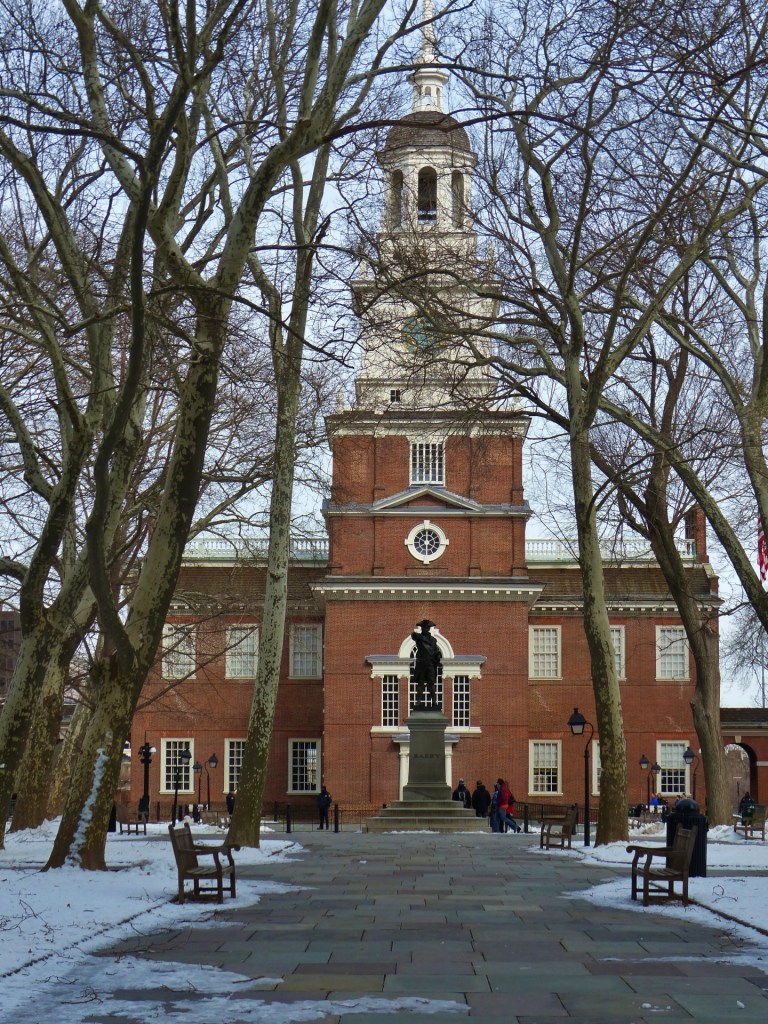
One of the many stories handed down about Benjamin Franklin is the one when he was asked coming out of Independence Hall about the new government that was hammered out during that long hot summer of 1787. He replied, “A republic, if you can keep it.”
Just about every news cycle carries at least one story or an editorial about how America’s democracy is in jeopardy. It is not democracy that is in harm’s way. It is our federal Republic form of government that we should be concerned with. Most people will still be able to vote. The question is who will end up representing them.
The government that got the states through the Revolutionary War, The Articles of Confederation, the “Join or Die” motto that held the the states together in war, was a loose confederation and not collectively or commercially effective at keeping them united in peace.
A quick review of 7th Grade Civics and history would indicate that the those who sweltered away in Philadelphia that summer did not trust each other any more than they trusted King George III. In some cases they trusted each other less. At least George III was 3,000 miles away and weeks away by ship. To Marylanders, Virginians were just a ferry boat ride across the Potomac River.
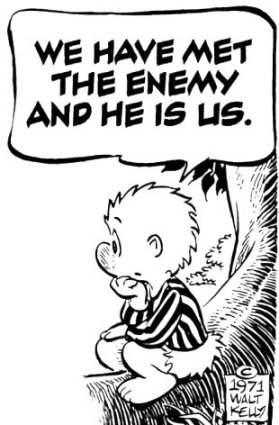
With the King out of the picture it was sort of a Pogo moment between the states: “We have met the enemy and he is us.” The solution: A new form of government. What Franklin did not explain when asked what they came up with was actuality a federal republic. As further review, a republic is a government where the officials are elected by the citizens to represent them. Our republic is designed where governmental power is shared between local, state and federal authority. For instance, FBI agents do not go around issuing parking tickets and deputy sheriffs do not investigate espionage. It is a government where nobody has to much power. It is a government with checks and balances and all sorts of stated and implied, but yet elastic and nebulous interconnected-powers that makes sure everybody is going to play nice. It was, and still is, a unique sharing concept for the times with the various branches and levels of government given specific delegated powers.
However, any document written in 1787 is bound to have holes in it. For instance, the Constitution does not address how governments deal with a pandemic. In many ways that is the genius of the Constitution. It is flexible enough to allow governments to do what is “necessary and proper.”
But here again, what is necessary may not be proper to some. Today, certain politicians are sniffing around the Constitution like Rat Terriers hunting vermin. One hole that they have found is the Tenth Amendment to the Bill of Rights. In order to get the new government approved a Bill of Rights had to be added. And probably the most nebulous amendment in the Bill of Rights is the Tenth.
The powers not delegated to the United States by the Constitution, nor prohibited by it to the states, are reserved to the states respectively, or to the people.
Tenth Amendment
According to Legal Information Institute: “The Tenth Amendment helps to define the concept of federalism and the relationship between Federal and state governments. As Federal activity has increased, so too has the problem of reconciling state and national interests as they apply to the Federal powers…” The power to tax and set regulations like mask and vaccination mandates, which have been argued vigorously at federal, state and local levels across the country. These mandates have been hauled into courts with mixed reviews. Even the ongoing Roe v Wade Supreme Court debate is shrouded in federalism. One of the questions before the Court is can a state overturn a Supreme Court decision along with allowing civil awards to citizens in upholding a state’s anti-abortion law.
It is not my intent to give a Civics lesson because that would be boring. But I once heard a math teacher say he would rather teach math then Civics. His reason was in math everything is cut and dry: One plus one is always two. Concepts like whatever you do on one side of the equal sign you have to do on the other. Theorems, equations can be proven. Math is not like the Senate saying we cannot approve a Supreme Court justice in election year and then turning around four years later and erasing the equal sign from the chalk board saying we moved the equal sign so we can now appoint a justice in an election. With math there is no argument where the equal sign goes. The problem with understanding Civics is that it seems as if variables can be plugged in whenever and wherever it pleases the person, or group, with the power cord. Today, time tested truths are being tested for popular political expediency. And in some cases, disrupt the checks and balances established in the Constitution like the January 6th assault on the Capitol.
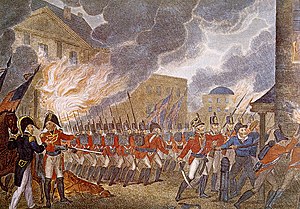
The recent claims that the 2020 presidential election was stolen or rigged hinges on variables being plugged in all over the place–literally in states across the nation. It is alway easier to prove something false. In this case, the claim of election fraud has not been proven true but many still ascribe to that belief. What we have witnessed in this case was an attempt to move the equal sign. But moving the equal sign around did not prove a false claim. It would seem that if it was proven true, then it would be easy to invalidate just about every election held since the 1900s, particularly when Jim Crow controlled the voting roost. What we are witnessing is our concept of a federal republic being stretched like an elastic band. Certain groups in various states are changing voting laws that will in effect determine what party has better chance of electing representatives to office.
Under the Constitution voting is not delegated to the federal government. It is left in the hands of 50 individual states. States can decide most everything from redistricting, to who votes, where and how they vote–and how those votes are counted. So much of this is determined by political parties that wield the power in the individual states. And to add another cog into the voting machinery throw in the Electoral College and we are now off to the political races.
The January 6th assault on the US Capitol was a physical attack to stop the federal government, Congress, from certifying elections results held in the individual states. A constitutionally delegated power. However, a minority of elected members believed that it was a stolen election. Now, some states are scrambling to change voting laws and regulations to guarantee a victory, or in essence, legally steel the next election.
What we are witnessing with these changes has nothing to do with voting integrity or security but a frontend-legal rigging of elections to ensure a desired outcome. Changing voting laws at the state level will then affect the representation at the federal level. Especially, when this process his handled under the auspices of political parties.
It is interesting to note that the Constitution does not mention, delegate or prohibit political parties. James Madison wrote about “faction” or what we would call political parties in the Federalist Papers No. 10. He wrote that. “So strong is this propensity of mankind to fall into mutual animosities, that where no substantial occasion presents itself, the most frivolous and fanciful distinctions have been sufficient to kindle their unfriendly passions, and excite their most violent conflicts.” And, boy have we seen some unfriendly passions at public meeting and street gatherings of late.
“The most common and durable source of factions, has been the various and unequal distribution of property….” “A zeal for different opinions concerning religion, concerning government, and many other points, as well of speculation as of practice; an attachment to different leaders ambitiously contending for pre-eminence and power.”
James Madison
He further states, that these factions; or what we would call the bases of the political parties today have created “instability, injustice and confusion (that have been) introduced into the public councils.” Madison calls this a “mortal disease” which has toppled governments everywhere “where the public good is disregarded in the conflicts of rival parties.”
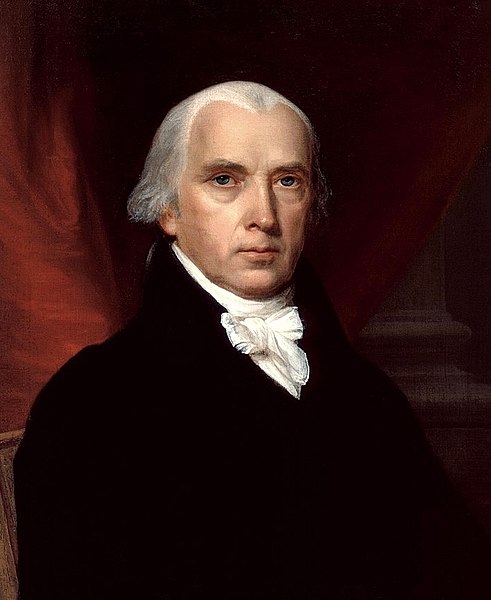
John Vanderlyn, Public domain, via Wikimedia Commons
What makes our political situation interesting is that Madison and others of his time were worried about a majority dominating the government and denying the minority the rights embraced in the struggle against Great Britain. Today it is not a majority that is trying to disrupt the the republican established powers of the Constitution. It is a minority political parity. It is the slow tectonic shifting of political power. It is a minority of politicians in various states cheered on by their federally elected brethren to change state voting laws. It is the practice of ambitious leaders “contending for power and preeminence” by changing elections laws ever so slightly to hobble its opposition.
If a faction consists of less than a majority, relief is supplied by the republican principle, which enables the majority to defeat its sinister views by regular vote: It may clog the administration, it may convulse the society; but it will be unable to execute and mask its violence under the forms of the constitution.
James Madison
Madison writes that there are “two methods methods of removing the causes of faction: The one by destroying the liberty which is essential to its existence; the other, by giving to every citizen the same opinions, the same passions, and the same interest.”
Basically what Madison is saying, and neither solution is acceptable, is one side must destroy the other side. This is something we are seeing now with the so-called voting laws to protect the “integrity” of elections. With razor thin margins of victory in many states, creating election laws that hinder an opponent’s supporters from voting may give a minority an electoral majority.
Although Madison was talking about the size of Republics he wrote that “each representative will be chosen by a greater number of citizens in the large.” Thus, making it “more difficult to elect “unworthy candidates to practise with success” their vicious arts.
Benjamin Franklin said that we need to be vigilant about our rights and “if animosities arise” we should look to the party “which unfurls the ensigns of public good. Faction will then vanish, which if not timely suppressed, may overturn the balance.”
It has been a balance of “We the People” and not of “We the Party” that has enabled us to keep our Republic. By constricting voting we can still claim to be a democracy but will we still be a Republic. Rome was not built in a day and it did not lose its Republic in a day either.
https://founders.archives.gov/documents/Madison/01-10-02-0178


Thank you for the civics lesson and the references of other situations that make the concept easy to understand. Seems to me we all need a civics review.
LikeLiked by 1 person