The Mother of all Shutdowns

Romulus leads Rome to victory

So we endure another governmental calamity: the federal government shutting down. With our love for drama nothing sells better than doomsday stories.

Shutting the government down is nothing new. At the beginning of the 5th Century BC Rome’s under class, the plebeians,  decided they had enough of upper class, patrician rule. They simply stomped out of Rome setting up a possible doomsday scenario.

The plebeians pitched camp on the Sacred Mount demanding that their rights and interests be addressed.  Since plebeians made up most of the soldiers in the Roman Army at the time, and since the expanding Roman city-state was constantly at war with one of its neighbors, the plebeians figured it was a good time to initiate negotiations in what could easily be called the first pre-union, sit-down strike in history. Oh, and it left Rome some-what defenseless.  Always a good bargaining chip to play in the art of the deal.

It would be a far stretch to call this the first socialist demonstration but the march out of Rome started a 200 year Struggle of Orders or the Conflict of Orders.  It  was the classic rich, noble, land-holding aristocrats versus the poor workers and farmers that also included a few non-noble well off citizens in the plebeian fold. Like most privileged-ruling elites throughout history, Roman patricians controlled most of the wealth and simply closed governmental doors behind them once they overthrew and consolidated power from the Etruscan kings who once ruled over them.

We have no Etruscan kings to overthrow.  In fact, historians are not sure what really happened to the Etruscans after the Romans wrestled control from them.  Just like the past, though, we do  have a burgeoning group of (patrician) billionaires with “charitable” trust funds that have put a firm down payment on our republic. And, although they may not shut the government down per say, their sponsored-elected elites have no problem pulling the power plug for them. This allows them to avoid the embarrassment of stomping across the Potomac like a bunch of demonic minions cast out the promised land.

Government shut downs are not new. They do seem to happen more often.  Shut downs occurred in Gerald Ford’s and Jimmy Carter’s administrations in the 1970’s and again in the ’80s  during Ronald Reagan’s administration; and twice under Clinton and once under Obama.

This does not include the numerous primate-like chest thumping rituals  the two parties  demonstrate across the aisle at one an other. Each side threatening to let the banana bunch in the middle rot so nobody gets any bananas. This lopsided-logic that a bunch of rotten bananas is worth more than one good banana is baboon backwards. And then when the media gets into the swing of things the treetop chatter soon becomes a blame game of he-said, she-said, “what about…”  and “I know you are but what am I…” in an ever spiraling drama filled-debate to sell a story and keep everybody agitated.
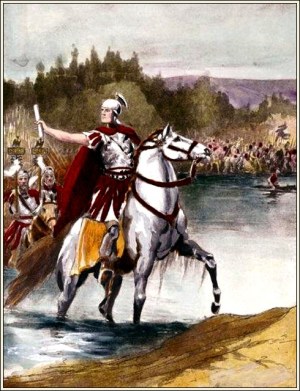
Caesar crossing the Rubicon The beginning of the end to the Republic?

Now most of us have heard about the fall of the Roman Empire but not so much about the fall of the Roman Republic.  The Roman Empire got started during the 1st Century BCE. It was teetering when Julius Caesar crossed the Rubicon River after being in Gaul. His return to Rome created a free for all civil war on who would control Rome.  Shortly there after, and for all practical purposes, Rome’s government shut down as various factions fought it out not with ballots but armies.

We are all familiar with Caesar’s assassination in 44 BCE.  Two of Caesar’s stanch allies, Mark Antony and Octavian, vindicated his death and defeated Caesar’s assassins:  Brutus  and associates. Mark Antony and Octavian then divided the former Republic between them.  But two men with  grand imperial plans soon proved that greed gets the better of any governmental agreements.  It was to be a short-lived arrangement and could be argued a pre-imperial shut down. Octavian later defeated Antony and Cleopatra in 31 BCE to become sole ruler of the newly-founded empire.  The Roman Senate then made him princeps or “first citizen” and gave him the name Augustus. After nearly a century of civil wars the Republic was dead.
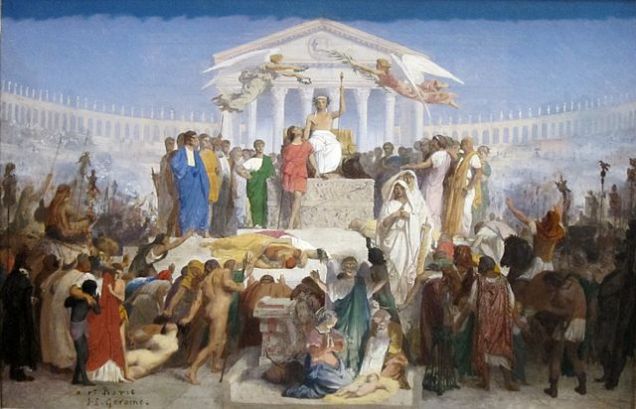
The Age of Augustus and the Birth of Christ And the death of the Repbulic

The Republic, however, began in 509 BCE when the Romans over threw of the Etruscan kings who had ruled over them for hundreds of years. Once free of the Etruscans, the Romans established a republic. One institution that carried over from the overthrow was the Senate.  This appointed body of 100 well-heeled advisers to the king was soon to be expanded to 300 of Rome’s noblest and wealthiest men.

One thing that did not carry over was a codified system of written law.  This is not to say that these patricians of the Republic were not civic or legally minded; it was more about their interest in maintaining their social position, wealth and prestige in the new republic the than putting  something legal in writing.

As Rome expanded and defeated other near-by enemies, it began creating new cities and a complex society.  Rome’s influence was growing beyond the Tiber River. Security was a prime concern as Rome had to continually defend itself against the various tribes and Gauls that would attack and plunder Rome. The security of the Republic fell on the shoulders of the farmer/soldier — the plebeian.

One vexing problem to the citizen soldier was debts.  It was not uncommon for plebeians to lose everything, including their freedom, from debt accrued while serving in the army defending the Republic. Since the Roman army at this time was made up of mostly farmers, and since Rome was at war most of this time, soldiers were not around to bring in a crop.  Also, Rome’s  invading  and marauding enemies could lay waste to soldiers’ farms putting them further in debt.

These continued wars meant that a farmer could be called into service at any time. Not only was this farmer still responsible for paying his taxes, he was also responsible for his military kit: weapons, armors etc.  Eventually these citizen-farmer/soldiers fell further into debt.  The debt left him with only one asset: his person as collateral for his debt.

There were several options open to the creditor.  However, there was very little wiggle room for the defender of Rome who now found himself in debt to his patrician overlord. The insolvent soldier could find himself without his farm, in prison, flogged or as a patrician’s indentured servant working off his debt.

Rome’s military success also brought in more public land for the growing Republic.  The problem was that these newly acquired large tracts of lands were often rented out to the wealthy patricians and not to the debt-ridden farmer/soldier. The classic scenario of the rich get richer simply because they can.

Another consequence of  Republic’s military success  was immigration. With less land available more people began to crowd into Rome increasing the urban populations. Despite the increase in the plebeian population, they were still under represented in government. The were also out voted at the polls. Roman voting was broken down in an electoral-like tiered-class structure that was heavily skewed in favor of the patrician classes with the plebeians voting last.  With majority rule it was not uncommon for the election to be decided well before the plebeians even had a chance to vote.
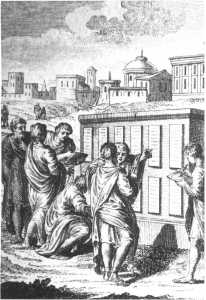
Laws posted on the Twelve Tables in Rome.

Eventually the plebeians were able to convince the patricians to give them government representation in the newly created office of tribune.  Tribunes had had veto power over laws. Rome also established the Twelve Tables in 450 BCE. On these tables laws and procedures were written down for all to read creating a “rule of law.”  It was the beginning of codifying Roman laws much like Hammurabi’s codes.

Unlike the plebeians march out of Rome 2,500 years ago, our governmental shut downs   are political grand stand events. It is the play of recalcitrant politicians fighting to get 15 minutes of stage time. The shut down quickly ends out of fear that maybe the plebes will realize  that we  do not need a group of spoiled patricians prancing around trying to fix some self-created government crisis.


https://nvdatabase.swarthmore.edu/content/plebeians-win-victory-rule-law-ancient-rome-449-bce-see-also-494-campaign

https://scholarship.law.nd.edu/cgi/viewcontent.cgi?referer=https://www.google.com/&httpsredir=1&article=4440&context=ndlr

http://sites.psu.edu/struggleoftheorders/

http://www.vroma.org/~bmcmanus/orders.html

http://www.historyguide.org/ancient/12tables.htm

http://avalon.law.yale.edu/ancient/twelve_tables.asp

http://news.gallup.com/poll/218984/congress-approval-remains-september.aspx?g_source=Politics&g_medium=newsfeed&g_campaign=tiles

https://www.zerohedge.com/news/2015-05-18/79-members-congress-have-been-office-least-20-years


Symbols: Stand up, Sit down or Take a Knee

Traditionally in football when a player’s knee touches the ground he usually has the football and that means the ball is down and the play is over. The trend, however, seems to be when a player takes a knee it is an indication that the player’s career is over.

Several years ago, Tim Tebow created a stir with taking a knee after the play was over when he scored a touchdown.  This was a  spiritual gesture, a more solemn form of celebration that was even given the term Tebowing. Tebowing, imitated on and off the field, was not the typical end zone celebration of spiking the football or the myriad other end zone dances performed after crossing the goal line.

Bronco players Tebowing.

A couple of seasons ago Colin Kaepernick decided to take a knee before the game actually started. He took his knee in protest during the National Anthem. Kaepernick wanted to bring attention “to the oppression of people of color.” A gesture that has caused national attention and earned Kaepernick status as a Public Enemy Number One right there with wanted men like John Dillinger and Alvin “Creepy” Karpis.

Ironically, both of these quarterbacks were released and have not taken a knee in any NFL huddle for several seasons. Their actions could easily be interpreted as a symbolic gestures. According to Merriam-Webster.com a symbolic gesture is an  act that has no purpose or effect other than to show support, respect, etc. And I guess this is where we run into the debate on how to show support and respect.

In most cases symbolic gestures are spontaneous, spur-of-the-moment responses. We are more familiar with simple use of hand gestures during polite conversation. This can morph quickly into the more animated hand gesture accompanied with the vein popping, red-faced, eye-bulging action of flipping off a driver who just cut you off in traffic. These sorts of gestures are easily understood; others, not so easy.

Symbolism is a way of expressing intangible ideas and concepts with recognizable material objects, which can be open to various interpretations and misconceptions. It could be like beauty is “in the eyes of the beholder.” It could be as Supreme Court Justice Stewart Potter said in trying to determine pornography  by simply saying he could not define it “but I know it when I see it.”

Franklin thought it looked like a Turkey but it looks more like a Blue Jay that just got beaned.

When The Continental Congress decided to design a seal for the newly united colonies, they went to its go-to guys who did a bang-up  job on the Declaration of Independence: Thomas Jefferson, Benjamin Franklin and John Adams. Three of the best philosophical, scientific and legal minds of the time. Basically the Congress took a pass on the seal for six years as different artistically-gifted colonials took a shot at creating the symbols acceptable to a finicky Congress.

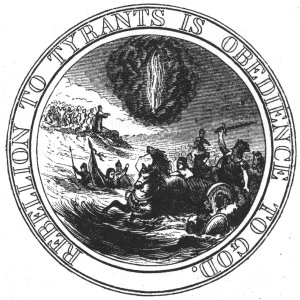
So what do we see when we see a symbol?   Franklin thought one of the first proposed seal’s depiction of the Bald Eagle looked more like a turkey. Jefferson’s vision for the seal was an illustration of Pharaoh in his chariot chasing Moses and the Hebrews across the Red Sea with the motto: Rebellion to Tyrants is Obedience to God as part of the seal.  I am not sure how that would play out today.

Pharaoh being swallowed up while Moses receives divine protection.

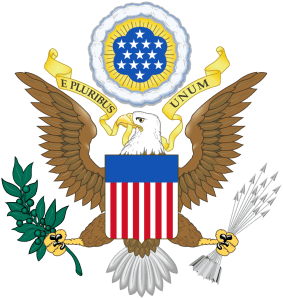
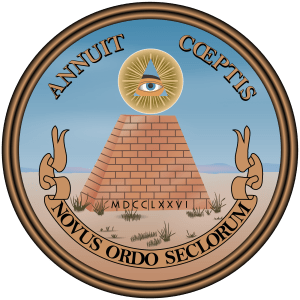
It eventually took three shots to get the symbols on The Great Seal that The Continental Congress wanted to represent the its beliefs and and values to future generations of Americans. On June 20, 1782 Congress approved the seal as we know it today. Everything on the seal from the colors, the 13-step pyramid with the ever watching eye in the sky on the reverse side symbolize a belief in the new nation.  Even the Latin phrases: “One out of many (or from many)” and  “New order of ages” are meant to represent the ideals of 1776. A sort of 18th Century flash forward to the present is a reminder of the symbols from the past meant to guide us into the future.

Wikipedia

Although the Great Seal was a thoroughly thought-out process sometimes symbolic traditions come along haphazardly.  For example, how did the knee-jerk tradition of bestowing God’s blessing on somebody who just sneezed get its start?

Wikimedia Commons

According to Baseball Reference  The Star Spangled Banner was first played at a baseball game  in May of 1862 at the Union Grounds in Brooklyn. The United States Navy started playing the Star Spangled Banner at official functions in 1889.  In 1916  President Woodrow Wilson signed an executive order making the Star Spangled Banner the National Anthem.

A half-of-a-century after the game at Union Grounds, The Star Spangled Banner made it back to the playing field. On September 5 during the 1918 World Series game in Chicago a band played the Banner. It just so happened they played it when everybody in the ball park would be standing for the traditional 7th Inning Stretch. A sailor on leave snapped to attention and the crowd followed suit. It has been played at World Series games and Opening Day ceremonies ever since, with one caveat: A band had to be present.

We have to remember that this was a time when the public address systems were in their infancy and was more likely a strong-lunged man with a megaphone.

Symbolism sometimes has a haphazard way of coming together.  I am not sure if Tebow or Kaepernick ran their decision to take a knee before a Congressional committee. More than likely they just did it as a symbolic gesture. Whether we stand up, sit down, take a knee or just shut up, the gesture, as a symbol, is always up for interpretation.


https://www.washingtonpost.com/news/acts-of-faith/wp/2017/09/24/colin-kaepernick-vs-tim-tebow-a-tale-of-two-christianities-on-its-knees/?utm_term=.892a4a41d66c

https://www.ourdocuments.gov/doc.php?flash=true&doc=5

Click to access 27807.pdf

http://www.nytimes.com/1987/06/12/us/washington-talk-briefing-tribute-to-cia.html

https://www.smithsonianmag.com/arts-culture/american-myths-benjamin-franklins-turkey-and-the-presidential-seal-6623414/

http://time.com/4955623/history-national-anthem-sports-nfl/

conventihttps://www.baseball-reference.com/bullpen/The_Star_Spangled_Banneron

http://www.latimes.com/nation/nationnow/la-na-nn-star-spangled-banner-200-anniversary-20140912-story.html

Ostracized or Exiled


4640103
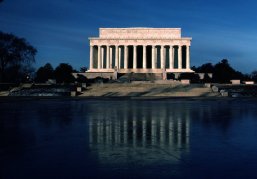
Lincoln Memorial

In the highly charged campaign-election atmosphere, Donald Trump promised to drain the D.C. swamp — starting with Hillary Clinton.  His supporters chanted throughout the campaign to “lock her up,” which sounds better than “ostracize her!”

The tone in the transition period, however, has changed dramatically from assigning a special prosecutor to look into Hillary Clinton’s improprieties from Trump’s first day in office to more of Lincoln’s Second Inaugural address were Lincoln advocated “malice towards none, with charity to all.”   President-elect Trump must have been channeling Lincoln, a president who presided over a severely divide country, when he said: “I don’t want to hurt the Clinton’s, I really don’t, she went through a lot and suffered greatly in many different ways.”

With that said, and since we are in what appears to be a wave of populism, there is one way to drain the D.C. swamp without legal prosecution but through the ancient Greek practice of ostracizing those who may have stepped out of favor with the voting public.

The Athenians practice ostracizing their leaders on an annual basis. The Greeks often sent off some of their most illustrious leaders into 10 years of exile.  In fact, Themistocles, the chief advocate and designer of Athenian naval power, who defeated the Persians at the Battle of Salamis, was sent into exile. Despite his forward thinking in preparing Athens for the upcoming struggles with the Persian Empire, he did not survive accusations of “bribery, sacrilege, and a suspicious association with a Spartan traitor.”

In the 1770s Boston was a hotbed of democratic “populism.”   It was not an unusual sight to see a Sons of Liberty inspired-crowd put the hot tar to some poor British official. After being administering the feathers, the misguided official was then regally escorted out of town on a rail. Once the Revolutionary War started, many “loyal” colonists opted for self-exile rather remain unfaithful to their king and face the possibility of mob reprisals.

The Sons of Liberty knew a thing or two about putting democracy into action. A mob can be a beautiful thing if it is controlled but, in the wrong hands extreme mischief can spiral into anarchy as when angry Massachusetts’ farmers decided to close down the courts to keep the state from reposing their property for back taxes.  When their attempt failed, one of the chief instigators, Daniel Shays, chose voluntary exile when he fled to Vermont to avoid prosecution.

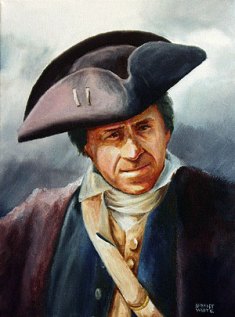
portrait_daniel_shays
Revolutionary War Army Captain Daniel Shays

These pre and post-Revolutionary War experience in inciting the people, and dealing with tyrannical Royal governors, must have given the framers some disconcerting thoughts when it came time to amend the Article of Confederation. Instead of amending a loose confederation of states they decided to create a tighter federation of states.  They created a hybrid form of government splitting governmental power between a central government and states and putting various political philosophies that incorporated checks and balances, separation of powers, (specifically in creating a separate judicial system) and a Bill of Rights into a Constitution that protected the people and the powers to be from each other.

The framers of our Constitution borrowed liberally from past political thinkers from Locke, Rousseau, and Montesquieu; but sending citizens deemed undesirable into exile was not incorporated into the Constitution. The framers also understood the difficulties the Greeks had in keeping a pure democracy from turning into a tyranny and they no doubt understand the slow fade that took the Romans from a republic to an empire ruled by a soon to be gods.

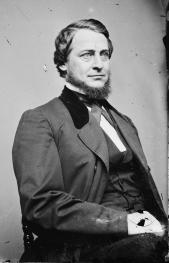
clement_vallandigham_-_brady-handy
Vallandigham

During the Civil War Clement Laird Vallandigham, a former Congressman from Ohio and an anti-war Democrat, who some believed was a member of the Knights of the Golden Circle, was banished to the Confederacy.  In the opening months of 1863 when the Civil War still hung in the balance, the Union Army issued General Order 38. The order curbed the right to express anti-government sentiments or to convey sympathy for the enemy.


Vallandigham, being the good Copperhead spoke out against Lincoln and the war in a Columbus, Ohio speech.  Union General Ambrose E. Burnside promptly had him arrested, tried by a military court, convicted and sentenced to two years in a military prison all the while avoiding a civil trial. Lincoln however, showing some charity for Vallandigham, commuted the sentence and exiled the former Ohio Congressman to the Confederacy.

The Southerners were probably no more interested in having him around sent him off to Bermuda. From there Vallandigham made his way Canada and ran unsuccessfully for governor of Ohio from Canada. Vallandigham eventually crossed the border and returned to Ohio. He returned after Lincoln had won the 1864 election. Lincoln, however, ignored his return and deemed Vallandigham’s pro South rhetoric and activities no longer a nuisance as Union armies began surrounding Richmond.

Lincoln was dealing with a divided country that some would say was in open rebellion.  Others might say they were defending their rights and homes from an over reaching federal government.

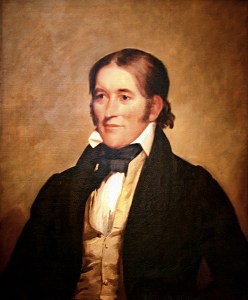
Most Americans who choose to go into exile do so to avoid criminal prosecution.  After falling out of favor for killing Alexander Hamilton, Aaron Burr slithered out West to look for new empires to create. His activities there ran him afoul with the Jefferson Administration.  Burr was later arrested and brought back East and tried for treason and found innocent. He later fled to Europe to avoid creditors. Some may say Davy Crockett went off into self-exile after losing his election for Congress by saying, “You may all go to hell and I will go to Texas.”

david_crockett
David Crockett

A modern day financial flight to exile was millionaire financier and Richard Nixon supporter, Robert Vesco, who some have said was the “the undisputed king of the fugitive financiers.” He fled the United States in 1973 for Costa Rica and eventually died in Cuba.  A more familiar flight from justice is Edward Snowden the Booz Allen NSA subcontractor who leaked secret NSA surveillance documents to the press. He has made Russia his home.

Lost elections, criminal charges and convictions might be one way to encourage certain evasive creatures to leave the quagmire of D.C. But any attempt to drain the D.C. Swamp of certain entrenched reptiles may be as futile as trying to lure escaped pythons and boa constrictors to leave the Everglades.