The other day I came across an article about a doctor ready to perform a head transplant. Evidently, a neurosurgeon feels like he can take the head off of a live human and place it on the a brain-dead body. Some people compare Dr. Sergio Canavero’s attempts at this type of operation kin to Dr. Victor Frankenstein. In fact, he may have already performed a transplant on a cadaver. They claimed it was the first successful head transplant. I am not sure how that qualifies as a successful transplant. If anything it qualifies him for a spot in Ripley’s. Believe it or Not! Museum in St. Augustine.
I must confess, though, I never read Mary Shelly’s Frankenstein. I never saw Boris Karloff as Frankenstein, either. I have been to Ripley’s museum and saw the shrunken head and how head hunters made them. I also saw Mel Brooks’ movie Young Frankenst-eyen or was it Frankenst-een. This, however, makes me neither an expert to comment on Mary Shelly’s work or on neurosurgery. All I know about the novel is that Victor Frankenstein pieced together a monster out of spare human parts, where he got these parts I am not sure, I would assume he was skulking around a morgue or digging in fog shrouded-graveyard after midnight. Everything creepy happens after midnight.
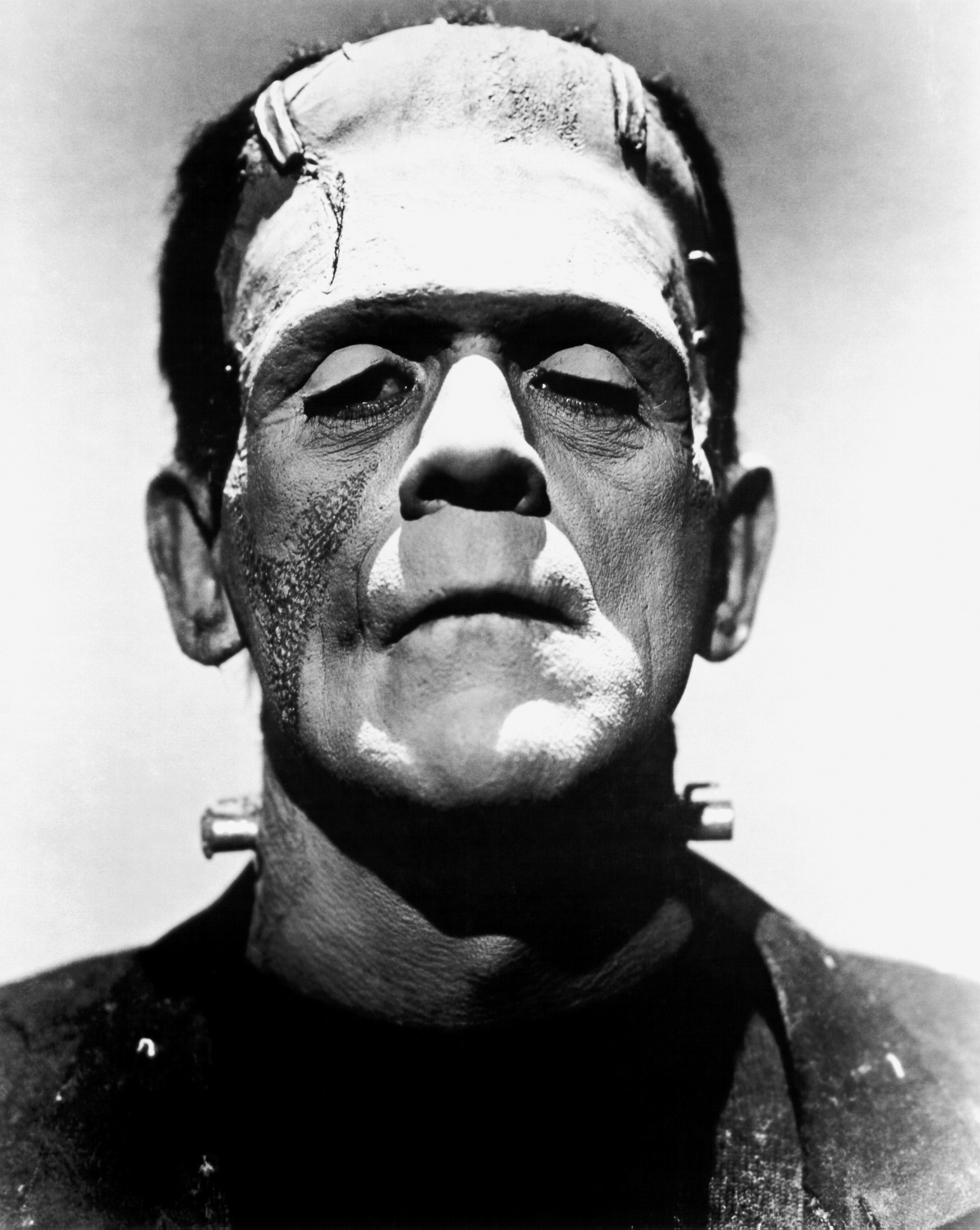
Boris Karloff as Frankenstein.And somehow the good doctor managed to get this creature up right and moving forward through the magic of alchemy or an ancient form Saksamaa voodoo–if such a thing exists. So now, this hodgepodge of random parts comes alive. However, life is never that simple or easy. The monster ends up making a lot problems for everybody involved. All of this is probably very similar to the way General Motors put together the Chevy Vega.
Most people today may not remember the 1970s when Japan started its invasion of small cars into the United States. American automobile manufacturers were still making those big-assed land monsters with 427 cubic-inch engines (or 7.0 Liters today). These behemoths like the Ford LTD, the Buick Riviera, the Dodge Polaris, the Cadillac Coup de Ville and the Chevy Impala to name of few with their wide body and flashy chrome were parading the American dream down the highway. These biased belted-tire rides were the queens of the road back when gas was 30 cents-a-gallon. A family of five or six could easily fit into their confines of these crusiers.
The Vega, named after the fifth brightest star in the night sky, and a star just slightly more than 25 light years away, was undoubtedly one of the worst American cars made in the 1970s: along with the Ford Pinto and the American Motors Gremlin. These subcompact cars were designed to compete with the new small Japanese cars hitting the market. The VW Beetle, with its distinct, curved half-bubble shaped-body first arrived in the United States in 1949 and was a well-established site on the road.
1971 Chevy Vega Hatchback CoupeBut like Frankenstein, the Vega, the Pinto and a host of other subcompact cars must have been created out of Detroit’s grave yard of left-over body parts. The fact that American auto manufacturers could not come up with a viable homemade subcompact car was a distinctive black mark on American engineering. Here is the country, in the midst of a space race, that designed three types of space capsules, with the Apollo capsule capable of carrying three astronauts 240,000 miles to the moon and back, This happened six times with two missions doing fly arounds of the moon. But yet, we could not put a four-passenger car on the street for under $2,100.
It was about this time that the first successful heart transplant took place in South Africa. Dr. Christian Barnard was able to take the heart of a 25-year-old woman and put it into a 53-year-old man. Louis Washkansky lived for 18 days with the woman’s heart dying not of heart failure, but from pneumonia. I am sure he had no problems accepting her heart. If he had lived there is no way of knowing how it would have changed him. Also, there were no real ethical questions considering that the woman, Denise Darvall was killed in a car accident and had just died. If there has been a debate about gender mismatch in organ donors it has not become a public social debate as to which bathroom the recipient would use if he or she ever made it to Charlotte, North Carolina.
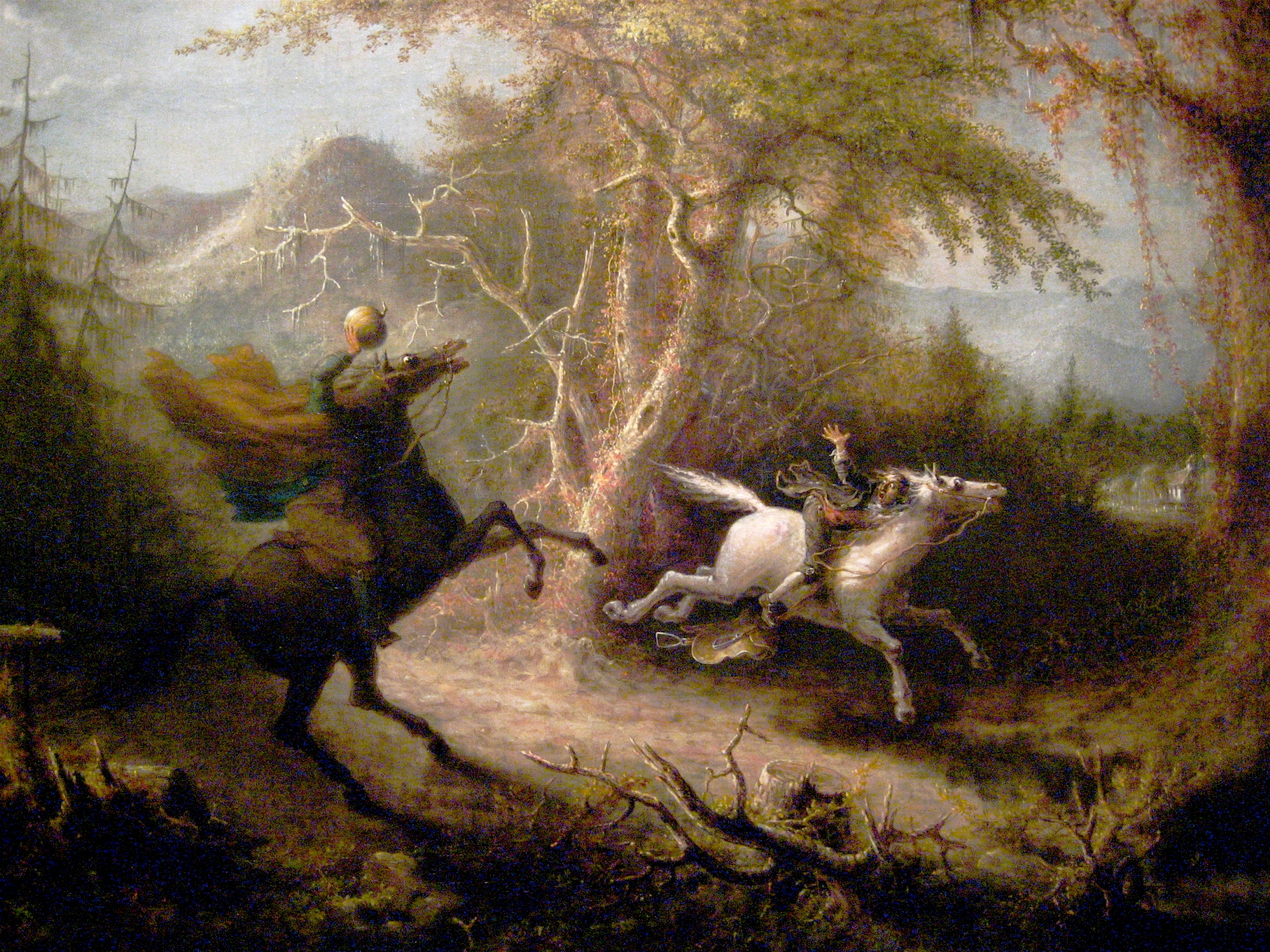
Ichabod Crane trying to avoid losing his head.However, lopping the head off of a viable human being’s body to attach it to another body recently deceased sounds morbidly funny and alien. And I would imagine a lot more complicated than tethering a pumpkin onto a headless body. Not to mention if the operation is not a success has the doctor committed a crime: murder. Unlike the heart transplant, it is the heart that is diseased and malfunctioning. In a head transplant, there is nothing wrong with the head. It is the body that is malfunctioning. Maybe it should be called a body transplant.
And here again what would society say if such a swap was also a sex change. This head body transplant brings up a whole lot of ethical, racial and gender issues. Suppose a doctor was to put the head of an African woman on an the body of a man from Southeast Asia. What is this new person’s nationality, forget about race and gender. It really goes beyond creepy and freaky.
To perform these types of operations maybe, we should consult ancient Egyptians records. From their hieroglyphics, it looks like they may have had some experience with this. The way they removed and preserved body parts the mummy makers office was like a NAPA auto parts store.
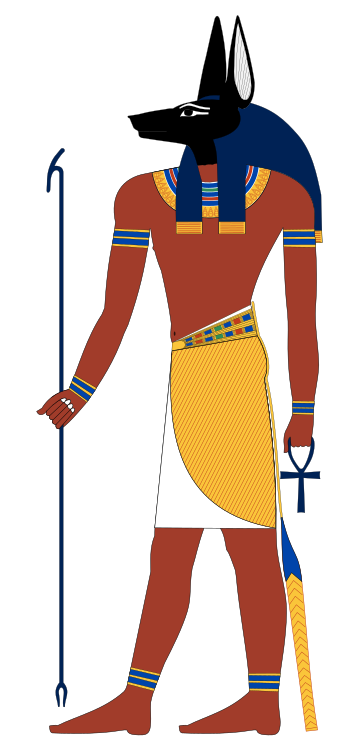
The jackal-headed god protector of the deadHorus keeping a hawkeye out for Egypt.Maybe all of this is head transplant talk is an effort to revive some sort of ancient alien procedure practiced on Egyptians four or five thousand years ago. It has to be that some ancient alien race was looking for a place to run a few experiments on the locals and leave. This would easily explain Anubis, the Egyptian god who was the protector of the dead. He had the head of a jackal. According to Egyptian mythology, jackals were often seen around cemeteries. Logically, putting two-and-two together, Egyptians came up with jackals w because they were protecting the dead. I don’t know about that one. Maybe they were spirits of ancient aliens prowling around looking for body parts to make a god. Or maybe they were just hungry and looking for a mummy to chew on.
Then there was Horus. The god with the hawk’s head. This has to give new meaning to bird brain. This is a transplant I would pay to see. How you get a bird’s head on a human body is beyond me. Maybe just maybe, the “Ancient Aliens” series on the History Channel is starting to make some sense. Maybe Modern Marvels will take a crack at explaining the Vega.
Now that the college football season is over with Clemson thrashing Alabama in the National Championship Game the speculation about next year’s season can begin. I am not a football expert by any means. I played a couple years in my youth and have, like a lot of people, spent a large portion of my lifetime in front of a TV watching the game. And yet somehow this qualifies me to be an expert on the game, which it really doesn’t. At best, like most Americans, it gives me the right to an opinion.
What really intrigued me about this year’s college football season was not that Clemson and Alabama played in the title game. I think that was a no brainier even for me to pick. My interest was with two other undefeated teams. One was fourth-ranked Notre Dame and the other was the University of Central Florida.
Alabama and Clemson, again.It is not my intent to rehash the history of how College football determines who is in the champion is; or who should be in the championship game; or the methodology they use. However in the past, various polls have been used to determine who was the top team without any sort of playoff. This was like ending the season the way Wall Street might end the year on a Bull run. The polls are still instrumental, I assume, but how does one undefeated team like Notre Dame fall into a playoff spot and another like UCF keep tumbling off into space? Is it determined by who has the most “likes”?
As far as I can tell a selection committee makes that determination. Probably a group of intellectual types similar to the group that decided whether Plato is or is not a planet. Is Pluto a Power 9 planet or a dwarf planet now relegated to sub status among our solar system’s celestial players. The question, I would assume, is UCF a Power 5 team–a dwarf planet or a fast radio burst from a distant galaxy? Or is it a team that just toils in the distant corner of our own little football galaxy. They play in a non-elite conferences that is just not that good. I guess the they are a quick look shooting star.
The fate of UCF post season play is determined by a 13 member selection committee. A committee consisting of sharp-minded experts in the science of football. Members include former football head coaches, athletic directors and even a sports journalist and a former Secretary of State. They serve for three years determining which four college football teams get to play for the National Championship.
According to various websites, the selection committee forms its hypotheses based on observations and by gathering data through the 12 game regular season. They also make their picks on team records, head-to-head results and strength of schedules. Plus, they will compare how teams did against common opponents; and of course, the all powerful conference championships factor in.
The thing to remember is that not all schedules, records and conferences are created equal. But when are 12-0 records not equal? The American egalitarian belief of equality does not fully play out on the gridiron. To make it easier, I would assume, College Football has 10 major conferences but only five power elites, which almost automatically eliminates a large percentage of the more than 100 college football teams around the country. And rightfully so, but this gives the power elites a foot up on teams, like UCF, who do not play in these elite conferences.
It is here, in my mind, where Notre Dame and UCF pass some sort of orbital plane. Both teams have an arrogance in pushing their claims to playing in the championship. Notre Dame has a storied and rich College Football history that must hold some sort of sway on current football minds. UCF, however, not so much. UCF did not come into existence until 1963. By then Notre Dame had already won five National Championships.
But the college football world changed in 1990 when most major independent schools like Penn State, Florida State and the University of Miami began joining conference as College Football moved towards a playoff system to determine what teams qualified to play in the championship. But not Notre Dame. They are special. They are loosely affiliated with the Atlantic Coast Conference, a Power 5 but not completely bound an ACC schedule.
1924, a time before instant replay. Notre Dame’s star backfield “The Four Horseman”: Jim Crowley, Elmer Layden, Don Miller and Harry Stuhldreher.
But watching them play is like star gazing. Going out at night and looking at distant twinkling lights. We are use to light being instantaneous but the light from our nearest star, Alpha Centauri takes more than four light years to get here. The Sun’s light takes about eight minutes. When we watch Notre Dame play is like we are watching football from the past. It is the Four Horseman led by Knute Rockne running loose in the 1920’s. College Football has moved on yet Notre Dame is still playing to its past glory.
Then there is the University of Central of Florida. A school founded in Orlando. The land of Mickey Mouse and Shamu the Whale. A not so special football school, despite being the largest university in the state of Florida. It is bursting out of the shadow of Disney World. UCF is a team that has basically a protostar, a mass of swirling football nebulae. It has gone from a winless season to two undefeated regular seasons. This burst of light has created a Pluto type argument among football scholars. Is UCF a supernova team from a non-power five conference, a real contender?
UCF might as well be playing on the newly discovered exoplanet, “UCF 1.01,” located 33 light years from any Bowl site here on Earth.
Unlike astronomers and astrophysicists, who deal with the cosmos and an infinite number of stars, football minds really have to observe a handful of teams throughout the season. At some point this gridiron group will have to translate their observations and data into a working theory that other football aficionados will believe. Much like the way Newton turned gravity from a theory to a law: what goes up must come down.
All stars over time eventually implode and so do football teams. Notre Dame’s recent 33-3 loss to Clemson in the Cotton Bowl is the most recent a example of it’s Bowl season’s implosion. Then there was their 42-14 implosion to Alabama in the title game in 2013. But they have not gone supernova. Notre Dame is like a low-mass star with plenty of life left in it but maybe not enough to outshine newer teams like UCF. Notre Dame has been around for a while and it knows it will shine brighter if it is the only star in the non-conference sky. It’s luminosity will be dimmer by several magnitudes if it has to toil as an upper-middle of the pack Power 5 conference team.
UCF, on the other hand, realizes that in order to get the selection committee to take them seriously they have to burn brighter and play with more intensity now. But like Notre Dame, if they were to join a Power 5 conference they might find themselves a 6-6 team struggling to be bowl eligible. Instead, they play in the back corner of the football universe, the American Athletic Conference, a non Power 5 conference where it might be easier to reel off 25 straight wins. Alabama reeled off 14 straight wins playing in the Southeastern Conference, arguably the best conference despite Clemson’s beat down.
The problem is that UCF had its moment much like Notre Dame. They both fizzled in their bowl losses. Although UCF’ played in an exciting game with LSU, a Power 5 team, and despite the 40-32 score, it was not really that close. But then neither was the National Championship game.
Romans getting personal.For a while it was in vogue to quote from the “Godfather.” Usually quotes, pithy sayings or maxims can be read one way but often they can become murky and be turned around and interpreted both ways. I think one of the quotes from the Godfather falls into this category. When Michael Corleone is ready to avenge the attempted assassinations of his father he says: “It’s not personal. It’s strictly business.” But is that really true? It is very easy to believe that the Robert Mueller’s Russian investigation can be turned around and be interpreted by some as: “It’s not business. It’s strictly personal.”
Journalist Ellen Goodman wrote that “much of journalism and politics are in a kind of collusion to oversimplify and personalize issues. No room for ambivalence. Plenty of room for the personal attack.” Today, we tend to think of a personal attack as a round of Twitter tweets fired across cyber space. But how about a time when personal attacks were “up close and personal” attacks.
Go into just about any Civics class in the United States and there is sure to be a mention of the Roman Republic, a sort of forefather of our Republic. But the Romans played politics for keeps. Arguments and disagreements, “fake news” and even claims of “fake news” could have dire consequences. First off, though, let’s not confuse the Roman Republic with the Roman Empire, which as the coachman in the Wizard of Oz says, is horse of a different color.
It took the Romans a couple of centuries to get their republic up and running and a couple of centuries to see it turn into an empire. Most historians would probably agree that the demise of the Republic started around 130 BC with Tribune of the Plebs Tiberius Gracchus and his brother Gaius Gracchus. These two brothers, as tribunes, proposed various land reform acts and other laws that would benefit the poor at the expense of the powers that be.
The brothers GracchiBoth brothers became tribunes, an office that was created in 494 BC to give plebeians, Rome’s lower classes, a stronger say in government. By the second century BC, the position with its ability to veto and propose laws, became one of Rome’s most powerful positions.
Tiberius, not to be confused with the Emperor Tiberius, ran a foul with the Optimates, or “the best men” of the Roman Senate, with his agrarian reforms. Not to weigh in too deeply into ancient Roman history and politics, let’s just say that the established Roman Senate took his reforms as anti-business and as a personal affront. It may be hard at first glance to understand the workings of the Roman Republic, but the issues they were dealing with were not so much different than what we are dealing with today: land reform, taxes and citizenship. Our government just doled out a $12 billion bailout to farmers to offset losses from new tariffs. When was there a time we were not dealing with immigration and now some want a new interpretation on the 14thAmendment in relationship specifically to people born here in the United States. And of course, just like the Romans, we bicker on who should be appointed or not appointed or elected to governmental positions.
The more Tiberius pushed his progressive reforms the more resistance he got. The Optimates decided enough was enough and took things outside the law and into their own hands. A group of senators gathered up a mob of their supporters, henchman and slaves; invaded the assembly where Tiberius was; and beat him and some of his 300 supporters to death. It is hard to determine if this was business or personal.
At the very least, it was murder. In some ways, it could be called a crime of passion because the Optimates were without a doubt enraged to the point of insanity with Tiberius. If that is the case, then this is personal. However, calling a mob together to kill someone takes planning and in that case, it is premeditated and then it has to be all business.
Brother Gracchus fared no better with the Optimates in his battle for reform several years after his brother’s beating death. What may have done him in, was proposing citizenship for some of Rome’s non-citizens. The politics of immigration and citizenship seem a messy affair in any age, but in Roman times it can get bloody. When one of Gracchus’ opponents was killed, the Senate took this as an opportunity to declare martial law. Soon, an armed group of Optimates was requesting Gracchus to appear before the Senate for a small question-and-answer get-together, no doubt as the guest of honor at another mob beat down. Gracchus refused. Seeing family history repeating itself, and being a good Roman, Gracchus fell on his slave’s sword. The killings, however, did not stop there. Several thousand of his supporters were rounded up and summarily put to the sword. I guess it could be said that this was strictly business.
At times, it becomes hard to tell if it is business or personal. It is easy to assume that in most cases it is a combination. Take Roman proscription. The Roman constitution allowed for a dictator to be appointed in dire circumstances. In 82 BC Lucius Cornelius Sulla became dictator. Sulla would head down to the Forum and post a list of individuals he deemed as enemies of the people. Once listed, the individual’s property could be seized without due process and most often they were murdered in the bargain. When the rule of law is supplanted by the needs of a few ruling elites, who find themselves in confusing times of crises, it becomes easy to get personal.
For instance, after Julius Caesar’s brutal assassination on the Senate floor, his trusted lieutenant Mark Antony and Caesar’s adopted son, Octavian, consolidated their power over what was left of the Republic, and began hunting down those who were responsible for Caesar’s killing. With the rule of law co-opted or gone, it was not hard for Antony and Octavian to come to a mutual (list) understanding. They both had enemies and they both needed money.
They did not invent proscription, they simply made their enemies list known to an eager public willing to cash in on the crisis. Once a person was identified, for whatever reason, it could have been as simple as being on the losing side, hanging a yard sign out on your front portico or just saying the wrong thing to be considered as a treasonous act. Once listed or procscripted, anybody and everybody could become “Dog the Bounty Hunter.” Those so proclaimed an enemy of the public, if lucky, got out of Rome in hurry taking what they could and losing the rest. Those not so lucky like Cicero not only lost everything but their life, too.
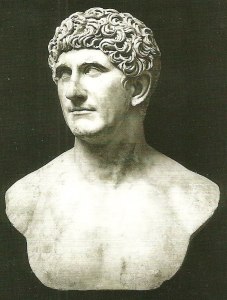
Antony had an eye on Cicero
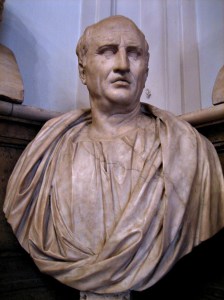
Cicero ran afoul of Mark Anthony. His sharp tongue and pen were aimed at Antony. He even quipped that they should have killed Antony with Caesar. In a series of 14 speeches called the Philippics, Cicero’s loathing of Anthony came out in full force. He attacked him as an enemy of the Republic. However, with the defeat of Caesar’s assassins, Antony and Octavian were able to completed their hold on what was left of the Republic. They now turned their attention to the less rebellious but quarrelsome Senate. For Antony, it was Cicero.
Cicero in headier times.
Antony’s soldiers beheaded Cicero and brought his head and hands to Antony. The story goes that Antony’s wife, who was once married to one of Cicero’s longtime enemies, took Cicero’s head and opened the mouth piercing the tongue with her hair pin. His head and hands were later displayed on the Forum as a causal reminder to who was now in charge. I am not sure it can get any more personal than that.
All of this may seem absurd in the 21st Century Republic but President Richard Nixon’s staff compiled an enemies list that included shock jock Howard Stern, actor Paul Newman and several journalists.
It is safe to say that running a republic, like any form of government, can have its ups and downs. Our country has had its share of scandals and scoundrels that have pushed our Republic to excesses. President Ulysses Grant’s administration was hit with the Whiskey Ring Scandal and Crédit Mobilier. Warren Harding had Tea Pot Dome and of course the mother of all political abuses: Nixon’s Watergate Scandal.
Investigations have rooted out the evil doers and brought the rule of law into play. At best, investigations and follow up laws tried to set things back on course to avoid them in the future. But scandals are as assured to happen as Hailey’s Comet will surely swing back by. The difference is scandals are not so easily predicted. They unfold overtime and the process to sort them out is done over time, too, through investigation and not through proscription.
Robert Mueller’s investigation, to some is a witch-hunt. To those being investigated it might seem personal, a form of Roman proscription.To others, it is all business. Is it business or personal? Only time will tell.
It does not matter who the Democrats run for president in 2020. It does not matter if the Russians meddle in the election. Donald J. Trump will win a second term. There are five reasons why he will win. Six if you live in a flyover state and seven if you have stocked a block house with survival gear for the coming Apocalypse.
It has nothing to do directly with his Administration’s policies, those are side shows. It is not because he is the incumbent or the economy is humming at 5 percent. That is helpful. It has nothing to do with tax cuts and tariffs. Our country was founded on the belief of not paying taxes so tax cuts are nothing new. Tariffs, ask any high school student and they might remember the Smoot/Hawley Tariff. But I can almost guarantee with 90 percent accuracy that the name is all they will remember.
It is not immigration either. Pick up any history book and we can find a period of time were somebody did not care for those coming down the gang plank to the New World. Check out the Know Nothings of the 1840s. (see the June 2016 blog The Know Nothings Ride Again)
An old interpretation to Native Americans
President Trump will win because of the drama. It is a story, a TV show that practically writes itself with Donald Trump cast in the lead role. It is similar to the movie, The Natural when the “slimy reporter” Maxwell Mercy, tells the aging ball player, Roy Hobbs, whether he wins or loses he is going to make Mercy a great story.
In literature, there are five characteristics that make a good story good; just ask any middle schooler in a Language Arts class. They will be able to draw a graphic organizer depicting the basic character, hook, setting, plot, conflict with rising action and resolution. Some have added elements like theme, and point of view but let’s not complicate the matter more than it already is.
Now some critics will argue about which characteristic is the most important in driving a good story. Some say that believable characters are needed; others will say it is the conflict within the plot that drives a story. With this administration conflicts abounds. The storyline can jump from one tweet to another. One day it can be a crime drama with indictments being handed out and lawyers making all sorts of counter claims. It could be billed as a modern-day Salem Witch Hunt. “Dunk him! See if he floats!”
Salem Witch hunt trials.
Other days it could easily be a suspense romance with salacious love interests or an erotic romance playing out in public with hushed-jilted lovers and the stoic wife quietly standing by her man. Or is she?
It could be a story of man against man or then just as easily, man against society: the news media, portrayed as the enemy of the people and the murky conspiratorial “deep state” trying its best to destroy the hero and all the values the hero stands for.
The story also has an epic quest. Epic quests like in Star Wars make the story. Quests are necessary for a hero to flourish. The greater the evil threat the greater the hero. For it is the enemy that really defines the hero. What makes Luke Skywalker a Jedi? He turns Darth Vader, the “baddest” dude in the galaxy, from the dark side. From Darth Vader’s first appearance there was no need to explain how bad this guy was. We all knew it from the beginning. Who can argue with a hero’s epic quest to “make America great again.” Even if the causes of America’s demise are as nebulous as the gases pulsating from the Crab Nebula.
It would be hard to classify this administration’s show as a comedy; a lot of late night shows seem to find the lighter side of this administration. I am not sure if this show could be classified as a dark comedy, blue comedy or obscene comedy. It is definitely not a slap stick although it could be argued it has some of the same elements as the Marx Brothers’ movie Duck Soup. It is hard to deny that all of these comic elements are taking place.
Although it could hardly be called a spy thriller. It reads more like Smily’s People than the Bourne Identity, it does have a foreign intrigue to it. Maybe more like the Cohen Brothers movie Burn after Reading or maybe the Bond flick, From Russia with Love.
Looking back into the future?
Others may see this as a tragedy; or an Armageddon film where dumbfounded scientist, generals and politician are completely surprised by the appearance of a large asteroid coming straight for earth. It could be some sort of cataclysmic weather-related event that will change the earth’s geo-economic powers into dying dinosaurs. An end game where the monkeys come down out of the trees and claim their true inheritance. It is the end of civilization as we know it. A real-life Planet of the Apes.
All of these elements make up many popular paperback books, movies and TV shows. The Trump Administration combines all of those elements. It defies a genre. So, what makes this different? Like any good book or a successful show, it is the believable characters. And ther are no shortage of these. There are Nazis, incompetent politicians, front stabbers, smarmy attorneys, babbling press secretaries, lurking women, bumbling family members and plenty of antagonists like the “Fake News,” The Supreme Leader (Iran’s Ali Khamenei). Or my favorite: Dear Respected Comrade Kim Jong Un, Chairman of the Workers’ Party of Korea, and Commander of the Korean People’s Army. Comic Book writers did not make this stuff up but it reads like a superhero battling evil. Just look in any “fake” newspaper. These characters secret villainy and conflict.
And then there is a hero: Donald J Trump. Although, some will argue that Trump does not fit the bill as the hero; and to many, he is completely miscast in role. But a story has to have a hero or an anti-hero to make the self-proclaimed quest to Make America Great Again a quest.
And just about every Sunday there is a new weekly hook to bring the audience back into to the drama. Trump, as the hero, gives people hope to believe in revenge for past wrongs; anticipation that mysteries will be solved; and that all the treachery of past adminstrations will be tamed.
Pundits and politicos may analysis this administration and pollsters may interpret the numbers on how popular the president is politically. But when it comes to selling soap, President Trump knows what the audience wants. And people are riveted to the drama.
Expect four more years in 2020. Just like the TV show LOST, where people had no idea of where the storyline was going, they tuned in, because they liked not knowing. The show, like this administration, practically writes itself. The problem, like LOST, is in the long run most viewers were disappointed in the ending.
It was in May of 1935 that Major League Baseball played its first night game in Cincinnati. Night baseball was a big deal at the time but after the preforming enhancement era of baseball, it is now one of those firsts that falls onto the “who cares” pile of baseball history.
It could be argued that night baseball opened the game up to many firsts. But for the Reds, that night game was just one of 154 that they played that year and the tens of thousands that have been played since.
Once there were lights, it was not too long before there were cameras; and after cameras commercials. The first televised MLB baseball game played on August 26, just four years after the first night game. W2XBS in Manhattan broadcast a double header between visiting Cincinnati Reds and the Brooklyn Dodgers. The NBC station used just two cameras so it is safe to say there were no slow motion replays or umpire reviews If a manager questioned a call he did it the old fashion way: getting into the umps face with a wad of chewing tobacco bulging in his cheek.
In 2008, as if the game was not moving slow enough, MLB decided to allow umpires to review calls using instant replay. At least when managers disputed calls it brought some excitement to the game. Watching umps review calls is like watching your kid play a video game.
It will not be long before umpires, referees and other officials are replaced with robotic movable field cameras controlled by a band of nerds and geeks buried deep with in the bowels of the stadium. I am sure that drones will soon be introduced to the game in some form or capacity.
Do not get me wrong, I still love the game. Watching it on TV has faded away for me like a foul ball slowly drifting into the left field stands, bouncing off outstretched hands of fans, to be pursued by a bunch of kids like a pack of dogs chasing a fox; ending with the ball held high for all to see like Achilles dragging Hector’s body around Troy. This triumphant ritual will be repeated throughout game.
The Triumphant Achilles
The major concern of late is the length of the game. With modern technology: lights indoor stadiums; a game can go on from sun up to sun set. Unless it is the 2002 All-Star Game where both leagues ran out of players. I for one do not want to sit in front of TV the better part of the night watching beer and car commercials. And I will not go on about listening to the yammering of the talking heads behind the mike.
In an effort to cut down on the length of the game Major League Baseball is trying to rid itself of some of its long held traditions. One ritual that MLB curbed is visits to the pitcher’s mound. I long lost interest in baseball before the new rule to limit how many trips emissaries can make a to the pitcher’s mound before a pitcher has to leave the game.
Most fans know when a pitcher is done. Shuttling out various players and coaches to talk to a hammered hurler is not going to change the situation before the manger with the hook yanks him off the mound.
Sure, those little junkets can eat up time. And really, how much strategy was being discussed? Everybody knows it is a stall tactic to give the relief pitcher a chance to get warm. It seems ridiculous to drag out the inevitable. After all, gone is the four-pitch intentional walk.
Ah, but some argue that this is where the real thinking of baseball is made. Those tough decisions managers had to make in the daylight before TV and the Designated Hitter era. Managers had to mull over when and how to pull his pitcher for the best pitcher-batter match-up, the double switch on where the new pitcher should bat in the lineup.
All of this cogitation requires counter cogitation in the other dugout, too. Does the opposing manager pull his batter for a switch hitter to check the other manager’s moves? It is a chess match played on a diamond—so they say. Oh for the sake of these chess like-managerial decisions: The King’s Pawn Opening, The Catalan Gambit or the Sicilian Defense.
In 1968 Bob Gibson pitched 47 consecutive scoreless innings and had a 1.12 earned run average
Two things are taking place in the late 1960s and early 1970s. Baseball games are becoming low scoring events, and the American League is losing attendance, which means lost revenues. Remember, this is a time before the plethora of sport channels and ESPN. Only a couple of MLB teams could wrangle a multi-million dollar TV deals.
Two quick fixes occurred. One, MLB lowers the pitcher’s mound. This was followed by the American League taking the bat out of the pitcher’s hands and replace him with a real hitter, a Designated Hitter to boost offense and excitement. Charles Finley, owner of the Oakland Athletics quest for the DH came true in the 1973 season.
I personally do not care one way or another about the DH. I do think it shows how out-of-touch baseball is with itself. I have come to accept the fact that just about every league in baseball (and softball) except the National League and the Nippon Central League are holdouts. The DH has been around for 45 years and I do not think it is going anywhere. The game loses a certain symmetry when one team plays the game slightly different than they normally play. It would be like one chess player starting the game without it one of his knights.
What I found more maddening about the slow pace of MLB games, besides the endless amount of commercials, is the batter stepping out between every pitch. I do not think sky divers check and adjust their equipment as much as a batter does between pitches. The constant adjusting of every accouterments a batter has on; tightening re-tightening of batting gloves, elbow pads; adjusting the jock; and holding his hand up to the ump while he is digging back into the batter’s box. I do not think the Aztecs went through this much ceremony when they were sacrificing virgins to their gods.
The same goes for the pitcher who steps off the rubber, shakes off the catcher two and three times. First of all, how many pitches does the pitcher have? And the catcher only has so many fingers and hand gestures to send out signals as to what pitch to throw. How many combinations and permutations of pitches can he throw to one batter? This is not British Intelligence at Bletchley Park trying to crack the German’s Enigma code during World War II. Throw the ball for god’s sake.
There were other events that killed my interest in MLB. Free Agency changed the game. I do not begrudge the players for making the big bucks. The Reserve Clause was a modern throw back tying players to a plantation much like a serf to the Lord’s Feudal Manor. You play here and die here unless the owner trades you.
Then there was the 1994 strike when a season was canceled and no Fall Classic was played. And in an attempt, bring back interest inter-league play followed. The first inter-league game was played on June 12, 1997. The Texas Rangers lost 4-3 to the visiting San Francisco Giants.
Major League Baseball, being the statistical abnormality that it has grown to be, keeps track of such now meaningless stats as the American League a positive 1,714 run-differential and .529 winning percentage over the National League in inter-league play. Really? Who cares about stats after the performance enhancement era of baseball? Maybe me, but not now.
I use to be a die hard American League fan. I grew up outside Washington DC as a Senator fan. At that time, Washington was in the American League. For Senator fans, any hope of getting out of the cellar and to the World Series was clinched by mid-May. As Charles Dryden wrote in 1904 that: Washington was first in war, first in peace and last in the American League.
Being a Senator fan I hated the damn Yankees. This puzzled my Mother when it came to the World Series. How could I hate the Yankees all year and then root for them in the World Series. It did not matter what American League team played in October–which now seems like November. The team could have been the ship of fools piloted by the devil himself. I did not care so long as they could beat the National League. So maybe inter-league play had a lot to do with me losing interest in MLB.
During my youth, I suffered mightily. In 1963 both leagues had won 17 All-Star Games. In the next 20 years the American League would only win two. It was not until last year did the American League finally evened the score with 43 wins a piece.
And who thought of tying the All-Star to the World Series with the winning league getting home field advantage. Baseball fans knew that the All-Star game was a stand alone game full of league pride prior to inter-league play. Inter-league play, free agency and commercial TV has turned it into some sort of Red Carpet Gala of stars in cleats.
Baseball, like so many things has to change with the time. But the real killer is TV. It is TV the lets us watch so many games but it is lights that let us watch night baseball. Television dictates the game itself. Television and its corporate sponsors literally has changed everything in American culture. Television uses baseball as the vehicle to sell more insurance, cars and beer. The game becomes secondary. Once advertisers figured out how to market their product to MLB, the game was never the same. MLB will tinker with the rules and rituals of the game to make Madison Avenue happy. And it all became possible when lights came on way back in 1936 and night baseball became a reality.
New words and phrases are always coming into use and out of use. It is interesting how unrelated words are combined into a meaningful phrase like “bottomless pit,” “exact replica,” and “speed trap.” When broken down these sorts of word combos really do not make sense but if you are pulled over along a stretch of road with other drivers for exceeding the “suggested” speed limit the word combo “speed trap” is very self evident in more ways than one. Not so much bottomless pit.
A recent word combo, “fake news” is making the rounds of late. When the two words fake and news are combined it seems obvious what is being conveyed. But what really is fake about the news?
The most vociferous user of the term fake news is President Donald Trump and his friends. Presidents and politicians have always used vague combo-words, catch phrases and cliches to have specific meanings easily understood by the masses. Pithy word combos can create an image like Theodore Roosevelt’s “Square Deal.” Franklin Roosevelt built off Teddy’s word combo to create a “New Deal;” Kennedy had his “New Frontier” and Johnson built off of Kennedy’s Camelot image with his “Great Society.” And who can forget George Bush’s oxymoron “Compassionate Conservative.” Granted all of these are catchy campaign slogans that try and boil complex issues into one pot without real specifics. Fake news is more of a rallying cry.
President Trump’s use of the FAKE NEWS, emphasized in all caps, is meant to register his contempt for established media outlets. His use of Twitter hammers home his views to any negative news story that criticizes him or goes against what he believes to be true. Twitter amplifies the president’s “bully pulpit.”
There is nothing wrong with using the media to get your message across. Presidents have been doing this as far back as the 1800’s. President Thomas Jefferson was tired of the partisan pummeling he was receiving from John Fenno’s Gazette of the United States. He and James Madison decided to hire Philip Freneau to edit a Republican newspaper, The National Gazette, to hit back at Alexander Hamilton and his Federalists. No more free unanswered shots.
Neither paper lasted more than a few years. It is not until the 1830’s that mass media begins to take off with the Penny Press. Steam presses and advertising made daily newspapers cheap and available to the public. One of the first presidents to realize the importance of mass media was Teddy Roosevelt.
As a writer, Teddy knew the power of the written word. He knew how to position himself in front of cameras for what we would call today a photo op. And he developed the office of the presidency into what he called the “bully pulpit.” A place to expound on his progressive policies. But time has changed the meaning of that term “bully.”
Today, the word bully as noun, is a brutish person that goes around intimidating the weak and feeble. As a verb it is the act of brow beating (another good two-letter combo) and tormenting the timid.
However, at the turn of the 19th Century when Roosevelt, the 26th President, used the phrase, bully was a superlative meaning grand or excellent. The presidency was an outstanding (another good word combo) office for pushing the president’s agenda.
Other presidents, like, Teddy’s cousin, used the new media of the day. FDR used the radio to his advantage in explaining his “New Deal” policies to the public. In the 1960’s TV added to John Kennedy’s prestige. Television, however, did not enhance Johnson and Nixon’s image. In fact, it helped topple their presidencies. It was Ronald Reagan, an actor turned politician, that became the “great communicator” using TV as the ultimate bully pulpit. So President Trump using Twitter is nothing new.
However the term fake news is interesting because on the face of it, it seems that there is no doubt in what the message is saying. But fake news can be like beauty: it is all in the eye of the eye of the beholder. It can also be like pornography in that most people know it when they see it. But do they really? Fake news that is.
What is counter intuitive (another good word combo) is that often for something to be fake, it usually is based on some sort of truth. For instance, there is only one real Mona Lisa but easily thousands of replicas. It would be hard to call them fakes–but they are. The big difference is everybody should know that if they have a Mona Lisa it is not the real one. The term “replicated news” does not come out with the same meaning as fake news. However, we are not replicating but realizing the possibility that some of the news is not 100 percent factual. But then when are we ever working with 100 percent certainty on anything.
Thoreau did not say it was fake just the same-old-same-old.
When it comes to news. we could look at David Thoreau’s impression when he wrote “all news is gossip and they who edit and read it are old women over their tea.”
That is rough on old women considering most of the people doing the loudest yammering today about the news, fake or otherwise, are not doing it over tea and would never classify it as gossip.–fake maybe. And usually, it is media-squawking heads who are the main purveyors in distorted one-sided news (another good word combo).
When a President attacks the news media with claims of “fake news” it can be interpreted as an attack on free speech and freedom of the press. Teddy Roosevelt wrote that “Free speech, exercised both individually and through a free press, is a necessity where the people are themselves free.”
He also wrote that a president should be supported or opposed “to the degree which is warranted by his good conduct or bad conduct, his efficiency or inefficiency.” To believe there should be no criticism of the President, and that “we should standby the President no matter if he is right or wrong, is not only unpatriotic and servile but is morally treasonable to the American public.”
The real problem is not “fake” but interpreting what is the truth. Teddy wrote that: “Nothing but the truth should be spoken about him (the president) or any one else. But it is even more important to tell the truth, pleasant or unpleasant, about him than about any one else.:”
Here in lies the dilemma. In today’s distorted, vindictive political climate trying to determine if a statement is true or just antagonistic to one’s cherished beliefs and opinion can bring out the cry “fake news!” At one time people believed the Earth was flat and the Moon was made out of green cheese.
Elon Musk now has the fastest car in the solar system. His Tesla red Roadster is on a multi-million mile track racking up more miles then all the 24 Hours of Le Mans combined. The problem is there is nobody racing him. It is believed that his roadster is about 1.3 million miles from Earth and heading to Mars at more than 43,000 mph.
There has been a lot of talk about privatizing space exploration. If privatizing space is a goal what is needed is a real space race like the Daytona 500. It could be the Mars Intergalactic 300.
Racing or exploration requires funding. Christopher Columbus had to shop his idea of getting to India by going west for years before he found any takers. It was not until a couple of Spanish royals put up the money for his journey that fell well short of India but opened up a whole new world to the Old World.
The first English colony in North America was privately funded. The Virginia Company was a joint stock company, the granddaddy of today’s corporation. The problem the Virginia Company faced was the start up cost of getting a colony up and running. This was a Herculean task considering the company was out looking for gold but found starvation instead.
But it was also is a need for speed. Jamestown was out of communication with its investor for at least six months out of the year. A trip back and forth across the Atlantic Ocean was always an iffy proposition — just ask those who were involved in the lost Roanoke colony. It put the Jamestown Colony in financial distress from the beginning. It was quickly going down for the third time when King James decided that his friends and investors, and his name sake endeavor, were to big to sink into the Virginia swamps. James’ investment in keeping the company from going up in smoke paid off handsomely later when tobacco became Virginia’s first cash crop.
Once it was realized that money could be made, Europeans made for their sailing ships and started out on the open seas in what some history books call a search for God, gold and glory. Deep space exploration, however, is different. Just existing in a space environment is a serious life challenge and not as easily over come as seen at the movies or on TV.
The beeping Basketball Ball size satellite that was the jump ball in the Cold War space race.
The race to space started in October 4, 1957 when the Russians chucked an 184 pound Sputnik satellite into low Earth orbit. From there it was a race to put the first man in space with the eventual goal of getting to the Moon. In all actuality it did not start until 1962 when President John Kennedy dropped the starter’s flag in the race to the Moon.
Unlike the New World, the Moon did not yield the same sort of riches that Columbus and other early explorers sought out. Going to the Moon was a scientific expedition. Six Apollo missions brought back almost 850 pounds of rocks but no gold. This was several tons short of what the Spanish could haul out of the New World on one ship. But maybe some where in a far away galaxy there is a planet called El Dorado where gold flows like lava out of volcano. That would jump start a space race.
A 15th Century sailing ship could carry between 100 and 250 tons of cargo at a top speed of 8 knots–weather permitting.
Gold might be a little more problematic and closer to Earth on Mars but still well out of reach. Recent Lunar probes indicate the possibility of water and other compounds on the moon. But anything of value might as well literally be on its dark side.
Another difference with Old World exploration and space explorations is that there are no alien heathens to convert. Early religious zealots took a keen interest in converting those they though were godless.
As for Glory, Musk has basked in blasting a red roadster into space but that is not the same thing as racing to the moon. His launch created a lot of interest but it could soon be a a faded dream. Who now can name more than half of the of the 12 men who have walked on the Moon. The last man left the Moon when Apollo 17 ‘s Lunar Module blasted off its surface in December of 1972.
Apollo 11 Lunar Module, The Eagle leaving the Moon.
What is needed for future space exploration is a genuine space race with a need for speed. Forget about exploration for the time being. Let’s get some guys ready to race some real space roadsters across the solar system.
In the early days it was just two countries, the United States and the USSR, that were locked in the race to the Moon much like Spain, England and France were vying for New World colonies in the 15th and 16th Century. Once Neil Armstrong and Buzz Aldrin took that one giant leap or small step, the space race for all practical purposes was over.
This is not to say space exploration has stopped because it has moved forward in a methodical scientific way. The only real competition was to see what science experiment could be packed on the limited space available on the Space Shuttle or to see who would replace who on the three-person International Space Station.
But space exploration is about the long haul. The Cassini–Huygens mission took 20 years to complete and was a combined effort between NASA, the European Space Agency and the Italian Space Agency ending in September of 2017 after Cassini dove through the rings of Saturn plunging into the ringed-planet’s atmosphere.
But in today’s world of instantaneous gratification 20 years is a dog’s life and then some. What is needed is another race that captures the need for speed and the competitive imagination of an interested audience, and not necessarily a race to plant a flag on Mars. But an honest, down to Earth drag race or NASCAR/ Formula 1 circuit with sponsors and a winner’s purse to the victor.
Once around Venus, twice around Mars.
Look what racing has done for the car. Henry Ford’s Model T was one of the first affordable cars but speed was not really one of its attributes. It’s 20 horse power, 177-cubic-inch (2.9 L) inline four-cylinder engine could muster a top speed of 40–45 mph. This is a far cry from the 200 mph some high performance cars can reach today.
According to the website Fastest Cars Zero to 60Times there are only a handful of cars that can boast getting to 60 mph in under two seconds. One of the cars is the prototype 2020 Tesla roadster that is boasting getting to 60 mph in 1.9 seconds and boogieing down the quarter-mile drag strip in 8.8 seconds.
Auto racing has given the car Anti-lock brakes, aerodynamic design, fuel injection, dual overhead cams and semi-automatic electrohydraulictransmissions just to name a few innovations that supply the need for speed. If man is going to conquer the final frontier, it is going to be a need for speed. What better way than to open up space to team racing. We need race teams that will come up with propulsion systems that put space beyond impulse power and into hyper-drive or at least to warp factor 1.
Scientists, space nerds and computer geeks could gather from around the world to design space crafts much like air craft designers and manufacturers did in the 1950’s to come up with a plane that could break the sound barrier. Its the need for speed.
The Bell X-1 chasing that demon in the sky.
It appears that we are at the same sort of stage in transportation that explorers faced in crossing the vast expanses of Earth’s oceans during 15th Century. Early explorers were subject to the seasonal winds and weather. Their journey’s were confined to what could be stowed on board small ships with schedule stops for resupply for long journeys. Distances were conquered with bigger and faster ships with dependable mechanical propulsion making sailing against the wind possible.
If man is to reach out farther into space, the need for speed is needed in covering those vast distances of outer space.
‘”Those who cannot remember the past are condemned to repeat it.” Some believe that this quote came from George Santayana. We are more familiar with: “Those who do not learn history are doomed to repeat it;” — or become bamboozled by it.
Repeating history is a great device for storytelling. For those that were around in the 1980s, and somewhat sentient, may remember a wacky professor turning a 1982 model DeLorean into a time machine.
Director Robert Zemeckis took movie goers Back to the Future, which started at present day in 1985 and then jumped back in time to the 1950’s, all the while Marty McFly and Doc Brown were desperately trying to keep the space time continuum from unraveling. In later squeals they leap into the future and then follow it bounding all the way back to the Wild West.
In 2004 J.J. Abrams confounded TV viewers with dueling, multiple realities in the series LOST. This show left viewers bouncing around the globe in variety of individual realities crisscrossing and spinning out of control like the pattern on a dye-tied tee shirt.
Those that are lost and do not know they are lost, usually remain lost.
In 2009 Abrams went to the big screen with Star Trek movies. He took the original Star Trek series’ timeline and wrapped it around like the strips on a candy cane in such a way that there are now two Spocks inhabiting the universe. This was not the first time the Star Trek crew found themselves in a different time or alternative universes. It is easy to beguile a movie goer who is looking to be entertained. History, however is a different matter.
History has all the dramatic characteristics of a good novel without a DeLorean time machine or movable island that turns time and space into Helter Skelter. History does this naturally. It is like a sidewinder snake moving forward in a zigzagging way, pushing and pulling its way through time.
It was a turbulent time after World War II. The war ended in a mushroom cloud. The United States was the only atomic power. But, in August of 1949 the Soviet Union detonated its first atomic bomb. The proliferation of this weapon of mass destruction created a real sense of Armageddon. For the United States the big question was how did the Soviets get atomic bomb making technology so soon? A hint; it was not from the Internet or Facebook.
Ethel and Julius Rosenberg sharing secrets with the Russians.
The Soviets got it the old fashion way. The bomb secrets came from Communist infiltrators and spies in sensitive position in the United States government. Senator Joseph McCarthy made his mark hunting down communists inside and outside of government. Eventually, two former communist party members, Julius and Ethel Rosenberg, were rooted out, convicted of espionage, and later executed for being spies.
Currently there is no “Red Menace” threatening the United States. But, all through 1950’s the United States was fully immersed in the “Red Scare” and fully immersed into what would become a the Cold War. President Harry Truman was faced with charges that his government was infested with communist spies and sympathizers while he was dealing with a what some called a communist monolith intent on engulfing the Free World. President Dwight Eisenhower dealt with the Soviets orbiting satellites; and President John Kennedy went about as far as the two countries could go without actually launching an all out nuclear war in the Cuban Missile Crisis.
The Soviets came into being overthrowing 500 years of entrenched, albeit inept, Romanov’s rule quickly and efficiently. They pushed this empire out of the way to create what President Ronald Reagan would call the “Evil Empire.” Starting with storming the Czar’s Palace in 1918, they have become experts at toppling governments.
After World War II the Soviets were determined to spread communism and control as much of Europe as they could grab using the Red Army to stuff ballots and police voter fraud. One by one the Soviets toppled one Eastern European government after another creating a block of communist countries later known as the Warsaw Pact. And it was deja vu ever since with tanks rolling into Hungry in 1956, Czechoslovakia in 1969, and Afghanistan in 1979.
The original Soviet “hackers” invading Poland in 1939.
Today, it would be hard to argue that Russian motives have changed. It appears as if we are “back to the future.” The difference now is there is no Berlin Wall. There is no overt threat of the Russian Army marching in with tanks to back up the ballot box. Unless it is in the Ukraine or Syria.
What was once done straight forward with T-72 tanks is done so much easier and quicker and stealthier with social media. An over zealous, miscreant hacker on social media cannot launch an errant missile “accidentally” shooting down a civilian airliner. Instead he can post all the needed propaganda aimed at unsettling an election and sowing general discord.
The interesting twist to this is the invaded country does all the heavy lifting. It provides the internet and social platforms and most of the personell in which the Russians can launch their hacking and fake news attacks from. Once the fake news is posted, the likes pass it along. Eventually talk radio and TV talking heads start bloviating, arguing and agreeing on what set of misinformation is “true. ” They give the phoney news legs that it can run with.
Eventually, certain less alert, partisan-elected officials begin pontificating the one-sided merits of the fabricated information completely unaware they are defending the Russian motives in around-about way. People are easily duped. Even the Bible tells us “there is no new thing under the sun.” Meanwhile, the snake slithers on..
There is a debate if it was Mark Twain or Winston Churchill who said, “A lie gets halfway around the world before the truth has a chance to get its pants (boots) on.” It really does not matter who gets attribution. With instant messaging a lie, or fake news can move about the globe almost instantaneously and with exponential speed.
Obsolete Russian mechanical trolls and bots
What is interesting to witness is how easy it is to see the people duped into the misinformation, misconceptions and misinterpretations of Russian intentions. This, despite 100 years of historical evidence of Russian meddling into foreign governments. A snake does not change despite shedding its skin. It stays a snake.
Recently a Justice Department Special Prosecutor looking into Russian meddling in the 2016 election, has arrested four Americans and interviewed many others for not being forthright with what appears ill-advised negotions with Russian officials during the 2016 election. Mere snake-bitten novices playing with experts.
Carl Sagan wrote that “One of the saddest lessons of history is, “If we’ve been bamboozled long enough, we tend to reject any evidence of the bamboozle. We’re no longer interested in finding out the truth. The bamboozle has captured us. It’s simply too painful to acknowledge, even to ourselves, that we’ve been taken. Once you give a charlatan power over you, you almost never get it back.”
Traditionally in football when a player’s knee touches the ground he usually has the football and that means the ball is down and the play is over. The trend, however, seems to be when a player takes a knee it is an indication that the player’s career is over.
Several years ago, Tim Tebow created a stir with taking a knee after the play was over when he scored a touchdown. This was a spiritual gesture, a more solemn form of celebration that was even given the term Tebowing. Tebowing, imitated on and off the field, was not the typical end zone celebration of spiking the football or the myriad other end zone dances performed after crossing the goal line.
Bronco players Tebowing.
A couple of seasons ago Colin Kaepernick decided to take a knee before the game actually started. He took his knee in protest during the National Anthem. Kaepernick wanted to bring attention “to the oppression of people of color.” A gesture that has caused national attention and earned Kaepernick status as a Public Enemy Number One right there with wanted men like John Dillinger and Alvin “Creepy” Karpis.
Ironically, both of these quarterbacks were released and have not taken a knee in any NFL huddle for several seasons. Their actions could easily be interpreted as a symbolic gestures. According to Merriam-Webster.com a symbolic gesture is an act that has no purpose or effect other than to show support, respect, etc. And I guess this is where we run into the debate on how to show support and respect.
In most cases symbolic gestures are spontaneous, spur-of-the-moment responses. We are more familiar with simple use of hand gestures during polite conversation. This can morph quickly into the more animated hand gesture accompanied with the vein popping, red-faced, eye-bulging action of flipping off a driver who just cut you off in traffic. These sorts of gestures are easily understood; others, not so easy.
Symbolism is a way of expressing intangible ideas and concepts with recognizable material objects, which can be open to various interpretations and misconceptions. It could be like beauty is “in the eyes of the beholder.” It could be as Supreme Court Justice Stewart Potter said in trying to determine pornography by simply saying he could not define it “but I know it when I see it.”
Franklin thought it looked like a Turkey but it looks more like a Blue Jay that just got beaned.
When The Continental Congress decided to design a seal for the newly united colonies, they went to its go-to guys who did a bang-up job on the Declaration of Independence: Thomas Jefferson, Benjamin Franklin and John Adams. Three of the best philosophical, scientific and legal minds of the time. Basically the Congress took a pass on the seal for six years as different artistically-gifted colonials took a shot at creating the symbols acceptable to a finicky Congress.
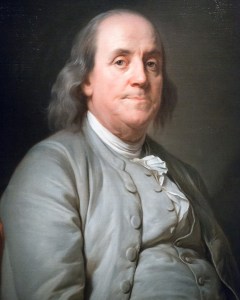
So what do we see when we see a symbol? Franklin thought one of the first proposed seal’s depiction of the Bald Eagle looked more like a turkey. Jefferson’s vision for the seal was an illustration of Pharaoh in his chariot chasing Moses and the Hebrews across the Red Sea with the motto: Rebellion to Tyrants is Obedience to God as part of the seal. I am not sure how that would play out today.
Pharaoh being swallowed up while Moses receives divine protection.
It eventually took three shots to get the symbols on The Great Seal that The Continental Congress wanted to represent the its beliefs and and values to future generations of Americans. On June 20, 1782 Congress approved the seal as we know it today. Everything on the seal from the colors, the 13-step pyramid with the ever watching eye in the sky on the reverse side symbolize a belief in the new nation. Even the Latin phrases: “One out of many (or from many)” and “New order of ages” are meant to represent the ideals of 1776. A sort of 18th Century flash forward to the present is a reminder of the symbols from the past meant to guide us into the future.
Although the Great Seal was a thoroughly thought-out process sometimes symbolic traditions come along haphazardly. For example, how did the knee-jerk tradition of bestowing God’s blessing on somebody who just sneezed get its start?
According to Baseball Reference The Star Spangled Banner was first played at a baseball game in May of 1862 at the Union Grounds in Brooklyn. The United States Navy started playing the Star Spangled Banner at official functions in 1889. In 1916 President Woodrow Wilson signed an executive order making the Star Spangled Banner the National Anthem.
A half-of-a-century after the game at Union Grounds, The Star Spangled Banner made it back to the playing field. On September 5 during the 1918 World Series game in Chicago a band played the Banner. It just so happened they played it when everybody in the ball park would be standing for the traditional 7th Inning Stretch. A sailor on leave snapped to attention and the crowd followed suit. It has been played at World Series games and Opening Day ceremonies ever since, with one caveat: A band had to be present.
We have to remember that this was a time when the public address systems were in their infancy and was more likely a strong-lunged man with a megaphone.
Symbolism sometimes has a haphazard way of coming together. I am not sure if Tebow or Kaepernick ran their decision to take a knee before a Congressional committee. More than likely they just did it as a symbolic gesture. Whether we stand up, sit down, take a knee or just shut up, the gesture, as a symbol, is always up for interpretation.
Recent news reports have the Russian hacking-election interference investigations moving at a faster pace as spat of subpoenas have been sent out and search warrants executed. Congress has socially invited Facebook and Twitter execs into closed door sessions to explain their unwitting role as social director for Russian election meddling.
The real issue is not if the Russians trolled, hacked or bo(t)ught their way into the 2016 Presidential election through a sea of social media. It was probably more about how easy it was to get so many “likes” while posting ads and fake news.
The open format of social media has made election meddling a lot easier. It always has been the mission of the Communist International to spread their brand of Marxism throughout the world. And let’s face it, there has been a Communist Party in the United States, CPUSA, since the 1920’s. The CPUSA has ran a presidential candidate starting with William Foster in 1924 and ending with Gus Hall in 1984.
Ironically, according to Marxist.org both men received the same vote counts of 36,386 votes. Voter fraud? In 60 years of presidential elections the CPUSA ended up exactly were they started. But those were tough times to get any sort of mainstream media buy.
Communists supported former FDR’s Vice President, Henry Wallace, who ran as the Progressive candidate in the 1948 election. There were two other socialist candidates running in the that election. And although none of them received a single electoral vote, they did pull in 65,000 more votes than Strom Thurmond’s Dixiecrat States-Rights’ Party, which managed 39 electoral votes. It seems ironic that these two political opposites now form the vocal bases of both the Democrat and Republican parties.
For most of its existence, CPUSA received financial support from the Communist International, the Comintern. The Comintern pushed for world communism but suspended its efforts in 1943 in a show of allied support in World War II. It was not until 1989 that the Soviet Union stopped funding the CPUSA. Funding that the FBI knew about and tracked.
Membership in the CPUSA was never more than 100,000 members, most of whom probably went underground when Senator Joseph McCarthy started his “Red” baiting. And no doubt, McCarthy snared a few vocal socialists sympathizers he could paint as being red into his bear traps.
According to a CIA research report, The Soviet Union and Nonruling Communist Party, “Almost all nonruling communist parties received some form of direct or indirect financial support from the Soviet Union.” For instance, in 1978 the Philippine communists received $50,000 from the Soviet Union while in 1981 the Soviets helped the French communists with “400,000 tons of oil at low price for profitable resale.”
Granted, it could be argued that placing ads or fake news on social media sites may not be legally or illegally construed as “direct or indirect support” to a political party. But it is a form of influence. In any case, it would fall somewhere under the First Amendment particularly, after Citizen United, where the Supreme Court ruled money is free speech. Talk about a double speak.
Today, Moscow has no need to get a KGB operative into a CPUSA meeting. What may have been done face-to-face in a semi-covertly fashion between a KGB agent and an American comrade can now reach the masses and be done through social media; all the while under the auspices of protected speech. Trolls and bots have replaced trained spies and handlers from the Motherland.
What were once the scoffed at voices deep in the political backwoods are now roaring crowds on main street thanks to social media. They can now blast their message from a bed in New Jersey or from Red Square in Moscow.
With the advent of social media and other instantaneous posting sites Russia, or anybody else can influence just about any election in any country at anytime. To think otherwise is contrary to history. Facebook CEO Mark Zuckerberg said, “I’m not going to sit here and tell you we’ll catch all bad content in our system. We don’t check what people say before they say it, and frankly I don’t think society should want us to. Freedom means you don’t have to ask for permission first.” Where was this idea during the McCarthy hearings.