Billionaires in Space, Buying the Final Frontier

Anyone who watched The Muppet Show in the mid 1970s will recall the iconic sketch “Pigs In Space.” The voyages of the Swintrek captained by Link Hogthrob, First Mate Piggy and Dr, Julius Strangepork in a spoof of Star Trek. As if pigs can fly on Earth or in outer space. Today we have three billionaires boldly going where no billionaires have gone before.

Chance are that some of the people who were watching Pigs in Space  grew up in the midst of the the Cold War between the United States and Russia, the former Soviet Union  and our old Cold War nemesis. We witnessed the global tensions between the US lead Nato countries and Russia’s “Evil Empire” of  Warsaw Pact nations.  These two forces spied on each other, tried to destabilize each other economically and politically,  and fought proxy wars indirectly attacking each other on just about every continent except maybe Antarctica. 

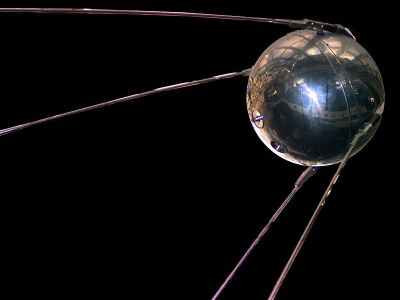
The Soviet starter gun, a 184 pound satellite that circled the Earth about every 90 minutes for three months before it fell into Earth’s atmosphere as space junk.

And to heat the Cold War up, they  took it to a higher level–to the cold reaches of outer space.  On October 4, 1957  the Soviet Union launched Sputnik, a basketball-sized beeping satellite that turned out to be the starting gun for what would be euphemistically called a “space race.” From there, it only took four  short years for President John Kennedy to up the stakes.  He threw down the gauntlet challenging the US to be the first country to put a man on the moon. 

On September 18th, of this year, Elon Musk’s SpaceX launched Inspiration4  sending an all-civilian crew up for a couple of laps around the Earth.  This seems to be the real beginning of new space race. Sending civilians up into space is nothing new.  NASA was sending non-military trained-scientists from around the world on Space Shuttle missions. Even a couple members of Congress copped a backseat ride on the Shuttle for the the ultimate political junket. We even have had civilian deaths resulting from going into space.

But there is something different with this space race. Space is no longer the realm of fighter jocks turned test pilots to astronauts.  Back then NASA was looking for somebody with the “right stuff.” Now, it appears more about checkbook flying and winning raffle tickets then having the right stuff to get the ultimate ride of the times.

So far there have been seven space tourist who have shelled out anywhere from $20 million to $30 million to take a trip on the Russian Soyuz to the International Space Station. This is more than $1 billion to a country that practices capitalism not so much as free market economic system but more like a controlled substance scheme. This was a country that could not produce a decent road car for a Sunday drive. The Russians may have lost the Cold War and the Space Race but they were cashing in on the demand for space travel. And with limited seating they had the only ticket on Earth. It was first come, first serve.  It was service with an open checkbook.  It really is discouraging when one has to get their space flights booked through a Russian travel agent. 

Lada Zhiguli 1200. The average Soviet citizen could not cough up the $7,000 to take the family on a vacation to Baltic Avenue let alone $20 million for a ride to the International Space Station.

As Lee Corso, an analyst on ESPN’s College Gameday often says: Not so fast my friend. Today’s space race is not about competing national interest, technical and military superiority over which economic/governmental system is better here on Earth. Although, leave it to the Chinese to explore  Pink Floyd’s Dark Side of the Moon. Several countries have sent orbiters, landers and rovers to Mars and other orbiting planets and moons with a degree of success.  All without the nationalistic bluster and smack talk of the first space race. However, it now appears as if the Russians will beat Hollywood with the first ever movie filmed in space. Are the Russians pulling off another space first for the Guinness Space Book of Records?

What we are seeing now is really a nouveau riche space war. It is competition between billionaires and not  so much with countries and competing ideologies. Inspiration4 mission raised $200 million with Elon Musk, founder of SpaceX, putting $50 million for St Jude’s Hospital. The commander of the flight, Jared Isaacman, a billionaire in his own right kicked $100 million. To put things in perspective NASA’s Mercury program ran from 1958 to 1963.  According to the San Diego Air and Space Museum the program cost the taxpayers “$277 million in contemporary dollars (almost $2.2 billion today).”

A big difference is that the Mercury, Gemini and Apollo astronauts were not space tourists. According to Yahoo.com “The minimum starting salary range for the first group of astronauts was set at $8,330 to $12,770 based on level of experience.” This was not a bad wage back then. “In modern money, that would equal a salary range of $73,815 to $113,159.” And, “At the time of the Apollo 11 flight in 1969, Neil Armstrong was paid a salary of $27,401 and was the highest paid of the flying astronauts, according to the Boston Herald. That translates to $190,684 in 2019 dollars.” Not a bad day’s pay but far short of the the $20 plus million today’s tourist are plopping down to get a meteor’s view of the planet. 

Yahoo also says that “Armstrong’s historic moonwalk lasted two hours and 40 minutes. Based on his salary and a 40-hour work week, that means he would have been paid roughly $33 for his time on the moon. Accounting for inflation, Armstrong was paid $230 in 2019 dollars.” Just imagine what a tourist would pay to go to the moon today.

When Virgin Galactic sent its first fully crewed flight up July 11th of this year on VSS Unity, the crew included billionaire businessman and founder of Virgin Galactic, Sir Richard Branson, and five company employees. 

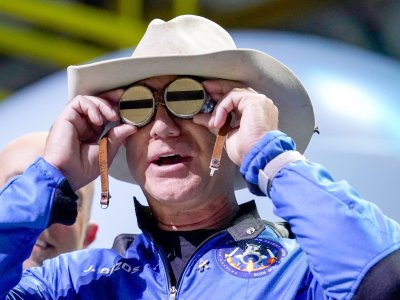
Bezo as a space cowboy: “Bet you weren’t ready for that…I’m sure you know where it’s at…” Seattle Times, photo:Tony Gutierrez / AP)

Not to be outdone, Jeff Bezos, the richest man in the world and founder of Blue Origin,  cannonballed himself, his brother, Wally Funk, a woman who trained to be one of the Mercury astronauts but was disqualified from flying because she was a woman and Oliver Daeman, a Dutch student, whose father shelled out $28 million for a seat on the New Shepard spacecraft.  (Their trip into space happened 52 years after Neil Armstrong and Buzz Aldrin landed on the moon.) 

But Bezos is not done.  The Russians might be making the first film in space but in the ultimate space-time twist of sending someone where few people have gone before, Bezos is planning to send  90 year-old William Shatner, Captain Kirk, the original space cowboy,  into the “final frontier.” Sending Shatner into space is definitely ironic since he was the TV pitchman for Priceline.com, the online discount travel agency for airline tickets, trips and hotels. 

The new space race, in some ways is an extension of old capitalistic battles of the past. It reminds me of a William Randolph Hearst/Joseph Pulitzer newspaper war and Yellow Journalism; a Coca-Cola vs the Pepsi generation, or Avis trying to outrun Hertz and OJ Simpson through an airport, Beta vs VHS, and Apple vs Microsoft. It could even be the Dodgers vs the Yankees rivalry with the old New York Giants thrown in the mix. I could go on but what we might be witnessing is a cut throat game of (space) pool between three billionaires, Elon Musk, Jeff Bezos and Sir Richard Branson spending their way into the cosmos.

So now it is not so much about the science and technology of getting to the moon or beyond.  It is about sending rich tourists into space. It could be the beginning of the HBO show Avenue 5 where tourist fly around the Solar System or as Jimmy Buffett would sing: “They soared through the Milky Way counting the stars, once around Venus twice around Mars.” 

Henry Flagler’s global trade ambitions for Key West may have tanked but he did develop what would become Florida’s Gold Coast and Space Coast.

It is interesting because it has taken so long for human space travel to become sort of a capitalistic endeavor.  I am sure the focus of those in the 1960s space race were not thinking about selling seats to the moon.  But here we are. It reminds me of Henry Flagler’s efforts to build a railroad to Key West, Florida in the early 1900s.  Flagler was one of the founders of Standard Oil.  He brought is ailing wife to Florida for her health and the weather. While there, he  decided to build a railroad to the farthest southern part of the US. It was not a lark.  The Panama Canal was being built and when it opened in 1914 it was considered the Seventh Wonder of the Modern World.  It was built during a time of American “imperialism” after the French failed miserably in connecting the Atlantic and the Pacific Oceans.  

Flagler’s efforts to connect to global trade using Key West as a deep water port never really panned out but he did attract a lot of rich winter tourist to the state of Florida, particularly Palm Beach where he built his mansion.  It may have never been his plan to create Florida’s “Space Coast”–or “Gold Coast” but Florida is a tourist mecca for the masses.  Within 100 years tourist from around the world come to the Sunshine State.  Florida could be considered the theme park capital of the world with Shamu and Mickey Mouse attracting between 100 million to 120 million tourists a year. But nobody really thinks of Henry Flagler as the man who made it happen. That accolade goes to Walt Disney.

It appears the end result of the manned Mercury, Gemini and Apollo programs, and the race to the moon, was to launch lucrative space tourist program. I am sure at some point the supply will catch up with  demand for seats and the price for a seat into space will come down considerably. Especially when  Carnival Cruise Lines figures out how to get a swimming pool into space. 


https://stacker.com/stories/815/where-richest-americans-go-vacation-within-us

https://www.cnn.com/2021/09/18/tech/spacex-inspiration4-splashdown-scn/index.html

https:// http://www.worldatlas.com/articles/the-most-successful-missions-to-mars.html

https://yahoo.com/now/believe-much-astronauts-used-231238348.html


Cogito, ergo sum or I am thinking and nothing is happening

Gerd Altmann “Coronavirus All Around” image under Public Domain

It seems that we as a country have hit an all time low in determining a collective reality. And much of this has to do with the pandemic we are in and the political reality of the time. I base this on the recent NPR article: Mississippi Is Pleading With People To Stop Using A Livestock Drug To Treat COVID-19. There seems to be a huge gap in the way people are interpreting the reality of this pandemic. The real effect of the coronavirus is the cognitive distortion or dissonance that it is creating in the masses that goes beyond science fiction.

According to NPR the state of Mississippi has seen “a jump in the number of calls to poison control that prompted an alert” from the “Mississippi State Department of Health about ingesting the drug ivermectin.” The poison control center said at least 70 percent of the recently received calls “were related to people who ingested a version of the drug that is formulated to treat parasites in cows and horses.”

The CDC says “a parasite is an organism that lives on or in a host organism and gets its food from or at the expense of its host.” Think of that blood sucking “skeeter” slurping away on your uncovered arm on a hot muggy night; or a roundworm making itself comfortable in your gastrointestinal tract. A virus is sort of like a zombie it is a living thing but not really. It needs a host, a body, to prey upon to reproduce and make more virus.

So maybe there is a short jump in logic from a parasite to a virus. But where did we get the idea that a livestock drug for parasites would work on a virus? Maybe from the same source that suggested we ingest disinfectants to clean the coronavirus out of our system. Or from people claiming that they have the right not to wear a mask–and then compare wearing a mask to wearing underwear. It is not what is coming out of our bottom end that is creating the problem right now. It is the misreporting and manipulation of facts. We keep moving further off into the deep end of mass confusion. I am not psychologist or sociologist but there is some real distortion of the facts and reality taking place in this country that goes beyond the normal “what was I thinking?” It is to the point of questioning the cognitive capabilities of groups of people. This is exacerbated by the belief today that feeling that one is right has now become a “right,” encompassed in the First Amendment. This despite and reasonable, logical and scientific evidence to the contrary.

PsychCenteral.com says: “A cognitive distortion — and there are many — is an exaggerated pattern of thought that’s not based on facts. It consequently leads you to view things more negatively than they really are…” And that is the problem. Our internal thought process is dialed into nothing but negative waves–amplified by certain news and social platforms. Squawking heads filter through facts painting them in black or white and then presenting them in an all or nothing manner with the “end is near.” Remember the Fiscal Cliff of 2012 when our government spending and tax policies would run us off the cliff and into the sea? Financial ruin was awaiting us. To quote the Doors: The future’s uncertain, and the end is always near.

“Our thoughts” according to PsychCenteral.com “have a great impact on how we feel and how we behave. When you treat these negative thoughts as facts, (facts by-and-large are not positive or negative it is the interpretation) you may see yourself and act in a way based on faulty assumptions.” Now this is written concerning one individual’s feelings, thoughts and behaviors. What happens when half the population of a country decides to run off the cliff and into the sea below; or people in one state start using a parasite drug to fight off a virus instead of a scientifically developed vaccine? We are dealing with some sort of collective emotional reasoning that our feelings reflect reality. We have taken Rene Descartes Cogito, ergo sum: I think therefore I am” to I feel therefore it is. Or better yet, As Curly of The Three Stooges once said: I am thinking and nothing is happening.

Who came up with cognitive dissonance theory?

Cognate dissonance was first investigated by Leon Festinger, arising out of a participant observation study of a cult which believed that the earth was going to be destroyed by a flood, and what happened to its members — particularly the really committed ones who had given up their homes and jobs to work for the cult — when the flood did not happen. (or an election that was lost but was believed not lost)

While fringe members were more inclined to recognize that they had made fools of themselves and to “put it down to experience,” committed members were more likely to re-interpret the evidence to show that they were right all along (the earth was not destroyed because of the faithfulness of the cult members).

By Saul McLeod, updated Feb 05, 2018 Simply Psychology
A Lemming hanging out in the weeds. Despite popular belief they do not commit mass suicide rushing off a cliff. Humans? A different story.
photo Frode Inge Helland 

Oh, there is always something happening despite how we think or feel. The coronavirus has us looking for consistency or way back to normalcy. But what really is normal or consistent in a time pandemic? It is our natural quest for consistency that has crushed and pushed our beliefs or “the way it ought to be” to the limits. The only consistency in this mess is the coronavirus. It does consistently what viruses do–and without feelings and thought. The coronavirus has never read the Bill of Rights or voted in an election. It doesn’t care how you think or feel the way “things ought to be.” According to the National Human Genome Research Institute “Viruses must infect cells and use components of the host cell to make copies of themselves. Often, they kill the host cell in the process, and cause damage to the host organism.” The coronavirus has not only infected our physical bodies it has infected our ability to rationally reason what is and what ain’t. It has created a cognitive disconnect in our thinking.

I am not virologist or an epidemiologist but I do know that any road will get you to where you want to go. For instance, we can mask up and get the vaccine to reach herd immunity or we can follow some of the Southern governors approach that seems to be let the virus consistently do its thing because sooner or later we will reach herd immunity with or without a mask and vaccine. But we will never reach it by taking livestock pills.

https://www.theatlantic.com/science/archive/2016/04/the-illusion-of-reality/479559/

What Is Cognitive Dissonance Theory?

https://www.everydayhealth.com/neurology/cognitive-dissonance/what-does-cognitive-dissonance-mean-theory-definition/

https://psychcentral.com/lib/cognitive-distortions-negative-thinking#types

If you cannot believe this; then you have to believe that

Guess who’s coming to dinner.
John Haaren: Famous Men of the Middle Ages
wikimedia commons

There may never have been a more conspiratal time in history than now. Fueled by ludicrous theories we have taken up some bizarre beliefs that one day people will say “what were those people thinking.” Some of these wild theories do not even fit into the belief that the Earth is flat or that the Sun revolves around the Earth. Our brains have always tried to fill in the unknown phenomenon we observe with whatever the mind can make up. Some people will say it is this while others will say its that.

The problem we are facing now is we invent the scenario–like Puritan prosecutors finding witches and then burning them– just so we can fill in the blanks and prove a point. We have been inundated with theories on how the 2020 election was stolen right out from under our noses–searching for ballots printed on Chinese bamboo paper. We are being confronted with such newly hatched concepts as woke, cancel culture, critical race theory, and Jewish lasers blasting away from space. There seems to be a greater interest into investigating UFOs then investigating how 10,000 people were able to storm the Capitol Building. Instead, we treat the assault on Nation’s Capitol as if it were some sort of “Black Friday” shopping event at Walmart.

I don’t get any of it. I have no real understanding of being woke. To me woke is when the guy across the street is cranking-up his Harley with straight pipes at 5 am in the morning. And cancel culture sounds bad just because of the word cancel. It’s like going to the airport and seeing your flight has just been xed from the board.

But what is this fascination with culture. I am going to bastardize a quote supposedly attributed to Mohandas Gandhi when asked what he thought about Western Civilization (culture): “I think it would be a good idea.” That’s right up there with the farmer when asked about culture. His reply was “the only culture I know is agriculture.” And herein lies our problem. It creates either a narrow view on the world around us or an over blown condemnation of what we disagree with.


For some reason when I think about American culture I think of how we super-size everything from just a plain old jet airliner to a “jumbo” jet; a hamburger to a “Whopper; and a 16 ounce Coke to a one-gallon bucket of soda with a two-foot straw. “Give me the number three meal deal and supersize it with extra fries.”

The time we live in makes it hard for a good idea to seep up from the primordial ooze that has us wading hip deep in ignorant nonsense. A good idea is like trying to find hen’s teeth in the barnyard. (Or common sense in Congress.) Today, an “idea” gets narrowed down to two choices: this and that. “If you cannot believe this then you gotta believe that.” Nothing expanded in-between. For some reason Mitch McConnell’s face pops into my mind. I am not sure if he is “this” or “that.” I think it depends on who is president.

Take The New York Times 1619 Project. Now I have to admit that I have not read it–but why should that stop me or slow me down from spouting off what I think. I do believe “that” in 1619 the first batch of enslaved people from Africa arrived in Virginia to meet the labor and economic needs of the English settlers. I also know “that” the Project has angered a lot of people who do not necessarily want to believe in “that.” They would say “I do not believe in “that” I believe in “this.” And now it becomes sort of hostile Beta v VHS marketing thing.

But in this age of bizarre theories and conspiracies I find I am no different. I am going to go off on my own theory. I believe all of the troubles and woes that we are experiencing today can be attributed to the English: Great Britain our “mother country.” My theory looks at “Merry olde England” long before it was a jolly good place. It is my contention that England was subjected to some of the most aggressive invaders around and that in 1607 their ancestors landed here bringing those aggressive qualities with them. Qualities that still linger on like a musty smell in a mildewed basement. The North American eastern coast was flooded with some of the most stiff-necked religious fanatics in New England; arrogant aristocratic cast offs in Virginia to plain old convicts and debtors in Georgia.

When you look at British history you realize the Brits come by it honestly. They were always beating back invaders starting with the Romans and all the way up the Nazi air assault in the Battle of Britain. The Romans were the first to come ashore way back in 43 BCE. I am sure it could be argued that they brought with them a certain amount of “Mediterranean civilization and culture” to the Celtic Brits. The Romans hung out in England for the next 400 years integrating and mingling with the local Celts. But once Alaric and his Visigoths sacked Rome in 410 things changed in England. The Romans moved on but no doubt left behind their methodical means of governing and the controlling and managing of foreign outposts and trade. When it came to infrastructure, Romans showed the Brits how to build a 70 plus mile wall in less than 10 years. Something the Trump administration failed miserably at. Good old Roman know how that would serve future Englishmen well.

With the Roman Legions gone a new wave of settlers took up residence in England. As Europe descended into the Dark Ages, the Juts, Angles and Saxons from Northern Germany rowed or sailed across the North Sea. It seems that the Romans built Hadrian’s Wall in the wrong location. In any case, it is this group of Germanic “barbarians” that created the first beginnings of an English country and culture.

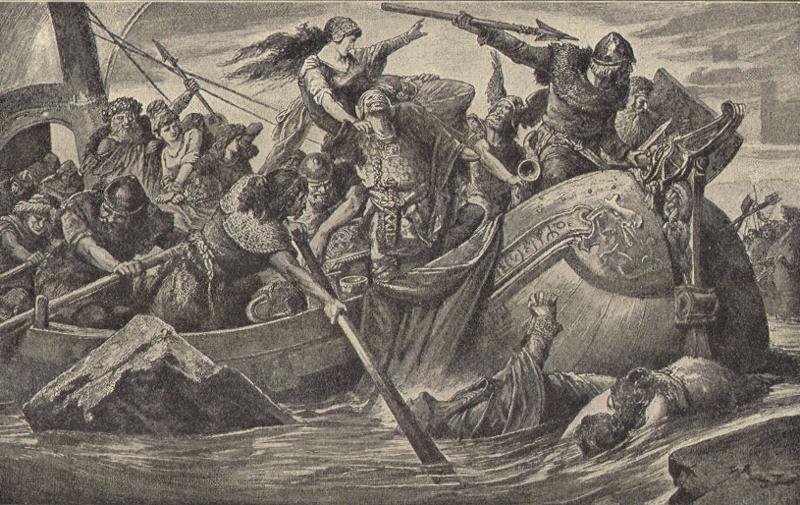
However, everything was not so idyllic because the next invasion was bit more vicious. Norsemen, Vikings began raiding England around 790 AD. If the Romans were methodical about maintaining a foreign province, the Vikings introduced methodical plunder and pillage to England. But maybe the most important legacy the Vikings left behind is their seafaring skills. Again, another trait that would serve future Englishmen (and America) well.

The sight of Viking raiding ships coming ashore could create wholesale panic and carnage; but in some cases Viking settlements. This brought the Anglo-Saxons into contact with Viking vitality and leaving them with a certain amount of hybrid vigor. My sense is that Vikings were not shy about taking what they wanted and staying as long as they pleased. If the Vikings were visitors knocking on the door to say hello they soon became house guests that stayed around for the next 300 years before moving back to Scandinavia. If one can say the Romans taught the Brits how to manage government and other affairs of state, the Vikings probably instilled in those Anglo-Saxons that things are always ripe for the picking and taking. And numbers never mattered when it came to conquering indigenous people. Just look at the British centuries-long control of Ireland and India.

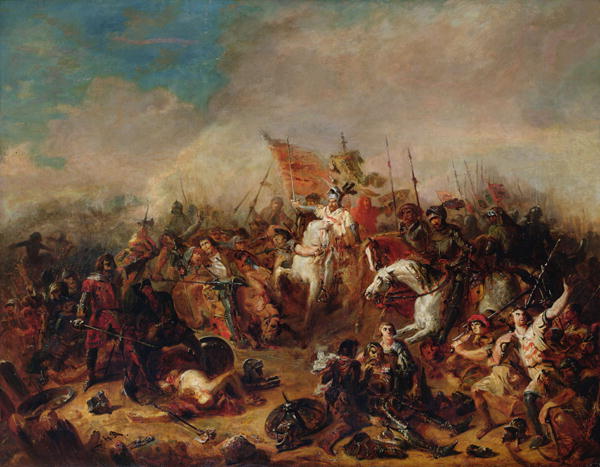
It may be hard to believe but by 1066 another group rowed passed the White Cliffs of Dover: The Normans. The Normans can also trace their ancestry back Norsemen. Generally, it could be said that the Normans took their martial skills from both the Romans and Norsemen. A big difference is that the Normans were not the pagans of the past. They had that Catholic zeal infused in them. Not only did the Normans invade England; they invaded Italy, Sicily the Iberian Peninsula, and North Africa. They killed the last Anglo-Saxon king, King Harold, at the Battle of Hastings in 1066 and did not relinquish the British Isle again. It is believed that the Normans introduced the feudal system creating a landed aristocracy and built upon what the Anglo-Saxons had developed.

The Normans meet the Anglo-Saxons at the Battle of Hastings
Musee des Beaux-Arts, Caen, France, Bridgeman Art Library
Francois Hippolyte Debon. “The Battle of Hastings in 1066”

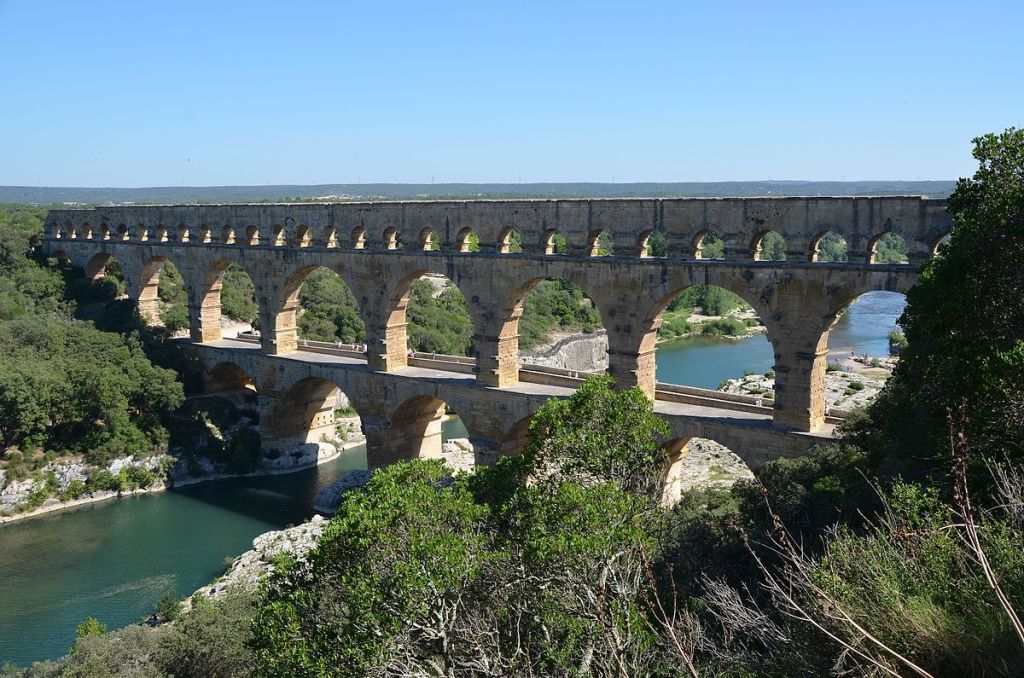
Of course, all of this is just one giant generalization. But when you look at America history it is laced with Romanesque causes. If anything, America is the modern self-actualization of English heritage. Before Eastern seaboard cities were settled, American explorer like their Vikings forebears, were continually looking for a Northwest Passage. When they finally realized they could not sail through or around North America (this could change as the ice caps melt) they settled down like Normans and came up with Manifest Destiny. It was the destiny of those early Americans (Englishmen really) moving steadily and quickly like Medieval Normans, from the Atlantic to the Pacific. Taking land, like Texas, and most of the Southwest from Mexico, when they could not buy. It was not until 1869, with the completing of the continental railroad, a project like a giant Roman Aqueduct or the Appian Way, that the two oceans were linked. A New World Roman engineering feat done American style.

The Roman engineering circa 40-60 AD An aqueduct bridge crossing the Gordan River at Nimes, France.
Carole Raddato

We also inherited the Norman’s social hierarchy. A landed aristocracy with disgruntled lower classes, like the Scots-Irish, who came to populate huge swaths of colonial America. These are the Americans, like the Hatfields and McCoys, that would fight for years over who owned a free range hog. The Scots-Irish were followed by a myriad of non-English immigrants who would take their place at the bottom of the social pyramid.

The Bard of Stratford-upon-Avon. Would he have been banned in Boston like Mark Twain?
Wikimedia Commons
unbekannt nach einem Gemalde

I know I have not mentioned some of the finer accomplishments we get from our British ancestors–like William Shakespeare and Jane Austen; the scientific brilliance of Isaac Newton or Stephen Hawking. I would bet that if Shakespeare or Austin were writing today they would be attacked for their lack of wokness or had their book deal or plays canceled. Adam Smith’s Wealth of Nations would be considered as a global system of exploitation. So many good ideas would have ended up fossilized to be dug up later like dinosaur bones to be pieced together. Never to be debated or enjoyed.

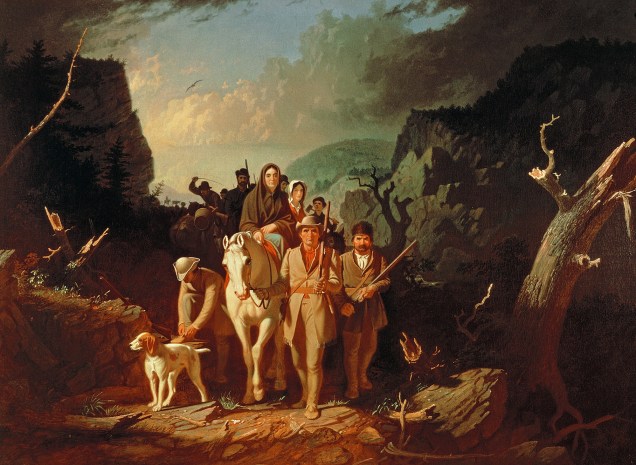
From the Cumberland Road to an Information Highway–A country on the move

Daniel Boone escorting settlers through the Cumberland Gap.
1851-52 by Bingham, George Caleb (1811-79); Washington University, St. Louis, USA;

After the 1890’s census the Superintendent of the Census declared the frontier closed. This did not mean that Americans could not travel into the West because as we have learned in our history classes it was America’s Manifest Destiny to control all the land between the Atlantic and Pacific. Basically, what the Census Bureau was saying is there was no real frontier line like the Appalachian Mountains, the Mississippi River or the Rocky Mountains that could distinguish civilized America from the unsettled wild. The West was always open for business. The hard part was getting there. The country needed roads and bridges to gap the great divides; or the infrastructure to get from one place to another. Today, like in the past, we bickered about what is infrastructure and how to pay for it.

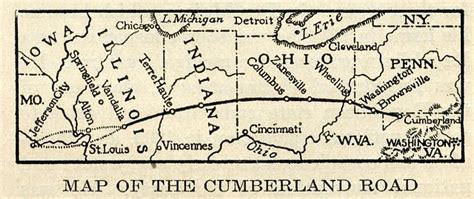
Unlike the British who, without infrastructure, foolishly tried to curb colonial western expansion beyond the Appalachian Mountains. However, our new federal government encouraged western migration, much to the chagrin of native Americans inhabiting the area. In 1811 the federal government began constructing the National Road. The 600 mile road started in Cumberland, Maryland and ended in Vandalia, Illinois. It was America’s first highway west.

Since then the country has built canals, a transcontinental railroad system, as well as a coast-to-coast interstate highway system, and an information highway along with a federally administered air traffic control system. We can also add intercity subway and transit and electric grids, much of it with government funding and assistance.

When Donald Trump was elected president there was a lot of talk about upgrading and improving our nation’s deteriorating infrastructure. The Trump Administration was more concerned about holding back surging groups of immigrants and building “the Wall” along the Southern Border. The one thing Trump realized, as all politicians dealing with infrastructure, is that roads, bridges and walls cost money–tax money. Hence, trying to get Mexico to pay for building the wall sounded like a good idea. But, for all the talk it failed to bring in any pesos. Instead, he pulled money from other government projects. Infrastructure got shoved to the side.

Now that Joe Biden is president, infrastructure has popped back up again. As with Trump’s Wall, the debate centers around who will pay for improving America’s aging infrastructure, with a slight twist on what really is infrastructure in the modern world we live in. And herein lies a problem of perception as to what is a public good.

Generally speaking a public good promotes the general welfare of the country and is free to use–so to speak. For instance, the Interstate Highway system is free for anyone to use unlike a toll road. But we all know that nothing is free. We all put in a our few cents worth with every gallon of gas we buy. The government, however, does not see a return for investors. What gets skewed a bit with a public goods is when we perceive them as a private good for profit. Private companies do not operate and maintain interstate highway systems because there is not profit in doing so. Hence, a public good for everybody; and a cost borne by the public. However, there is a belief in this country that we privatize anything. Just look at the prison system and the space program.

The country in the past has always wrestled with who is gonna pay for such projects. It is sort of hot potato game of passing the buck. Our history is laced with tax avoidance starting with the Boston Tea Party. As the country turned the corner of the 1700s and into the 1800s there was a real need for what was called “internal improvements.” As the country continued to expand getting people and goods from over the mountains and down rivers became not only a political problem but geographical and financial one, too. Thus, internal improvements could be a contentious issue . Projects like Improving ports, building roads and canals and eventually railroads were needed to keep the nation’s commerce growing and expanding. The government always stepped in to help out whether in the form of protective tariffs, land grants to railroad companies or tax breaks for manufacturers.

The financial dilemma, like today, is where to get the money. Between 1790 and 1820 tariffs accounted for ninety percent of the country’s revenue. That has sort of flipped today. According to the St Louis Federal Reserve Bank: “Half of U.S. government revenue in 2019, about $1.7 trillion, came from the public via individual income taxes, of which a significant amount came from payroll taxes, which are paid by employees.”

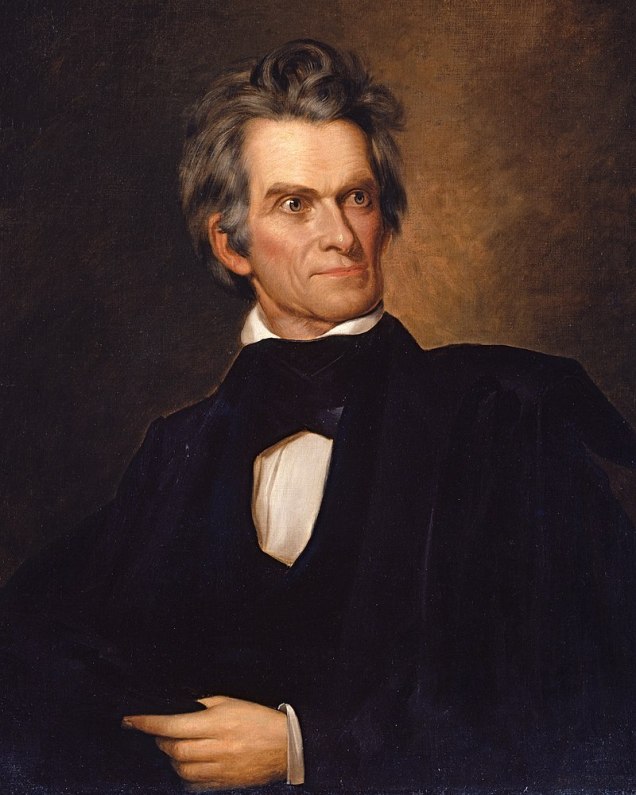
Tariffs have always been a big deal, as evidenced by Trump’s recent trade war with China; and they were a big deal in the 1820s. Now, I am not economist so trying to explain the intricacies of tariffs and taxes. That is not my intent. The tariff of 1828 created some serious political problems and was called, particularly in the South, “The Tariff of Abominations” because it placed high tariffs on imported goods the South depended on. South Carolina, under John C. Calhoun’s direction tried unsuccessfully to get the state to nullify the tariff causing a huge Constitutional and political spat with President Andrew Jackson.

John C. Calhoun of South Carolina knew how to get under President Jackson’s skin particularly when he threatened to take his state out of the Union over the tariff. George Peter Alexander Healy National Portrait Gallery

The complication developed with the North’s expanding commercial base and the South’s agriculture base of cotton and tobacco. The North preferred the higher tariff because it provided some protection for its nascent manufacturing industry that was trying to compete with Britain. It could be argued that an expanding internal improvement plan would help deliver manufactured goods to an expanding country. The South, on the other hand, depend more on slave labor and exporting cotton, took a bigger hit importing the now more expensive British goods. Because the South’s economy was not as diverse as the North’s, Southerners felt they took a bigger hit with a higher tariff. It could be argued that politically and economically that the North would benefit more from “internal improvements” while the South paid a higher cost for those improvements through higher tariffs.

So grappling with internal improvements or what we would call today as infrastructure is nothing new. In May of 1830 President Andrew Jackson vetoed federal funding in the Maysville Road project in Kentucky. This was a pet project of Henry Clay and a project that he felt fit in with his proposed American System. A big part of that plan was a high protective tariff, renewing the charter of the Bank of the United States and internal improvements. Jackson saw it differently. Jackson was not against internal improvements. He was just had no love for Clay. He justified his veto by saying that because the Maysville Road ran exclusively within the borders of Kentucky that it was not an internal improvement that benefited the nation. Since the road was in Kentucky, Kentucky can pay for it. Despite the possibility of the road hooking up with other federally funded roads and canals outside of the state.

Adding fuel to the debate were the normal political and constitutional questions about going beyond the enumerated powers of Congress. But in many ways we crossed that enumerated bridge when Alexander Hamilton created the Bank of the United States and Thomas Jefferson bought the Louisiana Territory from France. Both used Congressional powers not specifically spelled out in the Constitution.

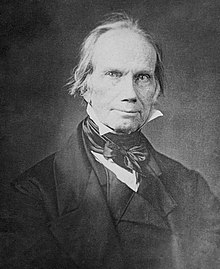
Henry Clay: The Great Compromiser and despite being a slave holding Southerner was no friend of Jackson.
wikimedia commons
Julian Vannerson
or Montgomery P. Simons

From a political standpoint it goes deeper and personal. It is easy to see why Jackson vetoed the Maysville Road bill. Clay and Jackson, despite being from the same section of the country, Kentucky and Tennessee, did not agree on too many issues of the day. Clay had split with the Jacksonian Democrat-Republicans and became a National Republican, later a Whig. Clay had created the American System and like any proposed government plan it came under fire from those opposed to higher tariffs and renewing the Bank of the United States. Jackson hated the Bank with a passion.

However, a lot of Jackson’s animosity for Clay comes from what Jackson supporters called the “Corrupt Bargain.” The 1824 Presidential Election was a contentious election that was thrown into the House of Representatives. Henry Clay was one of the presidential candidates in the race; but also the Speaker of the House. Jackson, despite winning the popular vote and having a plurality–not a majority–of the Electoral Votes, lost the election when the House, under Clay’s leadership elected John Quincy Adams as President. This was a political burn Jackson never extinguished. And dealt out plenty of political pay back to those responsible for his 1824 defeat. (Some of this sounds familiar, today.)

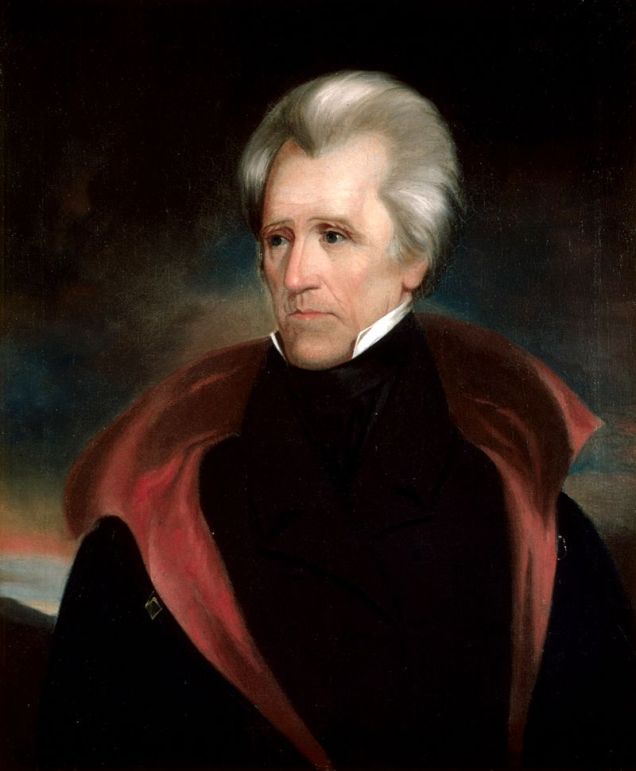
His adversaries called him King Andrew. He nearly went to war with Calhoun over the 1824 tariff. One of his regrets was he did not shoot Henry Clay and hang John Calhoun when he had the chance. whitehousehistory.org/galleries/presidential portraits
Ralph Eleaser Whiteside Earl

Today’s infrastructure needs go beyond roads and bridges but the political arguments seem to mark time. Biden is presenting Congress with what could be called a modern “American System.” According to the White House, “This is the moment to reimagine and rebuild a new economy. The American Jobs Plan is an investment in America that will create millions of good jobs, rebuild our country’s infrastructure, and position the United States to out-compete China…The American Jobs Plan will invest in America in a way we have not invested since we built the interstate highways and won the Space Race.” 

Biden’s plan is coming under fire on how to fund his ambitious project and defining what is infrastructure. Biden is aiming at busting the britches of those with seven-figure incomes to fund his trillion dollar plus proposed infrastructure program. This has GOPers howling. Not only is the size of Biden’s proposal beyond their budget comprehension (unless you include fighting an unfunded war in the Mideast) and the tax increases needed to fund it. Some of the proposed projects to them are incomprehensible. And that is understandable. The plan calls for creating “good-quality jobs that pay prevailing wages in safe and healthy workplaces while ensuring workers have a free and fair choice to organize, join union and bargain collectively with their employers.” Build next generation industries in distressed communities Redress historic inequities and build the future of transportation infrastructure.  To a lot GOPers this sounds like the anarchists and socialists demands of the early 1900s or a Stalinist Five Year Plan. And maybe it is.

The Frontier may have been closed now for more than 100 years. We no longer have people walking beside a wagon following behind a team of oxen for three to six month on the Oregon Trail. We have moved onto an internet information highway. The infrastructure of our country is what holds holds the nation together whether if is made of concrete and steel or digital information moving through cyber space. These upgrades go beyond upgrading an app. But it all seems to boil down to what Congress politically deems is a fundable “internal improvement.”

To Vote or not to Vote, this is the Question

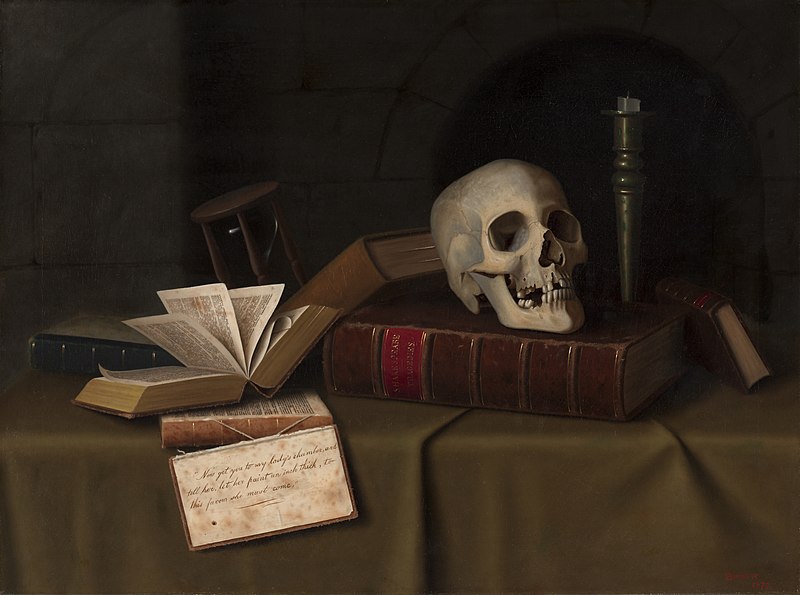
William Michael Harnett: Memento Mori, “To This Favour” Cleveland Museum of Art, CC0, via Wikimedia Commons

Recently two investment companies sent me ballots to cast my vote for changes to their corporate investing plan. Not being any sort of fiduciary wizard, and not having a single idea on what I would be voting on I ignored their requests to participate. I felt that my voice in corporate decision making, based on how many shares I owned was more of a silent minority thing.

However, that was not to be. Shortly after I trashed one ballot another one arrived in the mail. The other company started flooding my inbox with emails to vote. I relented and voted by mail and computer. It was quick and easy and in both cases I noticed some sort of control numbers on the ballots that would obvious keep me from voting more than once. What they did with my ballots after I voted I could not say.

The recent corporate/GOP fallout over recent voting laws, proposed and passed, on changing voting procedures is interesting, particularly when GOPers like a Senate Minority Leader and governors tell CEO’s to bugger off. The Texas lieutenant governor basically said CEOs were stupid when he told them they have “meddled in a lot of issues lately … stay out of things you don’t know anything about and if you want to get involved then you’re taking that risk.” This seems odd when a lot of legislation is actually written by corporate lobbyists. He also admonished them to “read the damn bill” before they proffer an opinion. This is bold talk for a politician fatted on the corporate larder, particularly when there is a shift away from typical and long-held GOP beliefs to more Trumpian attitudes.

The Texas LT may have a point, though. When I voted for changes to the investment management I had no idea what I was reading. Talk about the fine print. It made me think of legislators reading the numerous bills they are confronted with. For instance, the recent 5,500 plus page pandemic aid bill, one of the longest bills in Senate history, was handed out several hours before it was voted on.

Generally speaking, if you want to memorize something, you’ll need to read slowly. A normal rate for learning is 100-200 wpm, and for comprehension it is 200-400 wpm.

According to MindTools.com The average reader can read about 250 wpm. This a good speed for comprehension. If you crank it up a notch to speed reading, around 400-700 you can turn more pages quicker but you start lose something in the translation, especially when you hit 500-600 wpm. Evelyn Nielsen Wood, a pioneer of speed reading, supposedly hit super sonic speeds of 2,700 wpm. I am not sure if she could have read a 5,500 plus page document in two hours.

Several years ago Senator Rand Paul proposed a bill that would require the Senate a whole day to read 20 pages of proposed bills. Talk about bringing Congress to a standstill.

Kentucky Senator Mitch McConnell took a slightly different tact with those recalcitrant corporations. He fired a warning shot across Corporate America’s bow by saying that “corporations will invite serious consequences if they become a vehicle for far-left mobs,”–code for socialists, communist and other fellow travelers. This harkens us back to the eras of “Red Scare.” That’s heavy duty considering that Corporate America has a history of calling on the government, particularly the military or state militias, to physically bust up left leaning mobs like union strikes against railroad, coal and steel barons; and any other socialist and anarchists gatherings. Right wing mobs, however, are given free reign to tour Congressional chambers of the Capitol.

The symbiotic relationship between the GOP and Corporate America may not be crumbling anytime soon but the feeling that “I’ve got your back on this one,” maybe slipping a little. Georgia’s Election Integrity Act of 2021 just might be the first act in a right wing multi-act play to return the South to its core antebellum attitudes. A desperate play being acted out by desperate white men.

Unlike some of the proposed voting laws, it seems that those corporation managing my investment concerns went out of their way to make sure I participated in their decision making policies; no matter how small my voice.

Q are You?

Lost and Confused Signpost Wonder woman0731

It could be argued that most of American history can be interpreted through visions of unreality. My family loves to watch The Masked Singer and The Masked Dancer. They get a big kick out trying to figure out who is behind those exotic costumes. I grew up more in era of Sergeant Joe Friday: Just the facts… not cloaked in some shroud of fantasy but a man in a gray suit with narrow lapels and wearing a thin tie taking notes.

Recently I was watching HBO’s documentary on QAnon, Q: Into the Storm. As I watched the first episode I could not help but think how Americans love a good fantasy especially if it is cloaked in a mystery and salted with sexual behavior, particularly if it is prurient. For some reason sex makes it more believable.

Now I do not know much at all about QAnon, nor do I really want to. The internet search for the masked “Q” is beyond me with encrypted messages and social media platforms: 4chans or 8chans. It sounds more like what George Smiley and The Circus would be doing in a John le Carre novel. Or a more complicated game of Clue: Hillary Clinton did it with the Rope in the Pizzaria. And I think this is where we are at in time. Reality reads more like a game or fantasy/spy novel. It makes for great reading or a movie; but really. The problem becomes one person’s fantasy starts to creep into another’s reality.

I think of how Americans love a good story–the truth be damned. We love the missing pieces so much we get reeled in hook-line-and-sinker hitting at anything. We have even fought wars over phantom torpedo boats attacking US Navy Destroyers. We searched high and low in Iraq for Weapons of Mass Destruction and found out that maybe it was just a Saddam scavenger hunt. I really think we want to believe in the absurd. Who killed JFK? Was it the lone gunman in the book depository, Cubans behind the grassy knoll, the mafia or the CIA with exploding cigars? As far as Kennedy goes, it might as well be as the Rolling Stones sing: “well after all it was you and me,” There is always enough truth in the story to get us all fired up. When we cannot figure it out we make stuff up and extrapolate the story from there.

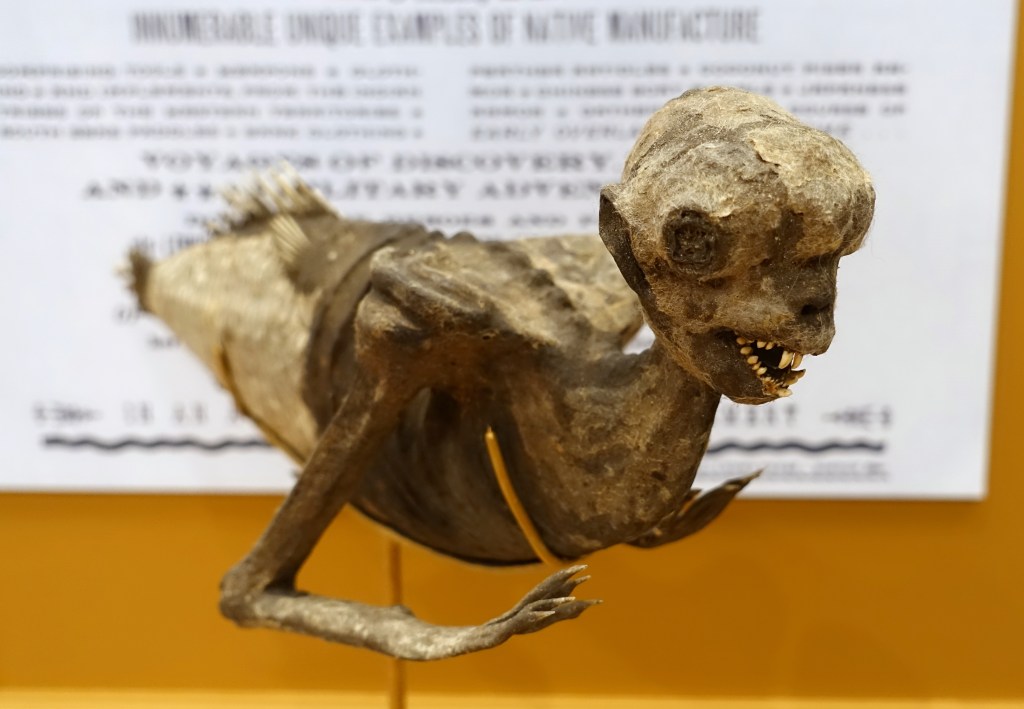
But on more benign level of fakery, take PT Barnum’s Feejee Mermaid. Americans flocked to see this freak of nature. Barnum, like many hucksters today, was media savvy. His use of the 1840’s media, peppered with expert opinions on the poor beast, created an insatiable interest, particularly the rare opportunity to see a bare-breasted mermaid. People were laying down good money and making PT Barnum rich in the process. Afterall, as Randy Newman sings: “It is money that matters in the U-S-of-A.” If anything, that has been the one constant fantasy in America. Who wants to be a millionaire?

A monkey with a fish tale makes a whale of fish story.
Daderot, Public domain, via Wikimedia Commons

As I continued watching the show I became lost in the technical workings of social media. The speculation that Q was sleeping in the Lincoln Bedroom and riding on Air Force One–for all we know he may be piloting it. The more I watched the more it reminded me of the television series Lost. ABC hit the mother lode for a story. People surviving an airplane crash on a tropical island. Nobody ever survives an airplane falling from 35,000 feet. But that ain’t gonna stop us from believing it could happen. Get out the tackle box load up the boat because we are going fishing.

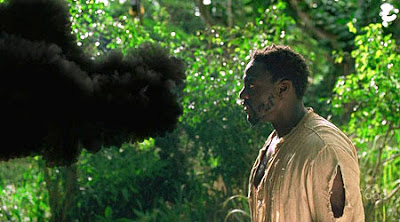
What started out with a an unbelievable plot turned into multiple realities; an island that can move about; a mysterious smoke monster; “others” who also inhabit the island; and characters named after historical figures like Locke, Faraday, Roussou and Boone. I watched that show to the end, and probably like people who follow the Q, I liked it. I was always wondering where the writers and J.J. Abrams were taking us. They tied everything together in science, fiction and mythology. I imagined the writers, sitting around stoned and coming up with these weird plot twists. Every episode required an even weirder plot twists to explain the previous plot twists. Pretty soon the whole show was out there in the ozones and I had to wonder if the only way to make any sense of the show is that you had to be stoned to get it.

Eyeball to eyeball with the elusive Smoke Monster on LOST

After watching the first episode of Q: Into the Storm I felt glad I was living in a state where recreational marijuana is allowed because QAnon seems to be just as bizarre as LOST. It made me feel like I really missed something by not playing Dungeons and Dragons in my youth. I think I would have had better insight to this realm of the reality that is being foisted upon us: pizza with pedophilia toppings. We go in the opposite direction of the Sherlock Holmes maxim: When you have eliminated the impossible, whatever remains, however improbable, must be the truth.

So who is Q? Maybe he is today’s alter ego of LOST’s Smoke Monster: somebody blowing a lot of smoke up our knickers.

The Pickwick Papers: fact or fiction

During this period of pandemic I decided to read The Pickwick Papers as an attempt to move away from the partisan period in which we are living through. Even in fictional works that are more than 200 years old there pops up the belief in the blind biased-emotional allegiance to particular party party.

When I decided to read The Pickwick Papers I was hoping to jump away from the “normal” noise and nonsense of today’s erroneous news claims and read some classic fiction.  As I drifted back into what I thought might be simpler times of late 1830s England, I found yesterday’s fiction is not so different from today’s fact. It becomes a question of which comes first: the fact or the fiction. 

It seems that whatever comes up today is immediately framed by some zealot or zealots. Take support for the covid stimulus package before the Congress. It is not surprising to see it passed strictly on party lines. The partisan divide is something that is now the normal way of getting things done. It is the old  saying: if it don’t fit, force it.   Actually, when it comes to just about anything we seem to thrive on divided government and hence being a bifurcated state.  A Balkanization of the New World.

When you think about it we come by it naturally.  Our country started out as 13 individual colonies and then 13 individual states.  From there we quickly developed into sections: the North, South and West. Now we are like a Dr. Seuss book: One State, Deep State, Red State, Blue State (the Texas State has a little star).

In all of this I had to laugh when I saw The Hill headline on the Apple news feed stating Wisconsin Senator Ron Johnson  forces reading of 628-page Senate coronavirus relief bill on floor. According to the story Johnson is going to inflict almost 20 hours of extracurricular reading on the Senate’s clerks. You may say this is more misery than humorous.  Odd maybe, since rarely does any bill get read on the Senate floor. What makes it funny or at least coincidental to me, is The Pickwick Papers is a book more than 600 pages, too. According to readinglength.com it would take the average reader 18 hours and 41 minutes  at 250 WPM (words per minute) to finish. So my suggestions to the Senate clerks is start reading.

Before I go further I must say I am not Dickensian scholar any more than I am a Senate antiquarian.  I am more of a Holiday Express man of letters.  In High School I remember our class reading Great Expectations.  We all got a kick out of Pip. I did read A Tale of Two Cities.  Today it would be The Tale of Two Senates. When my daughter was young she loved the musical Oliver!  I cannot count how many times I have seen that on VHS, yes VHS. And of course, we are all familiar with the classic  Christmas Carol.

The original 1836 cover

It is not my intention to rehash The Pickwick Papers or any legislation before the Senate. However, CliffsNotes describes Mr. Pickwick and his fellow travelers as “a silly old fool surrounded by worshipful admirers.”  Sounds somewhat familiar and maybe even senatorial. 

But then that could be a description of just about any group of men, the Senate, men going on any sort of expedition, or a seditious mob on a quest to  save democracy as they conceive it from the hands of pediphiles. 

What particularly grabbed my attention to rhyming history was the chapter in which the traveling band of  Pickwickians show up in the small English borough of Eatanswill during an election. (Eat-an-swill I am sure Dickens had something in mind with that.) It appears like many communities in contemporary America “that the Eatanswill people, like the people of many other small towns consider themselves of the utmost and most mighty importance…” and are “bound to unite, heart and soul with one of the two great parties that divided the town–the Blues and the Buffs.” Today we see it in different colors.

Dickens began literary success started off with the serialization of The Pickwick Papers in 1836.

Charles Dickens was at one time a law clerk and political reporter covering Parliament. He was an acute observer of social status and the economic impacts it had on English society.  Dickens wrote of the fictional political situation in Eatanswill in partisan terms. “Now the Blues lost no opportunity of opposing the Buffs and the Buffs lost no opportunity of opposing the Blues; consequence was, that whenever the Buffs and the Blues met together at a public meeting, town-hall, fair or market disputes and high words arose between them.” Like today, the issues didn’t matter as much as the opposition to them. 

Dickens continue to describes the  town where shops and inns were divided. Even the church itself was divided: “there was Blue aisle and a Buff aisle in the very church itself.”

And it goes without saying both sides had their own newspapers:the Gazette and the Independent. Dickens described those papers as: “Fine newspapers” with  “Such leading articles and such spirited attacks!” The Gazette paper was “worthless” the Independent was a “disgraceful and dastardly journal.” Dickens writes that both papers printed “false and scurrilous stories”and “other spirit-stirring denunciations, were strewn plentifully over the columns of each, in every number, and excited feelings of the most intense delight and indignation in the bosoms of the townspeople.” It sounds like Dickens is describing  weekday morning  TV “news” shows with Fox and Friends and Morning Joe. 

The papers, like today, questioned the character, motives and disposition of the townspeople demanding to know to know, “whether the constituency of Eatanswill were grand fellows they had always taken them for, or base and servile tools, undeserving alike of the name Englishmen and the blessing of freedom,” or just plain deplorable.  

When Mr. Pickwick  asked a local about the election taking place as a “spirited contest,” the local  informed him about how prospective voters are getting drunk and holed up in a local inn. “They keep ’em locked up there till they want ’em.  The effect of that is, you see it prevent our getting at them; and even if we could it would be of no use, for they keep them very drunk on purpose.” I guess claims of voter fraud and suppression were fictionally practiced way back then, too. It gives old historical meaning to the adage that says “if you ain’t cheating you ain’t winning.”

The Pickwick Papers was a good pandemic read.  It seems the more fiction you read the more you have to wonder where the facts end and the stories take over. 


Lunatic Fringe I know you are out there

Despite peaking  at number 11 on the US charts in September of 1981, the song seems apropos 40 years after its release, particularly for this moment in American history. Any time mobs take to the streets and start forcing their way to the business district, or in this case muscling past police to get into the House and Senate chambers of the Capitol, one has to wonder where will the fringe stop.

From videos of the Capitol blitz you can easily see that there are numerous members of, let’s call them for what they really are: “the lunatic fringe.” The fringe can turn a demonstration into a protest and then into a riot.  If unchecked, the fury of the fringe resorts to its lowest common denominator–witch doctors running around in bear skins, for example. Once it devolves into the mob mentality, the storming the Bastille or the Winter Palace, it can easily turn into rage and full blown revolution.

From videos of the Capitol blitz you can easily see that there are numerous members of, let’s call them for what they really are: “the lunatic fringe.” The fringe can turn a demonstration into a protest and then into a riot.  If unchecked, the fury of the fringe resorts to its lowest common denominator–witch doctors running around in bear skins, for example. Once it devolves into the mob mentality, the storming the Bastille or the Winter Palace, it can easily turn into rage and full blown revolution.

Peasant exhibiting Mass psychogenic illness (MPI),or mass sociogenic illness, mass psychogenic disorder, epidemic hysteria, or mass hysteria. The rapid spread of this illness effects members of  group and the symptoms have no corresponding organic causes.


Now, I am not using the term “lunatic fringe” as a disparaging remark. It’s a fact, as the song says: there out there. All one has to do is scratch the surface of our history to find it is laced with elements of the lunatic fringe from all over the spectrum.  At times it is like kicking over a rotten log in the woods and finding all sorts infestation crawling about. And for the most part that is where they remain.  But every now-and-then the fringe, and their conspiracies, scurry out from the dark and manifest themselves as some sort of defenders of the realm, keepers of democracy, protectors of the national identity. It can easily pull in your normal average Joe into the frenzy.

Take our beloved Pilgrims.  It could be argued that those purifying Pilgrims who settled on the rocky shores of Massachusetts more than 370 years ago were  the lunatic fringe of the Protestant  Reformation. They were breaking away from the English Church, which broke away from the Catholic Church. Think about it. You have to be on the fringes of religious fanaticism or sanity to get in a leaky boat for more than a month, on the stormy North Atlantic Ocean and head for a place sight unseen. That is a leap of faith. For the Pilgrims there was no second chance, no buyer’s remorse.

We view the Puritans efforts at settling in the “New World” with historic pride as they tamed the wilderness and ran off the indigenous people. Their religious dedication and hard work is ingrained in our national psyche. They have given us what Max Weber, a  German political economist and sociologist, called the Protestant work ethic.  This is based on the Calvinist belief that earthly material success and profit was proof of God’s grace bestowed upon an individual, a form of spiritual capitalism. It also set us up for the belief of blaming the victim. If you were not rich or successful then God was not shedding his grace upon you–you must have done something wrong or nothing at all and deserve a life of struggle and woe. 

These were the same devoted people who would later hang Quakers and threaten unwanted Catholic priests with death if they happened to show up unannounced for Thanksgiving dinner. And we won’t even go into the witch burning thing. 

Cotton Mather, the leader of America’s first “witch hunt.”


Throughout our history a lot of the fringe groups represented repressed religious and cultural beliefs.  For example, there was always a good Protestant/Catholic hate relationship taking place. This bitter religious divide over the same savior took off in the 1840s when Catholic Irish started washing up on the East Coast causing spiritual and cultural havoc among the predominantly English Protestants. Here come the Papists. 

At this time half of the immigrants coming into the US were from Ireland. Rekindling the centuries old Anglo-Irish blood feud, which predates the Pilgrims, but was still in everybody’s collective memory.  This wave of Irish immigration gave way to the Know Nothing Party, an anti immigration party in the 1840s that believed that these non-citizens were showing up at the polls in droves to vote–sound familiar: immigrant caravans heading for your town USA. (see June 2016 Know Nothings Ride Again)

Yale educated, the American Geographer and father of Samuel Morse.

And then there is the conspiracy theorists.  The United States was practically born with a conspiracy binky stuck in its mouth.  The country was barely 10 years old when Jedidiah Morse started spreading an intriguing fantasy of the Illuminati’s attempt at world dominion. 

Chances are most of what we know about the Illuminati comes from Dan Brown’s book (and the movie) Angels & Demon. According to danbrown.com his book is about “the resurgence of an ancient secret brotherhood known as the Illuminati… the most powerful underground organization ever to walk the earth…The Illuminati has surfaced from the shadows to carry out the final phase of its legendary vendetta against its most hated enemy… the Catholic Church.”  Some of what we read in the paper today about how we are one day away from being dominated by a confederacy of “Satan worshiping pedophiles” is right in line with some of our history’s past conspiracy theories.

There was a belief, according to University of Edinburgh professor, John Robison, who wrote in 1789 that the Illuminati was formed “for the express purpose of  rooting  out all religious establishments, and overturning all the existing governments of Europe.” European history is laced with inquisitions and burning heretics at the stake.  Just look what happened to the Knights of the Templar.  According to History.com “In 1307, King Philip IV of France and Pope Clement V combined to take down the Knights Templar, arresting the grandmaster, Jacques de Molay, on charges of heresy, sacrilege and Satanism. Under torture, Molay and other leading Templars confessed and were eventually burned at the stake. Clement dissolved the Templars in 1312. The modern-day Catholic Church has admitted that the persecution of the Knights Templar was unjustified and claimed that Pope Clement was pressured by secular rulers to dissolve the order.”

Let’s fast forward to the 1700s. Several things happened in the Western world. There were some significant shifts in thinking that took place. Europe moved through a Renaissance to a Protestant Reformation and now it was in a period of Enlightenment. A move from a religious based way of thinking to a more reasoned approach to the world.  This continual shift over the centuries in thought from the Dark Ages didn’t come without philosophical, religious, political, economical and cultural costs. By the mid 1700s the English colonies were coming up with their own conspiracy theories that led to serious questions concerning  English colonial rule.  And if anybody needed any proof of the shifts in political and economic thought just look at the insanity that was taking place in France.  France had decapitated its monarchy and was going through its bloody revolution. It was a time that would pit France against most of Europe.

Here, in America the colonies just turned the world upside down and were barely a decade into their new government. Political parties were forming across the new nation as Federalist, under John Adams and Alexander Hamilton, supported Great Britain. They were opposing Thomas Jefferson and James Madison and their Democratic Republicans who were more supportive of France–among other political and economic differences.  There was a deep belief that French spies (18th Century bots and hackers) were planting propaganda in American newspapers. This  created a parinora among Federalists. Into this changing political climate and cultural unrest, creeps the conspiracy theorist.  The rotten log in the forest has been turned over.  

But  it takes an educated man who sees what others are missing (an opportunity usually). A somebody to “connect the dots” for those who do not understand the crimes of the times. Enter Jedidiah Morse, a Yale educated New England preacher, geographer and father of Samuel Morse, inventor of the telegraph.  He took to the pulpit, a 17th Century social media platform. Morse expounded on Robison theories of Illuminati domination. He believed that an ever expanding brotherhood was slipping up on the shores and developing here in to dominate America. His preaching was able to convince other preachers which convinced Federalist leaders, like Adams, that this was more than a localized Salem witch hunt.

To the Federalist the threat was real. This was a time of political unrest with the Adams’s administration fighting a Quasi War with France on the open seas and Jefferson’s growing Democratic Republican party at home.   Adam’s administration began to “connect the dots.” To defend the nation from infidels and heretics they passed the Alien and Sedition Acts.  Probably the first attempt at a Patriot Act. The act increased from five years to 14 years the time required to become a naturalized citizen. It seems that most of the newly arriving immigrants had favored Jefferson’s Republican party. In case of a war, the act allowed the government to deport non-citizens who could be plotting against the US. And finally, probably the most egregious part of the act, was it allowed the government to jail citizens if they spoke out against Adams and his Federalist officials. Several prominent newspapers editors of the time were jailed for connecting the dots in a non-Federalist way, and now under the new laws, paid the price for their contradictory views. 

Now Morse did not create the discordant political environment, the chaos in France, or the Illuminati.  He just inspired the fringe element to look for a foreign speaking boogie man or men. His quest for an Illuminati brotherhood was much like searching for Saddam’s Weapons of Mass Destructions in Iraq. We know there out there but… It looked and sounded good but yielded no secret societies.

Senator “Tail Gunner Joe” McCarthy finding Commies in Hollywood, the State Department and under beds throughout the nation. One of the America’s best Inquisitor Generals since Cotton Mather

This was only the first conspiracy theory to send America into a frenzy and not the last.  Shortly after the Illuminati came and went the Anti-Masonry movement swept the country.  Freemasons were taking over the government. There were Southern sympathizing “Copperheads” during the Civil War and several “Red Scares”: one after World War I with socialist lurking everywhere. The next scare was McCarthyism during the Cold War. Since then we have had hippies and yippies supposedly putting LSD into public drinking water,  the Carlyle Group, the New World Order and now we have resurgence of old school klu kluckers–again with the Klan–alt right, QAnon, and antifa. 

The lunatic fringe is always around. As the song says: You’re in hiding, and you hold your meetings I can hear you coming. But before they come out of hiding they need some sort of influential person: a preacher, several senators or a president to validate their sketchy claims based on foggy logic and fuzzy cause and effect. A credible fear is easy to stoke when an accessible apparition to demonize appears. I can be anything: Illuminati, Catholics, Masons, communists or socialists; an immigrant with a different religion. Once a demon is identified, the fringe conspiracies need a voice to bellow out their theories to induce a mass hysteria.   And today pushing half-baked beliefs is so much easier and efficient with social media and the internet.  As Mark Twain supposedly said: History doesn’t repeat itself but it often rhymes.  

http://www.history.com/topics/early-us/alien-and-sedition-a

The Collapse of an ever Expanding Ego Bubble

Now that the Trump administration is winding down I am reminded of what my Dad would say after a contentious meeting with a business associate: Don’t go away mad, just go away. Of course he said this in jest, but I cannot help feel it is a mantra the country should embrace with the 2020 election, and maybe the entire year.

That is easy for me to say, but there are millions of Americans who feel President Trump should hang around for four more years or more despite the results of the election. His ego demands it. Some of his supporters believe in a widespread election fraud. Some elected officials, who took up an oath to support the Constitution, are looking for anyway to steal back a so-called stolen election. It would stand to reason that if millions of President Trump’s votes were thrown out, buried in landfills or in the Meadowlands with Jimmy Hoffa, there would be a lot of other races both Democrat and Republican, being bought and sold on the black market, too. And yes, there are some other disgruntled losers out their complaining and trying to find warmth in the president’s ego. But in this age of information everything is up for interpretation, particularly the voices in the back of a president’s mind.

It is not my intent to review the election, the last four years of the Trump administration, or become a political pundit or an armchair psychologist. God knows we have enough of both. And for the last four years they have both been expounding and extrapolating on the president’s comings and goings as well as his physical and mental acuity. It is a good thing that most of the country has gone digital because I would venture to say that if newspapers and magazines were still in vogue we would have deforested several states with the volumes that have already been written on the merits or demerits of President Trump’s administration and his always questioned mental state and intentions.

And here again what do I really know about sanity and insanity. I mean, I have seen a grown man sitting on a bus bench once having a vivid conversation with himself. Without a doubt this man had some deep-seated problems. But then who has not walked out of room (or a whole year) scratching their head, mumbling to themselves about what just happened. Today we can simply blast a tweet out to millions with only our deep feelings guiding our fingers. It gives new meaning to the old Yellow Pages ad: Let your fingers do the walking.  In this case it is more like letting your fingers do the talking.

When it comes to talking even when President Trump talks to himself he is not alone. When he tweets people are listening. I have a vivid picture of President Trump first thing in the morning sitting on the White House throne doing his constitutional duties while pushing out a good morning tweet to America. According to Forbes “the president hit an all-time peak follower count of 88,964,791 on Nov. 17. ” So if he was sitting on a bus bench rambling on he would have had close to 90 million people listening. Now that is insane.

However, some people are starting to tune out of this massive ego trip. According to the same article, “Dating back to November 18th, Trump’s verified account has a tallie of 18 consecutive days of net losses in terms of followers.” That’s close to more than 220,000 people. A mere drop in the bucket but a drop nonetheless.

But according to brandwatch.com President Trump does not even break into the top 5 of total Twitter followers. He is more than 30 million followers shy of former President Barack Obama’s 125 million who has the most followers. President Joe Biden sits at around 33 million followers.

Now the country has seen several economic bubbles pop in the last 20 years but I am not sure if we have seen an ego bubble before.  We had the Dot Com Bubble burst in 2000 as investors  in the 1990s poured millions into internet startups that never yielded the exorbitant profits that were envisioned. We saw the Real Estate Bubble rip the guts out of the construction industry, banking and investment services, not to mention the millions who lost their jobs and were foreclosed on. America was introduced to derivatives and tranches, which is just another way of letting an investor bet somebody else’s farm using somebody else’s money to so they can garner a profit. But what will be the effects of a supernova ego bubble bursting?

We have been on an ego trip for the last six years. And here is where a lot of the pundits get it wrong on what has happened starting with the 2016 GOP Presidential Primaries. Trump was able to pop all of his opponents egos on the debate stage. Since then, politics has been a side show, the facade for the giant ego trip since Donald Trump took office. We have had to endure the Twitter tweets spewing out all sorts of clatter into cyberspace. That constant voice in the back of the commander-in-chief’s head has 90 million people tuning in. It is like astronomers searching for extraterrestrial intelligence (SETI). In fact, according to Smithsonian Magazine “researchers noticed evidence of a strange radio emission while looking through archival data from 2019. The odd radio emissions seemed to be coming from the direction of Proxima Centauri, our closest neighboring star system at 4.2 light-years away.” Maybe they should direct their radio telescopes closer to the terra firma to see if there is intelligent life inside our own ego bubble.

What we have been dealing with is a growing radioactive toxic ego bubble that could rival Chernobyl. Again, I am not a chemist or a nuclear physicist, but I can spot a crazy man talking to himself on a park bench. But look at it from the atomic level, atoms can either be stable or unstable. An unstable atom is unbalanced if it picks up or loses electrons. It now has too many or not enough neutrons or protons. The atom will then start spitting out neutrons or protons, or other materials to reach stability. 

It is this egotastic instability we live in.  Consider presidential tweets as an atoms shooting out a constant stream of electrons trying to stabilize the his ego. The more tweets that are cast off into the universe the more unstable the tweeter. But the universe is not deaf. Like those astronomers listening into deep space for voices, 90 million people and the media here on Earth are amplifying the tweets that come flying out of Washington. More presidential particles or tweets flowing out simply means more unbalanced tweets come flowing back.

One sign of struggling ego is the need to be victorious at any cost. An easy observation of this is the ad hominem attack. This is a fallacy. According to Texas State Philosophy Department, “This fallacy occurs when, instead of addressing someone’s argument or position, you irrelevantly attack the person or some aspect of the person who is making the argument. The fallacious attack can also be directed to membership in a group or institution.” It is a kin to calling African nations “shitholes” or a US Senators Little Marco or Pocahontas.

Let’s face it, not all of the president’s followers are happy campers. So now we have this ever expanding unbalanced ego bubble feeding off an ever unstable universe because inside that ego and outside the ego bubble people are going simply bat shit crazy. This ego bubble might get punctured when Congress certifies the Electoral College results. Despite losing the election it appears as if President Trump’s ego is doing all it can to keep his ego bubble from bursting. His ego has engulfed some Senators and Congressmen who are vigorously manning the pumps to keep the bubble inflated. 

This could be a problem for the country. On an atomic level I do not think Joe Biden’s ego is big enough to offset and stabilize the decaying Trump bubble and what it may morph into. I do not believe the country has ever experienced this sort bubble before. It would be nice to see President Trump leave office calmly and quietly go home. And while doing so, he can take his  ego trip and deflated ego bubble with him.


The Thrill of Victory or the Agony of Defeat

Brooklyn Dodger fans lived this and picked up the mantra, “wait ’till next year.” Before the Dodgers moved to LA, they had won National League Pennants in 1941, 1947, 1949, 1952, and 1953. They lost the World Series all five times to the New York Yankees. “Next year,” however, finally came in 1955 when the Dodgers “Boys of Summer” shot down the Bronx Bombers in the World Series.

I was not around during those days but I was around to see the Buffalo Bills lose four straight Super Bowls from 1991-1994. It is a sporting accomplishment to make it to a title game one time; but to get there four years in a row and come away empty handed all four times is sports hell. The Buffalo Bills are equivalent to the presidential aspirations of the Federalist Charles Pinckney and Democrat Adli Stevens. Both losing twice. Pinckney to Thomas Jefferson and Stevens to Dwight Eisenhower.

When it comes to sports I do not recall reading or hearing about either the Dodgers or the Bills refuting the scores saying some runs or points were not counted after the games had been played. The games were played by the rules and even despondent Dodger fans accepted the loss with the fateful incantation, almost as if they expected the loss, “wait ’till next year.”

By playing the game there is the acceptance you agree to the terms and conditions that somebody has got to lose. In politics today certain losers are willing to entertain any conspiratorial theory or legal  efforts to overturn popular elections on perceived technicalities. Could you imagine the Buffalo Bills spending $3 million for a recount of the scoring in their 1991, 20-19 Super Bowl defeat to the New York Giants. It was a disheartening one-point loss but a loss just as much as their 1993, 52-17 pasting to the Dallas Cowboys. In both cases the games were played fairly and uncontested. There are 32 teams in the NFL. When the season is over there is only one real undisputed winner. In many ways it does not matter if you came in second or last.

Sports outcomes are usually not contested. Assigning  blame, making excuses and criticizing the outcome, yes. Criticizing how a game is played, or the officiating, is an American tradition. It has to go back to the first time a batter turned around to an umpire and said that pitch was outside. Bitching about the call is a part of the game itself. You can disagree with the call; you can even rant and rave about it from the sidelines, or from the cheap seats; but most often the play stands. In most cases the ref or the ump will give you a few seconds to jaw at them. They will  let you have your say so all the while turning a deaf ear to your complaint.

However, the game wants to get calls right. Sports have instituted replay procedures to properly challenge calls made on the field. And so, too, in voting. States have instituted protocols, legal safeguards and recounts to ensure votes are counted properly. Face it, nobody wants to win on a technicality (except maybe a desperate politician).

But getting too exuberant criticizing the officiating during a game by those playing or managing the game, is usually grounds for some sort of technical foul or worst ejection from playing field. And if it goes beyond the field, players and coaches can be fined, as was the case when Pittsburg Steeler Coach, Mike Tomlin, complained that the 14 penalty flags being thrown in their 41-17 victory against Atlanta in 2018 was a joke–and they were the winners!. The NFL, however, was not laughing. It flagged Tomlin and the Steelers $25,000 for his comments.

All of this is not to say that our sports are perfect. Take the legendary 1982 “Snow Plow Game” between the New England Patriots and the Miami Dolphins. The game was played as a cliche on a tundra-like field during a snowstorm fit more for the Iditarod then a football game. Snow plows were used as an “emergency ground rule” to clear field yard markers to help officials.

The two teams battled each other and the elements slipping and sliding around like mules on ice. Neither team was able to score until New England had the ball with less than five minutes left in the game. With the ball inside the Dolphin’s 30 yardline the Patriots decided on a field goal try. As the Patriots field goal team trotted out, a snow plow driver joined them, clearing off the spot for the home team’s kicker. The 33-yard kick was good giving the Patriots a 3-0 victory and leaving Don Shula, the Dolphin’s coach, livid enough to melt ice.

Shula said that this was the “most unfair act ever perpetrated in NFL History.” At the time there was no rule saying this was an unfair move. The NFL has an “unfair act” that allows officials to overturn flagrant illegal plays. The beloved Commissioner of the NFL at the time, Pete Rozelle, had the authority to overturn the outcomes of games. In fact he agreed with Shula but basically said the Patriot’s did not break any rules.

Next year was different story as Shula made sure that the rules stated that “Under no circumstances will a Referee permit clearing by the grounds crew of a spot for a PAT or field goal attempt.

This brings us back to the recent presidential election and the wild attempts to overturn the popular vote in “swing states” on technicalities. The 2020 election had several unique difference from past elections. First, and foremost, is the pandemic. It has had an effect on everything we do and voting is no exception. And almost as contagious as the coronavirus is the current toxic political atmosphere is just as bad. It has created a win now or lose forever mentality. Now, every election is some sort of fait accompli.  There appears to be no belief in wait ’till next year. This belief in no tomorrow  motivated people to get out and cast ballots in record numbers.

To some, it was not voting but how you voted. In the time of pandemic a lot of people voted early and by mail. It was the safest way to vote. To others, it looked like early voters were adhering to the old Chicago Style of voting: vote early and often. It is believed that 65 percent of the 150 million voters voted early in the 2020 election. The Department of Homeland Security said the 2020 election “was the most secure in American History.” Even the “got your back” Attorney General said there was no proof of widespread fraud. 

But then that DHS claim has not stopped more than three dozen lawsuits from those crying foul and pushing the mantra: “Stop the Steel.” This is more Hamlet than Hamilton as the “Lady doth protest too much.” Protesting too much can lead to a lack of credibility. Just look at Rudy Giuliani–he is the modern day boy who cried wolf .  Is there any fraudulent claim he won’t shill?He has gone from America’s Mayor to carnival barker trying to get people to guess the Fat Lady’s weight. 

It is one thing for a football team to go for the win with a two-point conversion at the end of the game and coming up short.  It happens. At some point in the baseball world the Dodgers were going to beat the Yankees. Without a doubt Americans love a winner. And at times, we can even be sympathetic and compassionate to the defeated. But we cannot stand a poor loser. But as Danny O’Keefe sings: “Some gotta win, some gotta lose, good time Charlie’s got the blues…”

As far as the election goes, it is time to do as the British say: Play on.


https://www.weather.gov/lmk/snow_plow_game