From Peanut Butter and Jelly to Artificial Intellegence


Animal intelligence with human overlords.
In so many little ways our country has changed in my life time. I often think of my wife’s grandfather who grew up as a Mississippi farm boy in the early 1900’s. He once tried to explain to me the work differences between oxen, horses and mules. I could not help but think of the recent tug-of-war demonstration Elon Musk put on with his new electric Cybertruck and a Ford F-150.  Who would have thought 20 years ago that an electric truck could take on the Ford, Chevy and Dodge gas guzzling giants in a tractor pull. I can imagine constructions workers bantering with each other in a bullying way over beers on which pickup truck was better for hauling or towing but I am sure electric trucks never entered the debate.  In our information age this would be equivalent of techno geeks pontificating on the qualities and drawbacks between computing capabilities of Notebooks, Macs,  Microsoft or any devices with an operating system.

But Paw, as we called him, lived long enough to see the beginning of the computer age.  He saw it but never really experienced it. He grew up fighting in the Great War and spent a year in France. Something new for a lot of country boys living in the Roaring 20’s with The Great Gatsby which would soon turn into To Have and Have Not during the Great Depression. If they lived long enough, they saw the world go from prices stamped onto products to scanning bar codes at the grocery store check-out line. They literally went from horse-and-buggy to landing on the Moon and the Space Shuttle.

That generation is all but gone. I am not sure if they had nickname except maybe “old fogies,” a term, which now, could be considered close to a hate crime or in the same category as a gender or racial slur.  I am not sure if the newly coined, “okay boomer” is descriptive or derogatory. The debate is on.

We boomers, too, have seen a thing or two and as of late it seems like things are moving a lot faster than plodding team of oxen on a Mississippi dirt road in August. I have seen it go from where a smart man carried a pocket knife with two blades and a can and bottle opener folded in there somewhere. The more sophisticated man’s knife would have a cork screw on it for that bottle of Chardonnay casually consumed on picnic blanket under a shade tree with your best girl. That was a time before pop top cans and twist off bottle caps.  Wine always had a cork and did not come in a box. I would not be surprised that in the very near future somebody comes up with some sort of app to open tough tightly lidded or shrink-wrapped products. I mean how many people today even carry pocket knives. But their phone is loaded with apps  that can book a flight, pay for the flight, and then get them on the plane.


The Swiss Army Knife:  Soldatenmesser 08, Militärsackmesser with multiple mechanical apps.


Who thought life could get better than pop top cans, and twist off Coke bottles? But it does. Just look at our old rotary dial phones with party lines. The first rotary phone came out in 1892 but it was not until 1963 that we went from dialing to push buttons. As Sonny and Cher would sing: and the beat goes on. Those land lines are still around but have been replaced with multiple iterations of wireless smart phones. Gone are long distance operators and rollover minutes.

According to the website SimpleTexting the first smart phone was an IBM  Simon Personal Communicator It came out in 1994 and looked like a slim version of a World War II walkie talkie. It could send and receive emails and faxes and “It even featured standard and predictive stylus input screen keyboards.” I have a feeling I should know what that is but don’t. When it comes to this sort technology, even 1994 era stuff,  I’m swimming in the shallow end of the techno pond.


The world’s first smart phone IBM’s simple Simon Personal Communicator.

The smart phone, in my opinion is a perfect example of peanut butter and jelly innovation. Before there could be a peanut butter and jelly sandwich, the world needed sliced bread. The basic ingredients for the sandwich were present. Just like there have always been radio waves.  It just took technology awhile to catch up. It is the old “what ya gonna do with it” innovation that has made America always great.

Peanut butter was around in the early 1890’s and was actually considered couture and not a food staple of the masses. Bread has been around for centuries.  However,  it took sliced bread to bring all three ingredients together.  In 1928. Otto Rohwedder brought in the new age of sliced bread with the first automatic bread slicing machine. An invention that gave us the modern Deli and maybe even ushered in the concept of fast food.


The late 1920’s Western Electric’s Model 102 B1 hand telephone with E1 handset with no Apps.


It is really is insane to compare the smart phone to a peanut butter and jelly sandwich.   Maybe it is more like the clock radio, which came out in the 1940’s. Combine the average alarm clock with a radio and life just gets better. The smart phone, like the clock radio and the sandwich, was out there just waiting to be developed.  It just took some innovation to bring them together. For instance, the first iPhone came out in June of 2007.  We are now up to 11 models and 5Gs. Phones with cameras and instant communication and apps that do just about everything for us but tie our shoes. People don’t go out of the house without the damned thing plastered to their faces or some sort of ear piece pushed into their ears. States have had to enact laws to curb people from using their smart phones and driving at the same time. A non alcoholic DUI. We love our smart phones. Now the  peanut-butter-and-jelly science is leading us to the innovation  of a smart car.


The Nokia 3210 , The “noisy cricket” considered by some to be one of the most popular and best phones Nokia made.

I do not think my first mobile phone had any Gs. It was a little analogue device that my wife called a noisy cricket. A neat feature was the various animal sounds you could choose for ring tones. I liked the Dolphin.  The little thing was about the size of the hand phaser that Captain Kirk zapped Klingons with in Star Trek.  It did everything my landline did without a wire but with text messaging and a voice mailbox.  Texting gave me the opportunity to communicate with people and not have to actually talk to them and the voice mail box meant I didn’t have to answer the phone at all. One drawback though, was the noisy cricket had no emojis. It is hard to imagine a time without emojis. Who could live in world devoid of such creatures.  It hearkens back to the dark ages when a P & J sandwich was waiting to come between two pieces of Wonder Bread.


Sliced bread. It brought peanut butter and jelly together.

But life does get even better than sliced bread.  Today’s technology allows us to call anybody within radius of a cell tower and a satellite link.  And if that is not enough we can now talk to people face-to-face.  But what is really great, is we can talk to the phone itself.  I cannot count the times I have screamed at some dumb insubordinate machine thinking that my tirade would bring it into some sort of compliance with my wishes. Now the phone is like Aladdin in a lamp. It is science and Arabian fantasy brought together—another peanut butter and jelly moment!  It is almost like having your very own Genie.  I think it would be neat, though, that when you summon Suri or some other so-called artificially intelligent speaking machine that they answer with, “Yes. Master. Your wish is my command.” The reason I say this is I just do not trust machines to comply with my wishes.

I first ran into this at an early age. My dad always thought I was lazy because I could never get any of his lawn mowers to start. Yes, my motivation to get one started was low but I really think I was meant to live in the age of the hammer and sickle, the era of  real  bricks and mortar. In a time when they actually stacked one brick on-top-of-two. A time when the goat took care of the lawn. A time before bricks and mortar was not meant to differentiate between a store front business and an online business.

As an “Okay, Boomer” I grew up reading dystopian novels like Alex Huxley’s Brave New World, Ray Bradbury’s Fahrenheit 451 and  George Orwell’s 1984. “Big Brother is watching.” My luck with dumb machines and a my dystopian view of them has created a deep distrust of machines that goes beyond any sort belief in the deep state.  It concerns me that a machine with artificial intelligence can out-think me.  It raises some real concerns because it really does not require much effort to out-think me. I have never fired on all synapses and now machines that can process information faster than me is the norm. And I am not just talking about playing computer chess.


The face of Hal.

I am not sure where things are going. Because what boomer can forget the recalcitrant, malfunctioning artificial intelligent computer HAL 9000 in the Stanley Kubrick and Arthur C. Clarke movie 2001: A Space Odyssey. When commanded by a space-walking astronaut to “open the pod bay doors” to let him back into the space ship, HAL responds with a cool mechanical voice: “Sorry Dave I cannot do that.” What the heck do you mean you cannot do that? HAL was going to leave Dave’s human butt out in deep space because he, HAL, had a better grip on what was going on with their mission. And I use the word their because at what point will we start cohabiting the planet with smarter-than-human machines?

It goes beyond traffic lights telling us when we can go and when we should stop.  Machines that have a better so-called understanding of what is going on are taking the peanut butter and jelly sandwich innovation and putting it in the realm of cognitive mental mischief. We may be setting ourselves up to a real dystopian moment.  To paraphrase the classic Blues song: It ain’t no fun when the Robot’s got the gun.” 


https://simpletexting.com/where-have-we-come-since-the-first-smartphone/

https://www.seriouseats.com/2007/04/the-history-of-the-peanut-butt.html

https://www.pri.org/stories/2016-03-31/pastrami-rye-full-length-history-new-york-jewish-deli

Novembers to Remember

As the nation gears up from an impeachment inquiry to an full blown on House investigation we have to wonder if is something about November that instigates radical political changes. It must be something in the fall air, the Earth’s rotation or the tilt. The changing of the temperatures, in the Northern Hemisphere not only has the leaves turning colors and falling to the ground but people turning red and blue. Maybe it could be just knowing that winter is getting ready to roll in and people, animals and plants know whatever has to get done needs to get done before the cold weather sets in.

Here in the United States,  our national elections are a biennial event. Much like plants that come to foliage one year, drops their seeds the next and then flower;  so it is with our presidential elections. We experience a two year campaign season that works its way into a frenzy during the dog days of summer with conventions and then culminates into the parties turning the their mad dogs loose onto the electorate.  Despite the elections being every two-to-four years, campaign season is now a continual growing season. Even plants need a break and go dormant. But impeachment is like the 50 year drought, or the sudden warm snap that could even lull  Punxsutawney Phil out for a day on the town. 

Since the framers of the Constitution lived in an agrarian society, maybe they planned for a fall pre-winter election and post-winter inaugurations with a dormant period to let the season do its thing. A sort of governmental sowing of seeds. A time to cage hostile feelings or create a season of contemplative planning to decide what to plant in the upcoming political season. Despite putting impeachment into the Constitution, I am sure it was not meant to be used for Presidential pruning. A nation, however, like the farmer reaps what it sows and we really planted a hybrid.

However, whatever gets planted, the fabric of our representative  democracy is intertwined in such a way that a November election is not too far off to initiate the change needed to rectify injustices.  For instance, in the 1960s it was Civil Rights laws that brought people to march and demonstrate for full equality. Congress enacted the Civil Rights Act.  It was the Vietnam War that brought about the belief if you are young enough to fight for your country you should have the right to vote. Hence, the 26h Amendment lowering the voting age to 18 years. Our outlet for resolving these issues is our biennial elections. But what happens when these elections gives a bad yield?

As the longest running representative democracy, these seasonal elections have served us well to relieve and  begin the process of implementing solutions to pressing public problems. Democracy, unlike other forms of government takes a little more time and work to get things done. And, in the view of many, it never gets it right. But it gets it close enough to right so that we do not end up out in the streets in mob rule. We usually get a workable balance between populism, reform and regulation.The two-year election cycle gives us time to sort things out, plant a few seeds and see what sprouts. Lately, though we are lucky if we get a crop in the field.

I would hardly say that today’s fall-season elected officials are like plants. This might be insulting to most plants or the common weed in your backyard.  Although, some politicians are well established dandy lions that seem to proliferate in all seasons–even the 50 year drought.  But there are some similarities.  Plants need rich soil to thrive. Politicians need some rich backers with deep pockets; a few, however, can actually self-fertilize–just look to the previous eight years of Florida’s governor’s office.  Florida is a place were just about any invasive can thrive all year long. Some plants prefer sunlight and others shade.  Politicians are similar in that some bask in the bright lights of the media enjoying their time behind the podium while others prefer to move about in the shaded areas of public service doing their deeds behind closed doors.

But before we lose that rustic fall scenery and the trees become bare, the clocks get turned back and the skies turn a darker shade of  gray, issues come forward and events occur that it some, cases cannot wait for the winter thaw.  In America, we are not immune to governmental up-evil. Like most countries around the globe, we have endured our share of struggles, social injustices that have resulted in civil disobedience. and in some cases just plain flat-out widespread rioting; we have endured various economic and natural catastrophes, as well as terrorist attacks and even a full blown Civil War. But in most cases we believe in the power of the ballot over the bullet. Hence, an impeachment clause to the Constitution.

But November in other parts of the world may not experience the growing and nurturing effects of biennial governmental gardening that our elections provide and instead find far more fiery ways to curb their enthusiasm. There is always somebody who wants to take a short cut.  They end up taking an ax to the tree trunk; or maybe they are just an overzealous gardener madly hacking away at whatever looks like a weed; or they start a scorched earth policy of burning the entire field and end up eradicate everything like a bunch of Bolsheviks.

Stalin and Lenin: The original Red Scare Duo.*

For example, it was November 7, 1917 when Bolsheviks took to the streets in what would eventually turn into a scorched earth policy. It was earlier in the year, however, that the Imperial St. Petersburg army garrison abandoned their posts and joined striking workers that exposed Russia to radical change.   Workers who wanted “socialist reforms”  forced Czar Nicholas II to abdicate. The Bolsheviks seized the moment. In November they overthrew Alexander Kerensky’s Provisional Government. Lead by Vladimir Ilyich Ulyanov, better known in the West by the notorious one-name moniker: Lenin, they set up The Council of People’s Commissars.

Unfortunately the seeds of democracy never took. Alexander Kerensky would bolt to the West and remain in exile for the rest of his life. Sadly, the Bolsheviks were less forgiving when it came to the current Romanov’s. In less than a year after toppling the Provisional Government, in what could be described mildly as the culmination of centuries of Romanov exploitation, a manifesto of peasant dissatisfaction with the  extravagant,  and sometime maniacal, monarchical rule ended with the execution of Nicholas and his entire family.  Thus bringing forth the Soviet Union and a radical form of socialism and an economic system we know as communism.

Mussolini and Hitler; Fascist fanatics.

Another November to remember occurred six years later almost to the day that the Bolsheviks took power,  Adolf Hitler and his burgeoning fascist movement took to the Bavarian streets in a failed coup. Inspired by Benito Mussolini’s  National Fascist Party March on Rome in late October of 1922. A march that toppled the teetering Italian Kingdom and brought Mussolini and his Brown Shirts into power.  An energized Hitler, encouraged with his fellow fascist’s  success, decided he could overthrow the Bavarian government in what came to be called the Beer Hall Putsch.  Hitler and his Nazi cohorts stormed the Buergerbraukeller where Bavarian leaders were meeting, in an attempt to kidnap them,  while other Nazis tried to capture key governmental offices.

The two-day Putsch failed in gunfire. Sixteen Nazis and four policemen were killed.  Hitler managed to slink off, hiding in a friend’s attic.  He was arrested three days later. Hitler was charged with high treason, and was found guilty and sentenced to five years in prison but only served eight months.

Hitler and fellow Nazis return to their failed Putsch in 1934*

Hitler’s form of Fascism would eventually come to power in 1933 eradicating those who did not see the goals of his  thousand year Third Reich, a sort of make Germany better again movement.  This unchecked fanaticism would  bring war to Europe and start World War II killing millions and leaving Europe in ruin.  To avoid any consequences for his fascist fanaticism Hitler would commit suicide.

Other monumental November changes happened,  in 1519 when Hernan Cortes captured the Aztec capital and Emperor Montezuma ending one of the “New World’s” established civilizations. And in a November closer to our times, a military coup killed South Vietnamese President Ngo Dinh Diem. The assassination of Diem and his brother signaled a deeper United States military involvement in South Viet Nam that would officially end with the fall of Saigon in 1975. It would take several biennial elections, demonstrations and four students killed at Kent state to bring about a political end to this unpopular war.

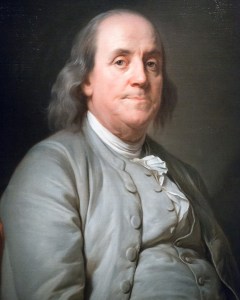
Franklin knew keeping a Republic would not be easy.

Our election cycle was created by men who wanted to “secure the Blessings of Liberty” for posterity. After leaving Independence Hall where the Constitutional Convention met in Philadelphia to write a new Constitution, a Constitution  that bound us together in a firm Republic, to replace the go it alone attitude of the Articles of Confederation; Ben Franklin was asked, “Well, Doctor, what have we got–a Republic or a Monarchy?” To which Franklin replied, “A Republic, if you can keep it.” The key to keeping a Republic  is remembering what it stands for.  In the closing paragraph of the Declaration of Independence the signers stated their support  for independence by putting a “firm Reliance on the Protection of divine Providence” and that “we mutually pledge to each other our Lives and Fortunes and our sacred Honor. ”

Our November elections can be a messy time because democracy is messy.  But it is a time when we pledge to each other our mutual support because it sure beats Conquistadors riding into town searching for gold. It is better than Bolsheviks imposing  a collective social order. And it is better than Nazis forcing their way into government like mobsters.

Elections might not settle every issue at any given time but if we are guided with the concepts in the Preamble of our Constitution  with the belief that we can  continually “form a more perfect Union” and not a create chaos out of division , we will be able to keep our Republic. It is unfortunate but maybe necessary at times that we need to review an election.  Say what you will about impeachment but the Constitution does give Congress a backdoor to tend to democracy’s garden.


*This photos have been edited by the powers to be at the time either cropping individuals out or simply removing them.  


“Truth can never be told so as to be understood and not be believed.”

In all this yammering about impeachment lately certain things become obvious yet misinterpreted. Forget about the simple truth–that slithered out the room a long time ago. There does seem to be some “truth” to the statement recently made that we don’t believe in the truth but in facts. I would think that facts build to the truth but I guess it all depends on how you stack them: end-to-end, one- on-top-of-the-other or sideways. And if we really want to get iffy maybe take the facts off into another dimension and alternate universes and reality altogether.

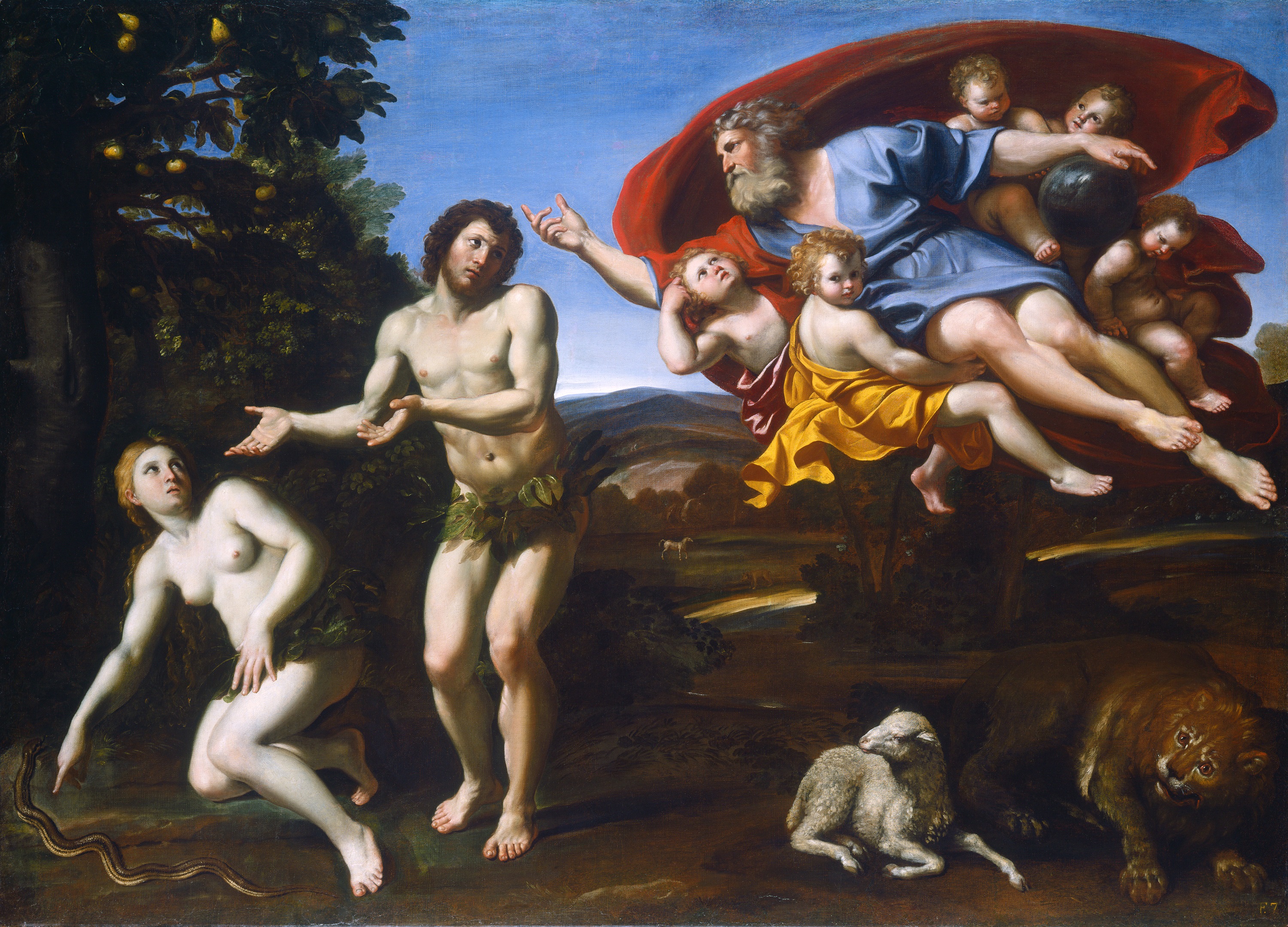
Take Adam and Eve for instance.  God dropped them into the Garden of Eden and gave them carte blanche.  He gave them run of the place with one rule: Don’t eat from the tree of knowledge  of good and evil “for when you do you will surely die.”  I honestly feel that God was the first Libertarian.  The Institute for Humane Studies at George Mason University says that a classic libertarian’s “perspective is that (of) peace, prosperity and social harmony.”  Libertarians “are fostered by ‘as much liberty as possible’ and ‘as little government as necessary’.” It sounds like paradise: no government, basically no rules to follow and no taxes to pay. But you know somewhere somehow it was going to get screwed up and Adam and Eve set the standard. The old saying if it is too good to be true…

Man, despite God’s good graces, has made things much more complicated through the millennia’s endless rules and regulations.  A large portion of the world’s population once believed that you could go to hell by eating meat on Friday. God created a couple of innocents to roam freely in Eden.  But once God created man his creation sort of went off the rails or maybe it was when he created the serpent. According to the Bible it took just three chapters starting from “in the beginning” and basically one chapter in the Book of Genesis for Adam and Eve to meet up with the serpent and see their lives completely transformed.  After that meeting with the serpent, there was no way to make the Garden of Eden great again.

History, however, is full of crafty, sinister, and evil individuals who can mesmerize the masses with their malevolence.  It may have started in the Garden with the beguilement of Adam and Eve. However, it did not stop there. The art of the deal gave us great concepts like the Pharaohs were Gods.  When that one did not float anymore somebody came up with the “Divine Right of Kings.”

We have seen outright brutal dictators like Hitler at his Nuremberg Nazi rallies.  We have seen Stalin and his mass purges that sent millions off to Siberia never to be seen or heard from again.

Napoleon’e triumphant return from his Elba exile. Making France great again.
The French zealously followed Napoleon off on European conquest and domination that scorched Europe for decades.  The word chauvinist comes from a faithful soldier,  Nicholas Chauvin, in Napoleon’s Grand Armee and his undying devotion and patriotism to the “Little Corporal.” And we have seen the less sinister swindlers and con artists like Bernie Madoff,  Charles Ponzi and Victor Lustig.  Lustig once sold the Eiffel Tower–twice! And even managed to con Al Capone out of $50,000. Talk about bravado and playing to somebody’s fantasies and getting away with it. It sort of reminds you of being able to stand in the middle of 5th Avenue and shooting people and not losing votes. Even Al Capone could not get away with that.

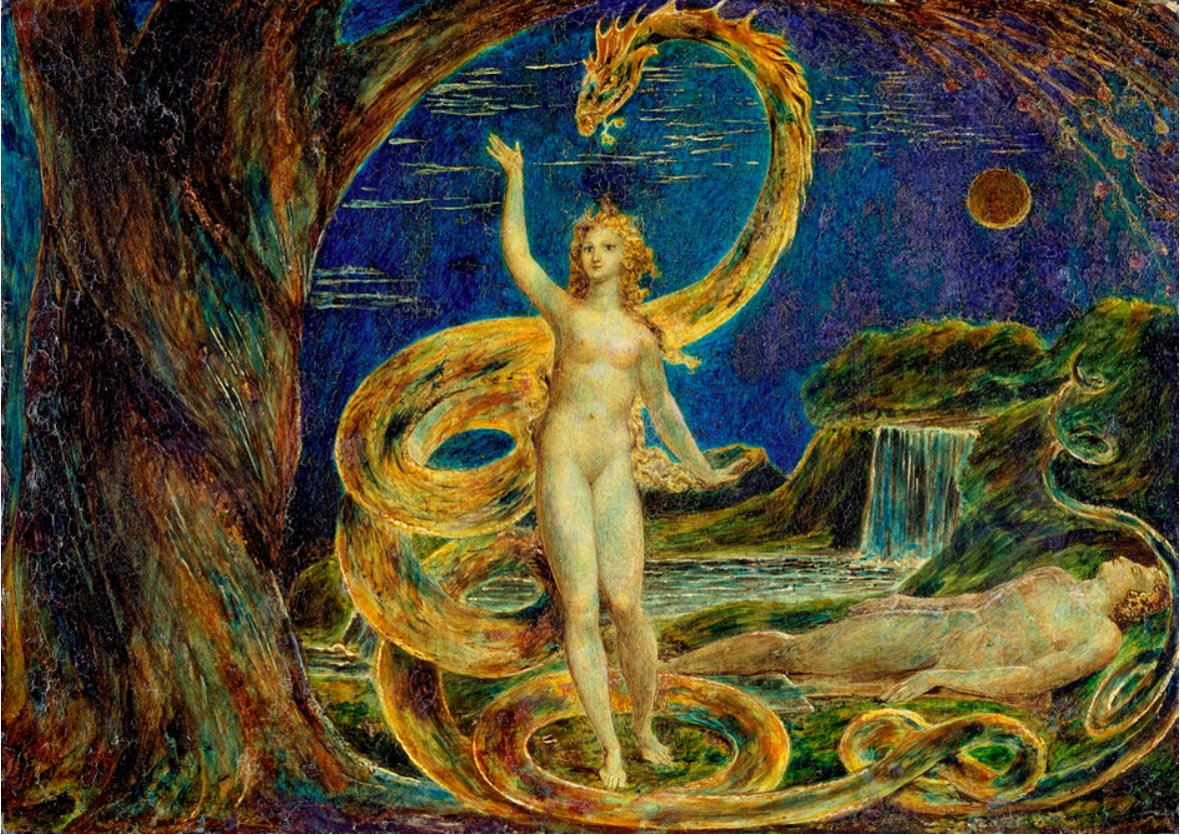
So where did these reptilian people come from?  In Genesis we are told that “the serpent was more crafty than any of the wild animals the Lord God had made.”  Now the Bible does not give us  an actual timeline on how long Adam and Eve were in Eden before they met with the serpent. It seems like one day God was taking a rib from Adam and the next thing you know he and Eve are having breakfast with the serpent.

But after their meeting with the snake, things changed for the worse. Often in life, we meet that one person or thing that can inspire the worst in us. For Adam and Eve it was the serpent telling them the tree in the middle of the garden has great fruit, the very best. “Don’t worry about God. I have a great relationship with God. We get along great and he is doing great things with Eden. God is somebody I can deal with. Besides, He is a great guy.”

“Better to shun the bait than struggle in the snare.” ― William Blake

Christians may call it original sin but I really think it was the original beguilement.  When God created the world, and let us put aside for a moment the old argument of Creationism v Evolution, and assume that God put Adam and Eve in the Garden of Eden. We can all agree it would have been a great place to raise your kids, a sort of nirvana neighborhood. However, the pair got played. After catching the serpent’s art of the deal they went  right over the fence with the “No Trespassing” sign on it. The sad part is Adam and Eve knew they had been conned.  Probably the same way Al Capone felt when he was fleeced for 50 Gees, just like the voters in Wisconsin, Michigan and Pennsylvania who never had any real ring time with a fast con developer who may now be suffering from buyers remorse.

And how did Adam and Eve know they crossed that line?  The found themselves hiding naked in the bushes mending fig leaves together. It would be safe to say that most of us have been found in similar situations only with our clothes on: Caught red-handed at the proverbial cookie jar. Most of us know not to take the boss’s parking spot; don’t eat somebody’s lunch left in the refrigerator. Yet there is always one of us who for whatever reason does not get it. Or maybe, like the snake, they just don’t care. From that time on I think all of mankind has been the subject of being beguiled by slippery ideas and catchy phrases

Today we can catch somebody “red handed,” on tape, live on camera saying exactly  what they did.  God did not need all the technical gadgets used today to catch a thief.  He could see for himself that Adam and Eve were in their new fig leaf attire.  This was not red-handed.  More like bare-assed naked.

The pair did not have cock-n-bull story.  Being innocents they had no idea how to lie their way out the situation. That would be an art learned and honed through time.  And although buses were not around yet,  Adam threw Eve right under the apple cart saying she gave him the apple,  In turn, Eve pointed the finger at the snake.  No loyalty here as we witness crap going down hill by the bucketful. You have to give the pair credit they did not cry and moan or seek legal advice because there was none to be had. (A  fixer would have to come much later.)   They took their eviction on the chin.

However, God went from being a  libertarian to puritanical vengeful God  as in Jonathan Edwards “Sinners in the Hands of an Angry God.”  Adam and Eve lost their interest-free credit card. It was strictly cash. They were now being held “over the pit of hell, much as one holds a spider, or some loathsome insect over the fire.”

In our modern day thinking we are quick to blame the victims and Adam and Eve are not exempt.  How can two people be fooled by a talking snake saying that if they ate from this tree things would be great, they would be perfect. The serpent was able to play on the their vanity and a belief that somehow they were being left behind.  It is not too hard to imagine somebody getting away with selling the Brooklyn Bridge or the Eiffel Tower. After all, the world is full of people trying to sell something bigger and better that glitters in gold.

I play to people’s fantasies. People may not always think big themselves, but they can still get very excited by those who do. That’s why a little hyperbole never hurts. People want to believe that something is the biggest and the greatest and the most spectacular. I call it truthful hyperbole. It’s an innocent form of exaggeration, and a very effective form of promotion.”


As for the snake, he did not fare much better than our pair of innocents. Think about it. What crime did the serpent commit? What are the facts? If you think about it, the snake did not even eat the so-called apple, no proof at all. This could have been the first witch hunt or rattlesnake roundup. I can see the snake now saying the conversation he had with Adam and Eve about the tree of knowledge was perfect, He may have even suggested there was no sort of quid pro quo.  Maybe he complained that God was not on the up and up with the tree in the middle of the garden.  He just suggested that if the pair ate from the tree of knowledge the Garden of Eden would be great. He possibly could turn heavenly opinion around. He could have told God . “Hey God I am really a great guy, very intelligent, brilliant.  I have one of the best brains around.  It is not my fault  Aimless Adam and Eyesore Eve are two not so bright people, ugly people who also are very stupid. There was no real collusion here because they are not very  smart. Besides, they’re no angels.”

All of this brings us back to the facts.  Some say facts are the truth.  Maya Angelou said, “There is a world of difference between the truth and facts.  Facts can obscure the truth.” This leads us to Mark Twain  and what he said that fits today’s world of so-called fake news:   “Get your facts first, then you can distort them as you please.” Or it is your lie you can tell it anyway you want.

The Bible does not record what the talking snake said to God , if anything, after the tree incident. And for sure God would not buying anything the serpent was selling. He condemned the the snake to a life of crawling on his belly and eating dust for the rest of his days.


https://theihs.org/who-we-are/what-is-libertarian/

http://mentalfloss.com/article/12809/smooth-operator-how-victor-lustig-sold-eiffel-tower

“Launch not beyond your depth, but be discreet, And mark that point where sense and dulness meet”


I always have to laugh when comedians make jokes about the inappropriate uncle who opens his mouth and jumps right into the water with the sharks.  He has no idea about political correctness, he is a conspiracy nut and can go on for hours about the Illuminati’s attempt at controlling the world.  In some cases he  just lacks the social graces of correctness: whether it be political or just plain manners.  It could be  something as simple as loudly passing gas at the Thanksgiving table or pontificating his  archaic views on race and gender equity. He is not a person we give permanent markers to.  We would like to assume that during his lifetime he has picked up a little knowledge and avuncular wisdom.  But think about it, despite his claims of being a know-it-all, his accumulation of little bits of knowledge has him  swimming in the deep end without floaties.  In reality this little bit of wisdom and knowledge along the way has made him more of wise ass than a wise old owl.  And this is not necessarily a good thing.

In today’s world of tweets, trolls and bots it may be hard to sort through all the ambiguous forms of  misinformation, fake news and alternate realities. As Steely Dan sings:  “You been tellin’ me you’re a genius since you were seventeen  In all the time I’ve known you I still don’t know what you mean … The things you pass for knowledge I just can’t understand.” Anybody with a social media account and the power of likes can pass along all sorts of “knowledge.”  For instance, any yahoo who sits back and watches a couple hours of  say the Weather Channel’s coverage of a hurricane and looks at a few weather maps may soon feel like an expert forecaster. He has his own mike to the world:  Give me the Sharpie. I’ll explain where this sucker is going.

Alexander Pope: Critic at large
However,  little increments of knowledge over time have moved the ball forward in a lot of areas of our lives.  We have gone from the gravitational pull of Newton’s apple falling to Einstein’s gravitational curving of space. These guys dealt with a lot of knowledge in small but deep depths of the unknown.  Not long after the apple beaned Newton it was Alexander Pope who is credited  with “a little knowledge (learning) can be a dangerous thing.” Pope is attributed this little phrase from his 1709  An Essay on Criticism. Through the centuries this phrase has been interpreted to mean that having a little knowledge on a subject is a dangerous thing, which it is. Sometimes we take it to mean no knowledge.  Actually, it is a little bit of  knowledge that emboldens us to make statements beyond our depth of knowledge that puts us in with the circling sharks.

In today’s world with information so available any idiot can look erudite for a moment. And then it goes off the rails. The world is full of  those with just a tincture of understanding.  They move through the universe with permanent markers and Twitter accounts (and blogs). We can see them  on any episode of America’s Funniest Home Videos, too. We have witnessed the  meticulous and well thought out stupidity of the imbecile making the calculations that will take him from the roof to the trampoline and then into the pool only to end up in the neighbor’s hedges hung up on a fence. And somehow they escape from their idiocy laughing with just an embarrassing bruise. What this proves is that a little knowledge  can be dangerous. Our jumper’s concept of going from the roof to the pool showed that he had a little knowledge on some of Newton’s laws of physics but did not really understand how to apply them.

The CDC 6600: Where is the camera?

Like Newton and Einstein, there are  the people who know a whole lot about something and have spent their lives investigating that little area of knowledge that most of us, present company including, know very little about. It should come as no surprise then that Gordon Moore,  the co-founder of Intel, came up with a law that bears his name in 1965.  Moore said “  the number of transistors on a microchip doubles every two years, though the cost of computers is halved.” Computer capability and speed have increased exponentially.  According to Extreme Tech the first supercomputer, the Control Data Corporation (CDC) was released in 1964. “The CDC 6600 was actually fairly small — about the size of four filing cabinets. It cost $8 million — around $60 million in today’s money.”  And we complain about the quality of the camera and the rising cost of a new iPhone. 

You now might ask, what does this have to do with your wacky uncle.  Well that uncle has more computing power in his fat fingers and capability than say an astrophysicist like Vesto M Slipher.  According to Sonoma State University’s Department of Physics and Astronomy, Slipher directed the Lowell Observatory from 1916 to 1954. This was in an era before supercomputers.  Slipher “discovered reflection nebulae and confirmed the existence of interstellar dust and gas.” Did the universe fart and then slowly left the galaxy several billion years ago and we are just now finding out?  He was also “the first to measure the enormous radial velocities of spiral nebulae, showing that most were receding from the solar system and providing important support for the then-controversial view that they were far outside our Galaxy.”

The spiral galaxy Messier 98 about 45 million light-years is estimated to contain about a trillion stars, and is full of cosmic dust and an abundance of star-forming material.

But wait a minute, here is where a little knowledge can be dangerous.  According to an August article in the Scientific American  “cosmic dust found in Antarctic snow was likely birthed in a distant supernova millions of years ago. The dust’s interstellar journey eventually brought the material to Earth, where scientists discovered the ancient grains.”  As somebody might have said in the 1960s: far out. Maybe these Antarctic researchers found the residue of Slipher’s cosmic fart. More than likely I am way over my head in cosmic swirl.

Right now I am treading into the world of the wacky uncle. Or as Pope writes I am launching out beyond my limits.  I am out in the deep end because I  cannot tell you the difference between a spiral nebula  or supernova.  But there is a way: just “Ask the Astronomer.”  He might  tell you that a  supernova is the passing gas of  a massive star in its final million years of life.  A planetary nebula is result of a low mass star fizzling out.–the cheek  sneak. From what I can gather the cosmic dust bunnies of a nebula can be recycled into, say, a newer star.  But really, what do I know?  I am just a guy with a Sharpie and a brain fart who cannot find a hurricane’s cone of uncertainty.  Or to quote Pope:

Some have at first for wits, then poets pass’d,
Turn’d critics next, and prov’d plain fools at last;
Some neither can for wits nor critics pass,
As heavy mules are neither horse nor ass.


https://pages.experts-exchange.com/processing-power-compared


Click to access Pope.pdf

I know you are but what am I. He called me everything but an American


Douglas was not called a “Red.” Just pink.

It appears that our political discourse of late has come down to playground name calling. Politics has always been about trying to paint an opponent in a poor light. Richard Nixon painted former actress, Helen Gahagan Douglas, as the “Pink Lady” in the 1950 California Senate race for her liberal views and Hollywood connections. In the era of McCarthyism, the moniker stuck and Nixon went to Washington. 

This was the beginning of the Cold War, the atomic bomb and “the Red Scare.” There was a deep seated fear of an international communist take over. Former British Prime Minister, Winston Churchill has already given his “Iron Curtain” speech at Westminster College in 1946. He said that an iron curtain was being built across Europe from the Baltic Sea to the Adriatic Sea.

In Asia in 1949 Mao Zedong finishes his “Long March” and finally chases the Chinese Nationalist off the mainland establishing a communist regime in China. A year later Kim Jong un’s granddaddy charges past the 38th parallel into South Korea. It was time of paranoia. People were finding top secrets stuffed into pumpkins and were looking under their beds for “Reds”. But we have to remember they also were looking to the sky and seeing flying saucers, too. There was no talk about Green Cards for these possible illegal aliens invaders. 

Today, invading Earthbound alien caravans are crawling to our borders.  Inside the border government officials are rounding up illegals.  The increased political chatter is setting social media off like a game of laser tag as opponents paint each other as  racists, Nazi, white supremacists homophobes or some sort of misogynist. Spotting a racist, for instance may have taken more physical observation and at times more difficult. A white robe and a hood could easily hide their identity even when marching in plain site. But nobody questioned their hooded beliefs as being un-American. 

Sometimes one way to tell a  “fellas” beliefs is the stories they tell.  Who among us has not snickered at an ethnic joke at one time or another. The classic joke: “Three men walk into a bar one…” When I was a kid I remember a book in novelty store in the mall called “Race Riots.” It seemed no ethnic or nationality was spared from the one-and-two line jokes. Just admitting that I once looked at such a book (never mind laughing at the jokes) could set me up as a racists today. My Mediterranean heritage, however, would keep me out of the “white supremacist” group, though. Once in the ’80s exiled Iranians took me for one of them. They were calling out to me in what I assume was Persian as I was leaving National Airport in Washington DC. They kept following me with pamphlets about the Shah. I called back to them that “I am an American!”

So who are you and where are you from?

So what is an American. How about the quintessential American guys who wrote the Constitution. I have not made a study of the 55 delegates from 12 states that attended the Constitutional Convention in Philadelphia in 1787. Yes, only 12. Rhode Island chose to sit this out. But I would venture to say that if you asked the delegates to fill out a Survey Monkey describing themselves they may not have considered themselves Americans. They would have more likely called themselves Pennsylvanians or Virginians. If you look at the federated document they produced at that conventions it is laced with “states’ rights.” They guarded their individual state’s interest like a junkyard dog snarling through a chainlink fence. Rhode Island was so adamant about not participating, they were the last to ratifying the Constitution. When they got around to it, it was already a done deal.

So who were these 55 delegates. In the first Census they would have fallen into the category: Free White males over 16. There were no National Socialist at the time and there was no gender gap. In fact, the Constitution did not address citizenship except to say it was up to Congress to determine and not the President. Citizenship back then was based on good old English Common law. Basically, who’s your daddy was and, yes, where did you come from. Which brings us to the modern day chant of “send them back.” If that were the case, most of us would be booking flights back to the old country. But with the grounding of the 737 Max this might take more than an Executive order.  In reality it took the 14th Amendment to define who a citizen was.

Nobody was asking how inclusive this group was. But they did get the job.

Today we have made it a “federal case” on the questions dealing with citizenship–who is an American–being proposed on the upcoming 2020 Census. According to the United States Census Bureau the first Census in 1790 asked six simple questions:

  • The number of free White males aged:
    • under 16 years
    • of 16 years and upward
  • Number of free White females
  • Number of other free persons
  • Number of slaves

It is interesting to note that government was not interested in the age breakdown of free White females, slaves or the ambiguous group of “others.” Were the White males who put the 1790 Census together racists? By 18th Century beliefs no, but by 21st Century standards, probably. Things change.  

The same might be said of the people who put together the 1990 Census where there were 32 questions. Gone are the “other free persons” questions. They were replaced with more specific questions like if somebody was Hispanic or of Spanish origin . They also wanted to know if somebody was lame, lazy or just crazy. Although it was not put in those terms. Question 17 asked if this person has “a physical, mental, or other health condition that has lasted for six or more months and which limits the kind or amount of work this person can do at a job?” Talk about tagging somebody. If the argument can be made that Robert E. Lee was a racist, it could be argued by today’s standards that the 1990 Census Bureau raced passed several “don’t ask don’t tell” questions. If you answered yes to that question today you might have just sunk your future chance to avail yourself of your Second Amendment rights. Forget about that assault rifle you want.  You might not even qualify for one of those rubber suction-tipped bow and arrow sets with the fake feathered headbands.

It just seems like we have come light years from the simple six question from 230 years ago to now. For instance, in 1790 it was black or white, free of slave–and the occasional “other.”  Today questions go deeper dealing with race and native origins. I think Census Bureau computer  might short circuit if it got a response saying a person was a Black Jamaican with  German origins. There might not even a box to check on that one. 

But people want to know more than just the obvious.  I went to a  Miami Dolphin Monday Night Football game once.  The Fins were playing the Bills back in the Jim Kelly and Dan Moreno era.  The Bills owned the Dolphins back then.  My brother and I had to hustle to get to the bus taking us to the stadium after work. We showed up at Joe Robbie Stadium in business casual.  The gal decked out in Dolphin colors that I was sitting next to gave me the evil eye as I made my way to my seat. No small talk. She  bruskly asked, “who are you rooting for.”  She wanted to know who I was.  Because sitting next to a possible Bill fan that night was not something she paid a ticket for.  The Dolphins lost 26-20. It is easy to tell who we are are at a football game.

It is not so easy other times. The way are tagging and slapping coats of paint on each other today we could be many things.  And as one of national motto states:  E pluribus unum  or Out of many one.  Granted, there are some seriously dangerous people lurking around there that need to be called out. One thing we should be called is American.  It will always be easier to label someone as the “pink lady” or a “Red.”  But it seems like we are falling into some sort of national:  I know you are but what am I!


The Phantom Call and Elections: You Make the Call

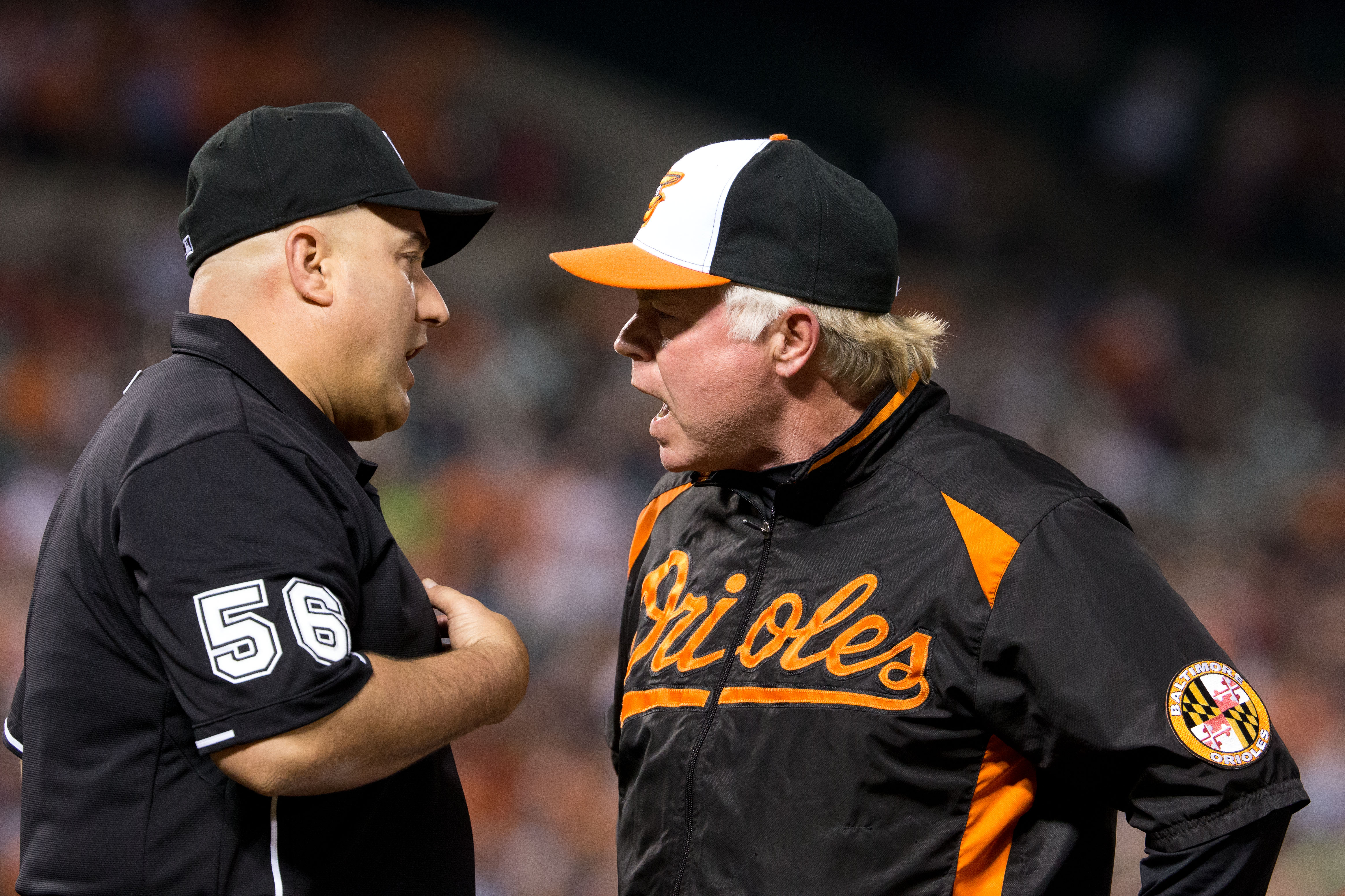
The problem with the Mueller Report, despite what ever Robert Mueller said in his press conference, has left us arguing like it was a play in a sporting event. What we have now are umpires on the sideline debating if a runner was safe or out but never coming to a decision.  It is almost as if the umpires know that whatever call they make they are going to end up ejecting one of the raging-mad manager from the game.  The report did not resolve a thing. If it proves anything, it is that modern day Americans want some sort of closure. We can live with a bad call so long as it looks like it was made judiciously with out some made up excuse like the ball was tipped or I would call the runner out if I could.

For instance, in the 1824 election Andrew Jackson won the popular vote and had a plurality of the Electoral College votes–but not the needed majority. In situations like this, according the the Constitution, the House of Representatives (a great bunch of umpires)  determines who becomes president. It seemed like an obvious call one with plenty of evidence on the ballot to make Jackson the president. But once Henry Clay, the Great Compromiser, became involved it was obvious that Andrew Jackson would be called out at the plate. A botched call. in what was called the Corrupt Bargain.  Thus, giving John Quincy Adams the walk-off Presidency–and giving Clay the Secretary of State position he wanted.  Back then, Secretary of State was the third base in getting to the Presidency.  It was a bad call but one that even Jackson accepted, albeit with retribution to follow.

I’m not crazy, my reality is just different than yours” ― Alice In Wonderland
Today, the polls on the Mueller Report are all over the place: Trumps approval is down; some say Attorney General William Barr mishandled the report; others indicate that most Americans are not in favor of impeachment but want to see the full report. And add to that, the report did not change too many people’s thoughts on Russian interference in the 2016 election. Putin is sitting on the Homeside of the field smiling like the Cheshire Cat. We are living  in an era of self serve.  It started with pumping our own gas and has moved to apps where we book our own flights.  It is now “you make the call.”

This is not a good concept.  The masses, or sports fans, have been known to go on a rampage flipping and burning cars, which is never a good idea.  The main reason we have judges, umpires and referees is to see that the game is played fairly with results we can all agree upon despite disagreeing with the call. Left to our own devices the masses or fans usually have a hard time coming up with an objective call.

Somethings, however, are not supposed to be open ended. We want a conclusion without illusion. I think one reason Americans like closure is because we watch sports.  Sports is on 24 hours a day. There are channels that even show college spring scrimmage games. The University of Nebraska had more than 85,000 fans show up for their spring football game  and maybe just as many sitting in a sports bar watching (this was a team that only won 4 games). There are channels dedicated to leagues, conference and individual teams.  There are now as many cameras on the sidelines and in the stands as there are players on the field.  We get to see those close plays at the plate, we get to see the replays from various angles. But not so with the Mueller report.  We just get to see the sideline arguments on cable news. We do not get to see the redacted version, the replay without slow motion so we end up with “collusion delusion.”

Preacher Roe out bear hunting.
It can be argued that having so many cameras and “slow motion,” instant replay has impacted officiating but maybe not the actual play on the field.  Any avid sports fan knows that bad calls are part of the game. People who played the game know of the phantom tag.  For instance, in baseball if the ball gets to the base before the runner in a bang-bang play, and if it was a good throw, the runner was usually called out even if the fielder “sort of” missed the tag.  There might have been a side comment by the runner as he dusts himself off and heads to the dugout, telling the ump out of the side of his mouth, that he missed the call.  But generally speaking, everybody accepted the call knowing that most of the time the good calls and bad calls even out unlike trying to determine how to call a “hanging chad.” As an old time baseball pitcher  “Preacher” Roe said: Sometimes you eat the bear and sometimes the bear eats you.  The same can be said of politics.  Just ask Merrick Garland.  He never even got on the playing field.

Today calls on the field can be reviewed.  Any fan watching from the stands;  ensconced on the couch; or slamming back a beer at the bar has been subjected to a break in play while an umpire or a referee–maybe two–head to the sidelines, put on the head phones or start looking at an monitor with instant replay trying to get the call “right.”  Most knowledgeable fans of sport will realize if the review was spot on or is inconclusive–that is not enough “evidence,” to use a legal term–to overturn the call on the field.

But what happens when there is not enough evidence to overturn a call.  For instance in the 1800 Presidential election, it was never in doubt who won the election.  It was Thomas Jefferson and Aaron Burr.  But hold on a minute there are no ties in Presidential elections. An election, unlike a football play cannot be replayed. A tie was was not the intended outcome in the 1800 election. Jefferson was supposed to be the president and Burr the vice president.  The Constitution at the time, however,  stipulated that the candidate coming in second would be the Veep.

Despite the intentions, Burr was not conceding the presidency to the Sage from Monticello. This was the first time an election was thrown into the House of Representatives.  It took 30 ballots and support from Alexander Hamilton’s Federalist party to get Jefferson into the Presidential Mansion.  It turns out that Hamilton hated Burr more than Jefferson. To avoid such election reviews the 12th Amendment was adopted specifying who would be president and who would be vice president.

However, the rabid partisan fan will never be happy. It is, as the old ABC Wild World of Sports saying “the thrill of victory and the agony of defeat.” No one wants to loose especially to their hated rival. Burr got his revenge on Hamilton in an 1804 duel.

But in sports, like politics,  a non call is not allowed–or is it? We cannot have two teams arguing on where to place the football or if a hooking fly ball to right field wrapping around the foul pole is a home run or a long foul ball.  We may disagree with the call but as they say in British football (soccer to us Americans) “Play on.” And we do.

No instant replay in 1985
In 1985 the Kansas City Royals were the benefactors of what was a bad call that some St. Louis fans would argue  cost them the World Series. It is not so much it was a bad call but more about when the bad call takes place.  In this case it was in the bottom of the ninth inning, the Royals down 1-0; game six  with the Royals one game down in the series   The Cardinals were three outs away from being world champions.  The Royals send up pinch hitter, Jorge Orta. He hits a squibber in-between second and first. Both the first and second basemen are going for the ball.  Jack Clark, the first baseman fields the ball and throws it to pitcher, Todd Worrell, who is on the run covering first base, something that is practiced over-and-over.  It was a close bang-bang play; and in sandlot baseball the saying is: Tie goes to the runner: play on.  In this case instant replay showed it was not a tie and that Don Denkinger, the first base umpire, missed the call.  There was no review and no appeal despite instant replay showing that Orta was out by less-than-a-half-a-step . The Cardinals complained from the dugout but as the British say: Keep calm and play on.  The next night the Royals slapped around their instate cousins 11-0 winning the World Series.

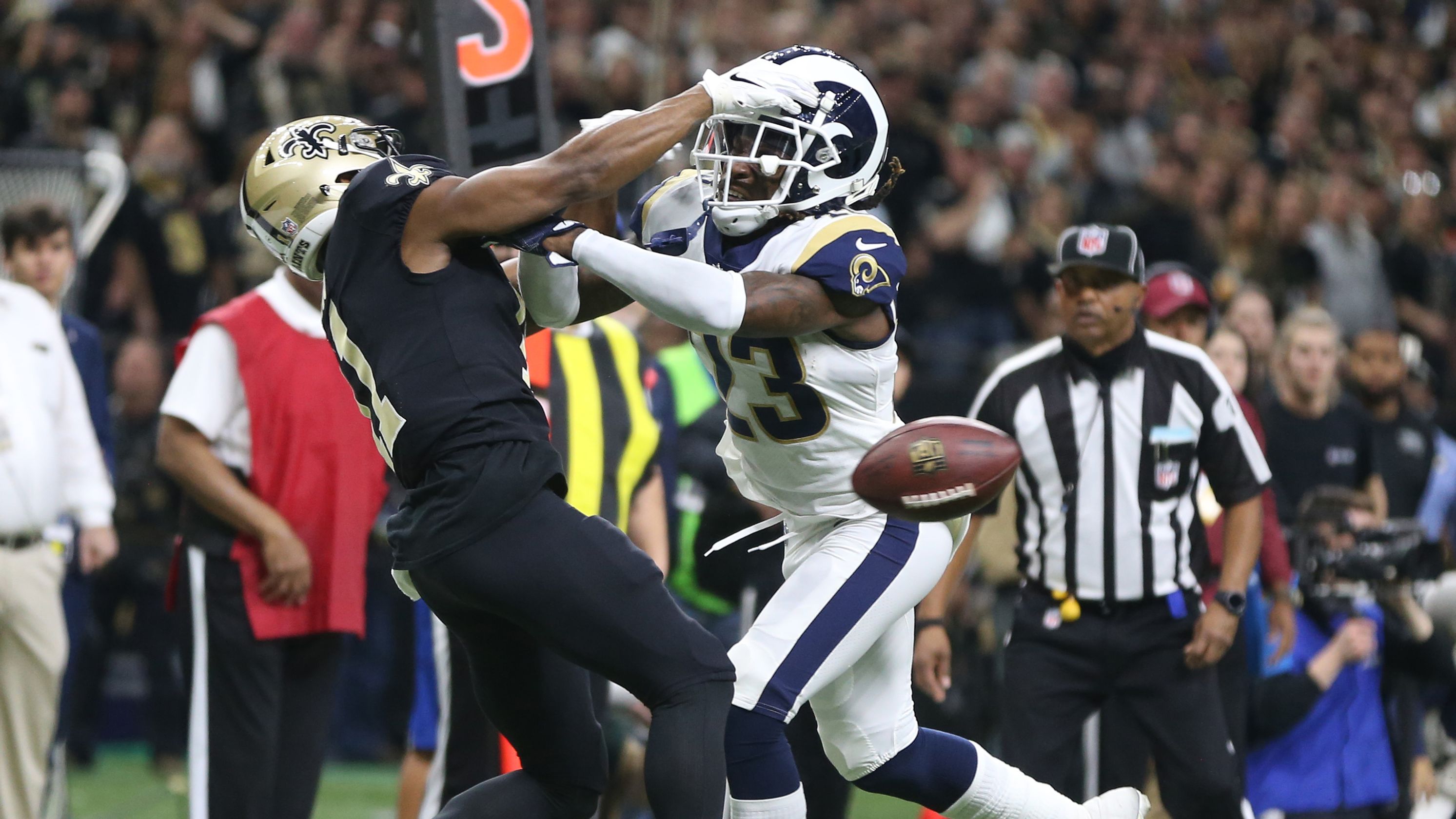
But a more recent call with national championship implications and reverberations was the NFC Playoff game between the St. Louis Rams and the New Orleans Saints.  Again, a close game. It was a tie game, 20-20, with 1:49 left in the game.  The Saints had a third-and-ten on the Ram’s 13-yard line.   Saints wide receiver, TommyLee Lewis was running a wheel route and was wide open inside the five-yard line;  Drew Brees sees the open Lewis heading towards the goal line. The pass  never made it to Lewis.  Ram’s cornerback Nickell Robey-Coleman was beaten and did what any cornerback in the NFL would do when beaten on a play that has touchdown written all over it: he mugged the receiver. If what followed happened in Walmart parking lot Robey-Coleman would have been charged with battery. He was not even charged with disorderly conduct as no flag was thrown on the play.  Without a doubt this was an obvious pass interference call. And a play that was not reviewed.

No call is better than a bad call?


The Saints, like the baseball Cardinals,  played on. They kicked a field goal but ended up losing in overtime 26-23.  For those in New Orleans it may have felt as if Mardi Gras had just been canceled. The NFL, however, “played on”: the Saints went marching out.

The Mueller report has been subjected to some real biased officiating leaving the American public unsure what the call really is.  It is not unusual in most sports to see officials gather around to get a call right. Much like the 2000 Presidential election where judges, legal experts, political hacks and pundits gathered and haggled for a month in an attempt to decide what a hanging chad was and ultimately who won the State of Florida’s electoral votes, and hence the presidency. It took the Supreme Court to put on the headsets and go to the monitors and review the vote.  The election stands with George W. Bush winning by less than a half-of-a-step. A lot of people hated the call but they lived with it.  We played on.

Today we are in situation where both sides are now calling balls and strikes; deciding where to place the ball on the playing field.  I even think some people have  been adding extra balls onto the playing field leaving us to argue about which ball is actually the game ball.  All this despite senators bleating from the stands: “case closed.” Until somebody comes out and makes a definitive call on the Mueller Report the 2016 election will always be a phantom call.  It took a disappointed Al Gore to say enough, the ”partisan rancor must now be put aside.” But for now the Mueller Report will remain a  “you make the call.”


https://www.mlb.com/news/don-denkinger-players-recall-blown-call-in-1985-world-series/c-99040244

https://www.sbnation.com/nfl/2019/1/20/18190891/pass-interference-rams-saints-nickell-robey-coleman

https://www.cbssports.com/nfl/news/rams-saints-ends-with-ugly-pass-interference-no-call-heres-the-simple-fix-for-the-nfl-going-forward/

A Crowded Field a Muddy Track


photo NBC Sports
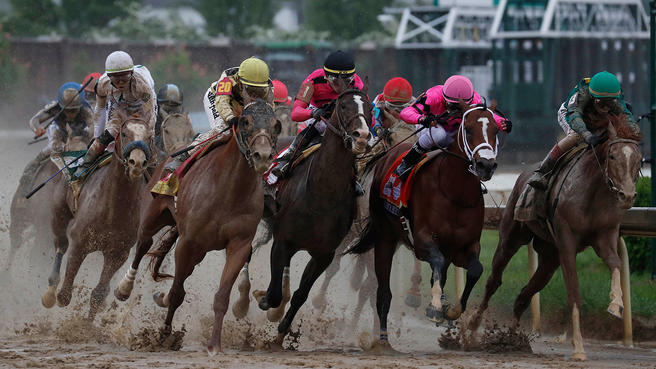
2019 Kentucky Derby Photo NBC Sports

The Democrats could learn a thing or two from the 145th  running of the Kentucky Derby–and possibly the GOP 2016 Presidential Primaries. Both races were run with a crowded field and a on a sloppy, muddy track.

The crowded Democratic field just got a front runner now that former Vice President Joe Biden officially joined the mob of hopefuls lining up like jockeys looking for the starting gate at Churchill Downs. The crowded Derby field and sloppy track conditions made for an exciting Kentucky Derby but track stewards had to adjudicate the race when the leader and favorite, Maximum Security, jumped lanes causing chaos among the field which lead them to disqualify the winner and name a long shot “Country House” the winner.   It was a tough call even using instant replay.  At least in football and baseball there are lines and definitive bases to be touched.  The Derby was a mass of equestrian flesh doing a mud-running-slide dance to the right.  It was first time in Kentucky Derby history that winner was disqualified.

But just maybe the race was similar to the 2016 GOP Presidential Primaries except without instant replay.  It would be an understatement to say that most people were mystified to see Donald Trump break from the pack and win the GOP Derby. Some may have considered his campaign a swerving mud-sliding race. It held up and he was able take the national race, too.

2016 GOP Presidential candidates looking for the starting gate. Politico

It could easily be argued that in the 2016 Presidential race there was no Secretariat running. One of the greatest races horses ever, Secretariat, won the Derby in 1973 with the fastest time ever: at 1:59.4. In that race “Big Red,”  Secretariat’s affectionate nickname, was challenged by Sham. Sham came in second and finished the race under two minutes, a time that would have put him in the winning circle in just about any other Derby.  Two weeks later Secretariat won the Preakness Stakes and then set another record at Belmont’s mile-and-a-half race winning easily by 31 lengths. No question about who won that race.

Unfortunately  for us, the last couple of Presidential races have not featured a Secretariat or a Sham. To make matters worst the upcoming political race can be counted not in minutes but days–more than 500 days. November 3rd 2020 is when we cross the finish line. The race for the Triple Crown takes about a month.

There are a lot of things that I am interested in.  Most of the time I know very little about them. But that does not keep me from acting like a know-it-all. For instance, I know very little about horse racing and its sister activity gambling. Two things I am clueless about.  I once read the book Seabiscuit: An American Legend.  I also saw the movie.  That would hardly make me a handicapper at the next Preakness.  I have been to one race track and have seen the ponies run–and a wiener dog race, too!  I even looked at the racing program It made me feel like a parakeet looking at himself in a mirror.  It was the closest thing to hieroglyphics without needing a Rosetta Stone published in the modern world.

I looked a plethora of coded racing information buried on those pages.  Information from previous races, winnings that also included  track conditions and when the last time the horse was exercised.  I am sure somewhere in there it had what the horse ate for breakfast. Some sort of oats I would assume.  To a novice  bettor only three things really stuck out in my mind: the name of the horse, the number of the horse and of course, the odds.  The only real information in the program that I could somewhat understand and that made any sense to me.

As I perused field prior to the running of the Kentucky Derby the name that jumped out at me was Long Range Toddy. He was running in the 18th position with odds 50:1.  I would think those odds are in the deep end of the betting spectrum  and equivalent to high risk junk bonds in investing–something else I know little about.

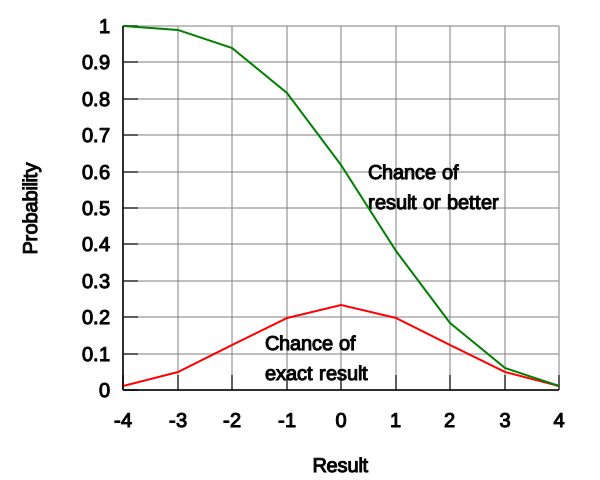
This leads me to another area of interest: math. My understanding of math is limited. My cursory knowledge of odds and probability comes from math classes with the classic flipping a coin or rolling one die. Two dice becomes a bit more complicated and can be likened to juggling with three or more objects–something I have not mastered.

Green line “Go!” Red line “Stop!?” Go figure.


How horse racing odds are originally set is beyond me. I do know that the odds eventually come down to how much money people are betting on one horse compared to other horses. The more money bet on a horse the lower the odds and the lower the payout if the nag wins.  It all seems very democratic, sort of a peoples’ choice. A real money is free speech movement without Citizens United and the Supreme Court. The bettors set the odds. In the case of Long Range Toddy I would assume that people were not really that confident about where he will finish after running 10 furlongs.

This brings me to a furlong. What the hell is a furlong?  According to Britannica, a furlong is “old English unit of length, based on the length of an average plowed furrow.” Really.  So the distance of the race is going to be based on the average length of what a plow horse plodded back in the time when King John was signing the Magna Carta, which was 1215 for those scratching their heads on that one.

No track records being set here.

Not being a plow boy I had no idea that a furrow in Merry Old England in the Feudal era was 40 × 4-rod acre, or 660 modern feet. Here is where I get a bit confused because most corn fields, wheat fields that I have seen are square and most race tracks are round. This brings me to the question of how that translates to the oval track at Churchill Downs.  Did somebody square a circle in making 10 furlongs a mile-and-a-quarter round-about. If so, shouldn’t this sort of think be studied in school.  Who gets credit for rounding the square? Is this similar to what we learned in elementary school about Ben Franklin and electricity? Or is it more like the Electoral College, which is not an institute of higher learning, but more of  the racing stewards of elections.  The scholars wizards that ultimately decide who wins the race after all the people have laid down their bets. Or is that the Supreme Court?

This brings me to politics.  A different kind of horse race. The more I read and see the more perplexed I get. There is nobody yelling “Get your programs! You can’t tell the candidates without a program!” But even with a program I doubt if I could tell one candidate from another. We should give them numbers and fancy jockey uniforms. But rest assured, any political program would be just as confusing as watching Fox and Friends and then turning to Rachel Maddow. Are we all seeing the same race?

Say what you will about racing programs there is a consistency to the information lodged in those pages. In some ways, though, candidates  have their own programs. They come out in hardback, paperback, Kindle and Audiobook editions.  I am not sure how many people plow through or listen to these “why me now America” books. But what I have decided is that I will pick my favorite candidate by the title of their book.  It is the same way I pick races horses: by their name.

After looking at some of the books candidates have written it is no wonder Donald Trump won in 2016.  His book by far had the best title: The Art of the Deal.  The perceived front runner at the gate was Jeb Bush but his book was Immigration War combined two objectionable topics. Immigration is always an American hot button topic in any time.  War?  The war part reminds me of FDR’s 1936 where he proclaims that he hates war “Eleanor hates war, and our dog, Fala, hates war.” Jeb! that dog just didn’t hunt.

Trust in me, just in me.

And Ted Cruz’s book was even worst: A Time for Truth. Really? From a politician, truth? I hate to say it but if Trump got one thing right it was his moniker for “lying” Ted Cruz.  I am not sure how Ted even qualified to run in that race. Wasn’t he a Canadian?

Another candidate that should have been scratched from the field from the get go is Ben Carson.  Suffice it to say I am not going to go into all of  Carson’s books but I think the 2015 book, “A More Perfect Union,” was phrase already taken. No originality at all.  And after seeing Lindsay Graham’s book, “My Story,” I would ask who would really wants to know his story. When I see Graham I cannot help but think of  James Louis Petigru’s  Antebellum era statement:  “South Carolina is too small for a republic and too large for an insane asylum.”  Sad to say but Petigru was a fellow South Carolinian.

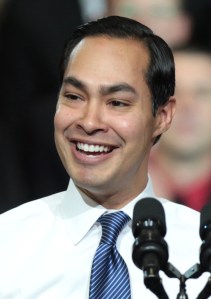
Julian Castro may be smiling now but it may be a very unlikely race.

I feel the Democrats are headed in the same direction as the GOP and the Kentucky Derby. After  looking at the names of some of the books I have to wonder who will run wire-to-wire.  I think I will play a long shot with Julian Castro with “An Unlikely Journey.” I hate to say it but after watching the 10 furlongs of the last Kentucky Derby it sounds like the next 500 days will be an unlikely journey.  But the title also sounds very Tolkin.: “The Hobbit” or There and Back Again.”  Who could not find inner strength from that brave Hobbit Bilbo Baggins.

“Where We Go From Here.” Yes , Bernie Sanders  follows up that phrase with “Two Years in the Resistance.”  This sounds like we are in the French underground fighting Nazis.  And maybe we are and I just don’t know it. But if we are,  I do not want my cause sounding anything like a question. The phrase where we go from here sounds too much like Bugs Bunny saying “I should have taken a left turn in Albuquerque.” Some think Bernie has already turned too far to the left.

Sorry Elizabeth Warren.: “This Fight is Our Fight.” I am curious about “our” in this.  I think it really means “your” as it being my fight. For those of us old enough it smacks of the 1970 TV show Chico and the Man with the late Freddie Prinze’s familiar quote: “It’s not my job man”; I get the feeling that we will get more of the fight than we signed up for. Tell it to the Marines, Lizzy. We need something more Churchillian like: Deserve Victory or (Let us go) Forward Together.

My other long shot favorite is Kristen Gillibrand’s “Off the Sidelines.” Unlike Sanders and Warren’s book titles this one sounds more like getting into the game than fighting a war. It also reminds me of being on a team:  put put me in coach.  Everybody wants to be in the game.  There are not many of us who want to ride the bench or be in the “Resistance.” What you resist persists.

Other books that won’t run are Beto O’Rourke’s “Dealing Death and Drugs.” That smacks of street gang movie that has been done many times. It’s a no brainer.  John Hickenlooper’s alcohol tinged book gives way to the Days of Wine and Roses:  “The Opposite of Woe.”  I am pretty sure I would not put any money on that horse especially with  “My Life in Beer and Politics” behind it. That sounds more like the follow up to Bret  Kavanaugh’s “I like beer” speech to the Senate Judiciary Committee. Peter Buttigieg’s “Shortest Way Home” sounds like a short cut there are no short cuts on the race track. Its a circle and everybody is going the same way from the same spot to the same ending.  You stay in your lane and you do the 10 furlongs.  Besides it sounds very Nixonian to me.  “Just get in the helicopter Dick.”

Finally, there is the front runner Joe Biden’s  “Promise Me Dad.”  I just have a feeling like Maximum Security, Joe Biden is going to end up out of the money, beaten by a Country House candidate running at 65-1. I am not sure if Horse racing has finally caught up to Presidential racing or the other way around. It’s a time where the winner or the favorite is the loser. Oh, and Long Range Toddy was way out of the winning come in 16th a long range off the lead.


Birthday Greetings Bottle of Time

Moving the clocks forward to Daylight Savings Time, and a couple of  recent birthdays in my family, made me think of how we as humans try and manipulate time. Man has always tried to coordinated the past with the present and on off into the future. What started out as the ancients watching the phases of the moons and stars; or dragging boulders around to see what kind of shadow was cast by the sun, ended up in creating various sorts of cosmic calendars used to measure large chunks of time.  The problem with early calendars is they were probably not very portable and they were out of whack with human concepts of time compared to celestial events.

It is this movement through time across space that has caused us problems.  It seems that our human activities, such as birthdays are slightly out of sync with the cosmos. According to Stanford University Gravity Probe B “space consists of 3 dimensions, and time is 1-dimensional, space-time must, therefore, be a 4-dimensional object.”  First off I have never looked at time or space as objects. Space by definition is “unoccupied”, hence empty. Oxford Dictionary has one definition saying space is “dimensions of height, depth, and width within which all things exist and move.” I guess all things would include time.

And this does make some sense when we look at sayings like “out of time” as if it we were to say we are out of sugar. Then there is “times up.” If time is up it must have been moving. And we also have a human concept that there is finite amount of time when we say we are “wasting time” as if time were a rotting banana in fruit bowl. It gives you the idea that time is some sort of commodity that can be bought and traded but not touched, much like a bitcoin.

Time is money. A Bitcoin is worth $4,000. So what is time worth?
Here is where it starts to get hairy because physicist  believe time is a continuum  with “no missing points in space or instances in time.”  Okay. So let’s add another wrinkle in time.  They also, “consider our world to be embedded in” a 4-dimensional continuum “and all events, places, moments in history, actions and so on are described in terms of their location in Space-Time.” Are events then marked like yard lines on some never ending cosmic football field?

This is heavy-duty since I was having a hard enough time advancing my personal Space-Time Continuum ahead an hour with the shift to Daylight Savings.  I have a hard enough time following a 1 dimensional line so dealing with a 4 dimension is a big “Ugh?”

All of this is more than I can fathom.  I would assume a simple calendar is a 1 dimensional depiction of linear time.  It made me think about one of my daughters and two sisters’ birthdays. Two are graced with having Leap Year birthdays and another was born on the 13th.

The 13th is unique because of its association with bad luck. It really has nothing to do with a calendar or the Space-Time Continuum except some mathematician has calculated past Fridays the 13th and projected on when future Fridays the 13th will occur.  As a bad luck event, I know my sister has celebrated ten Fridays the 13th.  As far as I know nothing truly evil has befallen upon her.   It is entirely a human “thing” and unfair to say that when one day of the week and a number sync on a man-made calendar it is the cause of anything–good or bad. It is just plain absurd.  I would assume that Friday the 13th really is just like any other event embedded somewhere on the 4 dimensional space-time continuum with any other numbered day.

The burning of the Grand Master of the Templars and another Templar. From the Chroniques de France ou de St Denis,
Some historians or “calendarists” for the lack of a better word, traced this “bad luck” event back to the year 1307, October 13th, a Friday. King Philip IV of France decided to raid the temples of the Knights of the Templar in search of supposed Templar riches. In reality it was only bad luck if you happened to be a Templar in the 12th Century and not somebody born decades or centuries later. (And for those interested the last time Friday the 13th fell in October it was in 2017. The next time this will happen is in 2023. Yes, somebody sat down and figured that out. ) 

It was also a time of Medieval reasoning. There was a belief that the Earth was flat and possibly one-dimensional.  It was also believed that if you tortured somebody long enough you would ultimately get to the truth–the truth as you wanted it to be. Templar Knights were subjected to the rack, strapaddo and having their feet slather with lard and then put over an open flame in an effort to find the truth; or in this case where the Templar treasure was buried. Those that did not confess after all of this to their alleged crimes were eventually burnt at the stake. And no doubt at this point on their personal time continuum they wished desperately to be at some other point on the Space-Time Continuum. So yes, Friday the 13th could have resulted in a long day for those who wore a white mantle with a red cross on it. Somehow the day and number has stuck. Where on the space-time continuum I could not begin to say.

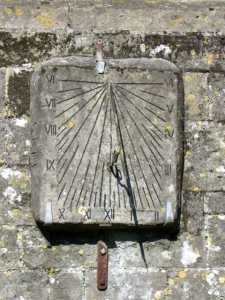
Sundial on the south wall of St Mary’s Church near Kilmington, Wiltshire, Great Britain

But that was a time before Rolex or Timex.  The sundial was more common.  People would simply look up at the sky, particularly the night sky to check out the phases of the moon. I am sure the Mayans and Egyptians paid a night watchmen to chisel in his nighttime observations on some sort of Rosetta Stone  every night as to what the moon was doing. The problem is while the moon was doing its thing so was the sun. Their celestial dances looked to be in step, but they were fractions of a beat off; and like two dancers starting off on the wrong foot it would take some sort of bunny hop to get them back in step.  Today, that bunny hop would be adding a day to a year every four years.

The problem really centers around man’s fixation on controlling and syncing  cosmic events to earthly events.  According to infoplease.com”the purpose of the calendar is to reckon past or future time, to show how many days until a certain event takes place—the harvest or a religious festival—or how long since something important happened.”

This brings us to Leap Year. Now it is not my intent to make sense of how we keep track of the days of the years or  how gravity can bend time and if you slingshot around the sun you will be in time warp–according to Captain Kirk. But just think about trying to sync all of your computer components. It seems simple.  Instructions for most technical fixes today start with going to Settings. But I doubt very seriously that today’s astronomers looking deep into space will find, tucked away in some far off galaxy,  a universal Settings App or restart button that allows for an earthly/cosmic reboot.

So we have an earthly rebut every four years. In this case February 29th. Past calendars based on the moon or a lunar calendar, which is little more than 29 days and adds up to a 354 day year is right off the bat 11 days out of sync with the solar year which measures time between vernal equinoxes; or just a tad more than 365 days. What to do with 11 days?

Lunar calendar counting days from New Moon to New Moon.
All of this created havoc, particularly with the Romans, who had an empire to run and could not let a simple thing as days of the year get in the way. Trying  to keep track of various earthly events tied to a lunar cycle became a complicated mess for the Romans as they added or subtracted months and days to the calendar trying to keep spring festivals in spring and not in fall. It is sort of like having Major League Baseball’s World Series slowly sliding into January and the Super Bowl running into June.  Additionally, the Romans were a superstitious group and felt that months ending in even numbers were bad omens.  Hence, their months could easily be 29 or 31 days long.

Julius Caesar came up with a fix  but his calendar still needed yearly tinkering to keep the seasons straight. But still, it was somehow running like the Foxtrot:  slow, quick, quick, slow over time.  In an attempt to get things on track Pope Gregory XIII  introduced his calendar in 1582.  This calendar  synced time with astronomical events tied to vernal equinox and the winter solstice.  This is the most widely used calendar today but it still caused some problems particularly with its implementation. It went from a bunny hop to a kangaroo hop.


An ancient Mexican calendar.

The major problem occurred in the past with the shift from the Julian Calendar to the Gregorian.  Ten days had to be hopped over or dropped from the calendar in 1582. In 1752 when England switched to the Gregorian calendar it lopped off 11 days to catch up with the rest of Europe.  They did this in in the beginning of September. Those people who were expecting a birthday or a payday between September 2nd through to the 14th were out of luck as those days were simply gone.  But were did they go?

And how has all of this  adding and subtracting affected where we really should be on the Space-Time Continuum. Did the Space-Time Continuum also shift or were these days sucked into a black hole and shot out through a wormhole into another universe or dimension. Did some alien race just find itself with an additional 10 or 11 days on their calendar? The question I have is how out of sync are we from the Space-Time Continuum? All of this tinkering with days of the year makes me wonder if February 29th really is February 29th. Could it be September 31st? Is there a possibility that we has humans are running behind or ahead of some sort of Universal clock and calendar–and how would we know?

Despite having the ability to chuck three astronauts towards the Moon at 24,ooo mph we are still moving pretty slow compared to the 186,000 mph that light travels.  In time and reality we are traveling through the cosmic world no faster than our ancestors and we are  still syncing the human concept of days of the weeks with a clock that runs slightly off kilter with a solar year.

Calendars are nebulous man-made creatures.  They are based on celestial occurrences; but does that sync us to a 4 dimensional Space-Time Continuum?  I guess this is something for some future physicist to figure out.  That is if a near space object of substantial size impacts with the Earth and sends us back into the Neolithic age where we can start gazing at the night sky trying to figure out what day of the week it is.


https://einstein.stanford.edu/content/relativity/q411.html

https://sciencing.com/difference-between-lunar-calendar-solar-calendar-22648.html

https://www.historic-uk.com/HistoryUK/HistoryofBritain/Give-us-our-eleven-days/

https://digitash.com/science/physics/the-geometry-of-the-fourth-dimension-and-the-space-time-continuum/

https://www.britannica.com/science/Egyptian-calendar

https://www.infoplease.com/calendar-holidays/calendars/history-calendar

http://mathforum.org/dr.math/faq/faq.calendar.html

https://www.timeanddate.com/calendar/julian-calendar.html


“Follow the Money”


Forget the collusion, if Watergate taught us anything  it was: Follow the Money.

“It’s money that matters in the US A”

It is sad to say but America is due for a big-time governmental/economic scandal of tsunami proportions. And whatever happens in the next couple of years can very well be one of seismic proportion.  Like most scandals, the next one could push the political process until it is flooded with ethical questions on government and making money.  Of course, this  is not new to America. It’s what Americans do. Push the boundaries until they snap.

Political scandals seem to roll around every 50 years or so.  What may start out as easy money in a  get-rich scheme usually turns into a Hansel and Gretel investigation of greed, which becomes a follow-the-money trail; but to those being followed it may seem like a “witch hunt.”

For instance, the United States was experiencing great growth after the Gold Rush in 1849.  Shortly thereafter, the term “Go West, young man, go West” was coined. Early pioneers went west on the Oregon Trail, a slow and a fatal trip for some. In the 1860s Horace Greeley would add to the phrase “and grow with the nation.”  But spreading Manifest Destiny via oxen driven wagons was a slow go–west.  The need for speed was apparent and wagon trails just did not meet the need.

Despite the country splitting apart fighting a Civil War,  Congress in 1862 passed the Homestead Act.  This act encouraged people to do just that:  go west.  It allowed any citizen to carve out 160 acres of public domain land and own it if they toughed it out for five years. The ultimate and probably the first no money down and zero interest deal (without a balloon payment). But farmers were not the only ones competing for these lands.  So were the newly growing corporate giants: Railroads. But their deal was a whole lot sweeter. 

Land grants to railroads started in the 1850s with the government paying railroads tens of thousands of dollars per mile to build roads, which was as good as gold to some.  The Civil War did nothing to slow this down.  In fact, with the South out of the Union, Southern opposition to northern routes was gone. It could be said that the need for speed increased as quickly as Southern states left the Union.

There is some room to  argue that railroads had played an indirect role in the start of the Civil War. Slave owners would have corporate competition for federally owned Western land and some serious “Yankee ingenuity” to contend with developing the lands. It is believed that Sectional interest on what a transcontinental railroad route should take: a southerly route out of New Orleans and through Texas and on out to San Diego;  or a more northerly one leaving out of Chicago to Sacramento. All of this just added to the fuel of the free-state slave-state balance-of-power that played into just about every government decree made; starting with the approval of the Constitution, which when simply put, was how to ensure slavery as a viable economic system well into the future.

Once the South  decided to seceed from the Union, with the belief that cotton was king, and that an enslaved workforce would generate the needed money to fight a war against a growing industrial giant, they simply forfeited any opportunity to profit in the upcoming land grab and industrialization the Gilded Age would have to offer. During this time, and into the post Civil War era, the government would give away  more than 155 million acres of land, or almost a one-third of the Louisianan Purchase.  And just as important as the land in all of this were government bonds issued to various railroads and construction companies as well as corporate stocks and bonds issued by the railroads to link the Atlantic and Pacific Coasts. These stocks and bonds could be offered to willing speculators and officials at “very attractive” prices to get the trains rolling. However, not a penny of it went to enrich or perpetuate slave owning.

When Congress passed the Pacific Railway Act in 1862, it created a race between the Union Pacific heading west from Chicago and the Central Pacific building east out of Sacramento in an effort to connect the country on a string of metal, in a 19th Century equivalent of the  Space Race that would take place 100 years later on who would get to the moon first.

Upfront construction costs had to be covered to attract investors and get the trains rolling.
The real problem was not only engineering. It was financing and getting investments for a project that was not going to return quick profits in a large amounts. Just like going to the moon,  the government was funding this coast-to-coast race. Building the railroads, like building rockets,  incurred a lot of upfront costs with very little upfront profit to attract investors.  There was no real investment infrastructure developed to build something of this size and scope.  If there was good ole American engineering know-how taking place on the construction site, there was also skillful financing taking place back East to keep the money flowing. Stocks and bond offerings and huge dividend payouts were issued and exchanged to keep money moving –even if the trains were not.  Despite government backing, the problem was always raising the needed funds. Providing the short-term profits that would create dividends to attract investors was crucial. It has been said that accounting is more of an art than a science. The principles of accounting can be as flexible as the times allow. Just look at Enron.

Never indicted, future President James Garfield took stock options that some say was a bribe.

To solve the problem The Union Pacific created the Credit Mobilier of America, a conduit to show a profit. The company was basically the Union Pacific’s private construction company that could show a construction profit despite the fact that the Union Pacific losing money. By separating the Union Pacific from the construction it still owned and controlled the construction company, Credit Mobilier. A viable company the Union Pacific could use to attract investors.  The Union Pacific could sell its and Credit Mobilier’s stocks and bonds, set up towns and sell the lots as well as sell the land granted to it from the federal government.  Nothing illegal at the time. However, Credit Mobilier also allowed the Union Pacific to divert funds from its construction company to pay dividends, sell stocks and bonds below par as a way of lining the pockets of Union Pacific’s directors and stockholders–who also owned Credit Mobilier and its stock.

To keep the rolling stock wheels greased it was important to keep Congress greased of the possible profits to be made as well with Union Pacific stocks. In an effort to keep the construction contracts coming close to  a dozen members of the House of Representatives, including the Speaker of the House, and future president James Garfield along with the sitting Vice President were buying Union Pacific’s stocks and bonds below par. As Massachusetts Congressman Oakes Ames, who was heavily invested in building the railroad, and one of its chief financial wheeler and dealers said, he wanted the stocks  “to go where it will do us the most good”: Congress.

Former Speaker of the House and Grant’s Vice President, Schuyler Colfax was accused of taking $4,000 in cash stuffed in envelopes.
In September of 1872, the birth of muckraking journalism was taking place.  The New York Sun opened up the scandal with a headline: “The King of Frauds.” This was the Gilded Age where government oversight was a concept; a time of little or no governmental banking, ethics, policies or regulations; a time when Jay Gould almost cornered the Gold Market. It was a time when Boss Tweed and his ring were ripping off New York City for millions and  “scalawags and carpetbaggers cashing in on Reconstruction.

Soon, journalist soon began asking questions about the financial comings and goings of the era.  The Union Pacific’s business practices came into questions.  In the end, the Union Pacific and Credit Mobilier fraudulently overcharged the government close to $50 million dollars, which in the Gilded Age was good business and not a crime.  It may have been hard to tell where the Union Pacific ended and Congress began.  No laws were “really” broken and only two Congressmen were censured for their profit takings.

It was during this era that the Grant Administration was hit with another scandal, The Whiskey Ring. This one actually lead to indictments  and convictions for manipulating whiskey taxes.  But it was the Teapot Dome Scandal 50 years later that saw the first Cabinet member jailed: Secretary of the Interior Albert Fall.

Here again, the country was making a shift in technology.  It was moving away from coal to oil. In 1910 the US Navy was converting its warships to oil.  Congress passed the Pickett Act that allowed the President to set aside land so that the Navy would have a reserve source of oil. The scandal gets its name from the Teapot Dome Rock in Wyoming near where the oil deposits were located.

A 1900 era Battle ship could burn 10 tons of coal in an hour.
 

One of the problems that plagued President Warren G. Harding was those he surrounded himself with. His campaign manager was twice investigated for federal corruption and the head of the Veterans Bureau was once found guilty  of bribery and corruption.  These “loyal” but shady characters may have had private monetary agendas in pursuing their public service.

Maybe a storm warning flag should have been hoisted up the Navy Department’s mast when Secretary Fall convinced  President Harding to transfer Navy oil reserve lands in Wyoming and the Elk Hills in California to the Interior Department. Once under Fall’s control, he leased the The Teapot Dome oil reserves out to Harry F. Sinclair’s  Mammoth Oil Company, which was a subsidiary of Sinclair Oil Corporation.  He also leased the Elk Hills oil reserve to Edward L. Doheny’s Pan American Petroleum and Transport Company, both in non competitive bidding.

Secretary of Interior Albert Fall personally cashed in on leasing oil lands
 

Oddly, leasing the lands was not illegal under the Mining Act of 1920. The real problem with these sorts of scandals is creative art of accounting and somewhere somebody is left out of the deal.  It only takes one disgruntled individual, in this case a left out oilman to start following a money trail of  illegal interest free loans and bribes that Fall received as compensation for his generosity to Sinclair’s  Mammoth Oil Company and Doheny’s Pan American Petroleum and Transport Company. Complaints ended up on the desk of  Senator Robert LaFollet who was chairman of the Senate Committee on Public Lands. What set the investigation off was the ransacking of LaFollet’s office. A sort of reverse follow the money investigation.

A Senate investigation revealed that Fall’s sudden increased standard of living was a bit too much. Fall, in the short time as Secretary of Interior, received more than $400,000, which is about $5 million in today’s bucks in interest free loans, cash and bonds. Something he may have gotten away with in the Gilded Age but not so much even in the Roaring Twenties.

Fall was eventually convicted of accepting bribes and paid a $100,000 fine and served nine months of a one-year sentence. Oddly his benefactors, Sinclair and Doheny were acquitted of such charges of criminal conspiracy and bribery.  However, Sinclair did spend more than six months in jail for contempt of court and contempt of the Senate.

Moving on from the Roaring Twenties to the turbulent times of Peace and Love brings us to the whopper of all scandals: Watergate.  Unlike the previous scandals that enriched those in power, Watergate was more about enriching the political power of those already in power with overwhelming amounts of cash to remain in power.  As journalist and Watergate investigators started following President Nixon’s campaign money trail a simple mantra was echoed: follow the money.

Much like the ransacking of LaFollett’s office, this scandal started as a bungled campaign-financed burglary of the Democratic Headquarters in the Watergate Building. It was an attempt to sabotage the Democrats.  Of course anyone who has followed politics for any length of time knows the Democrats do not need any help in sabotaging their efforts.  They do very well on their own.

Three convicted Nixon advisers: H.R. Haldeman, Dwight Chapin, and John D. Ehrlichman meet with the President.


But not to be deterred, and flush with cash CREEP, the Committee to Reelect the President, moved forward with other nefarious efforts like bugging phones and breaking into anti-war activists’ psychiatrist’s offices.  After various court battles over secret tape recordings, executive privilege,  a number of Nixon’s inner circle of officials and close advisers were indicted and convicted of felonies, Nixon found himself isolated in the Oval Office like a besieged Medieval king.

President Nixon’s Attorney General and Campaign Manager.
When the House Judiciary Committee approved five Articles of Impeachment Nixon was forced to flee a burning White House. He chose to fall on his sword and resign instead of standing for an impeachment trial in the Senate for high crimes and misdemeanors. However many of his close inner circle  did not escape jail. In the end,  69 people were indicted with 48 being convicted on charges ranging from burglary, conspiracy, perjury and obstruction of justice. Two of Nixon’s top aides were convicted; campaign manager and former Attorney General, John Mitchell served 19 months; and H.R Haldeman, White House Chief of Staff, did 18 months of jail time.

It could be said that both Credit Mobilier and Teapot Dome were associated with technical  advance as the country moved west or shifted its economy to a petroleum based one. A lot of the controversy surrounding the 2016 election revolves around the technical advances of the digital information age:  hacking and posting fake news items on social media. The collecting and analyzing of data and using it on a social network platforms to push sales or ideas can be done almost instantaneous.

Past scandals rubbed up against the creative art of accounting. Unlike Nixon’s reelection bid the 2016 presidential election swirls around First Amendment rights.  In the era that money is free speech social media has a lot of latitude to disseminate fake, fraudulent and downright erroneous stories without concern of any jail time or fines–and pull a profit at the same time.

Likewise the argument that there is no collusion might be easily defended  in court. There is no federal crime for collusion. According to USLegal, Inc. collusion “occurs when two persons or representatives of an entity or organization make an agreement to deceive or mislead another. Such agreements are usually secretive, and involve fraud or gaining an unfair advantage over a third party.” The third party in this case is the American voter.

Even in the digital age of information it will come down to old school money crimes of bribery and who is getting the money.  It will come down to legal crimes of  obstruction, conspiracy and perjury and not who let the trolls out from under the bridge.

The first possible waves of the next scandal could be the netting of  six former Trump advisers that include his former campaign manager and personal lawyer.  Both pleaded guilty to old fashioned money charges: bank fraud, tax fraud, illegal campaign contributions and making flat out false statements. Politics and money create some nasty campaign tactics that go beyond simple mud slinging.  Testifying before a grand jury in 1975  President Nixon said,  “It is time for us to recognize that in politics in America…some pretty rough tactics are used not that our campaign was pure…but what I am saying is that having been in politics for the last 25 years, that politics is a rough game.”

Prior to his resignation Nixon was asked if he was involved in the Watergate break in Nixon said, “The American people have got to know whether or not their President is a crook. Well, I’m not a crook. I’ve earned everything I’ve got.” Albert Fall may have agreed. He went to his grave proclaiming his innocence, saying: “My version of the matter is simply that I was not guilty.” History says otherwise to both men.


A good book to read on the transcontinental railroad is Stephen Ambrose’s “Nothing Like it in the World.”

https://www.britannica.com/list/9-american-political-scandals#googDisableSync

https://millercenter.org/issues-policy/us-domestic-policy/making-teapot-dome-scandal-relevant-again

https://www.wyohistory.org/encyclopedia/teapot-dome-scandal

https://www.americanheritage.com/node/132684

http://www.washingtonpost.com/wp-srv/politics/special/watergate/part1.html

https://www.nydailynews.com/news/politics/major-figures-watergate-scandal-sentenced-1975-article-1.2537923

https://www.nydailynews.com/news/politics/major-figures-watergate-scandal-sentenced-1975-article-1.2537923

https://www.cnn.com/2014/01/23/us/watergate-fast-facts/index.html

https://omegaworldnews.com/?p=7814

https://www.u-s-history.com/pages/h234.html

https://www.npr.org/2018/12/09/643444815/all-the-criminal-charges-to-emerge-so-far-from-robert-muellers-investigation

http://theconversation.com/theres-a-dark-history-to-the-campaign-finance-laws-michael-cohen-broke-and-that-should-worry-trump-102024

Nixon to grand jury: $100,000 cash contributions and rewarding donors with ambassadorships

https://www.vox.com/policy-and-politics/2018/2/20/17031772/mueller-indictments-grand-jury


Headless bodies, Ancient Gods and Subcompact Cars


The other day I came across an article about a doctor ready to perform a head transplant.  Evidently, a neurosurgeon feels like he can take the head off of a live human and place it on the a brain-dead body.   Some people compare Dr. Sergio Canavero’s attempts at this type of operation kin to Dr. Victor Frankenstein.  In fact, he may have already performed a transplant on a cadaver.  They claimed it was the first successful head transplant.  I am not sure how that qualifies as a successful transplant.  If  anything it qualifies him for a  spot in Ripley’s. Believe it or Not! Museum in St. Augustine.

I must confess, though, I never read Mary Shelly’s Frankenstein. I never saw Boris Karloff as Frankenstein, either.  I have been to Ripley’s museum and saw the shrunken head and how head hunters made them.  I also saw Mel Brooks’ movie Young Frankenst-eyen or was it Frankenst-een. This, however, makes me neither an expert to comment on Mary Shelly’s work or on neurosurgery.  All I know about the  novel is that Victor Frankenstein pieced together a monster out of spare human parts, where he got these parts I am not sure, I would assume he was skulking around a morgue or digging in fog shrouded-graveyard after midnight. Everything creepy happens after midnight.

Boris Karloff as Frankenstein.
And somehow the good doctor managed to get this creature up right and moving forward through the magic of alchemy or an ancient form Saksamaa voodoo–if such a thing exists. So now, this hodgepodge of random parts comes alive.  However, life is never that simple or easy. The monster ends up making a lot problems  for everybody involved.  All of this is  probably very similar to the way General Motors put together the Chevy Vega.

Most people today may not remember the 1970s when Japan started its invasion of small cars into the United States.  American automobile manufacturers were still making those big-assed land monsters with 427 cubic-inch engines (or 7.0 Liters today).  These behemoths like the Ford LTD, the Buick Riviera, the Dodge Polaris, the Cadillac Coup de Ville and the Chevy Impala to name of few with their wide body and flashy chrome were parading the American dream down the highway.  These biased belted-tire rides were the queens of the road back when gas was 30 cents-a-gallon. A family of five or six could easily fit into their confines of these crusiers.

The Vega, named after the fifth brightest star in the night sky, and a star just slightly more than 25 light years away, was undoubtedly one of the worst American cars made in the 1970s: along with the Ford Pinto and the American Motors Gremlin.  These subcompact cars were designed to compete with the new small Japanese cars hitting the market.  The VW Beetle, with its distinct, curved half-bubble shaped-body first arrived in the United States in 1949 and was a well-established site on the road.

1971 Chevy Vega Hatchback Coupe
But like Frankenstein, the Vega, the Pinto and a host of other subcompact cars must have been created out of Detroit’s grave yard of left-over body parts. The fact that American auto manufacturers could not come up with a viable homemade subcompact car was a distinctive black mark on American engineering.  Here is the country, in the midst of a space race, that designed three types of space capsules, with the Apollo capsule capable of carrying three astronauts 240,000 miles to the moon and back, This happened six times with two missions doing fly arounds of the moon. But yet, we could not put a four-passenger car on the street for under $2,100.

It was about this time that the first successful heart transplant took place in South Africa. Dr. Christian Barnard was able to take the heart of a 25-year-old woman and put it into a 53-year-old man. Louis Washkansky lived for 18 days with the woman’s heart dying not of heart failure, but from pneumonia. I am sure he had no problems accepting her heart. If he had lived there is no way of knowing how it would have changed him.  Also, there were no real ethical questions considering that the woman, Denise Darvall was killed in a car accident and had just died.  If there has been a debate about  gender mismatch in organ donors it has not become a public social debate as to which bathroom the recipient would use if he or she ever made it to Charlotte, North Carolina.

Ichabod Crane trying to avoid losing his head.
However, lopping the head off of a viable human being’s body to attach it to another body recently deceased sounds morbidly funny and alien.  And I would imagine a lot more complicated than tethering a pumpkin onto a headless body. Not to mention if the operation is not a success has the doctor committed a crime: murder. Unlike the heart transplant, it is the heart that is diseased and malfunctioning.  In a head transplant, there is nothing wrong with the head.  It is the body that is malfunctioning.  Maybe it should be called a body transplant.

And here again what would society say if such a swap was also a sex change. This head body transplant brings up a whole lot of ethical, racial and gender issues.  Suppose a doctor was to put the head of an African woman on an the body of a man from Southeast Asia. What is this new person’s nationality, forget about race and gender. It really goes beyond creepy and freaky.

To perform these types of operations maybe, we should consult ancient Egyptians records.  From their hieroglyphics, it looks like they may have had some experience with this.  The way they removed and preserved body parts the mummy makers office was like a NAPA auto parts store.

The jackal-headed god protector of the dead
Horus keeping a hawkeye out for Egypt.
Maybe all of this is head transplant talk is an effort to revive some sort of ancient alien procedure practiced on Egyptians four or five thousand years ago. It has to be that some ancient alien race was looking for a place to run a few experiments on the locals and leave. This would easily explain Anubis, the Egyptian god who was the protector of the dead.  He had the head of a jackal.  According to Egyptian mythology, jackals were often seen around cemeteries. Logically, putting two-and-two together, Egyptians came up with jackals w because they were protecting the dead. I don’t know about that one.  Maybe they were spirits of ancient aliens  prowling around looking for body parts to make a god. Or maybe they were just hungry and looking for a mummy to chew on.

Then there was Horus.  The god with the hawk’s head. This has to give new meaning to bird brain. This is a transplant I would pay to see.  How you get a bird’s head on a human body is beyond me. Maybe just maybe, the “Ancient Aliens” series on the History Channel is starting to make some sense.  Maybe Modern Marvels will take a crack at explaining the Vega.


https://www.redorbit.com/did-the-worlds-first-human-head-transplant-really-happen/

https://www.autonews.com/article/20111031/CHEVY100/310319922/the-vega-an-unmitigated-disaster

https://www.popularmechanics.com/cars/a6424/how-the-chevy-vega-almost-destroyed-gm/

https://www.ncbi.nlm.nih.gov/pmc/articles/PMC4964018/