The recent four day 15 ballot vote marathon to determine who the next Speaker of the House reminds me of classical music. Classical music has always been a mystery to me, much like the comings and goings of Congress. I know Classical Music did not start out like Willy and the Poor Boys out on the corner, down on the street–“bring a nickel, tap your feet.” It’s developed through several centuries of evolution starting out from monks chanting away in church music to Bach, chamber music, secular operas like The Marriage of Figaro and flying Valkyries in Norse mythology, to today’s atonal compositions that sprang forth in the early 20th Century. It is a musical history spans nearly 400 years.
One term that I associate with classical music is a “variation on a theme.” Take Sergei Rachmanioff’s Rhapsody on a Theme of Paganini. Here is where it gets confusing. Niccolo Paganini was an Italian violinist and composer born in 1782 and died in 1840. According to Wikipedia he “was the most celebrated violin virtuoso of his time, and left his mark as one of the pillars of modern violin technique.” His 24 Caprices for Solo Violin Op. 1 has “served as an inspiration for many prominent composers.”
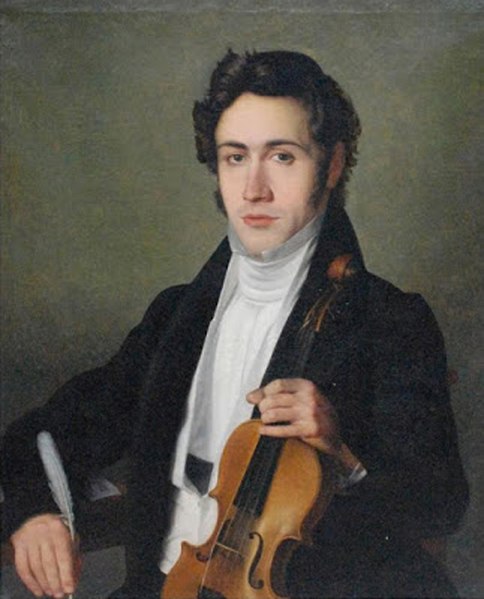
The Genoa born Niccolo Paganini was a European touring rock star of the early 1800s.
http://paganininiccolo.blogspot.it, Public domain, via Wikimedia Commons
Rachmaninoff, on the other hand was Russian/American pianist and composer who died at the age of 69 in 1943. According to utahsymphony.org. Paganini’s 24th Caprice “has a tonal structure that is ripe for variation.” And from what I can determine many composers through time have created some sort variations and themes off of Paganini’s work.
I am going to stop right there on the music because I feel like I am getting way over my head. It is all beginning to sound like an apple and orange sort of comparison. It is like comparing Tom Brady, a modern day quarterback, and Walter Johnson, a baseball pitcher from the early 1900s. They both threw a ball but they did it at different times and used different balls. Somehow in music it works but I cannot picture Brady on the pitcher’s mound with a football shaking off the catcher’s signals.
Washington Senator, Walter Johnson one of the greatest pitchers in baseball pitched for the Senators for 21 years (1907-1921). He won 417 games and not one was voted on by the House of Representatives.
Library of Congress, Public domain, via Wikimedia Commons

Take poor Kevin McCarthy. He is no political virtuoso. In fact some say his skills are suspect. He looks like a weekend kayaker on a Class V rapids. His election to become Speaker of the House will go down in history. For what, I am not sure. At the very least he was played like an historical variation on a theme.
Sitting on a sofa on a Sunday afternoon
Going to the candidates debate
Laugh about it, shout about it
When you've got to choose
Every way you look at it you lose

Mrs Robinson by Simon and Garfunkel
This is not the first time the House has had to deal with this sort of legislative mobocracy. Take the 1800 Presidential election between President John Adams and Thomas Jefferson. The first time the House had to make an odiferous hold your nose choice. Bipartisan bickering was the theme of the day with partisan newspapers sniping away at anything that crossed onto their side of the street. The framers of the Constitution failed to take into consideration party factions putting up individuals to run specifically for president and vice president. In this election the Jeffersonians, Republicans (later to become Democrats) voted lock step for Jefferson as president and his running mate, Aaron Burr. The problem is that each had 73 electoral votes–a tie. Oops. John Adams, the Federalist nominee, received 65 while his veep choice recieved 64 to avoid the confusion of a tie had they won. The House found themselves with a rat stuck in the plumbing. The Constitution says the candidate with the most electoral votes becomes president and the candidate with the next highest becomes Veep. In some ways this was like the 2000 election in when officials examined hanging chads to determine the president.
Aaron Burr, a patriot, the third Vice President and a true American scoundrel just behind Benedict Arnold in notoriety.
John Vanderlyn, Public domain, via Wikimedia Commons

The rat in the pipe was Aaron Burr. He was a smarmy guy, a cad known as much for his carnal exploits as his political and business hustlings. He was later tried for treason and acquitted. But in 1800, Burr brought Jefferson New York’s 12 electoral votes and the presidency. It was twofer for Burr because not only did he give Jefferson the presidency but at the same time he gave Federalist Alexander Hamilton a sharp poke in Hamilton’s political eye. Burr being a Republican and Hamilton a Federalist. Hamilton and Burr did not get along in New York politics and the 1800 election did nothing to improve their relationship. It only hasten their meeting on a a New Jersey dueling ground several years later.
So you think we think are divided now. Today, we are just playing a variation on an 1800 theme. This election was the first real game of political cutthroat where ties didn’t go to the runner. A lot of personal animosity played into this election. Hamilton and Burr did not play well with each other; and, Hamilton and Jefferson had been smacking each other around in Washington’s cabinet from the beginning, pulling at the old General’s ear for his soul. They took their personal battles into the fledgling press ripping each other apart like hyenas on carrion rotting away in the Serengeti. Party faithful and stalwarts shared this acrimony. And we haven’t even added the real loser in this mess, President John Adams’, and his cantankerous political and personal outlook as the first one-term president. After the election he shuffled off to Braintree and political exile–sort of like a ticked off unindicted Nixon.
The three remaining ambitious patriots created what Star Trek fans know as the Kobayashi Maru–the no win scenario. Despite being the vice presidential candidate Burr found himself within an arm’s length grasp of the presidency. The 1800 version of Gulum/Smeagol waiting to snatch the One Ring to unite them all from Jefferson. One catch though, everybody had to scale Mount Doom–The House of Representatives.
Much like the National Football League, the Constitution does not do ties very well. Most of the time the losing teams walk away after an overtime game feeling like they were cheated out of win. The framers, however, in their parochial wisdom, threw tie games into the House giving each state one vote to break the presidential tie. This would be like letting sports writers or gamblers pick the winner of tie games. At the time there were 16 states and nine votes were needed to cross the goal line.
The real kicker for Jefferson was that the old Congress still sitting was a Federalist Congress and they had no love for the red-headed Virginian. The Republicans swept the new Congress but those newly elected Republicans had not been seated. This “never Jefferson” Federalist Congress held him in high contempt. Jefferson’s chances were slim. The first ballot took place on February 11, 1801. Eight states voting for Jefferson and six voting for Burr with two states split. It remained that what for the next week and 34 more ballots.
Hamilton the clairvoyant sees Federalist support growing for Burr. Although not a member of Congress, Hamilton is the de facto leader of the Federalist party. Before 1800 is over he begins a letter writing campaign to fellow House Federalists urging them to vote for Jefferson. This perplexes many of the “never Jeffersonians.” Making a deal that hands the presidency over to their arch enemy is like replacing Saint Peter at the Pearly Gates with Beelzebub. But as the old saying goes: The devil is in the details. The country is facing its first apocalyptic moment.
Mr. Jefferson, though too revolutionary in his notions, is yet a lover of liberty and will be desirous of something like orderly Government – Mr. Burr loves nothing but himself – thinks of nothing but his own aggrandizement – and will be content with nothing short of permanent power in his own hands.
Alexander Hamilton to Congressman Harrison Gray Otis
Say what you will about Jefferson, and Hamilton said a lot through the years. But despite their drastic differences in principles and attitudes on government, Hamilton saw the that Jefferson’s principles heavily outweighed Burr’s ethics, or a lack thereof. In a letter to Massachusetts Congressman Harrison Gray Otis “In a choice of Evils let them take the least – Jefferson is in every view less dangerous than Burr.”
Eventually Hamilton convinced enough Federalist that Jefferson would not tear the government down and turn the US into a junior partner in the French empire. On February 17, on the 36 ballot 10 states voted for Jefferson with two states not voting for neither Jefferson or Burr making Jefferson the third president of the United States.
History like music may be written down and cataloged in a library–Googled today. But every now and then, like McCarthy’s Speaker election, we get to witness a variation on theme that reminds us of what once was, still is, and yet to come.
 mystoryorhistory