T’is the season to be jolly, unless one perceives that there is a war on Christmas. In today’s times, and maybe true of all times, people have been at war with someone or something. It could be a real hot war with bombs or a cold war of words. We have had a war on poverty, drugs, and terror. But just maybe, there is some truth to the belief that there is a “war on Christmas.” A war that goes beyond one of symbols and simply saying “Happy Holidays” as if it were a question about Happy Hour at the corner bar. Maybe it goes beyond putting up a Nativity scene in the public square or classroom.
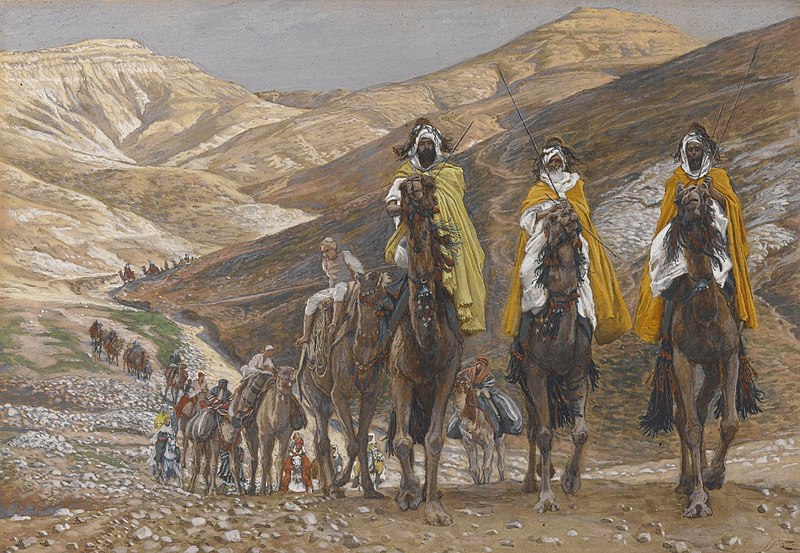
When you think about it, we really have to go back at least two centuries when Jesus was born in Bethlehem to determine if there could be a War on Christmas. Most of us are familiar with the birth of Christ. The Scriptures prophesied the coming of a messiah in the Old Testament Isaiah 60:1-6. The arrival of the Magi in Jerusalem gets prophecies going and only re-enforces the mysticism of Christmas. The Bible also makes a reference to the Magi, or as in Psalms 72:11 “May all Kings fall down before him.” And hence a 2,000 year tradition is started.
The Bible, however is vague on details when it comes to the Magi. The first verse of Matthew Chapter 2 says: “Now when Jesus was born in Bethlehem of Judaea in the days of Herod the king, behold, there came wise men from the east to Jerusalem.” No names are given and we are not sure how many wise men there actually were. Some say that there were just three because the Bible only mentions three gifts given to the babe in swaddling. Others think there could be as many as 12. For having a big part in the Christmas culture, they do not get any cast crediting.
One clue that Biblical scholars can use to decipher where the Magi came from is by the gifts that they brought. This may indicate where they came from. Take frankincense for instance. Frankincense grew and was widely traded on the Horn of Africa for 5,000 years, making its way as far as the Silk Road. The ancient Egyptians used frankincense in their mummification process. Myrrh, a herb also grown throughout the region in countries like Somalia, Oman, Yemen, and Eritrea could give an indication where the wise men started out from. Even knowing where these aromatic herbs were grown is no sure bet. These herbs had to be long-established trading items that could be picked up at the local herb shop for the right price–more if pre-rolled. And of course gold, the currency of the realm.
So the Magi could have come from anywhere. Some speculation believes they could have come from modern day Iraq or Iran. Maybe Turkey or as far away as Saudi Arabia. We are not sure if they met on the road or came collectively. If they had to travel several months, no doubt by camel and donkey, it might be safe to say these saddle sore Orientals were looking for a place to stay when they hit the outskirts of Jerusalem. And considering that all of Roman-controlled Galilee was on the move because of Caesar Augustus’ census, an obvious stop was King Herod’s palace for a kingly stop over.
We also have to applaud the Magi’s navigational skills in finding the Christ child. According to the historyofthecompass.com the Chinese were fidgeting around with the compass around the Second Century BCE. It is probably safe to say that the Magi did not have a hand-held compass. There is the possibility that they had some early form of an astrolabe. As as far we know their only GPS was the bright star in the east. This also brings up a host of questions. Astronomers have tried to back track the skies to determine what astronomical phenomenon could have lead the Magi to that manger off the beaten path.
In 12 BCE Halley’s comet made its appearance. However, the timing of Jesus’ birth and the comet is off by a couple of years. But surely learned persons of the times could tell the difference between a comet and a star. Speculation from ancient manuscripts dating back to 6 BCE indicate that there could have been a conjunction of Jupiter and Saturn. This would not have formed a single point of light in the sky, but could have been used as a navigational aid.
The Bible does tell us that when Magi got to Jerusalem they stopped off and sought out Herod for directions. In Matthew they are pretty specific about the star when they tell Herod “For we have seen His star in the East and have come to worship Him.” The Bible does not go into great detail but it could be safe to assume that if a king was being born the locals would have an idea as to where. Traveling from afar they had to be excited and curious when they asked Herod, “Where is the one who has been born King of the Jews?”
Herod’s scholars had to be familiar with the prophecies and would have seen this new-born king as a threat. In Matthew 2:13 King Herod, sucking up to the Magi, tells them he is not sure, but that he too wants to meet the baby Jesus. Maybe it was the look of insincerity on Herod’s face that puzzled the Magi. We are not sure what information the Magi shared with Herod. Email, Twitter and Instagram were several centuries away. So Herod had to cool his jets waiting for the return of the Magi to Jerusalem.
While the Bible has some great stories it can be vague on the politics of the times. After all, it is a religious tome and not The Times of Israel or The Jerusalem Post. There was no headline proclaiming, Messiah Born in Bethlehem. What makes Herod interesting is that he is like a modern day strong man propped up by a foreign super power. He could be put in with the Shah of Iran or East German president Erich Honecker around the time the Berlin Wall came down. History has a recurring theme in which lesser powers, for the lack of a better term, get swallowed up in the business of the prevailing super powers of the times. Herod was caught in the geopolitics of the times. He faced the Romans to the west, the Parthians (the old Persian Empire) to the east and a highly suspicious and disgruntled Jewish population at home. This messiah stuff could be bad news.
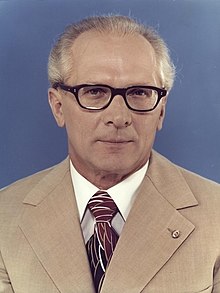
Erich Honecker, General Secretary of the Socialist Unity Party of (East) Germany. Honecker found himself on the wrong side of reform after the collapse of the Soviet Union. Anti communist government protests forced him to flee Germany to Russia in 1990. The Russians didn’t want anything to do with him and sent him back to Germany to stand trial for crimes against humanity. He eventually was exiled to Chile where he died in the custody of his family in 1994.
In the Hellenic World the Greeks had mixed it up several times with the Persians. Once Rome conquered Greece around 150 BCE it was now their turn with Persians–now the Parthians and the neo-Persian Empire. The Romans never did subdue the Parthians. Julius Caesar planned an invasion to avenge the death of his friend and fellow ruler, Marcus Licinius Crassus, but the Roman Senate had other plans for Julius, plans that makes an impeachment look like a picnic with plastic dinnerware. Crassus, at the time, was one of the richest men in Rome. However, his Parthian invasion didn’t go off so well for him–the Roman version of rich guy biting off too much–like Elon Musk buying Twitter. The Parthians defeated Crassus at the battle of Carrhae in 53 BCE. Roman and Parthian lore has it that the Parthians poured liquid gold down Crassus’s mouth to mock his riches. They also made sport of his decapitated head using it as a prop in Greek plays. No doubt a tragedy for him but comic relief for the Parthians.
It was around this time that Rome proclaimed Herod King of the Jews. The problem however, was there was already a king in Judea, Antigonus. Herod had managed to overthrow Antigonus around 34 BCE. And to make a long complicated story short, it was around this time the Parthians were making a run on the Roman province of Syria. Antigonus, looking over the possibilities, decided this might be a good time to cut a deal with the Parthians to regain his kingdom. A little cash in the right pocket and Antigonus was back on the throne. The Parthians chased Herod out of Jerusalem and Antigonus was riding high again. The Romans, however, had other ideas. Marc Antony, who stepped in for assassinated Julius Caesar, sends an army to Judea. The Romans shove the Parthians out of what would become the Holy Land, and Antigonus, unfortunately finds himself on the wrong side of Herod and Rome.
Once the Parthians were gone, Herod turned Antigonus over to the Romans. Some ancient historians say that Antigonus was either beheaded or crucified. In either situation Herod was left in control of Galilee under the watchful eyes of Rome. It is in this geopolitical landscape that Jesus is born–and would die. This is when the Christmas story begins, with Herod’s malignant fear of being overthrown. His Jewish minions were never really pleased with his rule. He had to keep the peace and Rome happy at the same time. And now the possibility of another king put Herod on high alert.
According to the Bible both the Magi and Joseph had forewarning dreams. The Magi were told not to tell Herod about the Christ child. They headed back East avoiding Herod. Joseph’s dream told him he needed to head for Egypt and set up shop there until it was safe to return.
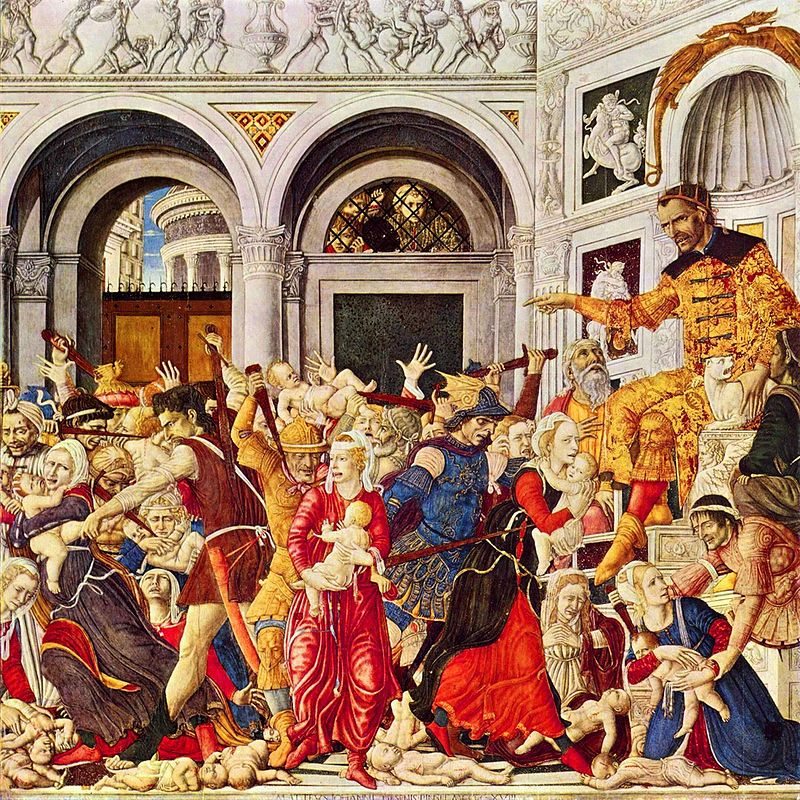
Herod, in his frustration for being duped the by the Magi, retaliates. In Matthew 2: 16 Herod was furious, he gave orders “to kill all the boys in Bethlehem and its vicinity who were two years old and under, in accordance with the time he had learned from the Magi.” This was the “Massacre of the Innocents” or the “Slaughter of the Innocents.”
Since that time we have had all sorts of religious wars, none specifically fought over Christmas. There was an Easter Uprising in 1916 in Ireland. Irish Republicans (no affiliation to Republicans who stormed the US Capitol on January 6th) decide that they had enough of British rule. The rebellion was crushed in English fashion–unconditional surrender and execution.
Today, if there is a war on Christmas it is a fear of heretics, secular progressives and plain old liberals storming the cultural gates, an attack on perceived cultural norms. We can trace this phobia to 1959. A geopolitical time of Communism and atheism when the UN was seen as the boogie man or men. The John Birch Society believed the “assault on Christmas” was being carried out by “UN fanatics.” The battle was being waged in department stores throughout the country utilizing “UN symbols as Christmas decorations.” They may be giving the UN way too much credit as an organization that can get anything done.
As Christmas became more commercialized the only battles being fought were consumer skirmishes, department store fist fights over who gets the last Cabbage Patch Doll; people getting trampled on Black Friday when Walmart stores opened their doors to the hoards of shoppers. And parades with more secular floats featuring modern day cartoon characters. Hardly a war. And where do flying reindeers come into all of this?
https://www.politico.com/magazine/story/2013/12/war-on-christmas-short-history-101222/
https://www.bibleodyssey.org/en/people/main-articles/herod-the-great
 mystoryorhistory