Public domain, via Wikimedia Commons
Howard Chandler Christy.
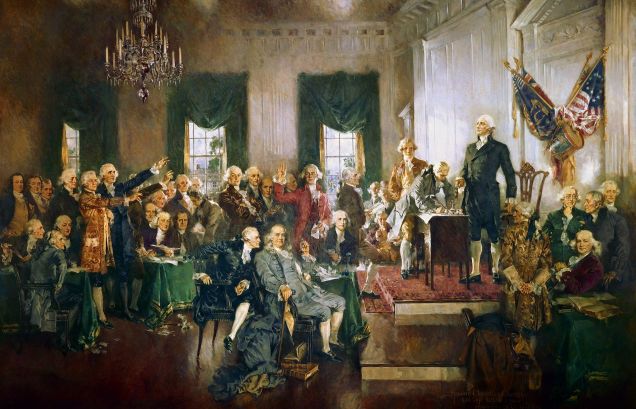
Whenever a big issue comes before The Supreme Court, the phrase “original intent” gets smacked around like an air hockey puck in an arcade. I am always perplexed as to what that actually means. There were 70 men appointed to revise the Articles of Confederation in 1787. Of those 70, 55 really showed up–most of the time– and of the 55 only 39 actually signed onto the new Constitution. Of the 55, none were whisked into the future or clairvoyant enough to say, “what a minute guys I think we may have to rethink this privacy issue. And while we are at it we might want to rethink the gun thing.”
My guess is we would be lucky if most Americans could name more than five or six men from 12 states that gathered to amend the Articles of Confederation for a new Constitution. I would guess that most Americans would be able to name James Madison. He is a no brainer. Most of us learned in history class he was the father of the Constitution. Then there was the 81 year-old Ben Franklin. Most people probably associate him with flying a kite in a lightning storm but he was there. George Washington was the president of the convention as was one of his surrogate sons, Alexander Hamilton.
After that I would say most Americans are going to start guessing. If you were to guess two of the more prominent men of the times: Thomas Jefferson and John Adams you would be wrong. Jefferson was ambassador to France and Adams was in England. Patrick Henry of “give me liberty or give me death” fame was a no show. He stayed in Virginia, saying he smelled a rat.
For those that really paid attention in their history classes they might be able come up with Roger Sherman or William Patterson. Both of these men proposed plans to counter Madison and George Mason’s idea on representation called the Virginia Plan. Sherman from Connecticut, proposed the bicameral compromise we see today in Congress. According to the State of Connecticut Judicial Branch Law Library Services Sherman’s compromise “prevented a stalemate between states during the creation of the United States Constitution.” The stalemate was between the more populous state and the less populated states on how to determine representation in the new Congress. In the unicameral Congress of the Articles of Confederation each state had one vote. Interestingly today, people are questioning how two states like North and South Dakota have four Senators while California has just two. Go ask Roger Sherman. It was his idea.
But what do we really about the other members of the convention. What was the intent of William Few of Georgia or Luther Martin of Maryland? Few signed off on the Constitution while Martin left Philadelphia and went back to Baltimore distressed with the proposed governments powers over “states’ rights.” Several other delegates left over the same concerns. Others because there was no bill of rights.
A shallow dive into the internet on the Constitution will lead us to the premise that there were plenty of rats in the walls–and disagreements from the beginning, particularly how to determine representation in the Congress. It took a long hot summer but those who roughed it out came up with a bunch of compromises some call “original intent.”
One thing the Framers could agree upon was the financial shortcomings of the Articles of Confederation. Government spending and revenues is an issue for any government and the states struggled individually and collectively to fund a central government. Plus, private business and commercial transactions suffered under 13 different interests, particularly those commercial dealings between states and foreign trade. The states didn’t need an Articles of Confederation upgrade 2.0. What was needed was a complete new application. Basically, the original intent of the Framers of the Constitution was to come up with workable form of government that they all could agree on–something that we lack today–to replace a cumbersome confederation. It would be safe to say that not all of them got all of what they wanted. Hence, compromise all the way up and down the process.
What is interesting about “original intent” is that it took less than 20 years after the Constitution was approved before men like Alexander Hamilton and Thomas Jefferson separated the country into factions–or what we would call political parties. George Washington was not even in his grave before these two, and their followers, began feuding over original intent of the Constitution, and what the new government was to be. Hamilton wanted a bank and Jefferson wanted to buy the Louisiana Territory from France. Neither desire was a power expressly delineated in the 4,543 word Constitution. Both used original intent to get what they wanted.
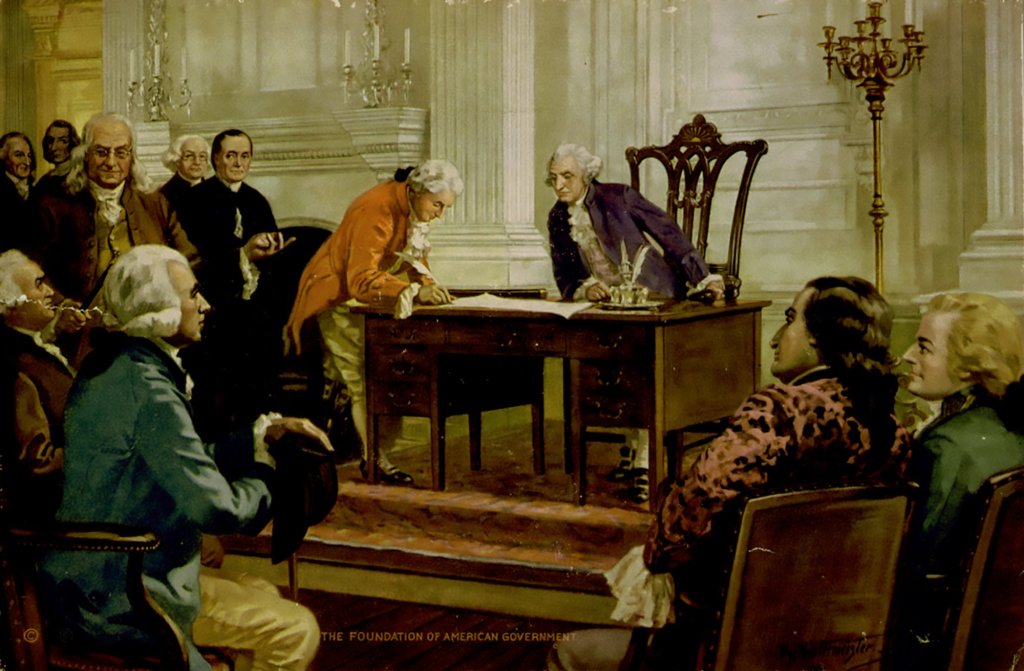
Foundation of the American Government by John Henry Hintermeister by Published by the Osborne company, Newark, N.J. From the painting’s copyright description:
We can surmise that the framers intended the Congress to be the real seat of power in the new government. The first Article in the Constitution deals with the legislature–Congress. Afterall it was the King’s unchecked executive power that got them all up in arms in 1776. And remember, The Articles of Confederation was a government that had no executive authority (Article II of the Constitution).
The one place that original intent gets thrown around the most concerns Supreme Court decisions, and rightly so. Take the recent overturning of Roe v Wade and repealing of a half century old the New York gun control law. The Framers did not put a whole lot of intent into Article III (the Judicial Branch) except to say “The judicial Power of the United States, shall be vested in one supreme Court, and in such inferior Courts as the Congress may from time to time ordain and establish.”
Although the Constitution provided important details for the legislative and executive branches, it did not flesh out the judicial branch of the new national government. For example, no one knew whether there would be any federal courts other than the “one Supreme Court” mandated by the Constitution, or how many judges would sit on the Supreme Court, or what sorts of jurisdiction any lower federal court might have. So, one of the First Congress’s first and most important duties was to establish the federal judiciary.
Encyclopedia.Com
Article III is about 500 or so words. When it came to dealing with the courts, the Framers either took a knee or punted the ball to the future Congress. In 1789 Congress approved the Bill of Rights and passed the Judiciary Act of 1789. It created the position of Attorney General and the beginnings of a court structure. From the time the first Congress met, there have been at least 10 Judiciary Acts passed and one in 1802 which repealed some provisions of the act passed in 1801.
The Judiciary Act of 1801 makes Senator Mitch McConnell’s yo-yo approval of justices during an election year look minor league. It was a last gasp grasp to hold onto judicial power. The Federalists could see which way the power was flowing on the Potomac. Thomas Jefferson’s presidential victory over John Adams was the beginning of the end of the Federalist Party. However, in their dying days, just before Jefferson was sworn in, they passed an act that was referred to as the Midnight Judges’ Act. It reduced the number of Supreme Court justices from six to five. It also increased the number of federal judgeships to 16, all filled by Federalists. Original intent or power politics?
Currently there is a proposal in Congress that would expand the Supreme Court from nine judges to 13. So what is “original intent” but the ever shifting political winds. In this case the political winds coming from the Senate in deciding when to approve Supreme Court justices to control the political aims of a particular party. Is this advice and consent?
It becomes difficult to determine what the Framers intended. The Constitution is a broadly written document. For instance Article II, Sec. 2 gives the president power to appoint government officials, like judges with “the advice and consent of the Senate.” That’s it. The Second Amendment is another example of broad reading with the first phrase of “a well regulated Militia” getting read out of the equation. Modern warfare, like so many other aspects of our lives today, has changed drastically since 1700 that men forming up with arms on the town’s Common Green is as anachronistic as a Knight of the realm defending a damsel in distress. Under the auspices of the Second Amendment’s “right to bear arms” original protects a 17 year-old boy to cross state lines with an automatic weapon to participate in a civil disturbance. A far cry from those who mustered on Lexington to meet the British in 1776.
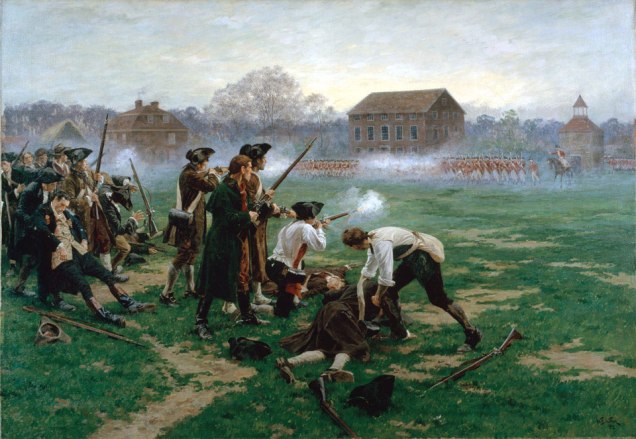
William Barnes Wollen National Army Museum Wikimedia Commons
Which brings us to the Fourth Amendment which states: “The right of the people to be secure in their persons, houses, papers, and effects, against unreasonable searches and seizures, shall not be violated…” Let’s keep this context of the time. The Constitution was written in the time of hand press printing machines. It was not until 1843 when newspapers could print out a million pages using the steam-powered rotary press. We now have satellite technology, digital mail and instant electronic communications. We have witnessed the extinction of the evening newspaper; the disappearance of local newspapers and the slow disintegration of the Postal Service. These are 19th, 20th and 21st Century difficulties, events and advancements unforseen by the 18th Century Framers.
“All printing was still done on hand presses, the output of which remained 200-250 copies per hour, a rate essentially unchanged since the invention of printing in the second half of the 15th century.”
HistoryofInformation.com
The genius in the Framers’ original intent were the compromises, being specific enough to establish a workable government but yet vague enough to allow Hamilton to establish the Bank of United States and for Jefferson to double the size of the United States and kick off Manifest Destiny. What makes the Constitution one of the greatest documents written is its flexibility to adapt to the times the Framers could not have intended or foreseen.
https://www.jud.ct.gov/lawlib/History/Sherman.htm
https://www.archives.gov/founding-docs/founding-fathers
 mystoryorhistory