There is something fundamentally wrong in this country when a school, or a place of worship, a hospital, or a grocery store becomes the hill to die on. These are not the places in which we should make our last stand as if we were manning the parapets of the Alamo. The children in the Uvalde, Texas elementary school did not volunteer to be on the front lines of a mass shooting.
There is something fundamentally wrong when we even think about hardening schools and other places to protect ourselves from assaults that should never happen. It seems as if our right to assemble is being infringed upon by the a belief in a right to bear arms anywhere one please.
Our government is based upon a social contract between the people and its government. Congress is failing to uphold its end of our social contract. Its do nothing attitude only exacerbates the situation.
In order to protect ourselves and our property, we may not know it but we agree to a social contract. It is not the sort of contract one would sign in a business deal or for a home mortgage loan. And probably for the most part, this contract can be as fuzzy as the terms and conditions every time we click agree to download an app—we have a vague idea of what we are agreeing to, despite it being written down.
A social contract is something handed down. As long as humans have huddled together going as far back as hunters and gatherers; or associated in more formal settings in villages. We agree to some sort of social structure that holds the community, and eventually a country together. At first it was understood. Later it was a formally written social contract.
Our Declaration Of Independence is based on the Enlightenment reasoning of a social contract between, in this case, a king and his colonies. The Declaration of Independence presents many ideas from the Enlightenment, particularly the concept that the founding principle of a government shall be to effect the “safety and happiness” of the people. And the people, have a natural right to life, liberty and property.
For those that have forgotten their middle school civics, a social contract is pact between the government and the governed. It is a concept developed from Enlightenment thinkers. The individual gives up some of their personal freedoms to the government so that the government can protect and maintain social order. This concept, when you think about it, was contentious and dubious to those in power. Look at how King George the III balked at being told how to run his empire, particularly by a bunch of upstart colonials.
It ancient times it was probably very hard to establish an equitable social contract when pharaohs were considered gods; and kings, who may not have been gods, were authorized to rule in a belief of some sort heavenly “divine right” of kings. Crossing the king, after all, could lead to earthly vengeance, which was nothing compared to eternal damnation from a god and a king. A lethal combination in the hands of a tyrant.
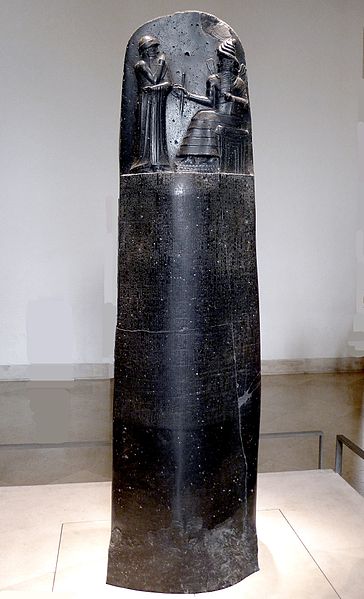
Hammurabi, CC BY 3.0 https://creativecommons.org/licenses/by/3.0, via Wikimedia Commons
The establishing of some sort of rule of law began around 1750 BCE. Babylonian King Hammurabi chiseled 282 laws into a stele column known as Hammurabi’s code. The code began to establish a rule of law over business, family, property and commercial activities. The dos and don’ts of the civilized man were starting to be cast in stone. The Old Testament tells of Moses coming down Mount Sinai with the Ten Commandments binding the Israelites to a religious/social code.
Around 450 BCE the Romans would codify the beginnings of Western law with the Twelve Tables. According to World History Encyclopedia “the Twelve Tables was a first step which would allow the protection of the rights of all citizens and permit wrongs to be redressed through precisely-worded written laws known to everybody.”
At times it appears as if our social contract is vague with ever changing attitudes and opinions shifting like the sands of a desert. These brings new meaning to old beliefs. What is unique about our social contract is that it can be examined with reason forcing us to critically evaluate simple phrases and beliefs like: “separate but equal.” It is also flexible enough to move with the times and can be amended for those times.
For example, in June of 1215, in the midst of a civil war, English barons wanted the king to shift his attitudes in respect to certain rights and privileges the barons felt needed addressing. Without knowing it these barons expanded the concept of a social contract. The barons, tired of King John’s divine rule, forced him to accept the idea that fealty needs to run both ways. King John signed the Articles of the Barons later known as the Magna Carta.
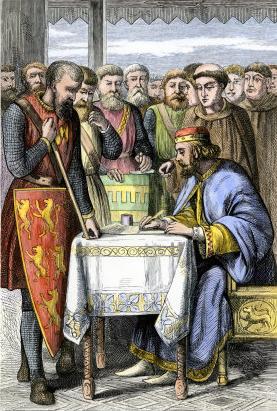
unknown, held by The Granger Collection, New York
According to history.com, “Of its 63 clauses, many concerned the various property rights of barons and other powerful citizens, suggesting the limited intentions of the framers. The benefits of the charter were for centuries reserved for only the elite classes, while the majority of English citizens still lacked a voice in government.” For the “lower classes” of English society the concept was most of us are so far “under the law” it does not even apply to us. Pity the poor farmer who killed a baron’s stag for dinner.
Beginning in the 1600s a period of Enlightenment and the Scientific Revolution, an era of reason took hold in Western Europe. Old beliefs like the solar system revolving around the earth were spiked through observation, moving thinkers of the time away from religious and Medieval mysticism. From this reasoning came a belief that man had natural rights that could not be taken from him. This reasoning developed new ideas on economics that helped to stimulate trade and industry. It birthed new ideas on the relationship between the governed and those doing the governing.
History.com says, “There was no single, unified Enlightenment. Instead, it is possible to speak of the French Enlightenment, the Scottish Enlightenment and the English, German, Swiss or American Enlightenment. Individual Enlightenment thinkers often had very different approaches. John Locke differed from David Hume, Jean-Jacques Rousseau from Voltaire, Thomas Jefferson from Fredrick the Great. Their differences and disagreements, though, emerged out of the common Enlightenment themes of rational questioning and belief in progress through dialogue.”
Today we lack that type of dialogue where rational reasoned thought can create an environment of accomplishment. Instead, we look at winning and losing as the only acceptable dialogue. And then, we still dispute the results. Fox News commentators spew their comments and opinions out during the day to be taken up later on by late night talk show hosts, who then roast these comments over the open pit of comedy. This is not reasoned dialogue. It does not promote “the general welfare or secures the blessings of liberty to ourselves” or anybody else.
Politicians and pundits from the left and the right throw out all sorts of reasons —and conspiracies theories, modern mysticism—for the cause of what is going on in our governments, communities and generally our day-to-day lives. Social Media then reenforces and puts everything on hyperdrive. These opinions and jokes become facts. Most of these opinions are unsubstantiated beliefs and go beyond jokes to the ridiculous. Some pontificate and dream about the way things use to be (but never really were). And how they should be now. These opinionated misconceptions have shaken the social contract that holds our country together.
Our social contract is our Constitution. It established a system of government that enacts laws and enables that government to operate with the consent of the people. But as of late we have too many elected officials, urged on by the lunatic fringe, reevaluating how to use the Constitution to twist what the social contract means to their specific beliefs. It is about winning and owning the other side that reenforce their beliefs and what our social contract means. Winning allows them to control who should be judges and how election results are counted. Our social contract is not a belief to the victors go the spoils.
When is reasonable behavior, logical and justifiable for an 18 year-old boy to cross state lines with an assault weapon to confront demonstrators. We get bogged down in what one or two clauses in an Amendment. We pull it, play with it and stretch it around like a ball of Silly Putty as to what we want it to mean. We completely disregard the Preamble of the Constitution, our country’s mission statement.
…establish Justice, insure domestic Tranquility, provide for the common defence, promote the general Welfare, and secure the Blessings of Liberty to ourselves and our Posterity,…
Preamble to the Constitution
The recent mass shootings is probably the most obvious breach in the social contract. Today people cannot go out in public without the possibility of being in the middle of a shoot out that makes the O.K. Corral gun fight look like a tea party. The social contract works best when a majority of the people agree to the contract and the government responds to that agreement.
To often the contract is tacitly understood. But in reality we know what is right and what to expect. This is a mark of civilized country when people have a basic understanding of what is right for the majority. When we refuse to surrender a small portion of our individual freedoms for the greater good, and believe it is more important of have political victory instead of reasoned thought we subvert the concepts espoused in the Declaration of Independence and the Preamble to the Constitution. When we feel that “the right to bear arms”—assault weapons— is a Constitutional and natural right, and non-negotiable we refuse to look at the greater good of “promoting the general welfare” of our nation, and the social contract that allows our government to ensure that welfare. Nothing is cast in stone.
Our Constitution’s Second Amendment “the right of the people to keep and bear Arms” was penned more than 230 years ago. A time before metallic cartridges and breech loading rifles let alone machine guns and assault rifles. Killing 20 people with a muzzle loading rifle took the work of more than one man. An 18th Century musket cold be reloaded in about 15 seconds. A trained soldier could accomplish the task in five-to-eight seconds. This was the reality of constitutional original intent.
A well regulated Militia, being necessary to the security of a free State, the right of the people to keep and bear Arms, shall not be infringed.
The Second Amendment
Logic and reason would tell us that individuals do not need assault weapons for security any more than one would need a flamethrower or Claymore mines to protect their home. The Second Amendment becomes a black hole of debate that pulls in states’ rights, militia, National Guard, deep state paranoia and what Congress can and cannot “infringe” upon.
It is interesting that we do not have any debate about the Eighth Amendment’s “cruel and unusual punishment”clause. Our social contract forced the Bush Administration to stop using what was called “enhanced interrogation techniques” on suspected terrorists. There was some debate as to what was “cruel and unusual.” But eventually there was a consensus.
Excessive bail shall not be required, nor excessive fines imposed, nor cruel and unusual punishments inflicted.
Eighth Amendment
Our government regulates and outlaws a variety of activities, products and goods. We do not have a Constitutional right to get stoned. The federal government, however, has made first-time possession of small amounts of marijuana a misdemeanor that can land you in jail for up to a year with a $1,000 fine. Attitudes and beliefs about marijuana have changed drastically. The same may be said about guns. Most Americans would agree that we have the right to own guns. The social contract looks to the government to protect that right. However, the social contract also protects our right to assemble safely. Therefore reason would dictate it is also a part of the social contract to control what kinds of arms the citizenry should have; who can own them; and where those guns can be carried.
 mystoryorhistory