“Plus ça change, plus c’est la même chose “ – the more things change, the more they stay the same.
French writer Jean-Baptiste Alphonse Karr, 1849
Once again European countries are trying to contain Russia. This time in Ukraine. Countries like Poland and Ukraine sit at the crossroads of history. This inevitable scenario has played out many times before with the Huns in ancient times heading west, to Napoleon in 1812 and Germans in 1914 and 1940 in modern times moving east.
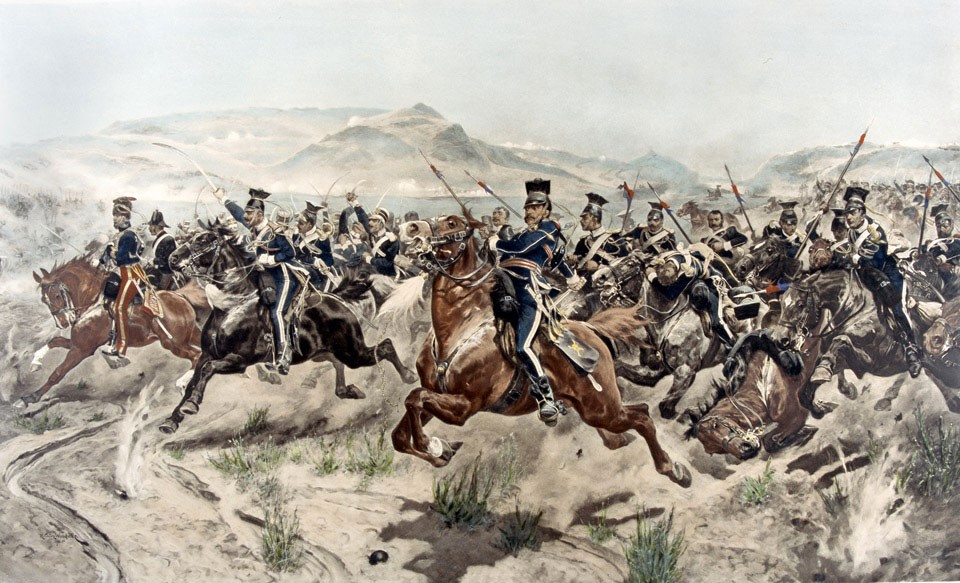
Containing the Russian bear has been the task of many European powers for generations going back as far as Peter the Great and Catherine the Great. In the 1850s it was The Crimean War. European powers contained Czarist Russia from moving into the Middle East. There were religious overtones to this conflict as Czar Nicholas I wanted more rights and access for Orthodox Christians in the Holy Land, which at the time was under the Turkish Ottoman Empire. Plus, Russia was looking to Constantinople, (now Istanbul) as a ticket through the Bosphorus Straits and into the Eastern Mediterranean Sea. Something the British, in particular, did not want to see happen.
Before long Britain, France, the superpowers of the time, joined and Sardinia joined Turkey in checking Czarist ambitions. The British, in particular feared that any Russian expansion could jeopardize their trade with Turkey and India. Add to that, neither Britain nor France liked the idea of Russian ships in the Mediterranean Sea. The land war turned to siege and trench warfare. A battlefield ground plan that would be later played out in WW I. Although the death toll in this war pales to later European wars, this three-year war from 1853 to 1856 killed an estimated 650,000 people.
Jump forward about 100 years to February of 1946. George Kennan, charge d’affaires in Moscow and diplomat who helped establish the US Embassy in the Soviet Union in 1933, wrote a “long telegraph,” to the US State Department. According to history.com, the telegraph was 8,000 words. History.com summarized by writing: “The lengthy memorandum began with the assertion that the Soviet Union could not foresee “permanent peaceful coexistence” with the West. This “neurotic view of world affairs” was a manifestation of the “instinctive Russian sense of insecurity.” It went on to say that “Kennan was convinced that the Soviets would try to expand their sphere of influence, and he pointed to Iran and Turkey as the most likely immediate trouble areas.” Leading the West to believe that the communist threat had to be contained.
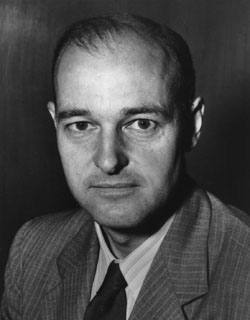
Kennan writes that, “Soviet pressure against the free institutions of the western world is something that can be contained by the adroit and vigilant application of counter-force at a series of constantly shifting geographical and political points…” Although the Soviet Union as we know it is not around now, the pressure on free institutions is still being applied with either cyber applications and political interference of free elections; or as in Ukraine: tanks.
“Russian rulers,” Kennan wrote, “have invariably sensed that their rule was relatively archaic in form fragile and artificial in its psychological foundation, unable to stand comparison or contact with political systems of Western countries.” And granted, Kennan is writing about Marxist, communist leaders like Josef Stalin. Vladimir Putin may not be a Marxist in the old traditional way. The question arises is there a hair’s difference between him or any past Russian ruler, czar or otherwise.
For those who lived during the Cold War it was always an international incident away from a hot war, one with nuclear weapons. Kennan’s idea of “containment” was one that kept the lid on explosive tensions for most of post World War II. But there were incidents with Russian tanks rumbling through Eastern European capitals to quell a popular uprising: East Germany in 1953, Hungary in 1956 and Czechoslovakia in 1968. The Ukrainie invasion or as Putin is calling it is not an invasion or war but a “special military operation.”
Call it what it really is, an invasion, a war. Putin’s invasion falls into the same overt aggressive overtures that the West was facing after WW II. To counter those communist threat to war torn Europe, President Harry Truman in May of 1947 announced The Truman Doctrine. According to the State Department’s Office of the Historian The Truman Doctrine “established that the United States would provide political, military and economic assistance to all democratic nations under threat from external or internal authoritarian forces. The Truman Doctrine effectively reoriented U.S. foreign policy, away from its usual stance of withdrawal from regional conflicts not directly involving the United States, to one of possible intervention in far away conflicts.”.
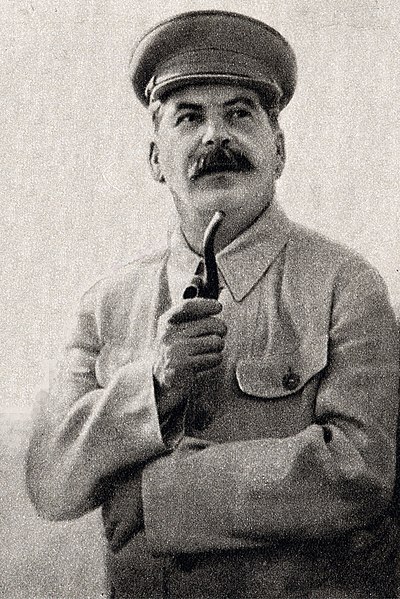
One leader who took exception to this new doctrine was Josef Stalin. Officially the “General Secretary of the Communist Party of the Soviet Union and Chairman of the Council of Ministers of the Soviet Union, premier. To most he was just a brutal dictator.
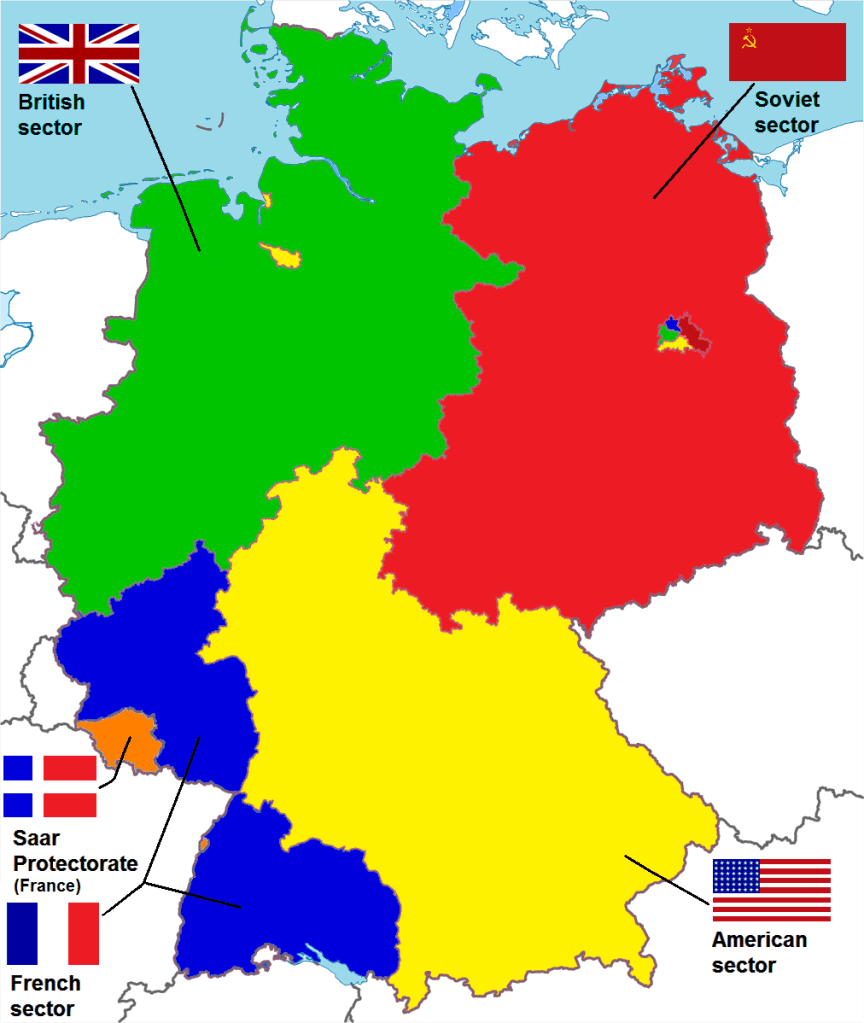
The East-West tension really started with the Berlin Airlift in June of 1948. The Soviet Union decided to cut off ground and water transportation to Berlin. The divided city, for those who too young to remember, was 100 miles deep inside Soviet controlled Germany–soon to be East Germany. Germany was divided among the victorious allies. In order to keep West Berlin from starving, President Truman ordered the military to begin flying in supplies to the surrounded city. The airlift lasted for almost a year before Stalin opened the road back up to Berlin.
There was a lot going on at this time. The United States, along with Britain and France was moving forward to unify the western zones of occupation into West Germany. A move to stabilize Europe and to thwart further Soviet conquests and revolutions that they may wish to dabble in. Of course this new German country did not sit well with Uncle Joe. Meanwhile relations between East and West just kept getting frostier.

At the time Eastern Europe–later The Warsaw Pact nations– was in the firm grip of Stalin. Greece was trying to fend off a communist take over. Truman went to Congress asking for aid to both Greece and Turkey. There is some debate to how much assistance Stalin was giving Greek communists. But Truman argued that if there was a communist victory in the Greek Civil War this “would endanger the political stability of Turkey, which would undermine the political stability of the Middle East.” As if stability is a word that could ever be used to describe the Middle East at anytime in history.
But European stability was on the mind of Secretary of State George Marshall when he spoke to the Harvard graduating class in June of 1947 calling “for a comprehensive program to rebuild Europe.” This would become the Marshall Plan. With “the fear of Communist expansion and the rapid deterioration of European economies in the post WW II winter of 1946–1947, Congress passed the Economic Cooperation Act in March 1948 approving funding that would eventually rise to over $12 billion for the rebuilding of Western Europe.” That $12 billion would be about $140 billion in today’s dollars. Not a bad deal when consider building back America could run us into the trillions–and we are not even devastated from four years of world war. Just 50 years of infrastructure neglect, changing technical needs and political dissention.
And this brings us to NATO. According to DW (Deutsche Welle) Germany’s international broadcaster, “NATO, the North Atlantic Treaty Organization, was formed in 1949 with the aim, first and foremost, of acting as a deterrent to the threat of Soviet expansion in Europe after World War II. Beyond that, the United States saw it as a tool to prevent the resurgence of nationalist tendencies in Europe and to foster political integration on the continent.” * see below website for article and maps
wikimedia commons author Paasikivi
The ’40s, however, quickly became the ’50s and a whole new set of Capitalism vs Communism battle grounds emerged across the globe and into space: the Communist takeover of China, the Korean War, the testing of nuclear weapons, the forming of the Warsaw Pact in 1955 and the Space Race to name a few.
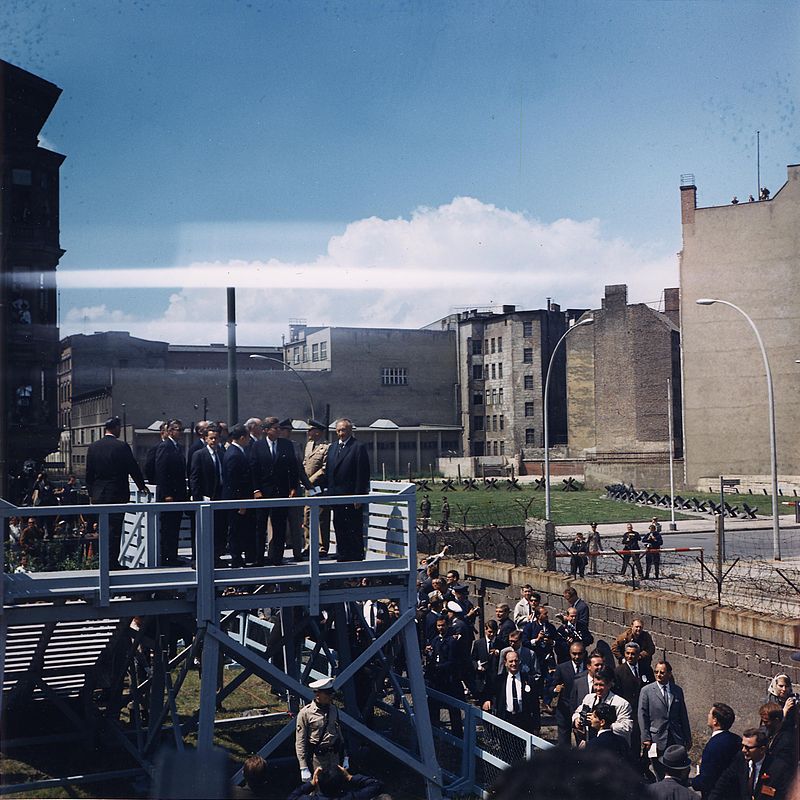
And who can forget the ’60s. In August of 1961 Russia built the wall: The Berlin Wall separating West Berlin from East Berlin. In June of 1963, President John Kennedy visited West Berlin telling the surrounded citizens, “Today, in the world of freedom, the proudest boast is “Ich bin ein Berliner.” I am a Berliner. He further said “There are many people in the world who really don’t understand, or say they don’t, what is the great issue between the free world and the Communist world. Let them come to Berlin.” It would take 30 years before that 27 mile wall patrolled by dogs, guarded by more than 40,000 border troops, and supplemented with more than 500,000 land mines would come down in 1989.
Russia’s ambitions were not just in Europe. Soviet missiles were placed in Cuba and in October of 1962, there was the quintessential standoff between East and West: the Cuban Missile Crisis. The nuclear war card was face up and on the table. Kennedy and Soviet Premier, Nikita Khrushchev, stood eyeball to eyeball waiting to see who would blink first. The Soviets blinked and the missiles would leave the New World but the standoff in the Old War continued.
I could go on about the Communist threats. But Mother Russia is not a communist country any more than it is a czarist one. That, however, does not seem to have changed Putin’s “neurotic view of world affairs” from any of his predecessors. He is still operating under old school Russian paranoia that seems to plague some modern Russian leaders much the same way hemophilia was passed along from one generation-to-another generation of czarist rulers.
With the collapse of communist economies in the late 1980s, Russian domination of Eastern Europe slipped away along with its empire. Russia saw its European allies looking for greener economies. Its buffer zone of satellite states joined either the European Union and or NATO. With so many Eastern European and Baltic countries in NATO, and the prospects of Ukraine becoming a member, is a just and East-West bridge too far for Putin.
According to National Geographic, Ukraine and Russia’s “shared heritage goes back more than a thousand years to a time when Kyiv, now Ukraine’s capital, was at the center of the first Slavic state, Kyivan Rus, the birthplace of both Ukraine and Russia.”
It is not a far Troika-sleigh ride from the Ukrainian border to Moscow, just under 500 miles. Ukraine was absorbed into Russia shortly after the Russian Revolution of 1918. It then suffered under Stalinist rule. In the 1920s and 30s millions of Ukrainians starved to death. In an effort to repopulate the eastern part of the country, Stalin brought in Russians to eastern Ukraine. People who had no cultural or language ties to Ukraine. Maybe this is why Putin feels that this “special military operation” is necessary, to reinforce the belief that “Russians and Ukrainians are one people, a single whole.” Putin appears to live with the attitude of a long lost Russian Empire. What was once mine (Russian) is still mine; a prospect that most Ukrainians today seem to disagree with.
What is puzzling is that there are so many examples of recent military adventurism failing miserably: Israel’s occupation of the West Bank, the Soviet Union in Afghanistan; the US in Afghanistan and Iraq are just a few examples for Putin’s perusal.
Putin’s special Ukrainian military operation is a continuing quest for a Russian empire. One that Europe has been able to roll back or contain for centuries. If history is any indication Putin’s success will most likely be short lived. President Kennedy had three short years in office but had several negotiated close encounters with Russia’s “neurotic view of world affairs”. He said of the Russians: “We cannot negotiate with people who say what’s mine is mine and what’s yours is negotiable.” Putin seems to have outrun reality where negotiations have dried up to the point where “yours” is not even negotiable.
https://history.state.gov/milestones/1945-1952/berlin-airlift
https://history.state.gov/milestones/1945-1952/truman-doctrine
https://history.state.gov/milestones/1945-1952/marshall-plan
* https://www.dw.com/en/what-is-nato-and-why-was-it-created/a-60688639
 mystoryorhistory