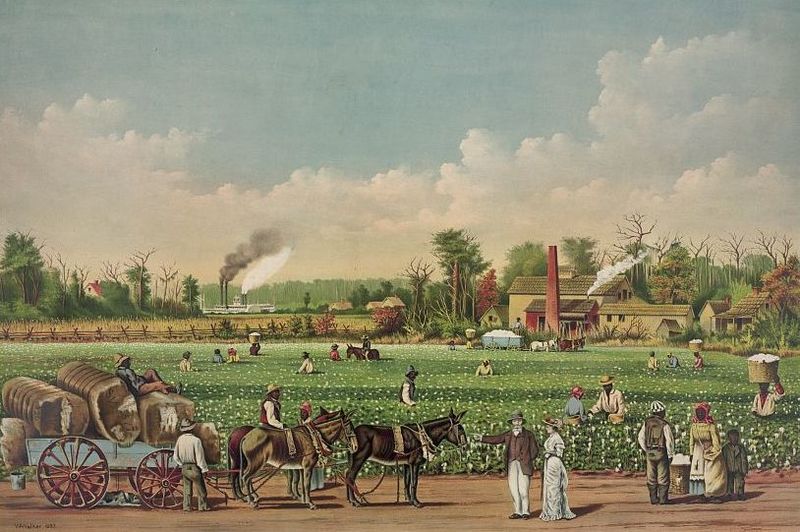
Currier & Ives, Public domain, via Wikimedia Commons
There is a certain passive/aggressive intransigence built into the American psyche. For the most part it lays dormant like a virus waiting for the right host or set of events to bring it out. The January 6th assault on the Capitol of the United States is perfect example of the aggressive egotistical character of certain people to poison the normal placid disposition of most Americans. Logic, compromise and sanity goes out the window, leaving ideologies and common values set—like bricks in a wall.
When these sorts of walls go up they are hard to bring down. In the last year or so there have been various public opinion polls that indicate that Americans believe there is a distinct possibility of a civil war in the near future. It is not unusual to see polls that show 70 percent of Trump’s supporters and 40 percent of Biden’s supporters feel that hostilities are about to break out. The Who may have been prophetic when they sang “we’ll be fighting in the streets…and the men who spurred us on, sit in judgement of all wrong, they decide and the shotgun sings the song.”
This is not a joke. A North Carolina Congressman, somebody elected to uphold and defend the Constitution says: “Because, you know, if our election systems continue to be rigged and continue to be stolen, then it’s going to lead to one place — and it’s bloodshed.”(I emphasises continue because this is new to me. Does this Congressmen know something we don’t!) Elections in Russia are probably rigged. Here in America, if it is anybody that knows how to rig an election, it is a conservative from North Carolina. North Carolina may not have invented Gerrymandering but they have sure made it performance art.
The irony of all of this talk of civil war in many ways centers around bogus claims that the 2020 election was rigged. It could be argued that the cause of “The Civil War,” I refrain from using The First Civil War, was the 1860 election of Abraham Lincoln—the first president to take a firm policy stand against slavery. It sounds incredulous that in the land of the free that 12 of the first 18 presidents were slave owners.
I do not think there were too many claims that 1860 election was stolen. It was just a plain old loss stemming from demographics and an ever so slight change in the attitude of the American people to slavery. It was an electoral defeat Southern Democrats could not fathom. Much like today, some people cannot grasp the changing demographics and more broad-minded attitudes. In reality it was inevitable. Slavery may have built the ancient world and kick started the New World; but it had no place in the new economics and industrialize world that was coming of age in the 19th Century. But old ways die hard.
Meanwhile, European countries were abolishing slavery. In 1811 Spain abolishes slavery; in 1833 Britain passes Abolition of Slavery Act, setting aside 20 million pounds to slave owners in compensation for their loses; in 1848 France abolishes slavery. By the time of the Civil War most European countries had abolished the slave trade.
Instead of letting slavery go as dying economic system and looking forward to the upcoming 20th Century, the South doubled down on human bondage to get their work done. They decided to take their electoral votes and start a new country. Keeping their slaves and old agrarian ways, as if cotton would be king for ever. Nothing wrong with agriculture but it seemed like the only culture the South would recognize is agriculture and an enslaved workforce. And those newly approved Constitutional Amendments after the Civil War, they were just roadblocks from keeping freedmen from the polls.
The South may have won the lighting rounds early on in the Civil War, which may have given them false hope in victory. But eventually the South took a real beat down, in particularly during the last year of the war from the more economically diverse North.

Unknown author Unknown author, Public domain, via Wikimedia Commons
In February of 1865 Lincoln and Secretary of State William Seward met with the Vice President of the Confederacy, Alexander Stephens, and several now-long forgotten rebels (one of whom was a former US Supreme Court justice) in Hampton Roads on the steamship River Queen. Their objective, to seek some sort of negotiated end to the war. The four-hour conference yielded no results as both sides, after four years of war, were no closer on slavery than when the war started. Neither side was in a mood to compromise on their views on Southern independence and slavery.
But when you think about it, the South really did not have any bargaining chips on the table. By this time the North’s stranglehold on the South was an ever tightening death grip. Slaves were flocking to the US Army, which now was besieging Richmond, the Confederate capitol; The US Navy had every major port in the South blockaded; Sherman had marched to the see and already made “Georgia howl;” General Phil Sheridan left the Shenandoah Valley “a barren waste” to such an extent that crows would have to bring their own provisions; the western half of the Confederacy was cut off from the eastern half. If it is believed that the English hang on in quiet desperation then the Southerners fight on in dying desperation. In three months time the Union Army would decide the matter: an end to the Confederacy and slavery. But did it? They may have “drove old Dixie down” but the lingering Antebellum beliefs festered in the mindset of those who refused to see the winds of change were upon them.
Marble and bronze vestiges of the Old South representing their lost cause were erected perpetuating the conviction of a separate but equal United States. Those statues are just now being pulled down from city squares and court houses across the country. These monuments have been around for more than 100 years. It is a representation that the Civil War narrative still runs deep in the recesses of our national thinking. It comes out easily in what some say is a slip of the tongue. But is it? Take Senator Mitch McConnell’s recent gaffe talking about African Americans and voting, as only a true Southern can. He said, “Well the concern is misplaced, because if you look at the statistics, African American voters are voting in just as high a percentage as Americans.”
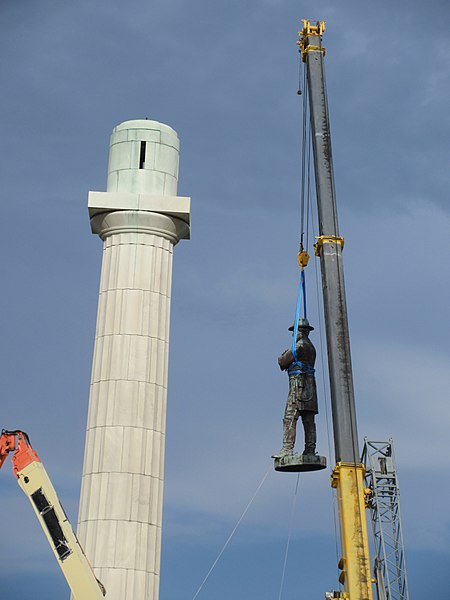
Infrogmation of New Orleans, CC BY-SA 4.0 https://creativecommons.org/licenses/by-sa/4.0, via Wikimedia Commons
That statement can be corkscrewed around like a rollercoaster at Six Flags over Texas. McConnell said it was an “outrageous mischaracterization of my record as a result of leaving one word out inadvertently the other day, which I just now have supplied to you, is deeply offensive.” There are a lot of things deeply offensive about his omission of one word. It sounds more like something from Shakespeare: “The (Senator) doth protest too much methinks.”
It is similar to when President Bill Clinton was skewered for trying to weasel out of his alleged sexual relation by saying: “It depends on what the meaning of the word ‘is’ is.” If Mitch was a Senator from the Pacific Northwest instead of Kentucky it might be easier to go along with his one word omission. But there is a history of omission.
“Because history gives us the tools to analyze and explain problems in the past, it positions us to see patterns that might otherwise be invisible in the present – thus providing a crucial perspective for understanding (and solving!) current and future problems.”
The University of Wisconsin Department of History web site: Why you should study history?
Mitch’s slip and the January 6th assault on the Capitol are those passive/aggressive yearnings for the days of cotton embedded in our national psyche. There just bricks in a wall that still needs to be brought down.
What would the American epoch be if when writing the Declaration of Independence Thomas Jefferson wrote that “We hold these truths to be self-evident, that men are created equal… Jefferson was a Southern slave owner. But, in seeking independence from Great Britain those who wrote and signed the Declaration of Independence knew it had to be “all” inclusive. It can be argued that in this case the concept “all” goes beyond Americans. It was a concept that was not achieved with the first stroke of the pen. It still is a principle that we strive to reach. A simple slip of the tongue reveals more than one might think about how far we still need to go.
https://www.nps.gov/foth/hampton-roads-peace-conference.htm
 mystoryorhistory