Southeast Conference’s Great Awakening

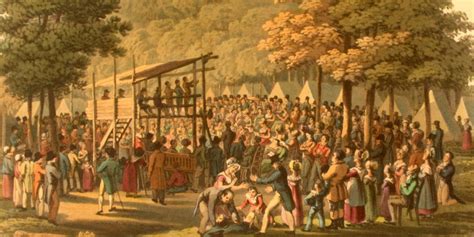
1819 Engraving of a Methodist camp meeting
Library of Congress, Prints and Photographs Division
Author Jacques Gérard Milbert (1766-1840)

Whether you are a football fan or not it is impossible to get through the holiday season without seeing a couple of minutes of football. Afterall, there are about 40 college bowl games on TV starting with the Bahamas and Tailgreeter Cure Bowls on December 17 and ending with the National Championship Game on January 10. If baseball is the national pastime than football is the national religion.

I do not mean any disrespect to any particular religion, but according to vox.com, “The popularity of American sport culture is deeply rooted in the history of a particular kind of American muscular Christianity a conflation of nationalism, nostalgia, piety, and performative masculinity. From the football stadium to the basketball court, American sports have been as much about defining a particular kind of male and typically Christian identity as they have been about the game itself.”

Now, I am not a diehard football fan. I am more of a casual observer of the game. It really is hard for me to get revved up over a match between Western Michigan and Nevada. But I probably will watch some of the College Football National Championship Game between Alabama and Georgia–two Southeast Conference teams. I will admit my interest in the game became more intense when I was in college at the University of Florida. It is hard not to get excited about football in a college town. And Gator football, like many other university football programs, has been around for more than 100 years.

Game day in a college town has the same exuberance and exhilaration, and mysticism of a medieval religious holiday. Not that I have been to an actual medieval fair. However, Gainesville does hold annual Hoggtown Medieval Faire with jugglers and such, but not during football season; but I digress. In a college town just about everything is geared for that Saturday game. Gainesville, like so many other college towns, becomes a sporting Mecca as 90,000 people pack the stadium. That is like putting one-third of the county’s population in one place for the better part of a Saturday. People tailgate with generators, set up outdoor canopies. The landed gentry can come from far away in their RVs. The booster elites seated up on high in their sky boxes. And those not in the stadium are at pubs and such; or home in front of a TV. It is a spectacle with a marching band.

It is also a day you can walk into just about any theater in Gainesville and actually yell “fire” without incurring panic. The panic-like conditions comes after the game moving 90,000 people from the stadium. Gainesville lives for those Saturday games. If the University of Florida left Gainesville and packed up like some NFL teams, the city would be just another rest stop on I-75.

The Florida Gators is a team that is in the Southeast Conference. A conference that was conceived in the old Confederacy. It is a conference that takes football seriously. Every Saturday when two SEC teams meet on the gridiron it can seem like the Vidalia Sandbar fight fought on an island in the Mississippi River. The Vidalia Sandbar duel that took place on September 19, 1827. It was the fight that made Jim Bowie a Southern legend. He was seriously wounded, two others were slightly injured and two others killed. It was this fight that started the myths of Jim Bowie and his famous knife. Southern tempers have simmered since then but the ferocity can be just as intense, particularly when two SEC rivals clash. As in the upcoming national championship game.

College football as a fall collegiate contest is undergoing a dramatic economic shift. It is not unusual for head coaches to have $8 to $10 million contracts and million dollar plus buyouts. States are now passing laws allowing players to earn money on their image and likeness blurring the age old divide between amateurs and professionals–as if that even matters anymore.

This concept of amatures has been long debated. For instance, was the Soviet Union National Hockey Team a team of amateurs or professionals? They were so good that ABC News wrote that “In February 1979, they (the Soviet team) faced an NHL All-Star team that featured an astounding  20 future Hall of Famers in a three-game series. The Soviets won two of the matchups, (tied one) including Game 3 at Madison Square Garden in a 6-0 rout.” Today there are 38 Russian players in the NHL. Sort of reverse if you can’t beat ’em join ’em.

The amature status debate goes even further back. Take Jim Thorpe, the best athlete of his time, and a gold medal winner in the 1912 Olympics. Thorpe, a pentathlon winner, was eventually stripped of his gold medals when it was learned that he was paid to play baseball in 1909 and 1910.
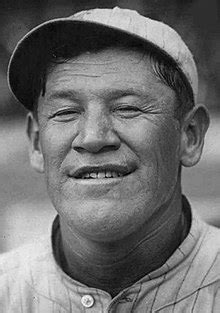
Jim Thorpe’s professional baseball career wasn’t nearly as golden as his amature career. circa 1913 Sporting News photographer unknown.

It is hard to imagine how “professional” baseball was at the turn of the century. This, in an era where owners, for all practical purposes, owned their players’ contracts for life. There was no collective bargaining and no marketing of players’ images. Take the 1919 Chicago White Sox known as the “Black Sox.” Eight players on this team were accused of consorting with gambler Arnold Rothstein and others to throw the game “for money.” A unique concept. This was a time of strikes: The Great Anthracite Coal Strike of 1902, the West Virginia “mining wars” that took place for 1912-22 and the Steel Strike of 1919.

Although the National Guard was not called in on the Black Sox, none of the eight were convicted in the trial that followed. However, Judge Kenesaw Mountain Landis banned the players from baseball for life. Getting paid very little to play a sport back then may have made you a professional; it just didn’t make you rich. But for some college athletes not getting paid at all is about to change.

Some may argue that college football players are already defacto professionals, NFL minor leaguers. NFL teams get to pick colleges’ cream of the crop players while letting the universities develop them for nothing. That nothing is the buffer between professional and amature.

Now, most college football pundits agree that the SEC is the best overall conference in college football. All university programs compete for the country’s best players. To appeal to these young squires universities need to raise millions from boosters to improve football facilities and to pay coaches. It is not unusual for head football coaches to be the highest paid state employee. In return the boosters demand victories. Not just wins but championships for their well-donated money. And the SEC does this extremely well, particularly in football by getting teams into championship games. And, at the beginning of the 2021 NFL season there were 1,696 roster players on NFL teams. Three-hundred and thirty-five of those players, almost 20 percent, are from the SEC.

To keep its preeminence the SEC is pushing out just like the Old South did. In recent years the SEC has pursued a Manifest Destiny mentality in its approach to dominate college football. It may not want to control college football from sea to shining sea but it is definitely preaching its football beliefs and culture. It is pulling in other schools like a traveling minister dunking converts into the healing waters at a camp revival. First it added Arkansas and South Carolina into the league in 1991 as sort of First Great Awakening.

Then Second Great Awakening occurred in 2012. In what seemed like the Missouri Compromise all over again when the conference expanded north of 36 degree latitude to bring Missouri into the fold. It then crossed Sabine River and annexed Texas A & M. Both teams were pulled from the Big 12. This expanded the SEC to 14 teams.

By crossing the Sabine River the SEC had a toe hold in Texas. In its Third Great Awakening the SEC annexed another big chunk of the state pulling in the University of Texas. It then moved north in a “take me to the river and drop me in the water” moment when the conference jumped over the Red River and on to the University of Oklahoma campus. Both teams are scheduled to begin conference play in 2025. Thus, leaving the Big 12 Conference without a big box football program to anchor the league.

According to Forbes “The move means the SEC will have nine of the 12 most valuable college football programs, which generate far more money than any other collegiate sport, while The Big 12 would be left without a single member among the 25 most valuable programs.”

The SEC’s moves have forced the other major conferences to protect their turf. College Football has seen the disintegration of The Big East Conference football and now the disfiguring and stripping away of valuable teams from The Big 12. The other conferences have reason to be concerned, And rightfully so. In the last 10 years the SEC has one seven championship titles with Alabama collecting five of them. Auburn and LSU each of won one. And, oh by the way, we can add Georgia to that list after its 2021 win over who else: Alabama.

https://247sports.com/LongFormArticle/Ranking-college-footballs-most-valuable-programs-Alabama-Michigan-Texas-Georgia-Ohio-State-Oklahoma-178007658/#178007658_1

https://www.forbes.com/sites/nicholasreimann/2021/07/30/texas-and-oklahoma-to-join-sec-in-colossal-shakeup-of-college-sports/?sh=204beb5021d8

https://247sports.com/LongFormArticle/Highest-paid-college-football-coaches-by-salary-for-2022-179113242/#179113242_1

https://www.vox.com/identities/2017/9/27/16308792/football-america-religion-nfl-protests-powerful
A Republic, if you can keep it.

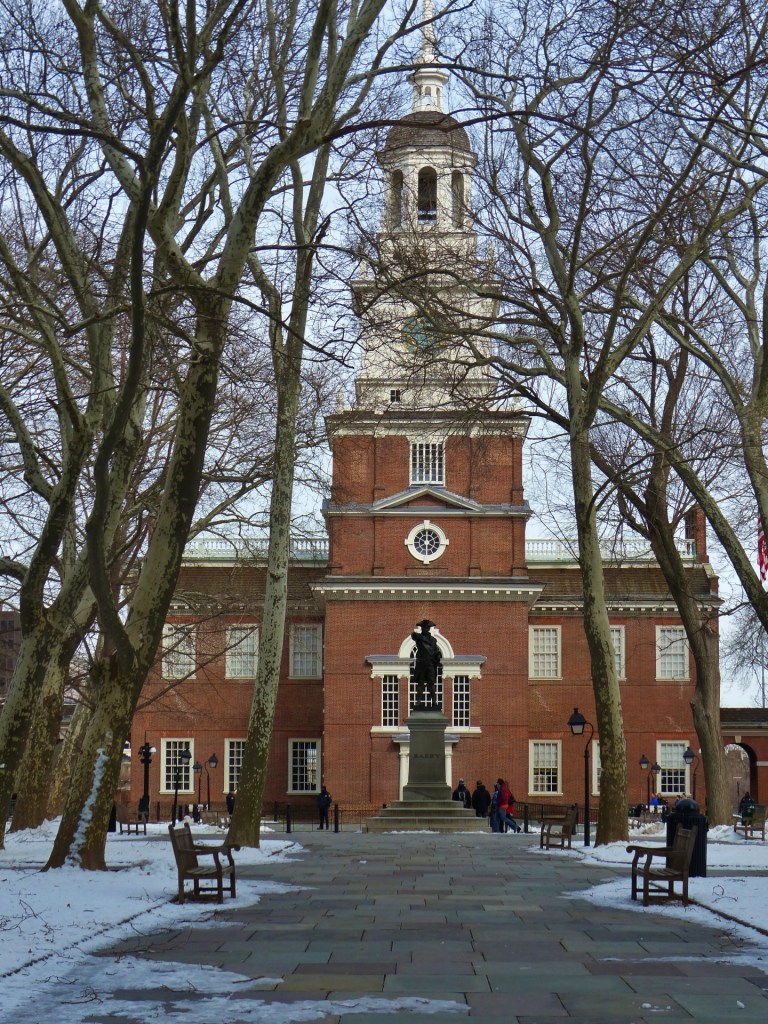
Independence Hall
publicdomainpictures.net

One of the many stories handed down about Benjamin Franklin is the one when he was asked coming out of Independence Hall about the new government that was hammered out during that long hot summer of 1787. He replied, “A republic, if you can keep it.”

Just about every news cycle carries at least one story or an editorial about how America’s democracy is in jeopardy. It is not democracy that is in harm’s way. It is our federal Republic form of government that we should be concerned with. Most people will still be able to vote. The question is who will end up representing them.

The government that got the states through the Revolutionary War, The Articles of Confederation, the “Join or Die” motto that held the the states together in war, was a loose confederation and not collectively or commercially effective at keeping them united in peace.

A quick review of 7th Grade Civics and history would indicate that the those who sweltered away in Philadelphia that summer did not trust each other any more than they trusted King George III. In some cases they trusted each other less. At least George III was 3,000 miles away and weeks away by ship. To Marylanders, Virginians were just a ferry boat ride across the Potomac River.

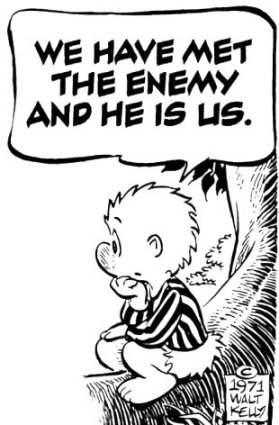
Walt Kelly distribution by the Post-Hall Syndicate.

With the King out of the picture it was sort of a Pogo moment between the states: “We have met the enemy and he is us.” The solution: A new form of government. What Franklin did not explain when asked what they came up with was actuality a federal republic. As further review, a republic is a government where the officials are elected by the citizens to represent them. Our republic is designed where governmental power is shared between local, state and federal authority. For instance, FBI agents do not go around issuing parking tickets and deputy sheriffs do not investigate espionage. It is a government where nobody has to much power. It is a government with checks and balances and all sorts of stated and implied, but yet elastic and nebulous interconnected-powers that makes sure everybody is going to play nice. It was, and still is, a unique sharing concept for the times with the various branches and levels of government given specific delegated powers.

However, any document written in 1787 is bound to have holes in it. For instance, the Constitution does not address how governments deal with a pandemic. In many ways that is the genius of the Constitution. It is flexible enough to allow governments to do what is “necessary and proper.”

But here again, what is necessary may not be proper to some. Today, certain politicians are sniffing around the Constitution like Rat Terriers hunting vermin. One hole that they have found is the Tenth Amendment to the Bill of Rights. In order to get the new government approved a Bill of Rights had to be added. And probably the most nebulous amendment in the Bill of Rights is the Tenth.

The powers not delegated to the United States by the Constitution, nor prohibited by it to the states, are reserved to the states respectively, or to the people.

Tenth Amendment

According to Legal Information Institute: “The Tenth Amendment helps to define the concept of federalism and the relationship between Federal and state governments. As Federal activity has increased, so too has the problem of reconciling state and national interests as they apply to the Federal powers…” The power to tax and set regulations like mask and vaccination mandates, which have been argued vigorously at federal, state and local levels across the country. These mandates have been hauled into courts with mixed reviews. Even the ongoing Roe v Wade Supreme Court debate is shrouded in federalism. One of the questions before the Court is can a state overturn a Supreme Court decision along with allowing civil awards to citizens in upholding a state’s anti-abortion law.

It is not my intent to give a Civics lesson because that would be boring. But I once heard a math teacher say he would rather teach math then Civics. His reason was in math everything is cut and dry: One plus one is always two. Concepts like whatever you do on one side of the equal sign you have to do on the other. Theorems, equations can be proven. Math is not like the Senate saying we cannot approve a Supreme Court justice in election year and then turning around four years later and erasing the equal sign from the chalk board saying we moved the equal sign so we can now appoint a justice in an election. With math there is no argument where the equal sign goes. The problem with understanding Civics is that it seems as if variables can be plugged in whenever and wherever it pleases the person, or group, with the power cord. Today, time tested truths are being tested for popular political expediency. And in some cases, disrupt the checks and balances established in the Constitution like the January 6th assault on the Capitol.

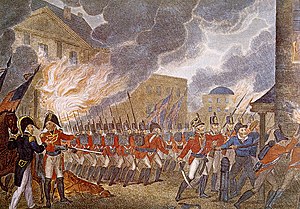
The British Army burning Washington DC during the War of 1812 Book: Paul M. Rapin de Thoyras, Public domain, via Wikimedia Commons

The recent claims that the 2020 presidential election was stolen or rigged hinges on variables being plugged in all over the place–literally in states across the nation. It is alway easier to prove something false. In this case, the claim of election fraud has not been proven true but many still ascribe to that belief. What we have witnessed in this case was an attempt to move the equal sign. But moving the equal sign around did not prove a false claim. It would seem that if it was proven true, then it would be easy to invalidate just about every election held since the 1900s, particularly when Jim Crow controlled the voting roost. What we are witnessing is our concept of a federal republic being stretched like an elastic band. Certain groups in various states are changing voting laws that will in effect determine what party has better chance of electing representatives to office.

Under the Constitution voting is not delegated to the federal government. It is left in the hands of 50 individual states. States can decide most everything from redistricting, to who votes, where and how they vote–and how those votes are counted. So much of this is determined by political parties that wield the power in the individual states. And to add another cog into the voting machinery throw in the Electoral College and we are now off to the political races.

The January 6th assault on the US Capitol was a physical attack to stop the federal government, Congress, from certifying elections results held in the individual states. A constitutionally delegated power. However, a minority of elected members believed that it was a stolen election. Now, some states are scrambling to change voting laws and regulations to guarantee a victory, or in essence, legally steel the next election.

What we are witnessing with these changes has nothing to do with voting integrity or security but a frontend-legal rigging of elections to ensure a desired outcome. Changing voting laws at the state level will then affect the representation at the federal level. Especially, when this process his handled under the auspices of political parties.

It is interesting to note that the Constitution does not mention, delegate or prohibit political parties. James Madison wrote about “faction” or what we would call political parties in the Federalist Papers No. 10. He wrote that. “So strong is this propensity of mankind to fall into mutual animosities, that where no substantial occasion presents itself, the most frivolous and fanciful distinctions have been sufficient to kindle their unfriendly passions, and excite their most violent conflicts.” And, boy have we seen some unfriendly passions at public meeting and street gatherings of late.

“The most common and durable source of factions, has been the various and unequal distribution of property….” “A zeal for different opinions concerning religion, concerning government, and many other points, as well of speculation as of practice; an attachment to different leaders ambitiously contending for pre-eminence and power.”

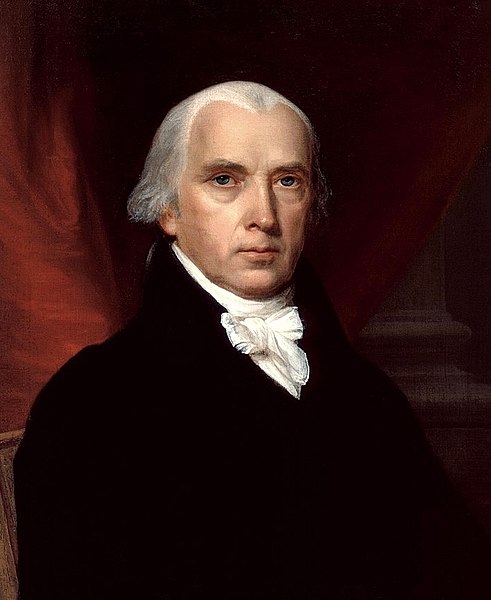
James Madison

He further states, that these factions; or what we would call the bases of the political parties today have created “instability, injustice and confusion (that have been) introduced into the public councils.” Madison calls this a “mortal disease” which has toppled governments everywhere “where the public good is disregarded in the conflicts of rival parties.”

James Madison, Father of the Constitution and the 4th President.
John Vanderlyn, Public domain, via Wikimedia Commons

What makes our political situation interesting is that Madison and others of his time were worried about a majority dominating the government and denying the minority the rights embraced in the struggle against Great Britain. Today it is not a majority that is trying to disrupt the the republican established powers of the Constitution. It is a minority political parity. It is the slow tectonic shifting of political power. It is a minority of politicians in various states cheered on by their federally elected brethren to change state voting laws. It is the practice of ambitious leaders “contending for power and preeminence” by changing elections laws ever so slightly to hobble its opposition.

If a faction consists of less than a majority, relief is supplied by the republican principle, which enables the majority to defeat its sinister views by regular vote: It may clog the administration, it may convulse the society; but it will be unable to execute and mask its violence under the forms of the constitution.

James Madison

Madison writes that there are “two methods methods of removing the causes of faction: The one by destroying the liberty which is essential to its existence; the other, by giving to every citizen the same opinions, the same passions, and the same interest.”

Basically what Madison is saying, and neither solution is acceptable, is one side must destroy the other side. This is something we are seeing now with the so-called voting laws to protect the “integrity” of elections. With razor thin margins of victory in many states, creating election laws that hinder an opponent’s supporters from voting may give a minority an electoral majority.

Although Madison was talking about the size of Republics he wrote that “each representative will be chosen by a greater number of citizens in the large.” Thus, making it “more difficult to elect “unworthy candidates to practise with success” their vicious arts.

Benjamin Franklin said that we need to be vigilant about our rights and “if animosities arise” we should look to the party “which unfurls the ensigns of public good. Faction will then vanish, which if not timely suppressed, may overturn the balance.”

It has been a balance of “We the People” and not of “We the Party” that has enabled us to keep our Republic. By constricting voting we can still claim to be a democracy but will we still be a Republic. Rome was not built in a day and it did not lose its Republic in a day either.

https://founders.archives.gov/documents/Madison/01-10-02-0178