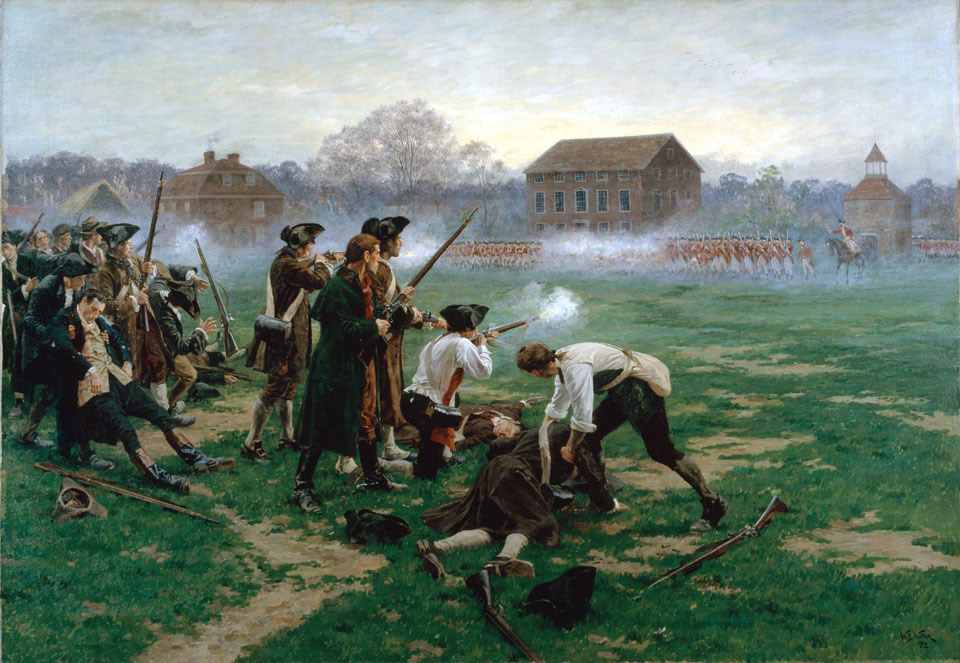
A well regulated Militia, being necessary to the security of a free State, the right of the people to keep and bear Arms, shall not be infringed. The Battle of Lexington by William Barnes Wollen National Army Museum Wikimedia Commons
I was nowhere near Kenosha, Wisconsin on the night of August 25, 2020 when rioters and looters met up with Kyle Rittenhouse and other so-called militiamen. They might feel like modern Minutemen but others might call them, and rightfully so, vigilantes. In either case, I could not begin nor would I try to unravel the mind frame of the individuals, armed or otherwise running through the streets that night. To say that there was any rational thought taking place that night is not really up for debate. The same could be said of the Second Amendment debate following Rittenhouse’s acquittal.
Many are saying that Rittenhouse’s trial is a victory for self-defense and the Second Amendment right “to keep and bear arms.” I am not really sure if that it is so. The right to bear arms will always be debated but never be in jeopardy. But probably one of the most ignored phrases or clauses in the Constitution one that gets batted around like a handball; and gets lost in any Second Amendment debate, is the first phrase concerning the necessity of a “well regulated Militia.”
There are many arguments about gun ownership and a militia. The exact legal definition of “well regulated” civilian militia, has not been completely addressed. If a civilian militia cannot be determined what it is, it might be easier to determine what it is not. For instance, well regulated militia is not a Western posse out looking to lynch horse thieves and cattle rustlers. And it is definitely not an ad hoc group of gun owners protecting a used car lot.
A very brief look at the concept of a well regulated militia can be traced back to England’s Glorious Revolution. It made its way across the Atlantic and into the New World basically out of necessity. The way it shapes out in America in the 1700s is that in order to form a militia the individual militiamen needed to arm and equip themselves. Hence, the need to bear arms.
The Militia Act of 1792 required that all able-bodied white male citizen between the ages of 18 and 45 be enrolled in the militia. (An interesting concept. I wonder how many white males would willing enlist today.) It also stipulated that each militia member “provide himself with a good musket or firelock, (or rifle) a sufficient bayonet and belt,” among other accoutrements. Again, the need to own, and keep a musket or rifle was an essential part of the local “well regulated” militia. In essence, you could not have one without the other.
The act makes some sense when we look at the frontier lifestyle of early Americans and the education of James Madison and others of his time who wrote the Constitution. Their education was steeped in the classics of Rome and Greece. In the beginning of the Roman Republic only a Roman citizen could be a legionnaire. And, as in Greece, it was up to the citizen to provide for his own equipment. The concept of the citizen-farmer leaving his plow and taking up his shield was rooted in the ancient world and grew and nurtured in the English colonies.
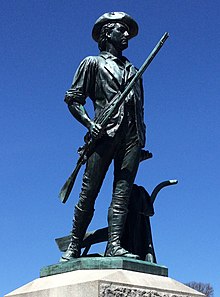
And fired the shot heard round the world. The Minute Man by Daniel Chester French National Parks photo
For most of our history state militias were an integral part the local and national defense. However, their training and performance in combat was suspect, particularly during the Revolutionary War. Militia units were never the most reliable troops on the field of battle. In the Revolutionary War, British troops could break militia units with one volley of fire and then get them high-tailing it off the battlefield for home with a bayonet charge.
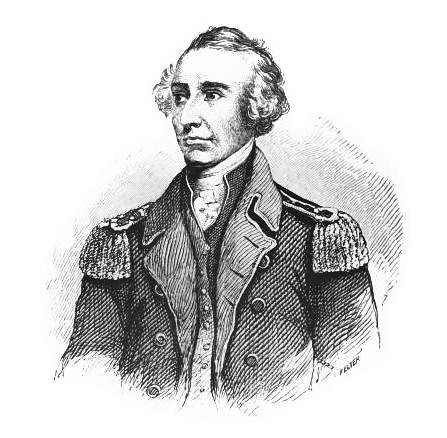
George Washington knew that if the United Colonies were to gain their freedom they would need a “well trained” Regular Army. It was Baron Von Steuben, a Prussian, who Washington looked to whip his tattered army from civilians into soldiers who could stand toe-to-toe with one of the best trained army in the world. This is not to say the militia did not play an important role in defeating the British they did. It was, however, more in the role of irregular troops lead by the likes of “The Swamp Fox” Francis Marion and others: harassing British foraging parties and supply columns. Fighting more like the Native Americans than shoulder to shoulder soldiers.
During the Civil War armies were almost exclusively volunteer. Units were recruited and trained at the state level. They did nearly all of the fighting and dying. At the time the US Army had less than 20,000 soldiers, and those that did not resign to join the Confederacy, were mostly posted across the frontier.
It was not until the Spanish American War did the need for a better well regulated militia become obvious. There was a lack of leadership, training and standardized equipment in state militias. The Militia Act of 1903 aimed to address the discrepancies among state militias. The Act reorganized state militias into what we now know as the National Guard. The Act ensured that there was a basic standard of training, leadership, equipment and organization in Guard units, not an ad hoc group of civilians showing up with a variety of weapons and uniforms on a whim.
Since then, the National Guard has become significant and integral fighting force of the US Army. The term part-time soldier probably does not apply to National Guard units that served multiple tours of duty in Afghanistan and Iraq.
But despite being well regulated, the Guard has had a few moments where they found themselves in confusing circumstance where their leadership and training was called into question. For instance, on May 4, 1970 Ohio National Guardsmen shot and killed four Kent State students and wounded nine others. This occurred during a demonstration protesting President Richard Nixon’s expansion of the Vietnam War by invading Cambodia.
Like Kyle Rittenhouse, some Guardsmen said they feared for their lives. Some felt they were being surrounded, others feared snipers and the general press of the demonstrators. Whatever the fear, it was a breakdown in leadership. Eight Guardsmen were indicted with the intent to deprive students of their civil rights. None was convicted. In the judge’s opinion he said:
“It is vital that state and National Guard officials not regard this decision as authorizing or approving the use of force against demonstrators, whatever the occasion of the issue involved. Such use of force is, and was, deplorable.”
Judge Frank J. Battisti
The Rittenhouse verdict should be viewed in the same manner. His acquittal should not be a decision “authorizing or approving” armed, untrained civilians to use lethal force against fellow citizens. Military tactics and club swinging police with dogs wading into crowds is an ineffective solution as seen at Kent State, during the 1968 Democratic Convention in Chicago or in any city dealing with riots. According to the US Army’s Field Manual on Civil Disturbances:
Crowd control requires its own thought process. Emphasis should be on prevention rather than confrontation. In combat, military forces are taught to fight and eliminate threats. In crowd control, military forces must deal with noncombatants that have internationally (Constitutionally) recognized rights. These rights must be respected while maintaining public order.
Partisan, politically motivated civilian militia, with teenagers armed with long rifles, is an unregulated mob, not a “well regulated militia.” Because of their lack of training and organization they have no business being on the streets. They are not the modern day Minuteman defending public safety or property.
https://www.npr.org/2020/08/30/907720068/are-citizen-militias-legal
 mystoryorhistory