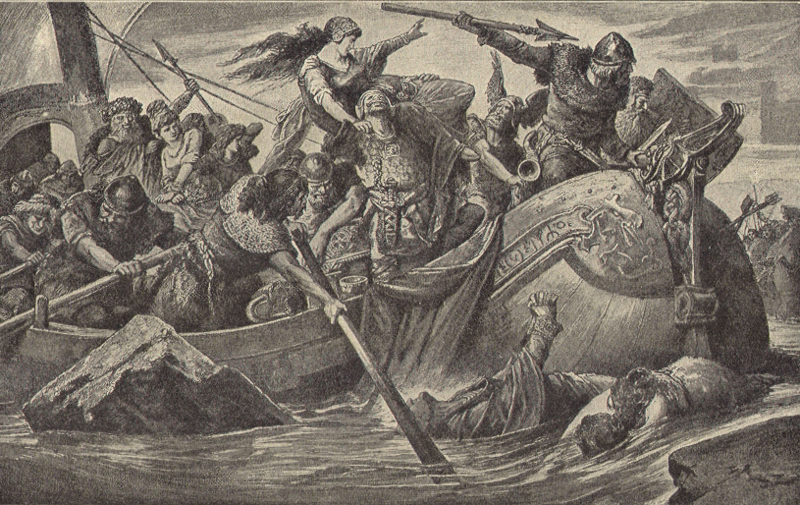
John Haaren: Famous Men of the Middle Ages
wikimedia commons
There may never have been a more conspiratal time in history than now. Fueled by ludicrous theories we have taken up some bizarre beliefs that one day people will say “what were those people thinking.” Some of these wild theories do not even fit into the belief that the Earth is flat or that the Sun revolves around the Earth. Our brains have always tried to fill in the unknown phenomenon we observe with whatever the mind can make up. Some people will say it is this while others will say its that.
The problem we are facing now is we invent the scenario–like Puritan prosecutors finding witches and then burning them– just so we can fill in the blanks and prove a point. We have been inundated with theories on how the 2020 election was stolen right out from under our noses–searching for ballots printed on Chinese bamboo paper. We are being confronted with such newly hatched concepts as woke, cancel culture, critical race theory, and Jewish lasers blasting away from space. There seems to be a greater interest into investigating UFOs then investigating how 10,000 people were able to storm the Capitol Building. Instead, we treat the assault on Nation’s Capitol as if it were some sort of “Black Friday” shopping event at Walmart.
I don’t get any of it. I have no real understanding of being woke. To me woke is when the guy across the street is cranking-up his Harley with straight pipes at 5 am in the morning. And cancel culture sounds bad just because of the word cancel. It’s like going to the airport and seeing your flight has just been xed from the board.
But what is this fascination with culture. I am going to bastardize a quote supposedly attributed to Mohandas Gandhi when asked what he thought about Western Civilization (culture): “I think it would be a good idea.” That’s right up there with the farmer when asked about culture. His reply was “the only culture I know is agriculture.” And herein lies our problem. It creates either a narrow view on the world around us or an over blown condemnation of what we disagree with.
For some reason when I think about American culture I think of how we super-size everything from just a plain old jet airliner to a “jumbo” jet; a hamburger to a “Whopper; and a 16 ounce Coke to a one-gallon bucket of soda with a two-foot straw. “Give me the number three meal deal and supersize it with extra fries.”
The time we live in makes it hard for a good idea to seep up from the primordial ooze that has us wading hip deep in ignorant nonsense. A good idea is like trying to find hen’s teeth in the barnyard. (Or common sense in Congress.) Today, an “idea” gets narrowed down to two choices: this and that. “If you cannot believe this then you gotta believe that.” Nothing expanded in-between. For some reason Mitch McConnell’s face pops into my mind. I am not sure if he is “this” or “that.” I think it depends on who is president.
Take The New York Times 1619 Project. Now I have to admit that I have not read it–but why should that stop me or slow me down from spouting off what I think. I do believe “that” in 1619 the first batch of enslaved people from Africa arrived in Virginia to meet the labor and economic needs of the English settlers. I also know “that” the Project has angered a lot of people who do not necessarily want to believe in “that.” They would say “I do not believe in “that” I believe in “this.” And now it becomes sort of hostile Beta v VHS marketing thing.
But in this age of bizarre theories and conspiracies I find I am no different. I am going to go off on my own theory. I believe all of the troubles and woes that we are experiencing today can be attributed to the English: Great Britain our “mother country.” My theory looks at “Merry olde England” long before it was a jolly good place. It is my contention that England was subjected to some of the most aggressive invaders around and that in 1607 their ancestors landed here bringing those aggressive qualities with them. Qualities that still linger on like a musty smell in a mildewed basement. The North American eastern coast was flooded with some of the most stiff-necked religious fanatics in New England; arrogant aristocratic cast offs in Virginia to plain old convicts and debtors in Georgia.
When you look at British history you realize the Brits come by it honestly. They were always beating back invaders starting with the Romans and all the way up the Nazi air assault in the Battle of Britain. The Romans were the first to come ashore way back in 43 BCE. I am sure it could be argued that they brought with them a certain amount of “Mediterranean civilization and culture” to the Celtic Brits. The Romans hung out in England for the next 400 years integrating and mingling with the local Celts. But once Alaric and his Visigoths sacked Rome in 410 things changed in England. The Romans moved on but no doubt left behind their methodical means of governing and the controlling and managing of foreign outposts and trade. When it came to infrastructure, Romans showed the Brits how to build a 70 plus mile wall in less than 10 years. Something the Trump administration failed miserably at. Good old Roman know how that would serve future Englishmen well.
With the Roman Legions gone a new wave of settlers took up residence in England. As Europe descended into the Dark Ages, the Juts, Angles and Saxons from Northern Germany rowed or sailed across the North Sea. It seems that the Romans built Hadrian’s Wall in the wrong location. In any case, it is this group of Germanic “barbarians” that created the first beginnings of an English country and culture.
However, everything was not so idyllic because the next invasion was bit more vicious. Norsemen, Vikings began raiding England around 790 AD. If the Romans were methodical about maintaining a foreign province, the Vikings introduced methodical plunder and pillage to England. But maybe the most important legacy the Vikings left behind is their seafaring skills. Again, another trait that would serve future Englishmen (and America) well.
The sight of Viking raiding ships coming ashore could create wholesale panic and carnage; but in some cases Viking settlements. This brought the Anglo-Saxons into contact with Viking vitality and leaving them with a certain amount of hybrid vigor. My sense is that Vikings were not shy about taking what they wanted and staying as long as they pleased. If the Vikings were visitors knocking on the door to say hello they soon became house guests that stayed around for the next 300 years before moving back to Scandinavia. If one can say the Romans taught the Brits how to manage government and other affairs of state, the Vikings probably instilled in those Anglo-Saxons that things are always ripe for the picking and taking. And numbers never mattered when it came to conquering indigenous people. Just look at the British centuries-long control of Ireland and India.
It may be hard to believe but by 1066 another group rowed passed the White Cliffs of Dover: The Normans. The Normans can also trace their ancestry back Norsemen. Generally, it could be said that the Normans took their martial skills from both the Romans and Norsemen. A big difference is that the Normans were not the pagans of the past. They had that Catholic zeal infused in them. Not only did the Normans invade England; they invaded Italy, Sicily the Iberian Peninsula, and North Africa. They killed the last Anglo-Saxon king, King Harold, at the Battle of Hastings in 1066 and did not relinquish the British Isle again. It is believed that the Normans introduced the feudal system creating a landed aristocracy and built upon what the Anglo-Saxons had developed.
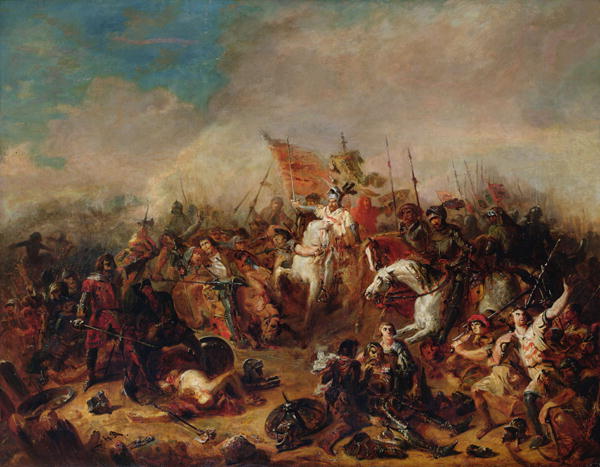
Musee des Beaux-Arts, Caen, France, Bridgeman Art Library
Francois Hippolyte Debon. “The Battle of Hastings in 1066”
Of course, all of this is just one giant generalization. But when you look at America history it is laced with Romanesque causes. If anything, America is the modern self-actualization of English heritage. Before Eastern seaboard cities were settled, American explorer like their Vikings forebears, were continually looking for a Northwest Passage. When they finally realized they could not sail through or around North America (this could change as the ice caps melt) they settled down like Normans and came up with Manifest Destiny. It was the destiny of those early Americans (Englishmen really) moving steadily and quickly like Medieval Normans, from the Atlantic to the Pacific. Taking land, like Texas, and most of the Southwest from Mexico, when they could not buy. It was not until 1869, with the completing of the continental railroad, a project like a giant Roman Aqueduct or the Appian Way, that the two oceans were linked. A New World Roman engineering feat done American style.
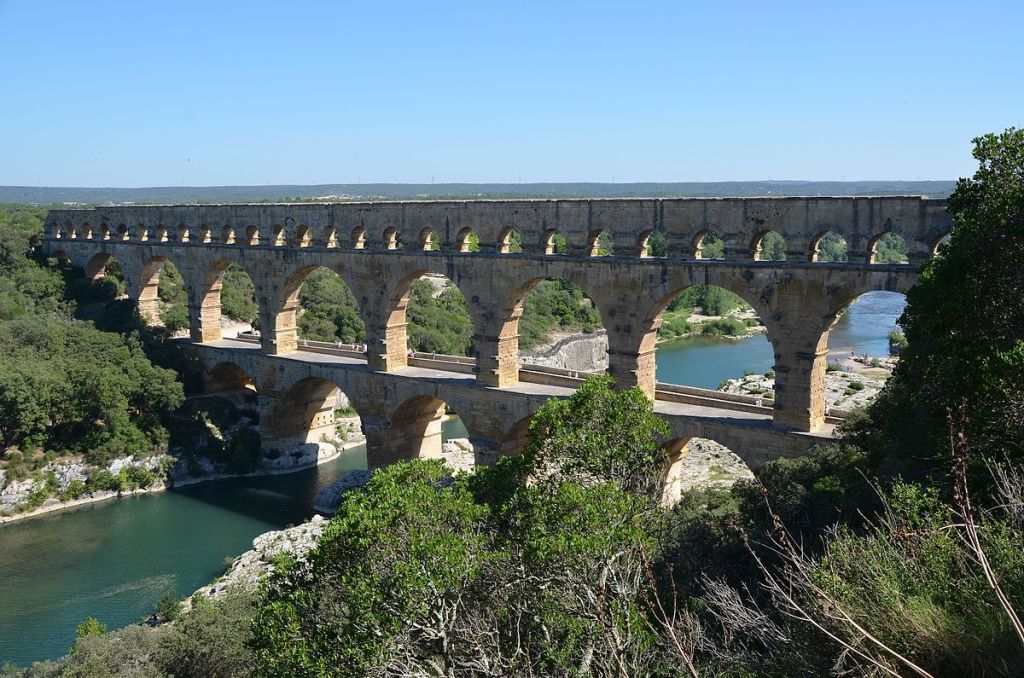
Carole Raddato
We also inherited the Norman’s social hierarchy. A landed aristocracy with disgruntled lower classes, like the Scots-Irish, who came to populate huge swaths of colonial America. These are the Americans, like the Hatfields and McCoys, that would fight for years over who owned a free range hog. The Scots-Irish were followed by a myriad of non-English immigrants who would take their place at the bottom of the social pyramid.

Wikimedia Commons
unbekannt nach einem Gemalde
I know I have not mentioned some of the finer accomplishments we get from our British ancestors–like William Shakespeare and Jane Austen; the scientific brilliance of Isaac Newton or Stephen Hawking. I would bet that if Shakespeare or Austin were writing today they would be attacked for their lack of wokness or had their book deal or plays canceled. Adam Smith’s Wealth of Nations would be considered as a global system of exploitation. So many good ideas would have ended up fossilized to be dug up later like dinosaur bones to be pieced together. Never to be debated or enjoyed.
 mystoryorhistory