The Covid-19 World War

I was not around during the beginning of World War II when Germany invaded Poland in September of 1939.  The Nazis had belief in the need for Lebensraum. Eminent domain was one of their many ethos that was backed up by force of arms. Simply put, they needed more living space and Poland and most of Central Europe was condemned property waiting to be re-developed

It is the post Polish invasion that reminds me of today’s battle with the coronavirus: Corvid-19. After Germany invaded Poland, France and England declared war on Germany. All sides sat around looking over their gun barrels for the next eight months in what was called a Phoney War.  There were a few minor battles but all sides were content at this time to prepare.  Britain began preparations for an aerial blitz that was sure to come. A conscription was put into place as well as rationing and the commandeering of public transportation for military use.  The Phoney War put them at ease, and made them little disgruntled with government efforts in the lew of any real combat.
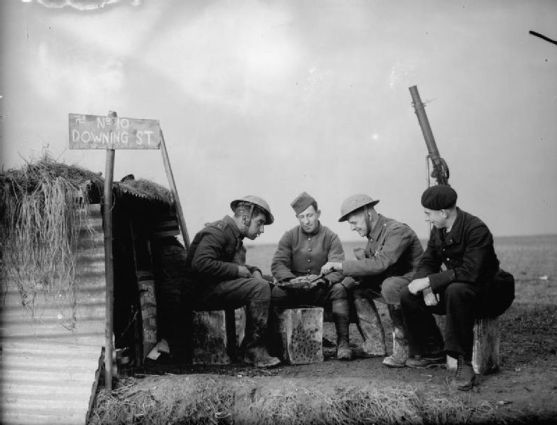
Allied troops sheltering in place

Despite the preparations neither side had any idea how this Phoney War turned out to be a life and death struggle. Little did France realize what would hit them in May of 1940.  German tanks rolled through France and on to the Atlantic in less than a month pulling France down.  The British barely had enough time to get their troops off the continent and  began the process of sheltering in place on their island fortress .

Before I go on any further there is no way that I am comparing the Nazi swarm to a coronavirus–the Black Death maybe.  But France and Britain  had eight months to prepare for war in which they declared. And the way the Germans rolled them up makes you wonder how well they used that time getting ready for the inevitable, particularly after witnessing how quickly the German army and Luftwaffe–along with the Soviets–put Poland in a box.

What puzzles me is that we watched what happened in China as the coronavirus roared through Wuhan, a city of eleven million. And much like the British and French in 1939, we just looked with unmasked faces during the month of January and February watching and waiting as the coronavirus marched through Italy.

For most of our history as a nation the two oceans have protected us from all foreign enemies.  These oceans may have even protected us to some extent from viral airborne invasions.  But the global world in which we live events and diseases can jump oceans and continents over night. A slow moving local disease can now become a blitzkrieg.

It was not long before the United States was dragged into the world at war. Much like our other Allies we were not prepared for battle. To quote a turn-of-the century Secretary of Defense who said before launching the nation into a decade of war in the Mideast: “You go to war with the army you have, not the army you might want or wish to have at a later time.”

Unfortunately, that is true and can be said about many things. But in World War II the United States got up from being sucker punched and began producing enough war material to supply not only our own armies but our Allies, too.  It was Rosie the Riveter: “We can do it.”

It brings to mind the story of the aircraft carrier USS Yorktown.  Badly damaged at the Battle of the Coral Sea, the Yorktown managed to get back to Pearl Harbor for repairs.  Engineers determined it would take at least two weeks around-the-clock to make the repairs needed. The problem was Naval Intelligence discovered that the Japanese Imperial Navy was in the process of invading Midway Island. They did not have two weeks. Admiral Chester Nimitz told the Navy Yard that the Yorktown was needed and that they had two days to get the Yorktown out to sea. Much to the surprise of the Japanese navy, the Yorktown was there and played a significant role in America’s victory, a victory considered the turning point of the war in the Pacific.

During that war we were cranking out tanks, airplanes and ships by the thousands not to mention all the other necessities.  I find it difficult to believe a country that could build a space program from the ground up, put a man on the moon and bring him back safely today cannot provide enough surgical masks, cotton swabs, and other simple medical needs to combat covid-19.

Granted, we might not have the necessary equipment now but in the past we could and did what needed to be done get the job done.  We may be going to war with the health system we have, but that needs to change. It is time to step up the A(merican)-game. Instead of talking about making America great again, realize We can do it!
Art of the Deal or a New Dealer

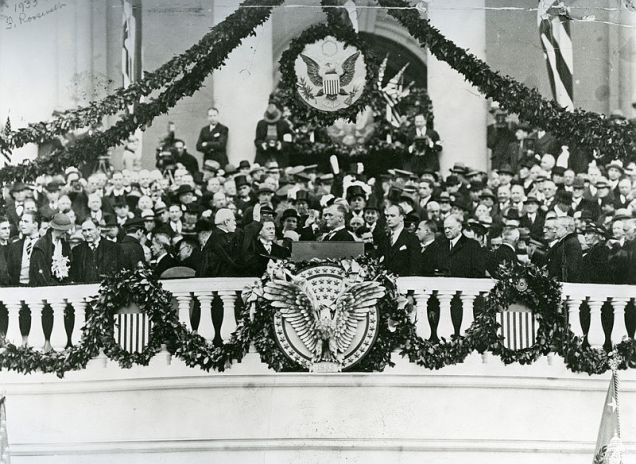
It is ironic that it was March 4, 1933 that Franklin Roosevelt gave his first Inaugural Speech. Most historically cognizant Americans may know only one thing from this speech and that is when Roosevelt told the country: “let me assert my firm belief that the only thing we have to fear is fear itself.”

The difference between now and then is that in 1933 the country was in the grip of the worst depression or panic the country has ever faced. More than 25 percent of the work force was out of a job. Businesses took it on the chin, too, losing $6 billion. Six billion sounds like chump change today. And it sort of is. When you adjust the 1933 loss for inflation that is close to throwing  $115 billion out the window today.  Jeff Bezos alone is worth close to $120 billion.

Today, we are witnessing a stock market collapse that is a throw back to the last recession but this time we can add a little oil to the fuel as the energy markets melt down. And of course the  pandemic virus adds to our economic woes with the possible overwhelming of our healthcare system.

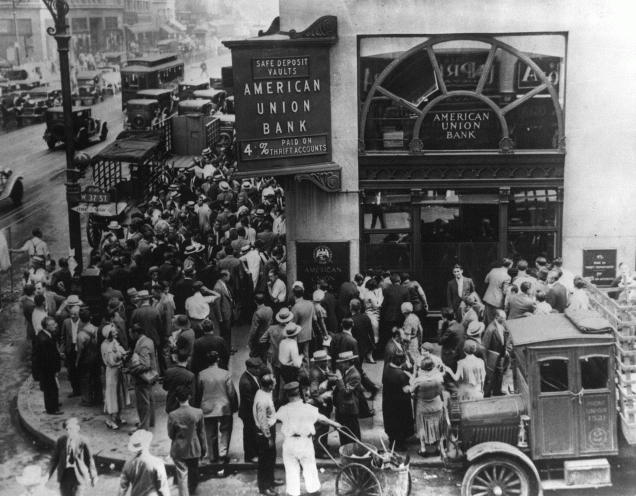
A bank run during the Great Depression or as Yogi Berra would say “A nickel ain’t worth a dime anymore.” If you could get a nickel for your dollar.

Historians say that the Great Depression kicked off on October 24, 1929 during Herbert Hoover’s Administration when the stock market tanked. Five days later the Dow Jones Industrial  had dumped 22 percent of its value.  This was a time investment bankers saw their portfolios go out the window. Contrary to popular belief, only two people literally followed their investments out the window


That was just the start. The Hoover Administration’s laissez faire affair approach did not help.  The idea of letting the markets do as they will was not working.  By 1930 consumer confidence went out the window with the Dow Jones. Interest rates were at rock bottom levels. production fell as did wages. Before long the country was in a deflationary spiral. Demand for goods fell, prices fell, wages kept falling and so did the Gross Domestic Product. Some estimated it fell by 15 percent. And we argue about 2 percent growth in the GDP as being a bad thing. Are things sounding familiar?

In the 1928 Presidential campaign Hoover campaigned on the promise of a “chicken in every pot and a car in every garage.” Boy would those roosters come back to peck Hoover. That little slogan sounded good at the time but I am sure it did not play well when people started bum rushing  banks trying to get their money out before banks defaulted. Forget about the car in the garage. When this was done people would be lucky to have a pot to piss in

Hands in pockets maybe but John D Rockefeller’s net wealth adjusted for today’s inflation was close to $420 billion.

Blaming Herbert Hoover for the Great Depression would be like blaming Donald Trump or even Barack Obama  for the coronavirus. The 1930s global economy was global pandemic waiting to happen. It was cooking off like a steaming tea pot.  Like the good business conservative Hoover was, he followed the belief of cheerful optimism that things are going to get better. And they usually do. But face it, when you have an old business tycoon worth $1.4 billion like John Rockefeller, probably the richest American ever,  sayingThese are days when many are discouraged. In the 93 years of my life, depressions have come and gone. Prosperity has always returned and will again.”  And he was right.  The business cycle is a double feature much like a roller coaster. It is a sure thing if it is going up at some point in time it will come back down and vice versa. However, for the out-of-work souls standing in a soup line that sounds encouraging but the real question was when. In the meantime, “brother can you spare a dime.

Today’s creeping coronavirus and the collapse of the oil market has not created soup lines or a rush on hospital beds–yet. It is, however playing havoc with the fear factor.

In his first Inaugural Address not only did FDR address fear but he also said, “Only a foolish optimist can deny the dark realities of the moment.” The dark realities of the Coronavirus may be embedded in its DNA but its stark realities are more than likely going to manifest in our bastardized healthcare economic system. Much like the 1929 stock market and banking collapse our healthcare system is humming along making profits for insurance companies, medical companies, pharmaceuticals and just about anybody else who can tag on to the medical gravy train. The question is if this pandemic gets out of hand what will happen to this single-payer profit system. It’s not where the buck stops put who will pick up the check.

In the Democratic debates we have heard a lot about “progressive ideas” that to some, border on socialism; or worst communism. One campaign slogan: “Medicare for all”  or “Universal Healthcare” already has people heading the Sheep’s Gate waiting for the stirring of the waters at the Pool of Bethesda to make them well of whatever disease they have.

Maybe one of the first National Healthcare Plans:The healing waters at the Pool of Bethesda

What Roosevelt stressed was a New Deal “because the rulers of the exchange of mankind’s goods have failed, through their own stubbornness and their own incompetence, have admitted their failure, and abdicated. Practices of the unscrupulous money changers stand indicted in the court of public opinion, rejected by the hearts and minds of men.”  We might not be there yet when it comes to healthcare. But we could be one patient away from a run on hospitals.

Now far be it for me to say what is what in the Healthcare Industry. It does, however, seem to be a system run for and by “unscrupulous money changers.”  I would venture that in the hearts and minds of most Americans there is some sort of agreement about changes to a system that favors profits over health. For some reason people are leery of a single payer national healthcare system. I think I can bastardize Churchill’s quote on capitalism and socialism by inserting the current healthcare system  is the unequal sharing of blessings (profits) with the inherent virtues of the equal sharing of miseries (lack of actual care).

I am not advocating for a single payer government system. However, the idea of national health insurance is nothing new.  FDR’s cousin Teddy Roosevelt, another reformer,  was bouncing the idea around when he ran for president in 1912.  Harry Truman tried unsuccessfully in 1945. John Kennedy floated the concept about, too. It was President Lyndon Johnson, a Roosevelt New Dealer, who managed to pull it off in 1965 for people over the age of 65. And here we are in 2020 debating the merits of Medicare for all.

At this moment there is a lot of speculation as to the short term and long term effect of the coronavirus on the world’s health as well as the economy.  Some countries have taken drastic quarantine measures. China even built two coronavirus hospitals in one week. Granted, this pandemic could be like a 25 year storm, but if it becomes worse it could possibly swamp our healthcare system creating a real need for a “new deal.”