
I always have to laugh when comedians make jokes about the inappropriate uncle who opens his mouth and jumps right into the water with the sharks. He has no idea about political correctness, he is a conspiracy nut and can go on for hours about the Illuminati’s attempt at controlling the world. In some cases he just lacks the social graces of correctness: whether it be political or just plain manners. It could be something as simple as loudly passing gas at the Thanksgiving table or pontificating his archaic views on race and gender equity. He is not a person we give permanent markers to. We would like to assume that during his lifetime he has picked up a little knowledge and avuncular wisdom. But think about it, despite his claims of being a know-it-all, his accumulation of little bits of knowledge has him swimming in the deep end without floaties. In reality this little bit of wisdom and knowledge along the way has made him more of wise ass than a wise old owl. And this is not necessarily a good thing.
In today’s world of tweets, trolls and bots it may be hard to sort through all the ambiguous forms of misinformation, fake news and alternate realities. As Steely Dan sings: “You been tellin’ me you’re a genius since you were seventeen In all the time I’ve known you I still don’t know what you mean … The things you pass for knowledge I just can’t understand.” Anybody with a social media account and the power of likes can pass along all sorts of “knowledge.” For instance, any yahoo who sits back and watches a couple hours of say the Weather Channel’s coverage of a hurricane and looks at a few weather maps may soon feel like an expert forecaster. He has his own mike to the world: Give me the Sharpie. I’ll explain where this sucker is going.

In today’s world with information so available any idiot can look erudite for a moment. And then it goes off the rails. The world is full of those with just a tincture of understanding. They move through the universe with permanent markers and Twitter accounts (and blogs). We can see them on any episode of America’s Funniest Home Videos, too. We have witnessed the meticulous and well thought out stupidity of the imbecile making the calculations that will take him from the roof to the trampoline and then into the pool only to end up in the neighbor’s hedges hung up on a fence. And somehow they escape from their idiocy laughing with just an embarrassing bruise. What this proves is that a little knowledge can be dangerous. Our jumper’s concept of going from the roof to the pool showed that he had a little knowledge on some of Newton’s laws of physics but did not really understand how to apply them.

Like Newton and Einstein, there are the people who know a whole lot about something and have spent their lives investigating that little area of knowledge that most of us, present company including, know very little about. It should come as no surprise then that Gordon Moore, the co-founder of Intel, came up with a law that bears his name in 1965. Moore said “ the number of transistors on a microchip doubles every two years, though the cost of computers is halved.” Computer capability and speed have increased exponentially. According to Extreme Tech the first supercomputer, the Control Data Corporation (CDC) was released in 1964. “The CDC 6600 was actually fairly small — about the size of four filing cabinets. It cost $8 million — around $60 million in today’s money.” And we complain about the quality of the camera and the rising cost of a new iPhone.
You now might ask, what does this have to do with your wacky uncle. Well that uncle has more computing power in his fat fingers and capability than say an astrophysicist like Vesto M Slipher. According to Sonoma State University’s Department of Physics and Astronomy, Slipher directed the Lowell Observatory from 1916 to 1954. This was in an era before supercomputers. Slipher “discovered reflection nebulae and confirmed the existence of interstellar dust and gas.” Did the universe fart and then slowly left the galaxy several billion years ago and we are just now finding out? He was also “the first to measure the enormous radial velocities of spiral nebulae, showing that most were receding from the solar system and providing important support for the then-controversial view that they were far outside our Galaxy.”
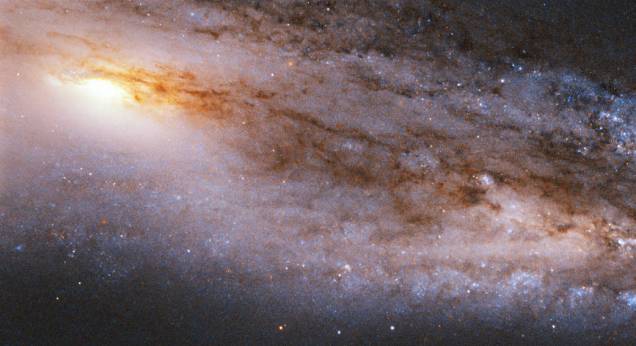
But wait a minute, here is where a little knowledge can be dangerous. According to an August article in the Scientific American “cosmic dust found in Antarctic snow was likely birthed in a distant supernova millions of years ago. The dust’s interstellar journey eventually brought the material to Earth, where scientists discovered the ancient grains.” As somebody might have said in the 1960s: far out. Maybe these Antarctic researchers found the residue of Slipher’s cosmic fart. More than likely I am way over my head in cosmic swirl.
Right now I am treading into the world of the wacky uncle. Or as Pope writes I am launching out beyond my limits. I am out in the deep end because I cannot tell you the difference between a spiral nebula or supernova. But there is a way: just “Ask the Astronomer.” He might tell you that a supernova is the passing gas of a massive star in its final million years of life. A planetary nebula is result of a low mass star fizzling out.–the cheek sneak. From what I can gather the cosmic dust bunnies of a nebula can be recycled into, say, a newer star. But really, what do I know? I am just a guy with a Sharpie and a brain fart who cannot find a hurricane’s cone of uncertainty. Or to quote Pope:
Some have at first for wits, then poets pass’d,
Turn’d critics next, and prov’d plain fools at last;
Some neither can for wits nor critics pass,
As heavy mules are neither horse nor ass.
https://pages.experts-exchange.com/processing-power-compared
 mystoryorhistory