
Moving the clocks forward to Daylight Savings Time, and a couple of recent birthdays in my family, made me think of how we as humans try and manipulate time. Man has always tried to coordinated the past with the present and on off into the future. What started out as the ancients watching the phases of the moons and stars; or dragging boulders around to see what kind of shadow was cast by the sun, ended up in creating various sorts of cosmic calendars used to measure large chunks of time. The problem with early calendars is they were probably not very portable and they were out of whack with human concepts of time compared to celestial events.
It is this movement through time across space that has caused us problems. It seems that our human activities, such as birthdays are slightly out of sync with the cosmos. According to Stanford University Gravity Probe B “space consists of 3 dimensions, and time is 1-dimensional, space-time must, therefore, be a 4-dimensional object.” First off I have never looked at time or space as objects. Space by definition is “unoccupied”, hence empty. Oxford Dictionary has one definition saying space is “dimensions of height, depth, and width within which all things exist and move.” I guess all things would include time.
And this does make some sense when we look at sayings like “out of time” as if it we were to say we are out of sugar. Then there is “times up.” If time is up it must have been moving. And we also have a human concept that there is finite amount of time when we say we are “wasting time” as if time were a rotting banana in fruit bowl. It gives you the idea that time is some sort of commodity that can be bought and traded but not touched, much like a bitcoin.

This is heavy-duty since I was having a hard enough time advancing my personal Space-Time Continuum ahead an hour with the shift to Daylight Savings. I have a hard enough time following a 1 dimensional line so dealing with a 4 dimension is a big “Ugh?”
All of this is more than I can fathom. I would assume a simple calendar is a 1 dimensional depiction of linear time. It made me think about one of my daughters and two sisters’ birthdays. Two are graced with having Leap Year birthdays and another was born on the 13th.
The 13th is unique because of its association with bad luck. It really has nothing to do with a calendar or the Space-Time Continuum except some mathematician has calculated past Fridays the 13th and projected on when future Fridays the 13th will occur. As a bad luck event, I know my sister has celebrated ten Fridays the 13th. As far as I know nothing truly evil has befallen upon her. It is entirely a human “thing” and unfair to say that when one day of the week and a number sync on a man-made calendar it is the cause of anything–good or bad. It is just plain absurd. I would assume that Friday the 13th really is just like any other event embedded somewhere on the 4 dimensional space-time continuum with any other numbered day.

It was also a time of Medieval reasoning. There was a belief that the Earth was flat and possibly one-dimensional. It was also believed that if you tortured somebody long enough you would ultimately get to the truth–the truth as you wanted it to be. Templar Knights were subjected to the rack, strapaddo and having their feet slather with lard and then put over an open flame in an effort to find the truth; or in this case where the Templar treasure was buried. Those that did not confess after all of this to their alleged crimes were eventually burnt at the stake. And no doubt at this point on their personal time continuum they wished desperately to be at some other point on the Space-Time Continuum. So yes, Friday the 13th could have resulted in a long day for those who wore a white mantle with a red cross on it. Somehow the day and number has stuck. Where on the space-time continuum I could not begin to say.
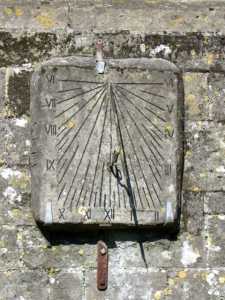
But that was a time before Rolex or Timex. The sundial was more common. People would simply look up at the sky, particularly the night sky to check out the phases of the moon. I am sure the Mayans and Egyptians paid a night watchmen to chisel in his nighttime observations on some sort of Rosetta Stone every night as to what the moon was doing. The problem is while the moon was doing its thing so was the sun. Their celestial dances looked to be in step, but they were fractions of a beat off; and like two dancers starting off on the wrong foot it would take some sort of bunny hop to get them back in step. Today, that bunny hop would be adding a day to a year every four years.
The problem really centers around man’s fixation on controlling and syncing cosmic events to earthly events. According to infoplease.com”the purpose of the calendar is to reckon past or future time, to show how many days until a certain event takes place—the harvest or a religious festival—or how long since something important happened.”
This brings us to Leap Year. Now it is not my intent to make sense of how we keep track of the days of the years or how gravity can bend time and if you slingshot around the sun you will be in time warp–according to Captain Kirk. But just think about trying to sync all of your computer components. It seems simple. Instructions for most technical fixes today start with going to Settings. But I doubt very seriously that today’s astronomers looking deep into space will find, tucked away in some far off galaxy, a universal Settings App or restart button that allows for an earthly/cosmic reboot.
So we have an earthly rebut every four years. In this case February 29th. Past calendars based on the moon or a lunar calendar, which is little more than 29 days and adds up to a 354 day year is right off the bat 11 days out of sync with the solar year which measures time between vernal equinoxes; or just a tad more than 365 days. What to do with 11 days?

Julius Caesar came up with a fix but his calendar still needed yearly tinkering to keep the seasons straight. But still, it was somehow running like the Foxtrot: slow, quick, quick, slow over time. In an attempt to get things on track Pope Gregory XIII introduced his calendar in 1582. This calendar synced time with astronomical events tied to vernal equinox and the winter solstice. This is the most widely used calendar today but it still caused some problems particularly with its implementation. It went from a bunny hop to a kangaroo hop.

The major problem occurred in the past with the shift from the Julian Calendar to the Gregorian. Ten days had to be hopped over or dropped from the calendar in 1582. In 1752 when England switched to the Gregorian calendar it lopped off 11 days to catch up with the rest of Europe. They did this in in the beginning of September. Those people who were expecting a birthday or a payday between September 2nd through to the 14th were out of luck as those days were simply gone. But were did they go?
And how has all of this adding and subtracting affected where we really should be on the Space-Time Continuum. Did the Space-Time Continuum also shift or were these days sucked into a black hole and shot out through a wormhole into another universe or dimension. Did some alien race just find itself with an additional 10 or 11 days on their calendar? The question I have is how out of sync are we from the Space-Time Continuum? All of this tinkering with days of the year makes me wonder if February 29th really is February 29th. Could it be September 31st? Is there a possibility that we has humans are running behind or ahead of some sort of Universal clock and calendar–and how would we know?
Despite having the ability to chuck three astronauts towards the Moon at 24,ooo mph we are still moving pretty slow compared to the 186,000 mph that light travels. In time and reality we are traveling through the cosmic world no faster than our ancestors and we are still syncing the human concept of days of the weeks with a clock that runs slightly off kilter with a solar year.
Calendars are nebulous man-made creatures. They are based on celestial occurrences; but does that sync us to a 4 dimensional Space-Time Continuum? I guess this is something for some future physicist to figure out. That is if a near space object of substantial size impacts with the Earth and sends us back into the Neolithic age where we can start gazing at the night sky trying to figure out what day of the week it is.
https://einstein.stanford.edu/content/relativity/q411.html
https://sciencing.com/difference-between-lunar-calendar-solar-calendar-22648.html
https://www.historic-uk.com/HistoryUK/HistoryofBritain/Give-us-our-eleven-days/
https://www.britannica.com/science/Egyptian-calendar
https://www.infoplease.com/calendar-holidays/calendars/history-calendar
http://mathforum.org/dr.math/faq/faq.calendar.html
https://www.timeanddate.com/calendar/julian-calendar.html
 mystoryorhistory