
Journalist Ellen Goodman wrote that “much of journalism and politics are in a kind of collusion to oversimplify and personalize issues. No room for ambivalence. Plenty of room for the personal attack.” Today, we tend to think of a personal attack as a round of Twitter tweets fired across cyber space. But how about a time when personal attacks were “up close and personal” attacks.
Go into just about any Civics class in the United States and there is sure to be a mention of the Roman Republic, a sort of forefather of our Republic. But the Romans played politics for keeps. Arguments and disagreements, “fake news” and even claims of “fake news” could have dire consequences. First off, though, let’s not confuse the Roman Republic with the Roman Empire, which as the coachman in the Wizard of Oz says, is horse of a different color.
It took the Romans a couple of centuries to get their republic up and running and a couple of centuries to see it turn into an empire. Most historians would probably agree that the demise of the Republic started around 130 BC with Tribune of the Plebs Tiberius Gracchus and his brother Gaius Gracchus. These two brothers, as tribunes, proposed various land reform acts and other laws that would benefit the poor at the expense of the powers that be.

Tiberius, not to be confused with the Emperor Tiberius, ran a foul with the Optimates, or “the best men” of the Roman Senate, with his agrarian reforms. Not to weigh in too deeply into ancient Roman history and politics, let’s just say that the established Roman Senate took his reforms as anti-business and as a personal affront. It may be hard at first glance to understand the workings of the Roman Republic, but the issues they were dealing with were not so much different than what we are dealing with today: land reform, taxes and citizenship. Our government just doled out a $12 billion bailout to farmers to offset losses from new tariffs. When was there a time we were not dealing with immigration and now some want a new interpretation on the 14thAmendment in relationship specifically to people born here in the United States. And of course, just like the Romans, we bicker on who should be appointed or not appointed or elected to governmental positions.
The more Tiberius pushed his progressive reforms the more resistance he got. The Optimates decided enough was enough and took things outside the law and into their own hands. A group of senators gathered up a mob of their supporters, henchman and slaves; invaded the assembly where Tiberius was; and beat him and some of his 300 supporters to death. It is hard to determine if this was business or personal.
At the very least, it was murder. In some ways, it could be called a crime of passion because the Optimates were without a doubt enraged to the point of insanity with Tiberius. If that is the case, then this is personal. However, calling a mob together to kill someone takes planning and in that case, it is premeditated and then it has to be all business.
Brother Gracchus fared no better with the Optimates in his battle for reform several years after his brother’s beating death. What may have done him in, was proposing citizenship for some of Rome’s non-citizens. The politics of immigration and citizenship seem a messy affair in any age, but in Roman times it can get bloody. When one of Gracchus’ opponents was killed, the Senate took this as an opportunity to declare martial law. Soon, an armed group of Optimates was requesting Gracchus to appear before the Senate for a small question-and-answer get-together, no doubt as the guest of honor at another mob beat down. Gracchus refused. Seeing family history repeating itself, and being a good Roman, Gracchus fell on his slave’s sword. The killings, however, did not stop there. Several thousand of his supporters were rounded up and summarily put to the sword. I guess it could be said that this was strictly business.
At times, it becomes hard to tell if it is business or personal. It is easy to assume that in most cases it is a combination. Take Roman proscription. The Roman constitution allowed for a dictator to be appointed in dire circumstances. In 82 BC Lucius Cornelius Sulla became dictator. Sulla would head down to the Forum and post a list of individuals he deemed as enemies of the people. Once listed, the individual’s property could be seized without due process and most often they were murdered in the bargain. When the rule of law is supplanted by the needs of a few ruling elites, who find themselves in confusing times of crises, it becomes easy to get personal.
For instance, after Julius Caesar’s brutal assassination on the Senate floor, his trusted lieutenant Mark Antony and Caesar’s adopted son, Octavian, consolidated their power over what was left of the Republic, and began hunting down those who were responsible for Caesar’s killing. With the rule of law co-opted or gone, it was not hard for Antony and Octavian to come to a mutual (list) understanding. They both had enemies and they both needed money.
They did not invent proscription, they simply made their enemies list known to an eager public willing to cash in on the crisis. Once a person was identified, for whatever reason, it could have been as simple as being on the losing side, hanging a yard sign out on your front portico or just saying the wrong thing to be considered as a treasonous act. Once listed or procscripted, anybody and everybody could become “Dog the Bounty Hunter.” Those so proclaimed an enemy of the public, if lucky, got out of Rome in hurry taking what they could and losing the rest. Those not so lucky like Cicero not only lost everything but their life, too.
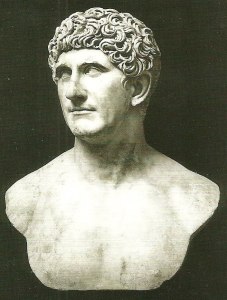
Cicero ran afoul of Mark Anthony. His sharp tongue and pen were aimed at Antony. He even quipped that they should have killed Antony with Caesar. In a series of 14 speeches called the Philippics, Cicero’s loathing of Anthony came out in full force. He attacked him as an enemy of the Republic. However, with the defeat of Caesar’s assassins, Antony and Octavian were able to completed their hold on what was left of the Republic. They now turned their attention to the less rebellious but quarrelsome Senate. For Antony, it was Cicero.
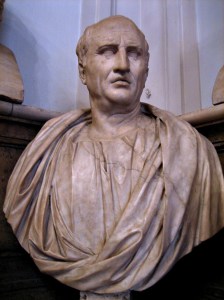
Antony’s soldiers beheaded Cicero and brought his head and hands to Antony. The story goes that Antony’s wife, who was once married to one of Cicero’s longtime enemies, took Cicero’s head and opened the mouth piercing the tongue with her hair pin. His head and hands were later displayed on the Forum as a causal reminder to who was now in charge. I am not sure it can get any more personal than that.
All of this may seem absurd in the 21st Century Republic but President Richard Nixon’s staff compiled an enemies list that included shock jock Howard Stern, actor Paul Newman and several journalists.
It is safe to say that running a republic, like any form of government, can have its ups and downs. Our country has had its share of scandals and scoundrels that have pushed our Republic to excesses. President Ulysses Grant’s administration was hit with the Whiskey Ring Scandal and Crédit Mobilier. Warren Harding had Tea Pot Dome and of course the mother of all political abuses: Nixon’s Watergate Scandal.
Investigations have rooted out the evil doers and brought the rule of law into play. At best, investigations and follow up laws tried to set things back on course to avoid them in the future. But scandals are as assured to happen as Hailey’s Comet will surely swing back by. The difference is scandals are not so easily predicted. They unfold overtime and the process to sort them out is done over time, too, through investigation and not through proscription.
Robert Mueller’s investigation, to some is a witch-hunt. To those being investigated it might seem personal, a form of Roman proscription.To others, it is all business. Is it business or personal? Only time will tell.
Some websites to check out.
https://http://www.washingtonpost.com/wp-srv/national/longterm/watergate/articles/072874-1.htm?noredirect=on
http://penelope.uchicago.edu/~grout/encyclopaedia_romana/calendar/cicero.html
https://http://www.ancient.eu/article/95/the-brothers-gracchi-the-tribunates-of-tiberius–g/
https://http://www.ancient.eu/Tribune/
 mystoryorhistory