“May Day! May Day!”

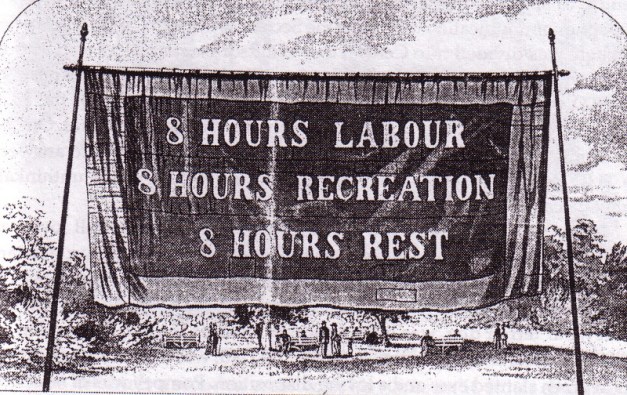
8hoursday_banner_1856

For most Americans an eight-hour work day is something we take for granted.  It is hard to believe that at one time in our history people labored on factory floors for 10 to 16 hours a day or picked cotton from sun up to sun down six days-a-week. Unlike those sweat-shop workers of yesteryear, today’s worker is more concerned with having their job off-shored or being replaced by a robot. Technology has replaced workers on the assembly line as well as on the bank teller line.

cotton pickers

It was after the Civil War, the first real industrial strength war that the industrial revolution started to crank it up into high gear. Workers had to kick it up a notch as they raced with machines to keep up with production. It was the Gilded Age when a buck earned was a tax free buck, which is appealing in any Age.

The industrialist of this time had few, if any, labor laws or regulations to slow production down. Any hint of a child labor law or a minimum wage was at worst anarchy or at least some form of creeping socialism that had to be eradicated.

On May 4, 1886 in Chicago’s Haymarket Square a protest over workers’ rights turned deadly when somebody (an archaist) chucked a bomb at police sent to disperse the rally. The ensuing riot killed seven policemen and at least four civilians. Police rounded up eight local anarchists. In the ensuing trial for conspiracy seven of the eight were sentenced to hang and one was given a 15 year prison sentence.

http://www.chicagohistory.org/hadc/intro.html
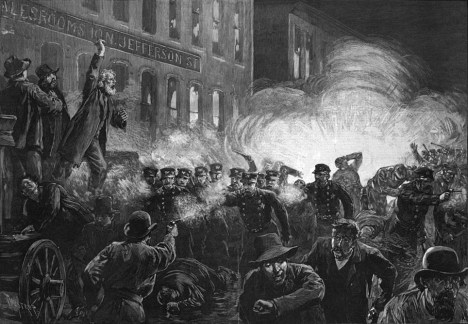
HACAT_V46


However, a 40 hour work week as not as far fetched as it seemed. Forty years later on May 1st Henry Ford would be one of the first industrialists to bring the eight-hour-a-day, 40 hour-a-week work schedule to the factory floor.  In 1914 Ford began paying his workers a minimum wage of $5 a day for an eight hour day.  This was a raise from $2.34 for nine hours-a-day.

http://www.history.com/topics/haymarket-riot

To put some perspective on this the Federal Minimum Wage in 1977 was $2.30 an-hour. The current rate is $7.50 an-hour and may vary from state to state. In many cities there is a push for a $15 an-hour minimum wage. Economists and politicians debate the impact that these wage hikes will have on the price of hamburger.  One thing is certain: The economy did not collapse when Henry Ford put in the 40 hour week and Americans did not become communists.

http://www.history.com/this-day-in-history/ford-factory-workers-get-40-hour-week

http://www.huffingtonpost.com/leonhard-widrich/the-origin-of-the-8-hour-_b_4524488.html
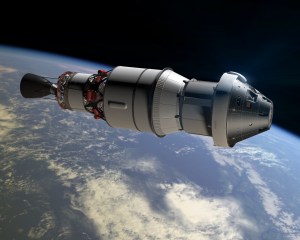


Space, still the Final Frontier

Rendering_of_Orion_Exploration_Flight_Test_1

Last month the Orion Crew Module was flown to NASA’s Kennedy Space Center. The Orion space craft is designed to take four astronauts beyond low Earth orbit and on to Mars. But before any deeper voyages into space the Orion is scheduled to take a test spin around the  moon sometime in 2018.

http://www.nasa.gov/exploration/systems/orion/index.html

Ironically  it is the near, disastrous flight of  Apollo 13 that holds the record for the farthest voyage from earth: 248,655 miles.  The Orion will go just a bit farther from Earth. The distance to Mars may vary depending on the position of the two planets.  It could be as close as 34 million miles or as far away as 250 million miles. In any case it will be more than a small step or giant leap to get there.

http://www.space.com/24701-how-long-does-it-take-to-get-to-mars.html

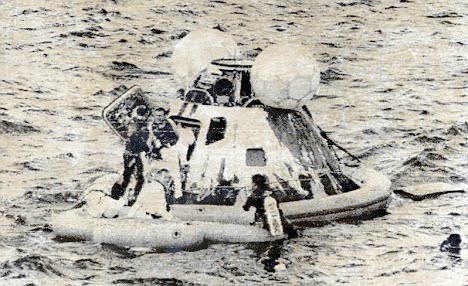
Apollo 13’s record setting distance was the unintended consequences of a slight malfunction in an oxygen tank giving us that famous saying: “Houston we have a problem.” The tank exploded due to a frayed wire forcing the crew to shut down the command module and abort a lunar landing. In order to return to earth Apollo 13 looped around the moon in a free return trajectory sending it beyond the low elliptical lunar orbit of 70 to 200 miles as planned.

After 56 hours of surviving in 30 degree temperatures in the Lunar Modul, Jim Lovell, Fred Haise and Jack Swigert splashed down on April 17, 1970 proving any landing you can walk away from, or in this case float away from, is a good one.

apollo13

April is a first for other maned space flights. On April 12, 1961, Yuri Gagarin in Vostok I became the first human in space. Yuri’s one lap around the Earth at an altitude of 187 miles took all of  108 minutes.  On May 5 twenty-three days later Alan Shepard’s 15 minute canon ball shot in Mercury 7 boosted him 116 miles into space before he splashed down in the Atlantic Ocean. A year later President John F. Kennedy dropped the starting flag for the race to the moon.

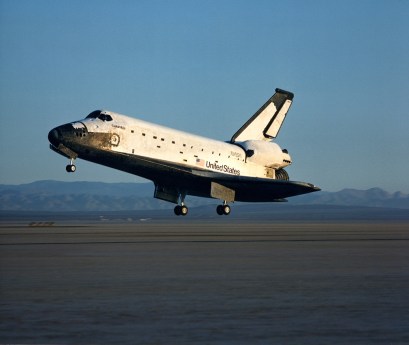
Twenty years after Yuri Gagarin orbited the Earth John Young and Robert Crippen were the first astronauts to take the Space Shuttle Columbia out for a spin.  Young had flown in the Gemini and Apollo programs. Young, like Lovell had flown to the moon twice.  Young, however, as commander of Apollo 16 got his chance to walk on the moon.

Space_Shuttle_Columbia_lands_following_STS-28_in_1989


Young and Crippen pushed The Columbia for close to 55 hours and 37 orbits at an altitude of 168 miles above the Earth. It was the first of 27 successful flights for The Columbia.  It’s 22 year career would end when it disintegrate on reentry on February 1, 2003.

There is no race to Mars, as of now. The Orion missions will, however, take space flight from out of the shallow end of space to at least somewhere on the way to the deep end.